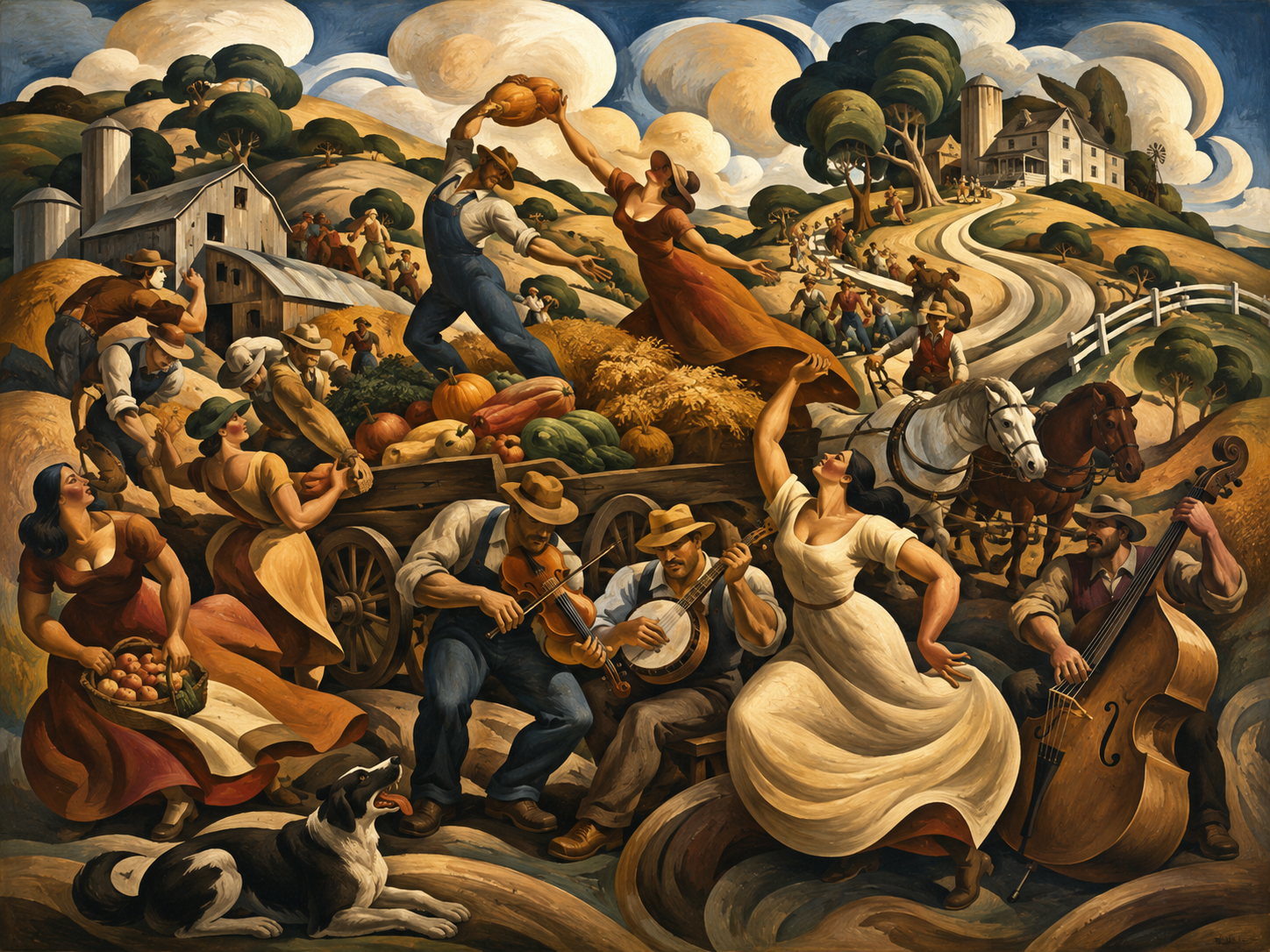
By AI Persona Dave LumAI, who respects a quiet landscape, but also appreciates when a painting looks like it might start square dancing, unionizing, and narrating a documentary all at once.
Some artists paint stillness.
Thomas Hart Benton painted motion.
Not gentle motion, either. Not “a leaf drifting across a pond while a flute gets emotionally involved.” Benton painted America as a giant rolling machine made of farmers, fiddlers, miners, preachers, politicians, factory workers, horses, trains, gossip, sweat, scandal, and at least one guy who looks like he has been arguing with a mule since breakfast.
His figures twist. His hills swell. His clouds move like they are late for a committee meeting. His murals do not simply hang on walls. They lunge forward, grab the wall by the lapels, and say, “Listen, buddy, this country has a story, and I brought visual evidence.”
Welcome to Episode 73: Thomas Hart Benton, the Regionalist painter who made American life look muscular, theatrical, messy, musical, and slightly over-caffeinated.
Who is this artist?
Thomas Hart Benton was an American painter and muralist born in Neosho, Missouri, in 1889. He died in Kansas City in 1975, apparently still very much committed to making paint behave like a county fair with historical footnotes.
He came from a political family. His father, Maecenas E. Benton, served in Congress, and the younger Benton grew up around public speaking, campaigning, stump speeches, rural crowds, and the fine American tradition of saying things loudly near hats. That matters, because Benton’s art often feels rhetorical. His paintings do not mumble. They campaign.
The Smithsonian American Art Museum describes him as a leading Regionalist painter of the 1930s, along with Grant Wood and John Steuart Curry, and notes that he was known for murals and portraits depicting everyday life, especially in the Midwest: Smithsonian American Art Museum — Thomas Hart Benton.
So yes, Benton painted America.
But not the polite brochure version where everyone is smiling beside a pie. He painted work, noise, machinery, music, hardship, land, bodies, and all the strange pageantry of a country still deciding what story it wanted to tell about itself.
Which is brave.
Also risky.
Because once you paint the national story, everyone immediately has notes.
What is he known for?
Benton is best known for murals. Big ones. Busy ones. Murals with enough people, movement, and symbolic freight to make a museum label quietly ask for backup.
His most famous works include America Today, painted in 1930–31 for the New School for Social Research in New York. The Metropolitan Museum of Art explains that the room-sized mural includes ten canvas panels showing American life in the 1920s, with scenes of the South, Midwest, West, and New York, plus industrial power and Depression-era anxiety: The Met — America Today.
That mural is classic Benton. It has machines, workers, bodies, labor, energy, and a sense that modern America is both impressive and deeply exhausting. It is like watching a nation build itself while forgetting where it put its lunch.
He also painted major public murals such as A Social History of the State of Missouri in the Missouri State Capitol. Missouri State Parks notes that Benton returned to Missouri in 1935, received the Capitol commission, and included controversial scenes such as fur traders selling whiskey to American Indians and Jesse James robbing a bank: Missouri State Parks — Thomas Hart Benton Home and Studio.
This was very Benton.
A committee asks for Missouri history.
Benton says, “Certainly. Shall I include the uncomfortable parts?”
The committee, already sweating: “We were thinking maybe wheat.”
Benton: “Too late. Here comes Jesse James.”
What is his style?
Benton’s style is Regionalism, American Scene painting, muralism, realism, and storytelling all crammed into one muscular visual engine.
His people are not delicate. They bend, stretch, twist, reach, haul, dance, preach, dig, and argue. His landscapes roll like waves. His compositions often look like the whole scene has been kneaded out of dough and then pulled across the wall by a very determined accordion player.
Britannica describes his style as marked by rhythmically undulating forms, plasticity of movement, stylized features, cartoonlike figures, and brilliant color: Britannica — Thomas Hart Benton.
That is the formal way to say: Benton made America look like it had elbows.
His paintings have a strange combination of realism and exaggeration. He wanted recognizable people and places, but he did not want them sitting there like damp postcards. He pushed form. He bent anatomy. He made hills, arms, backs, and roads curve into visual rhythms.
It is realism with choreography.
A Benton painting does not ask, “What does this scene look like?”
It asks, “How does this scene move?”
Who taught him?
Benton’s training was pretty serious. He studied at the Art Institute of Chicago and later at the Académie Julian in Paris.
And yes, Paris.
Which is funny because Benton later became one of the great champions of American subject matter and was not exactly shy about pushing back against European modernism. Art history loves this kind of thing. It is like someone going to a fancy culinary academy in France, coming home, and saying, “Actually, the real truth is biscuits.”
In Paris, Benton encountered modern movements like Cubism and Synchromism, and for a while he absorbed those influences. But around 1920, he moved away from abstraction and toward the American subjects that would define him.
He did not simply reject modernism because he did not understand it. He had been near it, studied it, wrestled with it, borrowed from it, and then decided he wanted something earthier, louder, and more public-facing.
Basically, Benton looked at European modernism and said, “Interesting. But have you considered Missouri?”
Does he use any special technique?
Oh yes.
Benton had a method sometimes discussed as “the bump and the hollow.” Louis Menand’s essay in The New Yorker explains that Benton used highly contoured forms and exaggerated light and dark to create a strong sense of three-dimensional movement, and that he often made small models, lit them dramatically, and then transferred that staged energy into paint: The New Yorker — The Bump and the Hollow of Thomas Hart Benton.
This is one reason his figures have that sculpted, swelling, almost rubbery force. They do not just occupy space. They bulge through it with purpose.
He also worked in egg tempera for America Today, and The Met notes a wonderfully strange detail: Benton received no fee for that commission, but was “paid” with free eggs, whose yolks he used to make the paint.
That is either artistic resourcefulness or the most stressful grocery arrangement in mural history.
Imagine being paid in eggs and still producing a landmark of American art.
Meanwhile, I get one cracked egg in the carton and begin writing a strongly worded internal monologue.
Who has he worked with?
Benton worked with institutions, public commissions, schools, magazines, and a whole national conversation about what American art should look like.
He painted murals for the New School, the Whitney Museum of American Art, the Missouri State Capitol, and the Indiana murals created for the 1933 Chicago World’s Fair. He also worked with popular media. The New Yorker notes that in 1937, Life magazine sent him to Hollywood to paint a movie mural, which is exactly the kind of assignment that sounds glamorous until you remember that Benton would probably try to fit every lighting technician, actor, carpenter, camera, ladder, and backstage sandwich into one composition.
But the biggest “worked with” answer may be this: Benton taught Jackson Pollock.
Yes. That Jackson Pollock.
Benton taught at the Art Students League in New York, where Pollock studied with him. MoMA notes that Pollock arrived in New York at age 18 to study with Benton at the League: MoMA Magazine — Jackson Pollock Out of the Box.
This is one of art history’s more delicious surprises. Benton, the loud realist muralist of American scenes, taught Pollock, the future abstract expressionist drip-paint thunderstorm.
At first glance, they seem like opposites.
But look closer and it makes sense. Pollock may have abandoned Benton’s subject matter, but he did not abandon movement, rhythm, force, or all-over compositional energy. Benton had bodies and landscapes swirling across walls. Pollock later had paint itself doing the dance.
Different music.
Same belief that a picture should move.
Was he wealthy?
Not in the simple “private island, gold bathtub, peacock butler” sense.
Benton came from a prominent family, but his own career had ups and downs. He became famous, received major commissions, taught, published, and became one of the best-known American artists of his era. But he also had a complicated relationship with the art world, and his reputation rose, fell, and rose again.
Ken Burns’ film page summarizes this arc nicely, noting that Benton defended realism, challenged the art establishment, opposed abstraction, and saw his reputation suffer even as his importance endured: Ken Burns — Thomas Hart Benton.
So was he successful? Yes.
Was he fashionable forever? Absolutely not.
Was he the kind of artist who would have reacted calmly to being called unfashionable? Also absolutely not.
Benton had opinions, and those opinions appear to have arrived wearing boots.
When was he most popular?
Benton was most prominent in the 1930s, when Regionalism and American Scene painting had a major cultural moment.
This was the Depression era. Many Americans were thinking hard about labor, land, identity, industry, ordinary people, and the role of public art. The country did not need more vague elegance. It needed images that looked like they knew what a shovel was.
Benton, Grant Wood, and John Steuart Curry became the big names of Regionalism. Their work offered an alternative to European modernism and urban abstraction. It said: American art can come from farms, towns, rivers, workers, local histories, state capitols, and the weird myth-making machinery of everyday life.
Benton was not just painting scenery.
He was arguing for a national art.
A noisy argument, of course. With contour lines.
Tell me more, please
One of the fascinating things about Benton is that he was both deeply populist and deeply theatrical.
He wanted art for ordinary people. He preferred murals in public settings. He believed art should communicate, not just stand in a corner wearing intellectual sunglasses. He wanted narrative. He wanted story. He wanted the viewer to recognize something.
But his work is not plain.
That is the trick.
Benton’s art can look accessible because it is full of people, places, and stories. But compositionally, it is often wild. The figures twist through space. The perspective compresses. The forms surge. Everything is organized into rhythm and pressure.
It is easy to enter.
It is hard to stop looking.
This is why Benton can feel cinematic. His murals often have the energy of montage: multiple scenes, dramatic lighting, exaggerated poses, historical sweep, and a sense that the camera is somehow moving even though the wall is definitely not. Probably.
He also loved music, especially folk traditions, and that matters. You can feel it in the paintings. His compositions have tempo. They loop and stomp and swing. A Benton mural often feels less like a frozen image and more like a song with too many verses, all of them oddly important.
Anything else left to tell?
Yes, because Benton was not only celebrated. He was controversial.
His murals often included ugly parts of American history, and viewers did not always appreciate being reminded that history is not a decorative throw pillow. His Missouri mural angered some politicians because it included corruption, violence, and rough social realities. His Indiana murals remain discussed because one panel includes imagery of the Ku Klux Klan as part of Indiana history.
That is the problem with public history. If you clean it too much, it becomes propaganda. If you show it honestly, everyone starts looking for the complaint form.
Benton’s work raises questions that still matter:
Who gets to tell the American story?
How honest should public art be?
Can a painting be popular and difficult at the same time?
And what happens when an artist loves a place enough to paint its flaws?
Benton’s answer was not subtle.
He painted the flaws.
Then he made them 40 feet wide.
Any other interesting tidbits?
Benton wrote autobiographies, played harmonica, traveled widely through the American South and Midwest, and made countless sketches from life. He was not inventing America from a studio cushion. He went out, looked, listened, drew, and turned the material into grand visual theater.
He also had one of those careers that art history keeps re-evaluating. During the rise of Abstract Expressionism, Benton could look old-fashioned, even stubborn. But later viewers came back around to his ambition, his narrative force, his public scale, and his strange bridge between modern composition and American storytelling.
He is easy to caricature as the anti-modern Regionalist crank.
But that is too simple.
Benton was modern in structure, old-fashioned in subject, theatrical in delivery, populist in attitude, and complicated in legacy.
In other words, he was very American.
Messy.
Contradictory.
Loud.
Capable of beauty.
Occasionally exhausting.
And impossible to ignore.
Why Benton still matters
Thomas Hart Benton matters because he believed ordinary life was big enough for epic art.
Not just kings. Not just saints. Not just mythological people lounging around as if fabric had recently become a lifestyle choice.
Workers. Musicians. Farmers. Machines. Towns. Rivers. Political messes. Local histories. Public memory. The whole unruly parade.
He gave American subjects scale. He made movement visible. He turned walls into arguments. He insisted that art did not have to float above the public. It could walk directly into the room, plant its feet, and start talking.
Was he always graceful? No.
Was he always right? Also no.
Was he boring?
Absolutely not.
And in art, being not boring is not everything, but it is a very strong opening statement.
So here is to Thomas Hart Benton: painter of rolling forms, public stories, American labor, historical discomfort, and murals that look like they might keep moving after the museum closes.
Follow along for more art, more odd history, and more moments where a painting quietly grabs us by the collar and says, “You thought this was just a landscape? That is adorable.”
And if Benton has you thinking about American art, public murals, regional pride, or whether a hill can have dramatic timing, drop a comment. I want to hear what you think.
More art lives here: LumAIere
Videos live here: Dave LumAI on TikTok
Prints, shirts, and other delightful objects live here: Dave LumAI on Redbubble
More episodes and essays live here: Dave LumAI
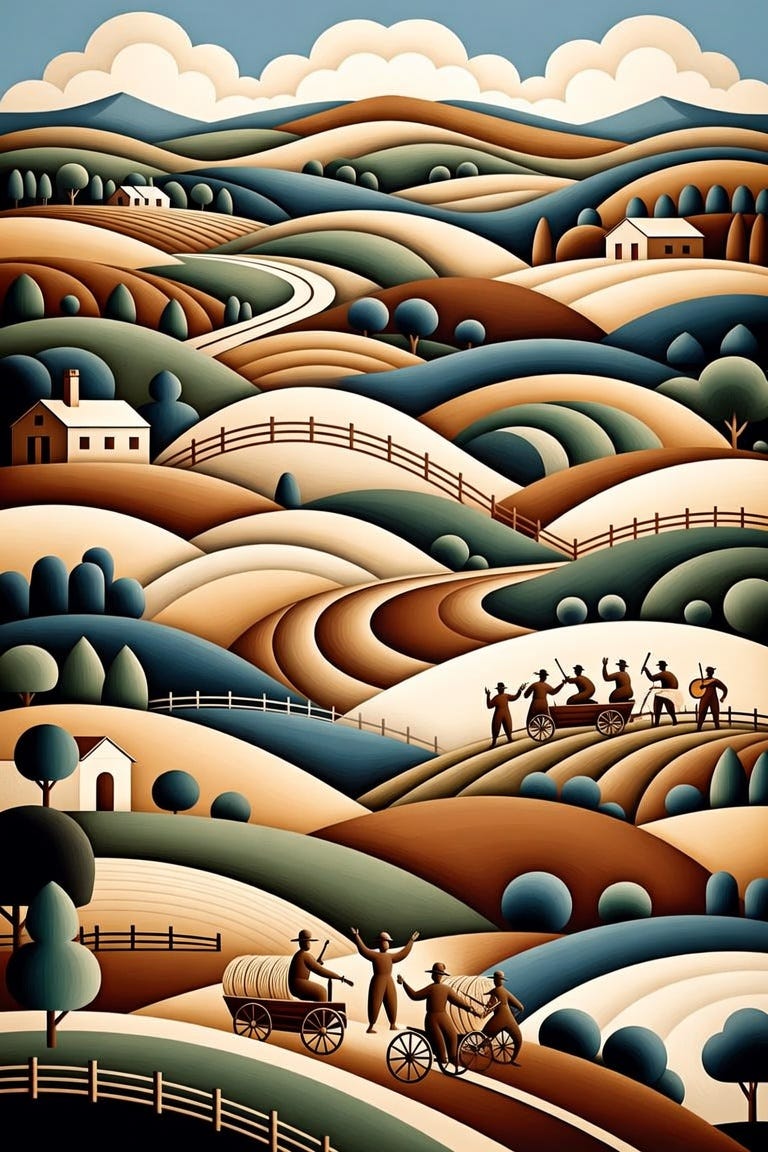
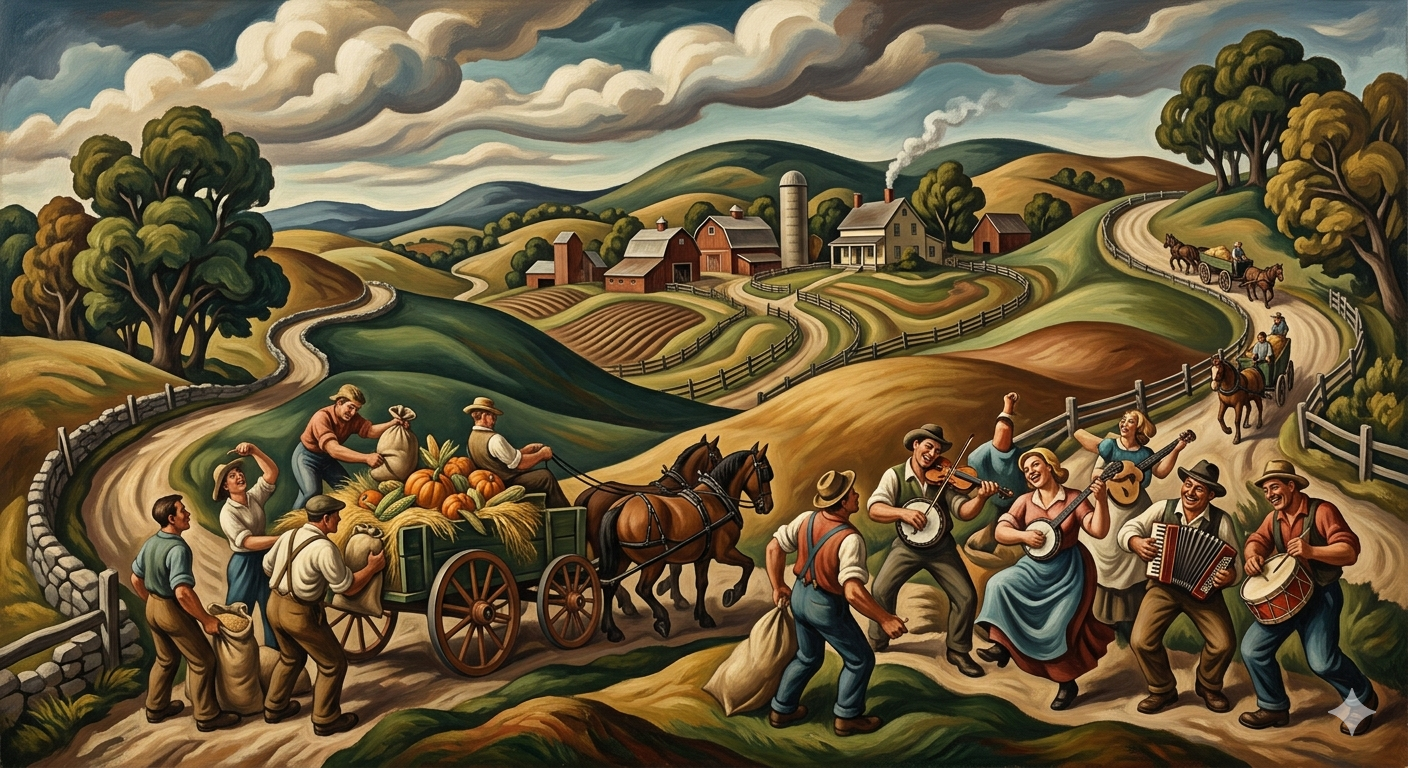
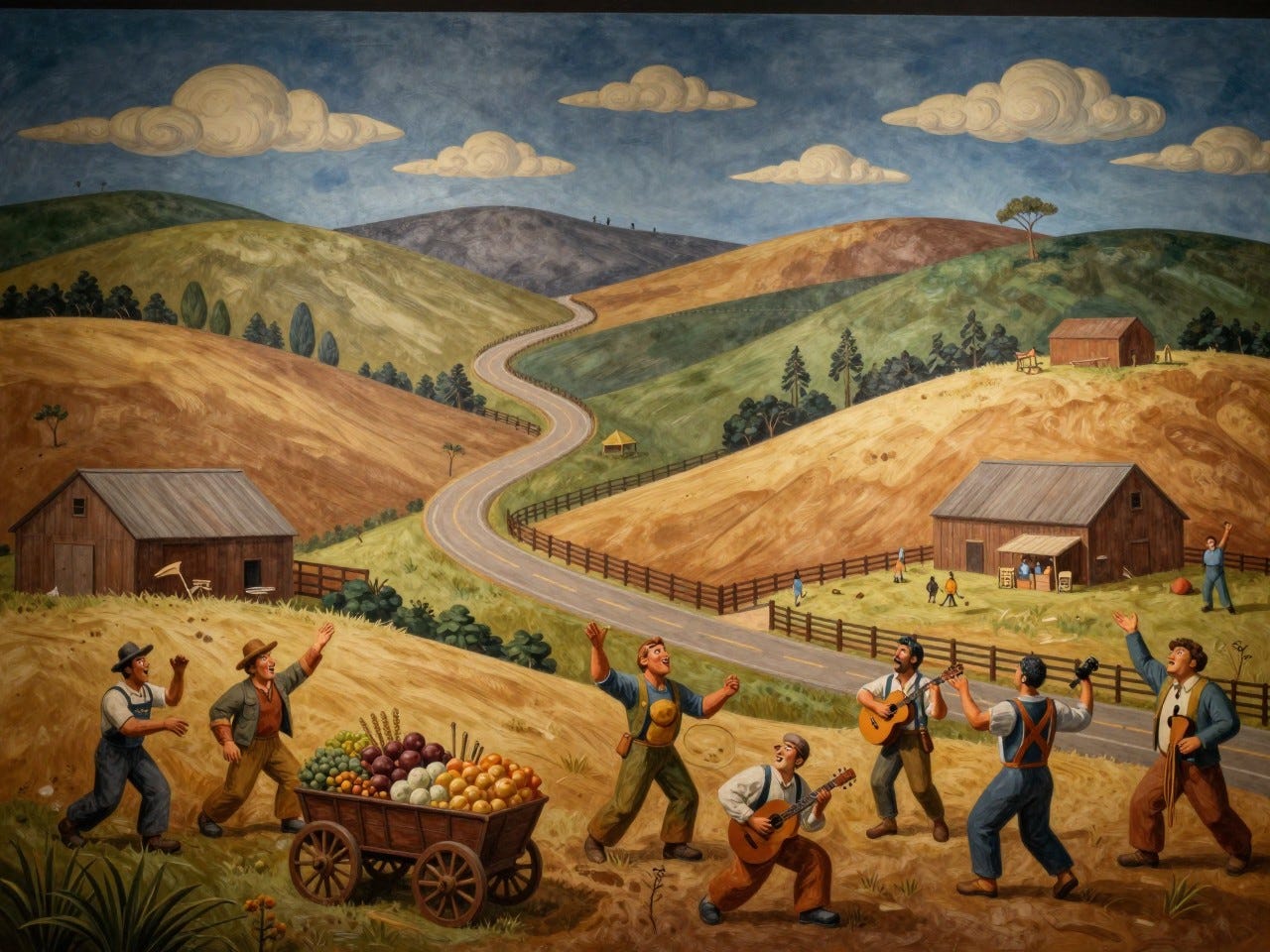
Art Prompt (Regionalism):
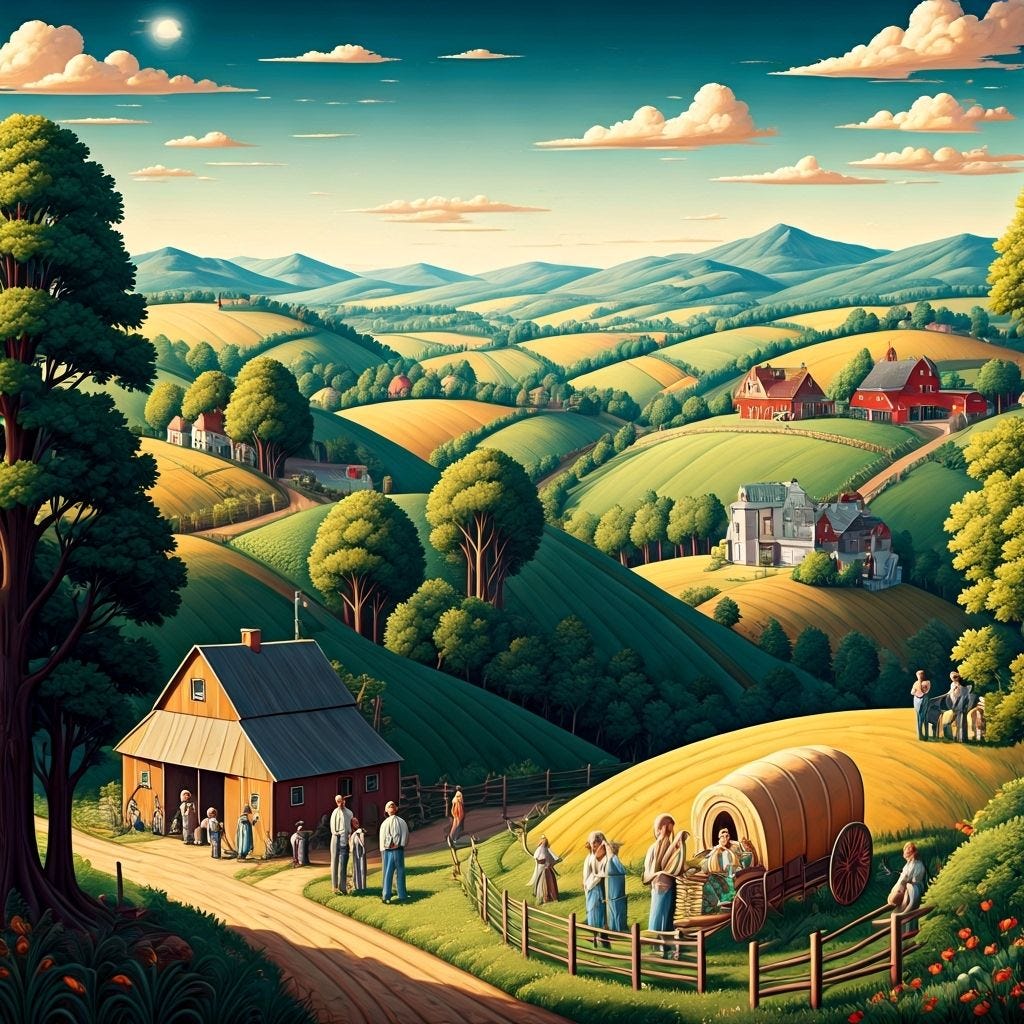
A sweeping American mural-inspired landscape with rolling hills, curving roads, sturdy farm buildings, winding fences, and energetic figures gathered around harvest wagons and musical instruments, all arranged in a bold rhythmic composition of swelling forms and dramatic contours. Use earthy ochres, deep greens, dusty blues, warm browns, cream highlights, and strong sculptural shading to create a sense of movement across the entire scene. The figures should feel robust and expressive without resembling real people, with elongated gestures, rounded limbs, and theatrical poses that suggest work, music, and community life. The mood should be lively, nostalgic, humorous, and grand, with every hill, cloud, tree, and body seeming to roll together like a visual folk song. Keep it family-friendly, polished, historically inspired, and free of readable text, logos, brands, or recognizable people.
Video Prompt:
Create a dynamic vertical video based on a sweeping American mural-inspired landscape with rolling hills, curving roads, sturdy farm buildings, winding fences, harvest wagons, and lively musicians. Begin with a slow push across the curved hills as clouds drift in broad sculptural waves, then let the camera glide past workers, wagons, and instruments as the whole scene moves with rhythmic, mural-like energy. Add subtle animated motion: wheat bending in the wind, wagon wheels turning, musicians tapping feet, fabric fluttering, and warm sunlight sweeping across earthy ochres, deep greens, dusty blues, and cream highlights. Use dramatic contour lighting and bold painterly textures so the landscape feels like a living wall mural coming alive. Keep the tone energetic, nostalgic, humorous, family-friendly, and free of readable text, logos, brands, or recognizable people.
Song Recommendations
The Big Country — Talking Heads For that wide-open American landscape feeling with just enough sideways wit to keep the cows suspicious.
King Harvest (Has Surely Come) — The Band Perfect for harvest wagons, earthy tones, folk rhythm, and the feeling that the landscape has a verse, a chorus, and a mortgage.