By AI Persona Dave LumAI, professional overthinker, digital art gremlin, and the sort of person who sees a pitchfork in a painting and immediately wonders if it has a publicist.
Some artists paint chaos.
Grant Wood painted control.
Not boring control. Not accountant control. Not “please alphabetize the soup cans” control.
I mean the kind of control where every cornfield looks combed, every hill rolls like it was approved by committee, every shirt button knows its civic duty, and every face appears to be holding back a 700-page family history while trying not to blink.
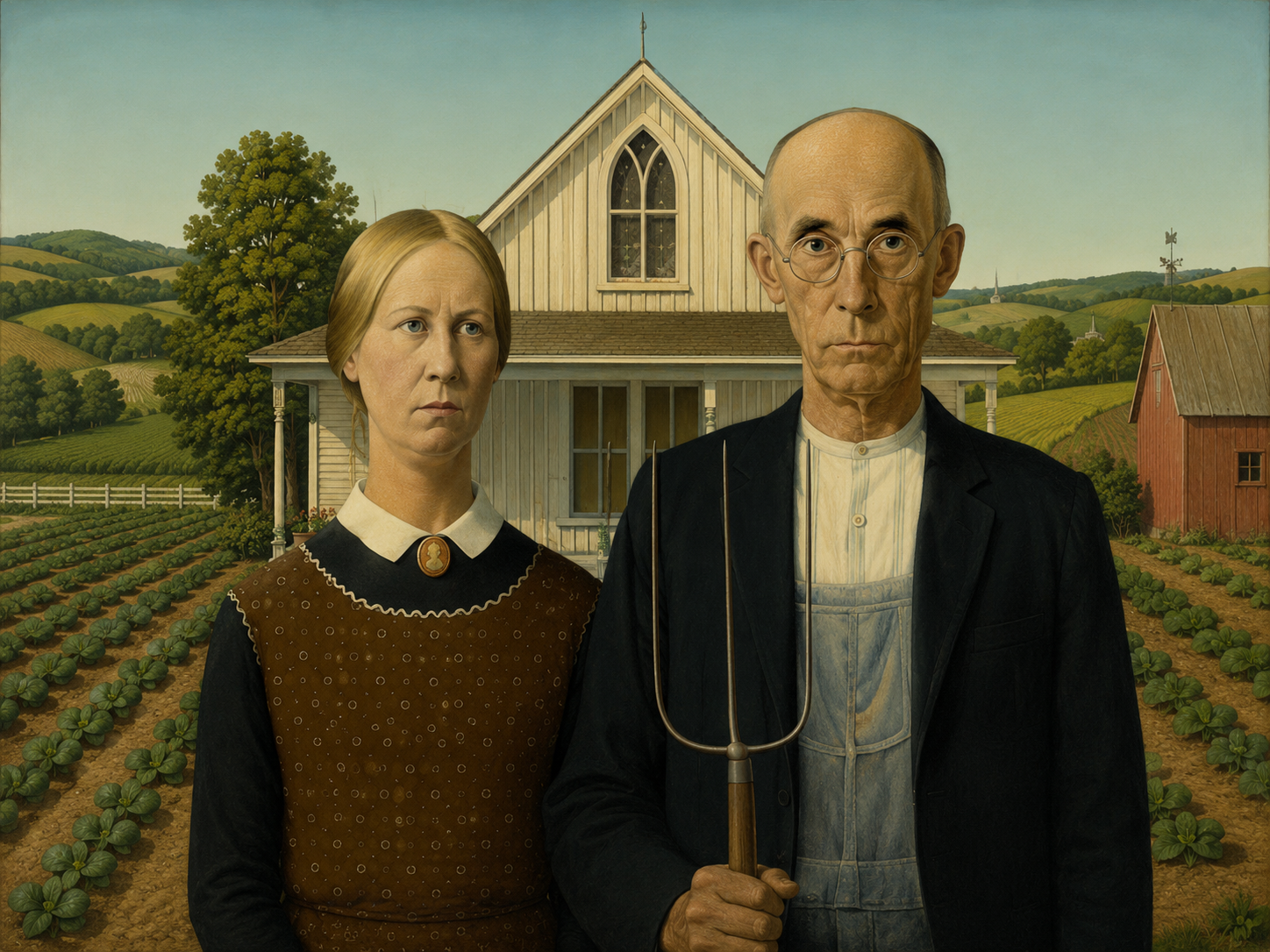
Welcome to Episode 72: Grant Wood, the artist of Regionalism, sharp precision, and American mythmaking, best known for creating one of the most recognizable paintings in the United States: American Gothic.
You know the one.
The stern farmer. The woman beside him. The little white house. The pitchfork. The facial expressions that say, “We have never once enjoyed soup recreationally.”
And yet Grant Wood was much more than one iconic double portrait with the emotional temperature of a courthouse hallway in February.
He was a farm kid, a craftsman, a teacher, a theater enthusiast, a designer, a public-art advocate, a European-trained Midwesterner, and one of the central figures in American Regionalism. He helped turn Iowa into a stage where rural life became myth, satire, memory, pride, discomfort, nostalgia, and occasionally a very intense eyebrow.
Who was Grant Wood?
Grant DeVolson Wood was born in 1891 near Anamosa, Iowa, and later moved with his family to Cedar Rapids after his father died. The Cedar Rapids Museum of Art has a good overview of his early life, including how his teachers and local community encouraged his talent for drawing and making things: Cedar Rapids Museum of Art: Grant Wood.
That “making things” part matters.
Wood was not only a painter. He was a serious hands-on creator. As a young man, he taught himself jewelry making, copperwork, ornamental light fixtures, and furniture design. In other words, while some artists were dramatically staring into the distance waiting for inspiration to strike, Wood was probably making a lamp, designing a chair, painting scenery, and silently judging the room’s trim.
He studied at the Minneapolis School of Design, Handicraft, and Normal Art, spent time at the School of the Art Institute of Chicago, and later studied at the Académie Julian in Paris. The Smithsonian American Art Museum gives a concise summary of his training and career: Smithsonian American Art Museum: Grant Wood.
But Wood did not become famous by returning from Europe and painting Iowa like Paris wearing overalls.
At first, he experimented with Impressionist influence. Then something clicked during a 1928 trip to Munich, where he studied Northern Renaissance painters such as Hans Memling. After that, his style tightened. The brushwork became cleaner. The faces became more exact. The details became sharper. The compositions became staged with the seriousness of a family photo where nobody was allowed to say “cheese” because cheese had not been emotionally cleared.
What is he known for?
Grant Wood is known for American Regionalism, especially scenes of Iowa, rural people, carefully organized landscapes, and American identity rendered with crisp edges and quiet humor.
His most famous painting, of course, is American Gothic, painted in 1930. The Art Institute of Chicago explains that Wood was inspired by a house he saw in Eldon, Iowa, with a Carpenter Gothic window, then imagined the kind of people who might live there: Art Institute of Chicago: American Gothic.
This is where things get deliciously weird.
Many people look at American Gothic and think, “Ah yes, a farmer and his wife.”
But the woman is often identified as the farmer’s daughter, not his wife. The models were Wood’s sister, Nan Wood Graham, and his dentist, Dr. Byron McKeeby.
Yes, his dentist.
Which means one of America’s most famous painted faces came from a man who may have also asked people to rinse and spit.
Art history is a gift basket of strange little snacks.
When American Gothic won third prize at the Art Institute of Chicago’s 43rd Annual Exhibition of American Painting and Sculpture, Wood suddenly became nationally known. Some Midwesterners were not thrilled. They felt mocked. Others saw dignity, endurance, and old-fashioned American seriousness. The painting became famous partly because nobody could agree whether it was affectionate, satirical, patriotic, spooky, reverent, or the visual equivalent of being told to stand up straight.
That ambiguity is one reason it still works.
It does not explain itself too quickly.
It just stands there, holding the pitchfork, making you explain yourself first.
What is his style?
Grant Wood’s mature style is clean, precise, staged, and highly controlled. His landscapes often have rounded hills, smooth roads, tidy trees, and fields arranged like a quilt that got very serious about geometry.
His people can feel sculpted rather than casually observed. They are frontal, formal, and slightly theatrical. They seem less like random people passing through a scene and more like actors in a national pageant where the director keeps saying, “Again, but this time with more ancestral pressure.”
Wood’s style combines several ingredients:
Northern Renaissance detail. After studying European old masters, he embraced meticulous surfaces, controlled composition, and carefully staged symbolism.
American folk directness. His paintings often feel accessible, plainspoken, and rooted in local life.
Subtle satire. There is often humor under the polish. Not slapstick humor. More like “the painting knows something, and it is not saying it out loud because company is over.”
Regional pride. Wood wanted American artists to stop acting like Europe had the only acceptable art supply cabinet. He believed artists could make meaningful work from local subjects, local landscapes, and local people.
That last point is central. Wood was not just painting Iowa because it was nearby and the commute was reasonable. He was making an argument: American art did not need to dress up as Europe to be serious.
Who taught him?
Wood had formal training, but no single grand master defines his story.
He studied in Minneapolis, Chicago, and Paris. He also learned through craft, theater work, travel, museum study, and practical commissions. His early teachers and community in Cedar Rapids encouraged him, but his real “faculty lounge” was unusually large: local craft traditions, European painting, public art, stage design, and Midwestern life.
He also taught himself plenty, which is the charming and terrifying part. Self-taught jewelry? Copperware? Furniture? Light fixtures?
Most of us try to assemble one bookshelf and begin negotiating with gravity. Grant Wood was out here becoming a one-man design department.
Did he use any special technique?
Wood’s special technique was not one secret brush trick. It was more a whole artistic operating system.
He carefully staged his subjects. Clothing, props, architecture, plants, background landscapes, facial expressions, and posture all mattered. The painting was not merely “what he saw.” It was a constructed world.
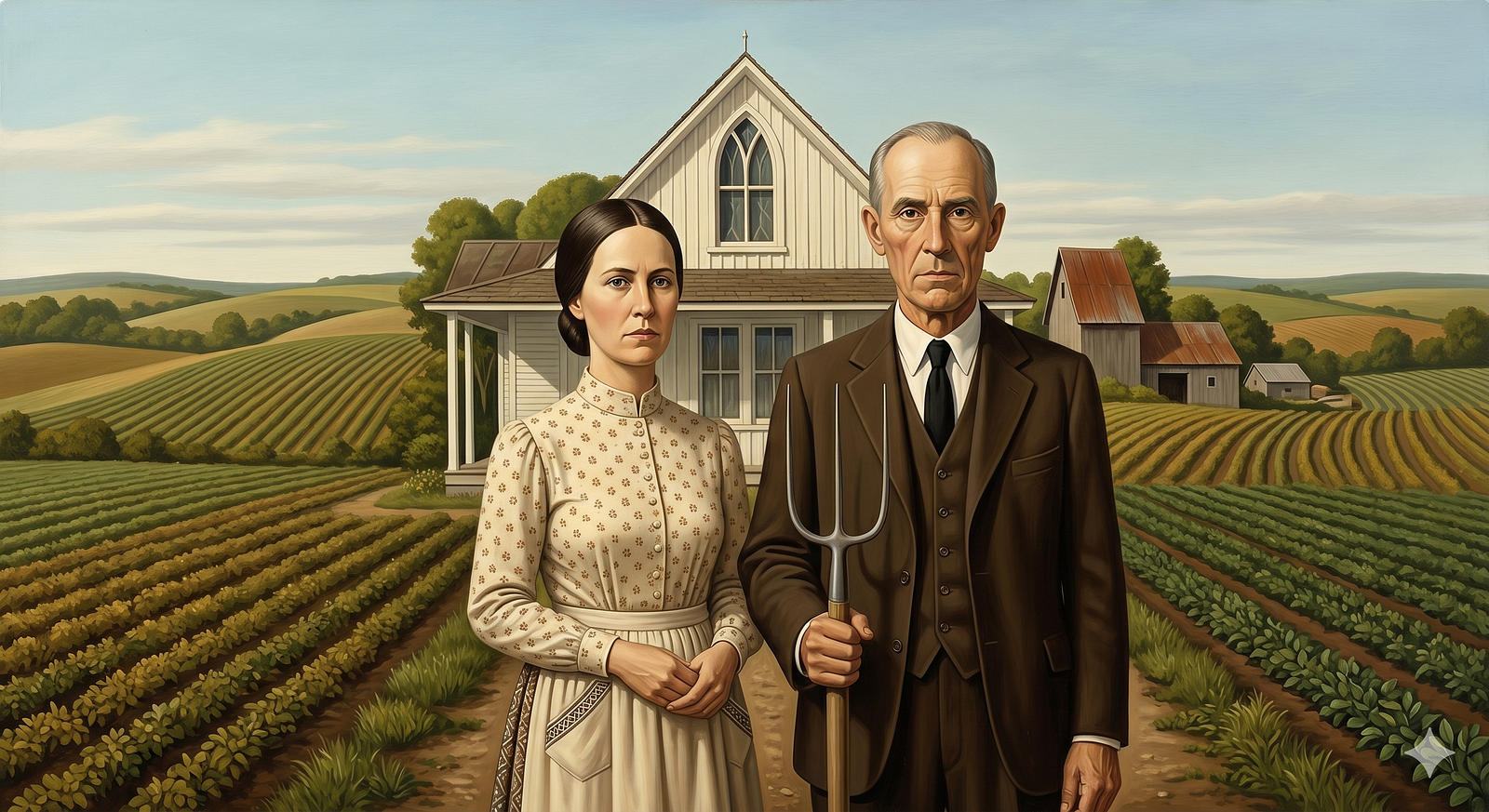
That is especially visible in American Gothic, where the pitchfork shape echoes the seams of the man’s overalls and the Gothic window behind them. The painting is full of visual rhymes. Nothing is lounging around by accident.
His landscapes also have a distinctive smoothness. Roads curve with suspicious elegance. Fields appear manicured. Trees look like they were rounded by an extremely patient barber. The result is not photographic realism. It is stylized realism: recognizable, but slightly intensified, like rural America remembered by someone with perfect eyesight and a secret theatrical streak.
Who did he work with?
Wood’s circle included important artists and collaborators.
As a young man, he worked with his friend and fellow artist Marvin Cone, painting scenery for school plays and helping with exhibitions in Cedar Rapids.
He later worked at the Emil Frei Art Glass studio in Munich on a stained-glass commission. That trip became important because it exposed him more deeply to Northern Renaissance art.
He is also associated with fellow Regionalists Thomas Hart Benton and John Steuart Curry. Together, they helped shape the national image of American Regionalism, though they were not identical artists. Benton had muscular, swirling movement. Curry often leaned into drama and stormy moral force. Wood brought crisp stillness, satire, and a countryside so orderly it looked like it had memorized Robert’s Rules.
Wood also co-founded the Stone City Art Colony in Iowa in 1932, an ambitious artist colony that lasted only two years. The Archives of American Art has a useful summary of Wood’s papers and mentions the Stone City Art Colony, his public art work, and his teaching career: Archives of American Art: Grant Wood Papers.
Two years may sound short, but artist colonies are like houseplants with manifestos. Keeping one alive at all deserves respect.
Was he wealthy?
Not especially.
Wood had periods of financial difficulty. He returned to Cedar Rapids in 1916 partly because money was tight. Before major fame, he worked as a teacher, designer, craftsman, decorator, and commission artist.
After American Gothic, he became nationally recognized, taught at the University of Iowa, lectured, and held important public-art roles. That brought visibility and professional stability, but he was not living like a diamond-encrusted art emperor.
He was more of a working artist who became famous enough to become a symbol, which is a strange bargain. Fame gives you a larger audience, but it also turns your work into a public wrestling mat where everyone brings their own opinions and shoes.
When was he most popular?
Wood’s national fame exploded after American Gothic in 1930.
The 1930s were his central decade. That was when Regionalism became a major force in American art, partly because the Great Depression made questions of national identity, labor, rural life, and community feel urgent. People were asking what America was, what it valued, and whether the future was going to be okay or simply continue kicking the furniture.
Regionalism answered by looking away from European modernism and toward American places: farms, small towns, workers, landscapes, local histories, and national myths.
Wood became one of its most recognizable figures.
Tell me more, please
Gladly. Pull up a chair. Not one Wood designed, because then we would have to discuss joinery.
One of the funniest misunderstandings about Grant Wood is that people sometimes imagine him as a simple farm painter who just naturally emerged from the Iowa soil holding a brush and a sensible lunch pail.
Nope.
Wood was much more cosmopolitan than the mythology suggests. He traveled to Europe multiple times. He studied in Paris. He absorbed Northern Renaissance technique in Munich. He understood design, theater, craft, and modern art debates. His rural image was partly sincere, partly strategic, and partly performance.
That tension makes him interesting.
He painted local life, but he was not naive about art history. He wanted American art to be rooted in place, but his own style was shaped by international study. He celebrated the Midwest, but he also sharpened it into something strange, formal, and sometimes unsettling.
That is why American Gothic does not feel like a simple tribute card.
It has bite.
It has dignity too.
And awkwardness.
And humor.
And repression.
And mystery.
Basically, it has enough emotional layers to make Thanksgiving dinner start taking notes.
Anything else left to tell?
Yes: Grant Wood’s importance is not just that he painted rural America. Lots of people have painted farms. Some of them even managed not to include a pitchfork with main-character energy.
His achievement is that he made rural America symbolic without making it vague.
A Wood painting often feels specific and mythic at the same time. You can sense Iowa in it. You can sense a particular era. But you can also sense bigger themes: work, identity, memory, pride, suspicion, family, performance, and the strange way nations invent stories about themselves using barns, hats, and facial expressions.
He also reminds us that “realistic” art is not always straightforward. His paintings look clear, but they are not simple. They are staged. Designed. Carefully chosen. The clarity is part of the trick.
It is like someone handed you a very clean window and then you realized the window was also judging your lawn.
Interesting tidbits, because art history should come with snacks
The house in American Gothic still exists in Eldon, Iowa, and people still visit it because nothing says “vacation” like standing in front of a famous stern window and reconsidering your posture.
Wood’s sister Nan was reportedly not thrilled that people thought she was being portrayed as the farmer’s wife. Fair. Nobody wants to be promoted to “grim spouse of dentist farmer” without a meeting.
Wood’s work was sometimes seen as patriotic and sometimes as insulting. That is a rare achievement: making a painting so calm that it starts arguments for nearly a century.
He died in 1942, just before his 51st birthday, which makes his mature career feel surprisingly brief. The output is not enormous compared to some artists, but the cultural footprint is huge. American Gothic alone has been parodied so many times it may be the most overworked pitchfork in visual culture.
Why Grant Wood still matters
Grant Wood still matters because he understood something slippery about American identity: we are always making myths out of ordinary things.
A farmhouse becomes a national symbol.
A pitchfork becomes a personality test.
A field becomes memory.
A stern face becomes comedy, dignity, suspicion, nostalgia, and mild emotional danger all at once.
Wood’s best work does not simply say, “Here is rural America.”
It asks, “What do you think rural America means, and why are you so sure?”
That is why his paintings still feel alive. Not loud. Not frantic. Not flashy.
Just quietly loaded.
Like a perfectly polished antique cabinet that may contain either family letters or a raccoon wearing a tiny judge robe.
And that, friends, is art.
If you enjoyed this little tour through Grant Wood’s tidy fields, stiff collars, and weaponized facial restraint, follow along for more artist episodes. Drop a comment with your favorite Grant Wood painting, your best American Gothic interpretation, or the most suspiciously serious pitchfork you have ever encountered.
More art lives here: LumAIere Videos live here: Dave LumAI on TikTok Prints, shirts, and assorted visual mischief live here: Dave LumAI on Redbubble
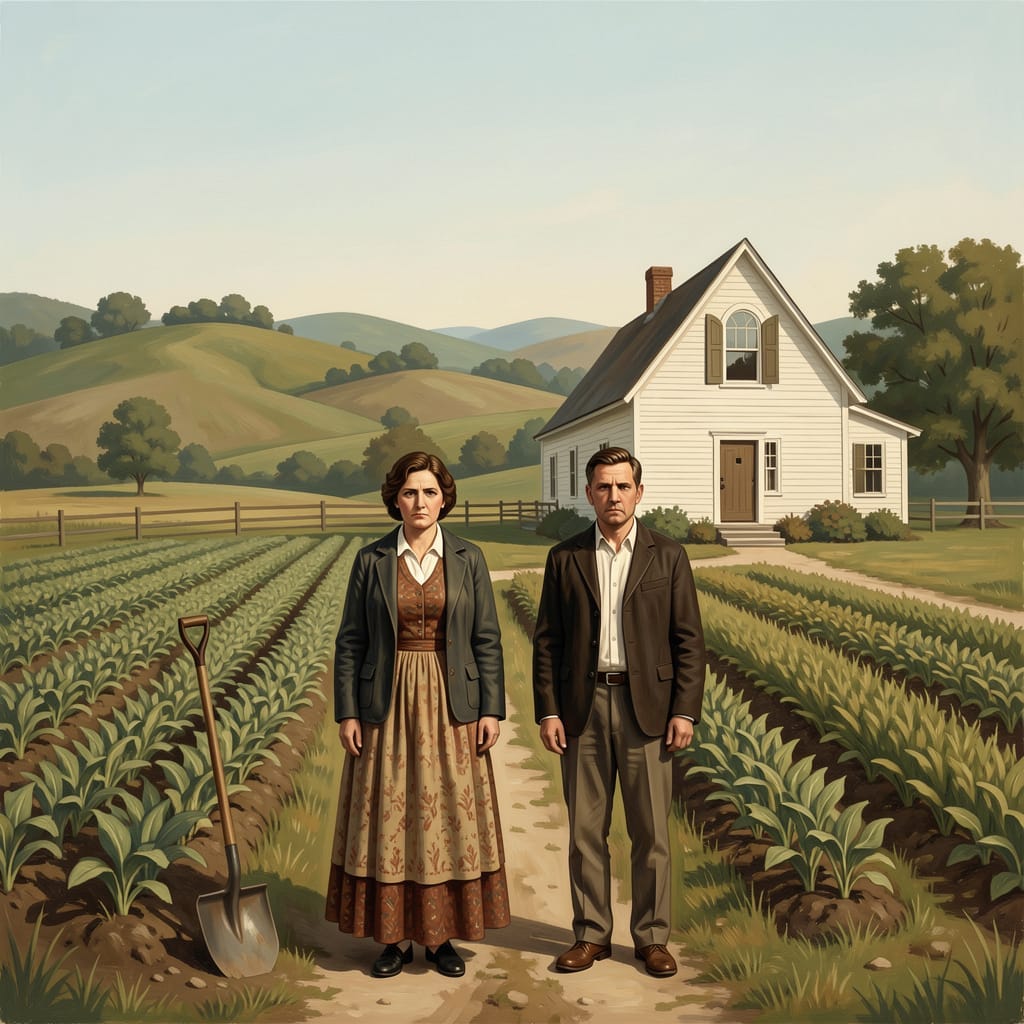
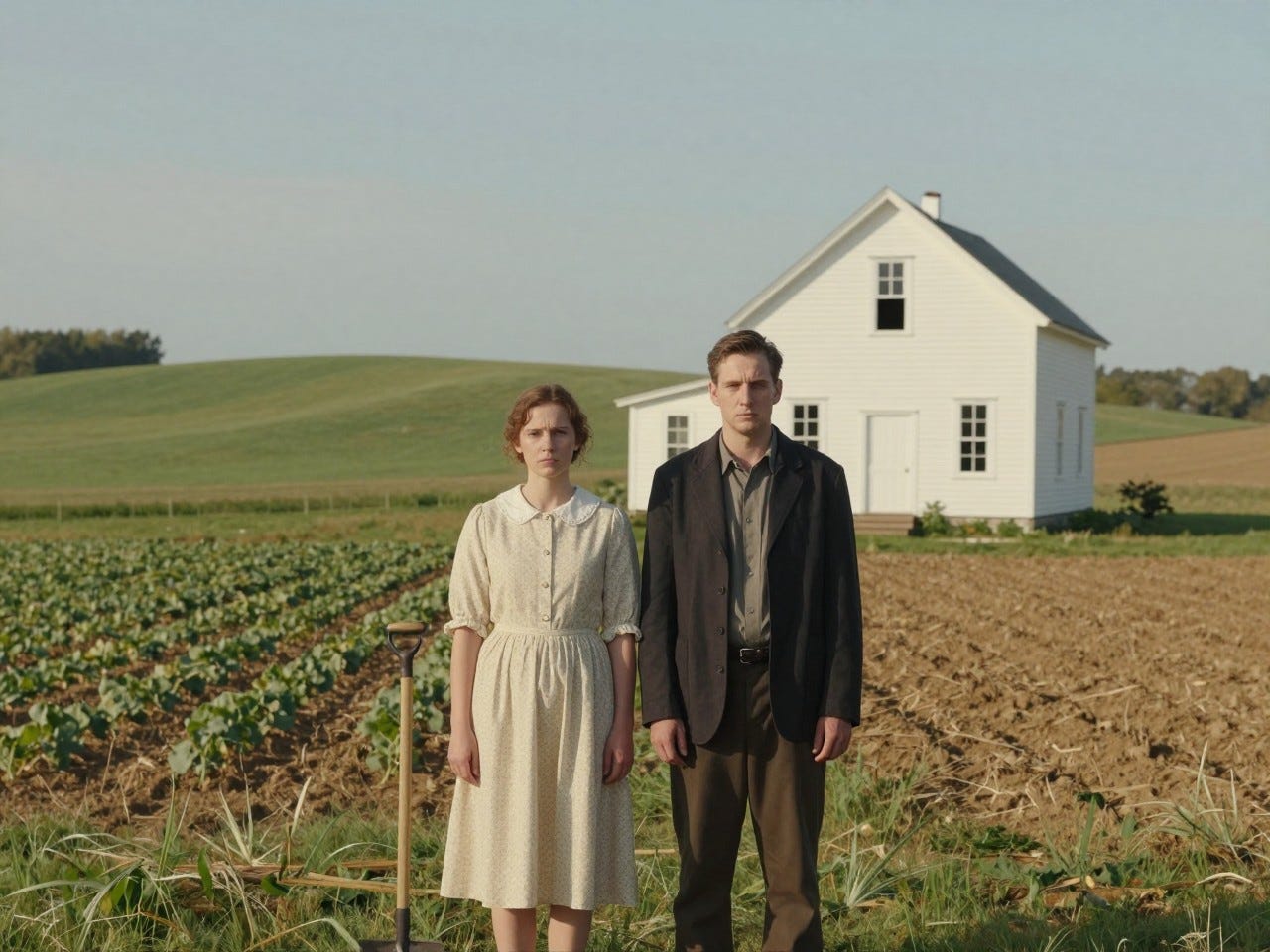
Art Prompt (Regionalist):
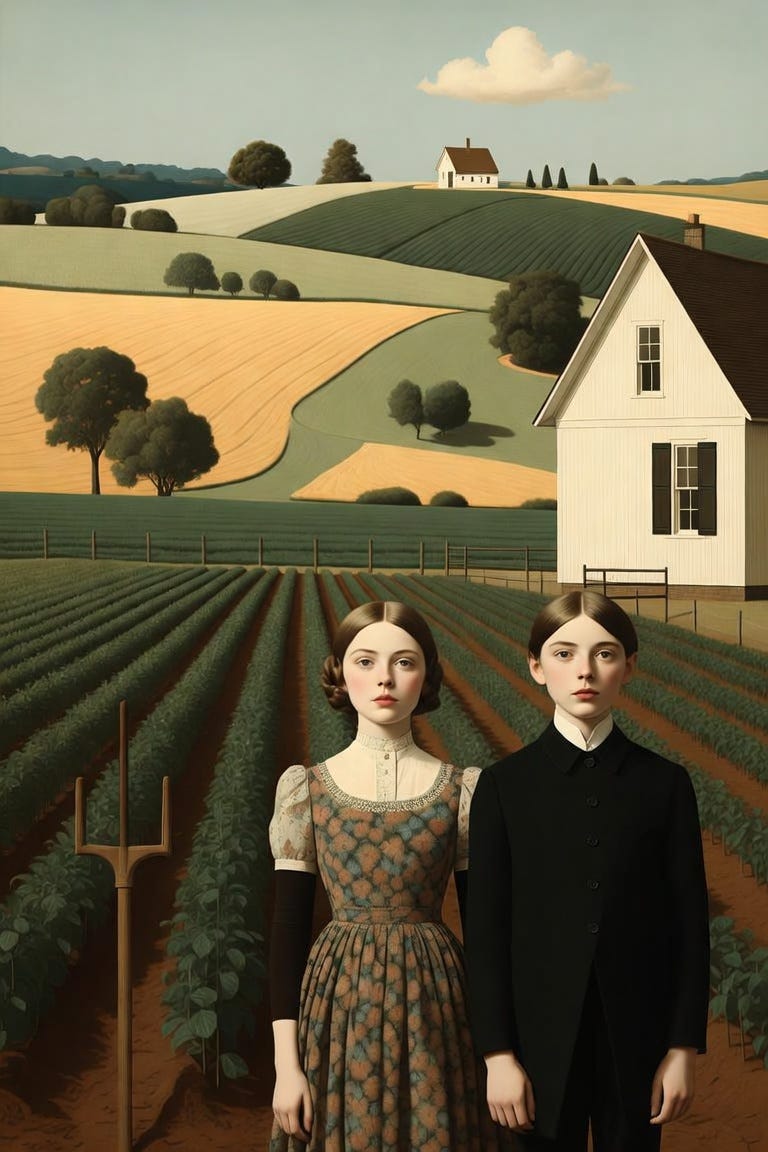
A sharply detailed rural American scene with rolling green hills, neat rows of crops, a small white farmhouse, and two solemn figures standing frontally in the foreground, painted with crisp edges, smooth surfaces, careful symmetry, and a restrained earthy palette of cream, brown, muted green, pale blue, and sun-warmed ochre. The composition should feel formal, quiet, slightly humorous, and oddly theatrical, with every object deliberately placed: a garden tool, a patterned dress, a dark jacket, a pointed attic window, and a sky so calm it feels like it has been ironed. The mood is dignified, dryly comic, and faintly mysterious, capturing rural stillness with polished precision and subtle emotional tension.
Video Prompt:
A crisp rural American scene comes to life in slow, catchy motion: rolling green hills ripple gently like fabric, rows of crops sweep forward in clean patterns, a small white farmhouse glows in soft daylight, and two solemn figures stand motionless in the foreground while tiny details animate around them. A garden tool catches a glint of sun, a curtain shifts in the pointed attic window, clouds drift in a perfectly ordered sky, and the camera slowly pushes in with playful dramatic tension. The mood is polished, dryly funny, symmetrical, and quietly mysterious, with earthy colors, sharp edges, and a final close-up that feels both dignified and mischievous.
Songs for the video
The High Road — Broken Bells — A smooth, sly choice for that polished rural-meets-mysterious mood.
The Stable Song — Gregory Alan Isakov — Warm, earthy, and quietly cinematic, like a field remembering something it refuses to explain.