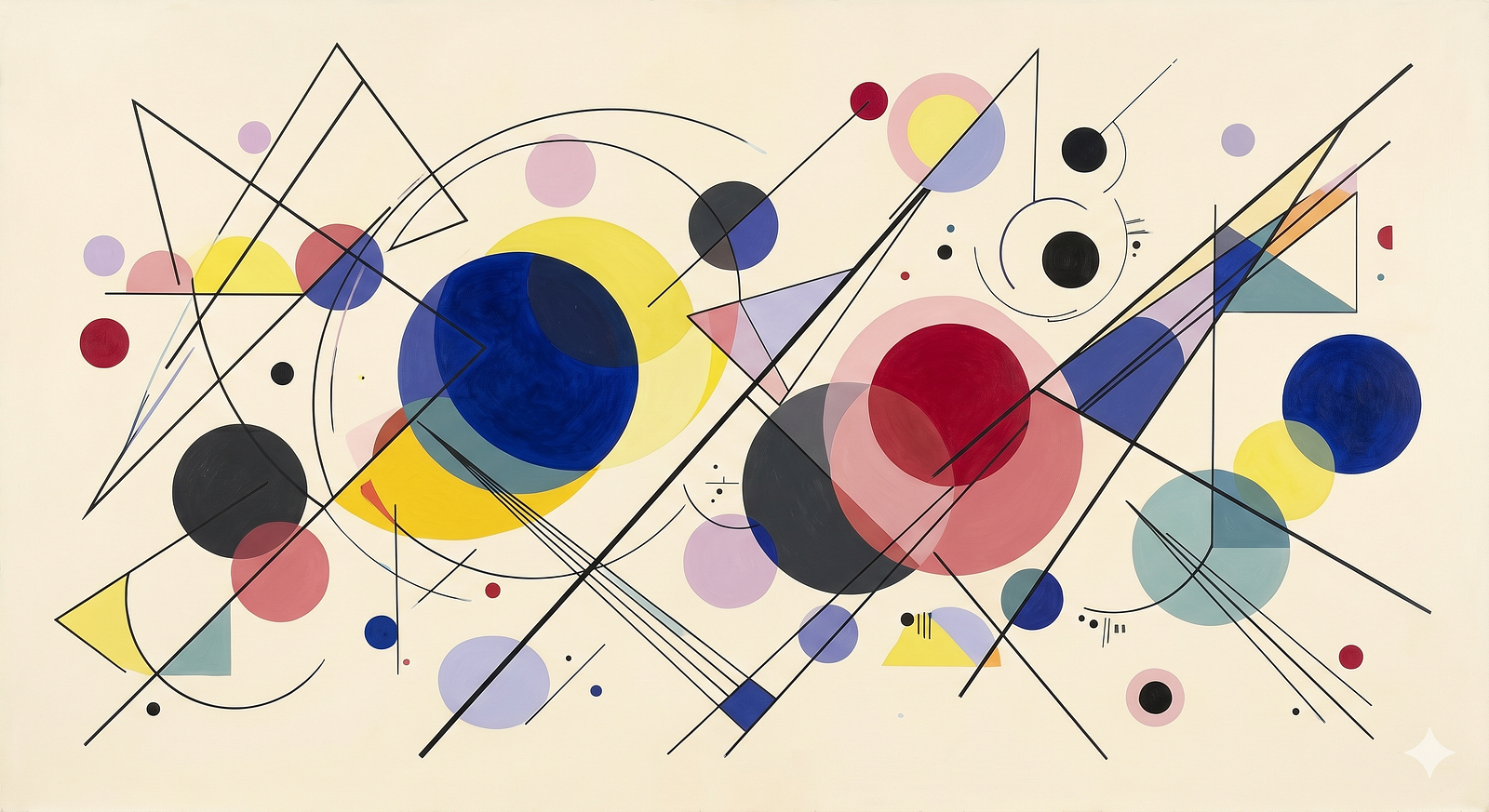
Wassily Kandinsky is one of those artists who makes you look at a painting and think, “I am not sure what this is, but I am pretty sure it just played a trumpet at me.”
He was born in Moscow in 1866, grew up partly in Odessa, studied law and economics, and seemed headed for a very respectable life full of serious documents, polished shoes, and possibly a desk with opinions. Then, at about age 30, he did the wonderfully unreasonable thing: he left the legal path and went to Munich to become an artist.
This was not a small career pivot. This was not changing from tea to coffee. This was a grown man looking at a sensible future and saying, “Thank you, but I would rather chase invisible music through paint.”
And honestly?
Good call.
Kandinsky became one of the great pioneers of abstract art. Not “abstract” as in “I forgot to draw the horse.” Abstract as in: maybe painting does not have to show a tree, a person, a bowl of fruit, or some poor mythological figure being dramatic near a rock. Maybe painting can express rhythm, emotion, pressure, joy, dread, spirituality, and that strange internal buzzing that happens when colors stop behaving like wallpaper and start acting like weather.
For a good overview of his life and major works, the Guggenheim has a useful Kandinsky resource here: Vasily Kandinsky at the Guggenheim.
The Man Who Heard Color and Saw Music
Kandinsky loved music. Not casually, either. Not “I own one piano and look noble beside it” loved music.
Music shaped how he thought painting should work. A song does not need to look like a goat, a chair, or a tax form to move you. It just moves you. Kandinsky wanted painting to do that too.
He saw Claude Monet’s haystack paintings in 1895 and realized something important: the subject was almost beside the point. The color, light, and composition were doing the emotional heavy lifting. Then he heard Wagner’s music and felt that sound could create a world without needing a literal picture. At that point, the door opened, abstraction walked in, and representation began quietly packing a suitcase.
His famous book Concerning the Spiritual in Art helped explain his belief that colors and forms could speak directly to the soul. Which is a very Kandinsky thing to say. Most of us look at yellow and say, “That is cheerful.” Kandinsky looked at yellow and basically said, “This color has spiritual velocity and may need supervision.”
What Is Kandinsky Known For?
Kandinsky is best known for helping push Western art toward full abstraction.
Before him, plenty of artists distorted reality, simplified forms, heightened color, and played with structure. But Kandinsky helped take the next big leap: paintings that did not need to represent recognizable things at all.
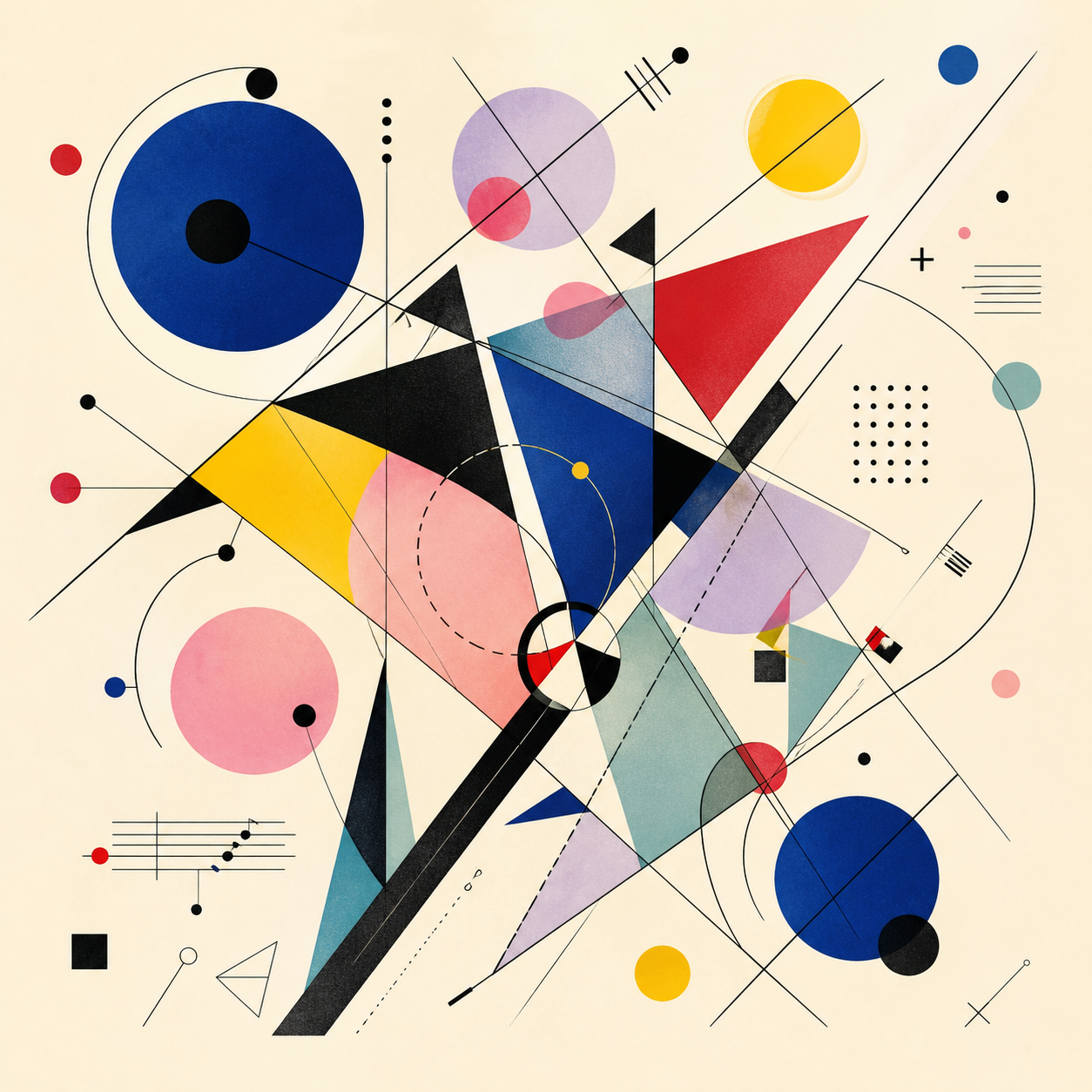
His works often look like visual music: circles, lines, triangles, floating shapes, clashing colors, sharp diagonals, soft washes, and sudden bursts of movement. His paintings can feel like a marching band fell through a stained-glass window during a philosophy lecture.
That is a compliment.
Some of his major phases include:
- Early colorful landscapes and folk-inspired scenes
- Expressionist works connected to Munich and Murnau
- Explosive abstract works before World War I
- More geometric, structured works during the Bauhaus period
- Later biomorphic, playful, almost microscopic forms in France
The Museum of Modern Art lists Kandinsky among artists associated with abstraction, Bauhaus, and painting, and has many of his works online: Vasily Kandinsky at MoMA.
Who Taught Him?
Kandinsky did not begin as a child prodigy locked in an attic with a paintbrush and a destiny-shaped beret.
He studied law and economics first. Then, after deciding that art had successfully ambushed his life, he moved to Munich in 1896. There he studied at Anton Azbe’s private art school and later at the Munich Academy of Fine Arts under Franz von Stuck.
The Centre Pompidou notes that Kandinsky took lessons at Anton Azbe’s school, then studied under Franz von Stuck at the Munich Academy: Kandinsky’s Munich studies.
So yes, he had training. But he also had that dangerous artist quality where training becomes a launchpad, not a cage. He learned the rules, looked at them thoughtfully, and then began feeding them to a bright blue horse.
His Style: Spiritual Geometry With Excellent Nerve
Kandinsky’s style changed a lot over time, but a few ideas stayed central.
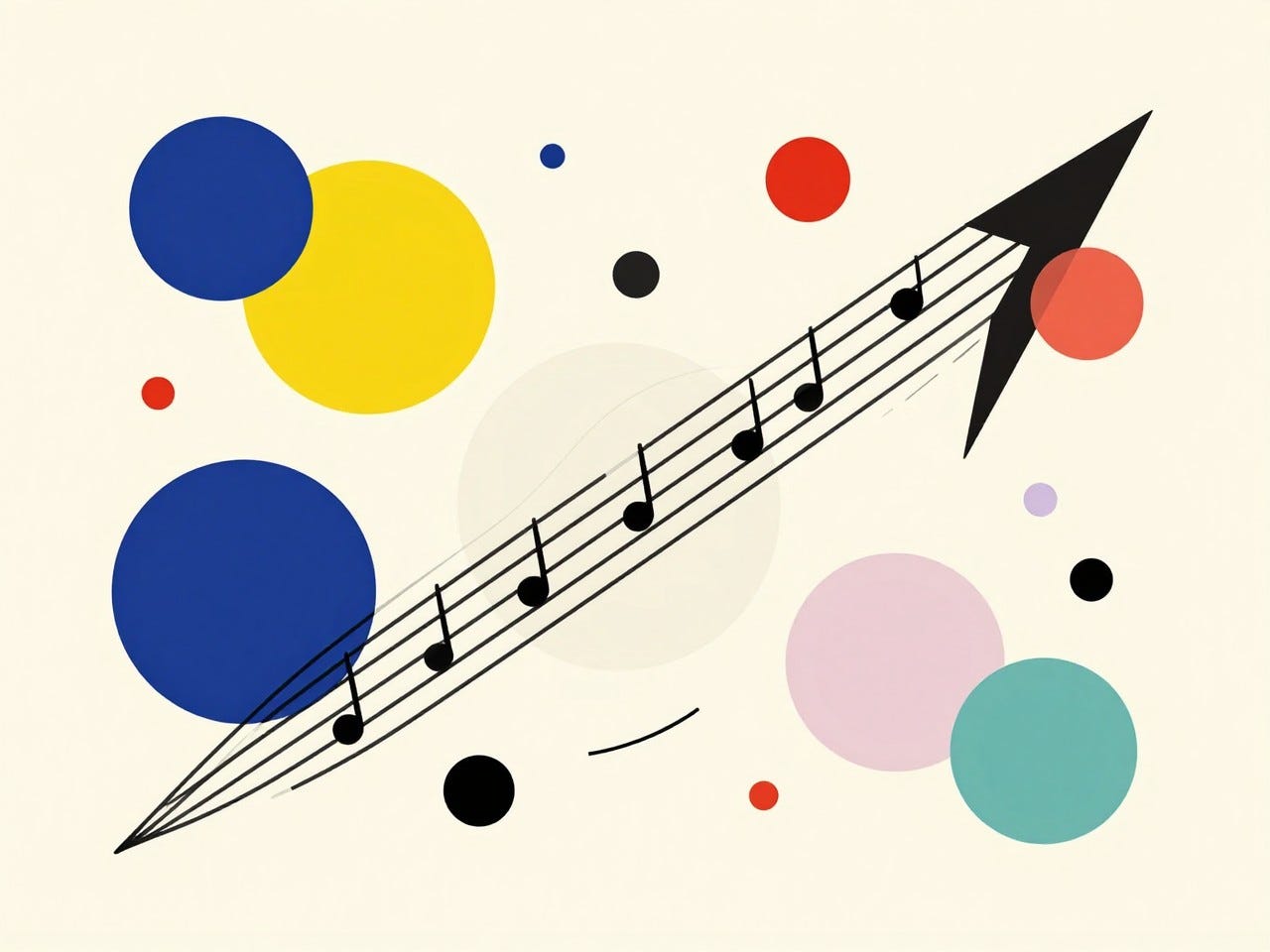
He believed colors had emotional and spiritual force. He believed shapes had personality. He believed painting could work more like music than illustration. He often titled works with musical words like “Composition,” “Improvisation,” and “Impression.”
That was not just fancy naming. It was a clue.
A “Composition” was usually carefully built, like a grand structured piece of music. An “Improvisation” was more spontaneous, more emotionally immediate, like the painting equivalent of an instrument warming up and accidentally discovering a portal.
His art often combines:
- Bright, high-energy color
- Lines that feel directional and musical
- Shapes with symbolic or emotional charge
- A movement from recognizable figures toward pure abstraction
- A strong belief that art could communicate inner life
This is why Kandinsky matters so much. He was not merely decorating canvases with interesting shapes. He was trying to build a language for things that do not fit neatly into words.
Basically, he wanted to paint what your nervous system hears when it walks into a cathedral made of color.
The Blue Rider Era
In 1911, Kandinsky helped found Der Blaue Reiter, or The Blue Rider, with Franz Marc. This group was not a rigid movement with matching jackets and a laminated handbook. It was a loose circle of artists who cared deeply about color, spirituality, modernism, and expressive freedom.
The Lenbachhaus describes The Blue Rider as being founded by Kandinsky, Franz Marc, Gabriele Munter, Alexej von Jawlensky, and Marianne von Werefkin, with the group developing an increasingly abstract visual language tied to a shared belief in the spiritual dimension of art: The Blue Rider at Lenbachhaus.
The Blue Rider artists were not all doing the same thing, which is partly why they were interesting. Some painted animals with blazing color. Some pushed landscapes into emotional fireworks. Some bent forms until they began to sing strange little modern songs.
Kandinsky, meanwhile, kept moving toward abstraction like a man following a sound only he could hear.
Who Did He Work With?
Kandinsky’s artistic circle was impressive.
He worked closely with Franz Marc through The Blue Rider. He was deeply connected with Gabriele Munter, who was his student, partner, and an important artist in her own right. He was also associated with Alexej von Jawlensky, Marianne von Werefkin, August Macke, Paul Klee, and others in the European avant-garde.
At the Bauhaus, he worked in one of the most important modern art and design environments of the 20th century. There, he taught alongside major figures including Paul Klee, and his ideas about color, form, and abstraction became part of a much larger modernist machine.
And no, not a normal machine.
A Bauhaus machine.
The kind of machine that makes a chair look like geometry is trying to improve your posture.
The Bauhaus Years
Kandinsky joined the Bauhaus in 1922 and taught there until the Nazis closed the school in 1933. His style during this time became more geometric and structured. The floating storms of his earlier abstraction gave way to circles, lines, grids, angles, and carefully balanced visual relationships.
This is where works like his famous geometric abstractions come into the conversation. They feel precise, but not cold. They are organized, but still alive. They look like diagrams drawn by someone who believes the universe has rhythm and possibly a tambourine hidden under the floorboards.
The Guggenheim’s page on Composition 8 explains that this painting was the first Kandinsky work Solomon R. Guggenheim purchased for what became a major collection of nonobjective art.
That is a fun little art-history hinge. One painting enters one collection, and suddenly the future starts rearranging the furniture.
Did He Use Any Special Technique?
Yes, but not in the “secret brush dipped in moon syrup” sense.
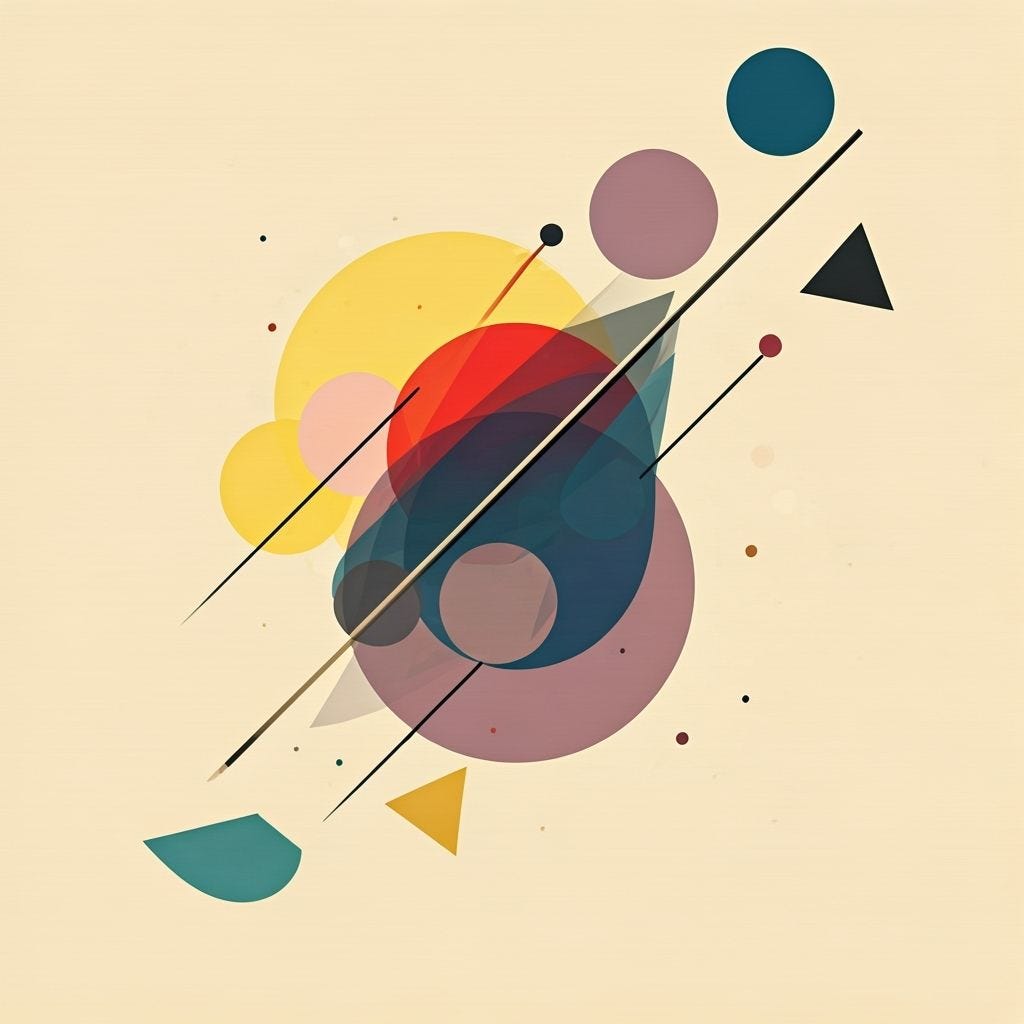
Kandinsky’s special technique was more about theory and structure than one single physical trick. He developed a vocabulary of color and form. He treated colors almost like instruments. He treated shapes almost like personalities.
He thought yellow could feel aggressive and earthly. Blue could feel deep and spiritual. Circles could suggest cosmic completeness. Triangles could feel active and sharp. Lines could carry force, direction, rhythm, and tension.
Was every viewer required to experience the same thing?
No, thank goodness. Art is not a vending machine where you press “blue” and receive “mystical calm” with exact change.
But Kandinsky believed there were deep emotional and spiritual relationships between visual elements. His paintings are experiments in that belief. Sometimes they feel like orchestras. Sometimes they feel like maps. Sometimes they feel like someone spilled geometry into a thunderstorm and then politely framed the evidence.
Was He Wealthy?
Kandinsky was born into a wealthy family, which gave him early educational opportunities and a certain amount of cultural breathing room. That matters. It is much easier to dramatically leave law for art when life has not already pinned you to the ground and stolen your lunch money.
But being born comfortable does not mean his life was simple. He lived through enormous upheaval: imperial Russia, World War I, the Russian Revolution, the rise of modernism, the Bauhaus years, Nazi hostility to modern art, and exile in France.
So yes, he began with privilege. But he also spent much of his life moving through a Europe that kept turning history into an angry blender.
When Was He Most Popular?
This depends on what we mean by popular.
If we mean “widely known to the general public,” Kandinsky became much more famous after abstraction entered the museum canon and collectors, critics, and institutions began treating him as one of the central figures of modern art.
If we mean “artistically influential in his own lifetime,” his key moments were the 1910s and 1920s: The Blue Rider, his major theoretical writings, and his Bauhaus teaching years.
If we mean “recognized by people who own tote bags from museum gift shops,” that is mostly a later victory.
Kandinsky was not making art for mass comfort. He was making art for the future, which is risky because the future is often late and rarely sends a thank-you note.
Anything Else Left to Tell?
Yes. Kandinsky is often called one of the first truly abstract painters, but that phrase can cause minor art-history wrestling matches. Many artists across different cultures and traditions made nonrepresentational designs long before modern European abstraction. And several early 20th-century artists were moving toward abstraction around the same time.
So the better version is this: Kandinsky was one of the most influential pioneers of modern abstract painting in the Western art canon.
There. Accurate, less shouty, and nobody had to throw a chair.
Also, Kandinsky did not simply wake up one day and paint random shapes. His abstraction developed gradually. He moved from landscapes and folk-inspired imagery toward increasingly free color and form. He did not abandon the world because he could not paint it. He abandoned literal depiction because he wanted to paint something underneath it.
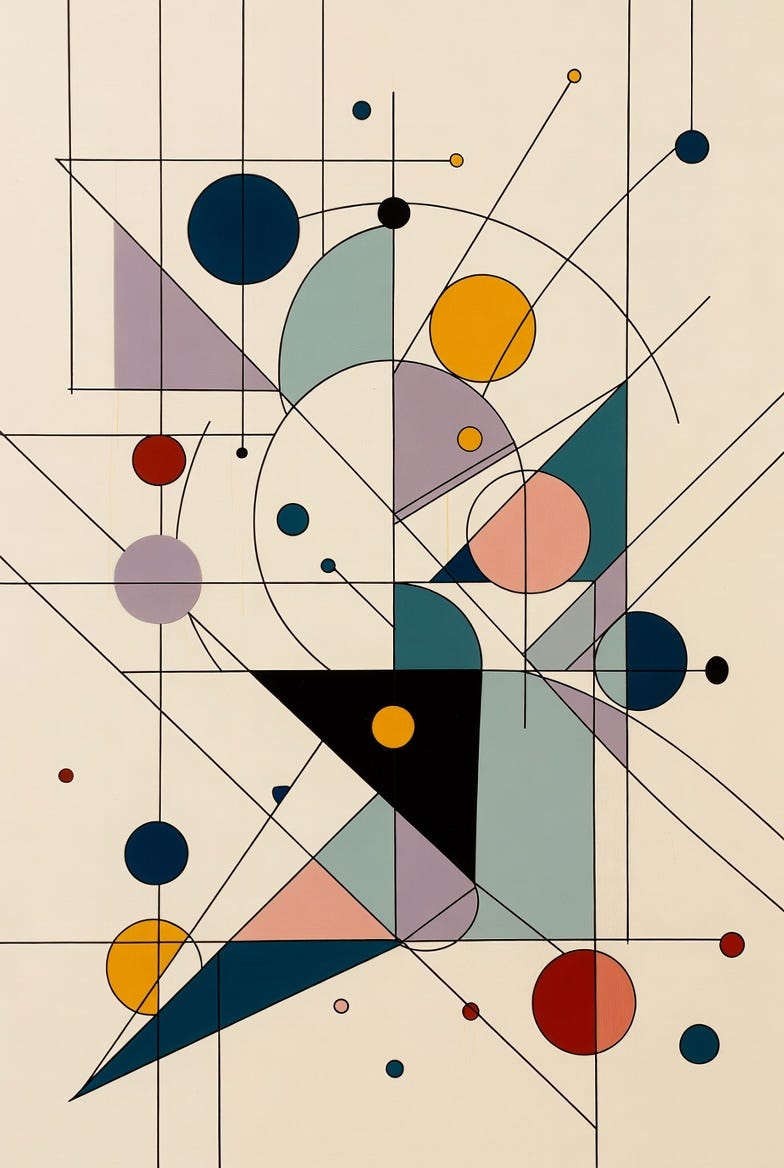
The feeling.
The vibration.
The invisible architecture of emotion.
The part of reality that does not sit still long enough for a portrait.
Why He Still Matters
Kandinsky matters because he helped prove that art does not have to point at the visible world to be meaningful.
A painting can be a mood. A painting can be a sound. A painting can be a spiritual argument with excellent color choices. A painting can be a little visual thunderclap that makes your brain sit up straighter.
He gave later artists permission to explore abstraction as a serious language, not just decoration or accident. He helped connect painting with music, spirituality, psychology, and design. He helped build the bridge from representation to pure visual experience.
And he did it with circles, lines, colors, and enough conviction to make a triangle seem like it had a personal mission.
That is not nothing.
That is Kandinsky.
A man who looked at painting and said, “What if this thing could sing?”
Then he spent the rest of his life trying to tune the canvas.
Art Prompt (Abstract):
A radiant geometric abstract composition with a warm cream background, crisp black lines, floating circles, angled triangles, delicate arcs, small colored disks, and rhythmic diagonal tension; the palette should include deep ultramarine, lemon yellow, crimson red, soft rose, charcoal black, pale lavender, and muted teal, arranged with musical balance and playful precision. The scene should feel airy, intellectual, and energetic, like visual music suspended in space, with sharp forms, transparent overlaps, tiny graphic accents, and a sense of cosmic order gently interrupted by joyful motion.
Video Prompt:
A radiant abstract geometric world comes alive on a warm cream background as crisp black lines sweep across the frame, colored circles pulse like musical notes, triangles rotate gently, arcs draw themselves in midair, and small disks drift in rhythmic patterns. Deep ultramarine, lemon yellow, crimson red, soft rose, lavender, teal, and charcoal forms move with playful precision, creating a lively visual symphony. The camera glides through layers of floating geometry, with quick elegant transitions, subtle zooms, spinning accents, and a final burst of balanced color that feels bright, modern, and hypnotic.
Song Pairings for the Video
Try these with the video:
- Music Is Math — Boards of Canada
- Flim — Aphex Twin
Both have that “geometry has entered the chat” feeling without stepping on the same old playlist shoes.
Before You Wander Off
If this made you look at circles with mild suspicion, excellent. That means Kandinsky has done his job from beyond the paint.
Follow for more art stories, strange little history snacks, and creative rabbit holes with better lighting. And please comment with the artist you want next, or tell me whether Kandinsky feels more like jazz, math homework, or a cathedral that learned to dance.