
Before we walk into Sikhism, here is the intro to the whole series, because every decent road trip needs a map, snacks, and at least one person asking whether we are there yet:
The Modern Religion Series: Many Paths, One Curious Human
Sikhism begins in 15th-century Punjab with Guru Nanak, born in 1469, a spiritual teacher whose message was both simple and enormous: there is one God, all human beings are equal, and a meaningful life is not just something you believe in your head while your hands are off somewhere causing trouble.
That last part matters.
Sikhism is not a religion of decorative spirituality. It is a religion that asks belief to put on shoes and go do something useful.
The official reference for this episode is the Sikh Coalition, which offers clear educational resources here:
And a helpful overview here:
So, What Is Sikhism?
Sikhism, also called Sikhi, is a monotheistic religion founded by Guru Nanak in the Punjab region of South Asia. It developed through Guru Nanak and the nine Sikh Gurus who followed him, with the Guru Granth Sahib now revered as the eternal Guru and central scripture of the Sikh tradition.
That is the short version.
The slightly longer version is this: Sikhism is a disciplined, devotional, community-centered path that emphasizes remembrance of God, honest living, equality, and service.
It does not ask people to disappear from the world. It asks them to live in it truthfully.
Which is wonderful, because most of us are already here, have errands to run, and are not currently scheduled to float into a mountaintop cave by Thursday.
The Founding: Guru Nanak and a New Religious Path
Guru Nanak lived in a world shaped by social divisions, religious boundaries, caste hierarchy, political power, and human beings doing what human beings have always done: building walls and then acting surprised when everyone feels separated.
His teachings emphasized the oneness of God and the equality of all people. Sikh tradition developed through ten human Gurus, ending with Guru Gobind Singh, who affirmed the Guru Granth Sahib as the continuing spiritual authority of the Sikh community.
The result is one of the youngest major world religions, and also one of the largest, with more than 25 million Sikhs worldwide.
Not bad for a tradition whose central message includes, in very broad terms: remember God, live honestly, serve others, and maybe stop ranking human beings like badly organized office supplies.

A Scripture Quote, Exactly and Carefully
The opening of the Guru Granth Sahib begins with the Mul Mantar, one of the most important statements in Sikh scripture:
“One Universal Creator God. The Name Is Truth.”
Sri Guru Granth Sahib Ji, Ang 1. English translation by Dr. Sant Singh Khalsa, Siri Guru Granth Sahib Ji, Volume 1, Edition 4, SikhNet, 2020.
That is a compact sentence with a lot of theological furniture in it. One God. Truth as central. Creation as unified. Not a casual opening line. More like the spiritual equivalent of setting the foundation before anyone starts arguing about window treatments.
Core Tenets of Sikhism
Sikhism is often summarized through three daily principles:
- Naam Japna: remembering and meditating on God.
- Kirat Karni: earning an honest living.
- Vand Chakna: sharing with others.
The Sikh Coalition also describes the three core daily principles as devotion to God, truthful living, and service to humanity.
Those are not tiny ideas. They are the sort of ideas that look simple until you try applying them before coffee, during traffic, or while reading comment sections.
Sikhism teaches that God is one, formless, eternal, and present throughout creation. Human beings are considered equal before God, and discrimination based on caste, gender, ethnicity, religion, or social status has no theological place in Sikh belief.
In Sikhism, spirituality is not supposed to make you aloof from humanity. It is supposed to make you more responsible to it.
Is Sikhism Growing or Shrinking?
In raw numbers, Sikhism remains a large global religion, with more than 25 million adherents worldwide. Sikh communities are especially concentrated in Punjab, but Sikh diasporas have also grown in countries such as Canada, the United Kingdom, the United States, Australia, and elsewhere.
Is it growing in popularity? That is related, but not exactly the same question.
Number of practitioners means how many people identify with or practice the religion.
Popularity can mean visibility, cultural awareness, public understanding, online interest, or positive perception.
So Sikhism can grow in public visibility even if its percentage of the global population changes slowly. And because Sikh communities are often very active in public service, civil rights, education, and interfaith work, many people encounter Sikh values through lived example before they ever read a formal theology page.
Sometimes the first sermon is not a sermon at all. Sometimes it is a meal.
Langar: The Holy Art of Feeding People
One of the most famous Sikh practices is langar, the community kitchen associated with gurdwaras, Sikh houses of worship. In langar, people are served free meals regardless of background, status, wealth, caste, religion, or whether they know how to pronounce gurdwara correctly on the first try.
The point is not just food.
The point is equality made visible.
People sit together. People eat together. People serve together.
It is theology with plates.
And frankly, if more arguments ended with everyone sitting down to eat together, the human species might have avoided several centuries of unnecessary nonsense, plus at least three awkward family reunions.

Benefits to Individuals
For individuals, Sikhism offers a structured way to live with discipline, devotion, purpose, and ethical clarity. The emphasis on honest work gives ordinary labor spiritual dignity. The emphasis on remembering God offers inner focus. The emphasis on service pulls people out of the small, exhausting room of self-obsession.
That does not mean every Sikh is automatically serene, flawless, and able to assemble furniture without irritation.
Religious traditions guide people. They do not turn human beings into software updates.
But Sikhism offers a strong model: live honestly, serve generously, remember the Divine, and treat others as equal.
That is a pretty sturdy daily operating system.
Benefits to Families
For families, Sikhism encourages shared devotion, mutual responsibility, respect, and service. Practices around community worship, music, scripture, and langar create rhythms that are not only religious but relational.
Children can grow up seeing service as normal.
Parents can model humility and courage.
Elders can pass down memory, language, ethics, and spiritual identity.
The family becomes more than a private unit. It becomes part of sangat, the community.
And community matters because, left alone, many of us eventually start treating our own opinions like sacred texts, which is how group chats become small theological emergencies.
Benefits to Society
Sikhism has created a powerful social ethic around equality and public service. Sikh communities have contributed to farming, medicine, education, military service, civil rights work, entrepreneurship, disaster relief, food aid, and interfaith outreach.
The tradition’s public presence is often tied to service. During crises, Sikh organizations and gurdwaras have frequently provided meals, supplies, and support to people far beyond their own community.
This is one of Sikhism’s great gifts to society: it makes service a religious obligation, not a branding opportunity.
Help is not supposed to arrive wearing a cape and asking for a press release. It is supposed to arrive because someone is hungry, suffering, excluded, or in need.
Benefits to the Human Race
At its best, Sikhism contributes a deeply humane vision to the human story: one Divine reality, one human family, and a spiritual life measured partly by how one treats others.
That vision challenges caste, hierarchy, indifference, selfishness, and spiritual vanity.
It reminds the human race that devotion without compassion is incomplete.
It also offers a useful correction to the idea that religion must be private, abstract, or detached from daily life. Sikhism says: pray, yes. Sing, yes. Study, yes. But also work honestly, share what you have, and serve.
The universe may be vast, but lunch still needs to be made.
Benefits to All Living Things and the Physical Universe
Sikh teachings include a strong awareness of creation as infused with Divine presence. This can encourage reverence for the natural world and concern for all living beings.
Sikhism does not treat the physical universe as spiritually meaningless background scenery. The world is not just a waiting room before something more important happens. It is part of creation, and human beings have responsibilities within it.
That does not mean Sikhism is reducible to environmentalism. It is a religious tradition, not a recycling brochure with hymns.
But reverence for the Creator naturally shapes how creation is viewed. The physical world matters because it is not spiritually empty.
Spiritual Benefit
Spiritually, Sikhism offers a path toward union with God through remembrance, humility, devotion, ethical living, and grace.
The tradition teaches that ego separates human beings from the Divine. The path is not about inflating the self into a spiritual celebrity. It is about moving beyond ego into truthful living and devotion.
This is spiritually refreshing, especially in a world where even meditation apps sometimes sound like they are trying to sell you a luxury candle named Inner Revenue Stream.
Sikhism’s spiritual aim is not performance. It is transformation.
How Sikhism Portrays God
Sikhism portrays God as one, eternal, formless, beyond birth and death, without fear or hatred, and present throughout creation. God is not limited to one tribe, nation, caste, language, or social class.
The Sikh understanding of God supports the Sikh view of human equality. If the Divine is equally present, then discrimination is not only socially ugly; it is spiritually incoherent.
Which is a polite way of saying: you cannot claim to honor the One while treating people like leftovers.
Conflict, Persecution, and Discrimination
Sikh history includes courage, conflict, persecution, and survival.
The Sikh community has faced persecution under various political powers in South Asia. In modern times, Sikhs have also faced discrimination, hate crimes, profiling, and misunderstanding in diaspora communities, especially because visible Sikh identity, including turbans and uncut hair, can make Sikhs targets for ignorance.
The Sikh Coalition has done extensive work in civil rights, education, workplace discrimination, school safety, and religious freedom.
This is an important part of the story. Sikhism teaches equality and service, but Sikhs have often had to defend their own right to live openly and safely.
A tradition can be peaceful without being passive.
A community can serve humanity and still insist, firmly, that humanity stop being ridiculous toward them.
Famous Works of Art, Music, and Culture
Sikhism has a rich artistic and cultural presence, especially through devotional music, manuscript traditions, architecture, and visual depictions of the Gurus.
Important cultural forms include:
- Kirtan, the singing of sacred hymns.
- The Guru Granth Sahib as a poetic and musical scripture.
- Gurdwara architecture, including the Harmandir Sahib, often called the Golden Temple, in Amritsar.
- Paintings and portraits of the Sikh Gurus.
- Sikh martial and ceremonial traditions connected to identity and history.
The Harmandir Sahib is one of the most recognizable sacred sites in the world, and it is not just visually stunning. It is also connected to worship, music, pilgrimage, and service.
Some buildings impress you by being large.
Some impress you by being beautiful.
Some impress you because people are being fed nearby.
That last category deserves more applause.
Interesting Tidbits
Sikhism is the fifth largest world religion.
The Guru Granth Sahib is written in poetry and includes hymns not only from Sikh Gurus but also from saints associated with different religious backgrounds.
The Sikh articles of faith, often called the Five Ks, are visible reminders of commitment and identity.
Many Sikhs wear turbans as an expression of faith, dignity, discipline, and equality.
The Khalsa, established by Guru Gobind Singh in 1699, is the community of initiated Sikhs committed to a disciplined Sikh way of life.
And langar remains one of the most beautiful religious practices in the world because it takes a profound idea and makes it edible.
Final Thoughts
Sikhism is a young major religion with an old soul: one God, one human family, honest work, service, devotion, courage, and equality.
It does not separate spirituality from responsibility. It does not let belief sit comfortably in a chair while the world needs help. It turns worship outward, toward neighbors, strangers, families, communities, and the hungry person who does not need a lecture before dinner.
That may be one of Sikhism’s clearest gifts.
It reminds us that spiritual life is not just what we say about the Divine.
It is what we do because of it.
Follow along for more in the Modern Religion Series, and if this episode gave you something to think about, comment with the part that stayed with you. I am especially curious whether langar, equality, scripture, history, or the idea of service as spiritual practice hit you hardest.
Song Recommendations
- Pulaski at Night — Andrew Bird
- Sweet Tides — Thievery Corporation

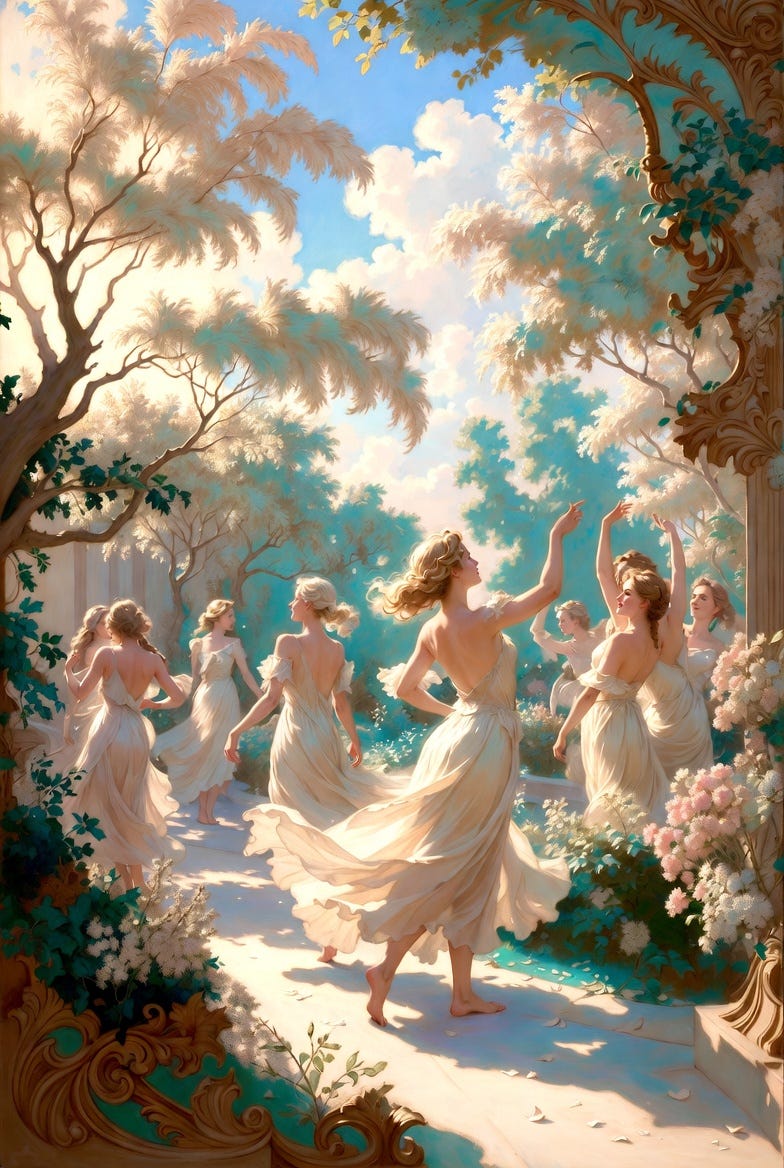
Art Prompt (Rococo):
A luminous garden scene filled with theatrical softness and airy elegance, composed with sweeping diagonal movement, pastel rose, pale turquoise, ivory, and warm honey-gold tones; delicate figures gather beneath feathery trees and cloud-bright sky, their gestures graceful and lightly animated, with fluttering fabric, powdered light, and a romantic sense of suspended conversation; the brushwork should feel loose yet refined, with shimmering highlights, ornate natural details, and a playful atmosphere of leisure, music, and gentle enchantment, like a painted sigh in a sunlit courtyard.
Video Prompt:
A graceful Rococo garden comes alive in soft golden light as pastel clouds drift slowly overhead, ribbons and gauzy fabric flutter in a mild breeze, and elegant figures move through the scene with small, dance-like gestures. The camera glides through flowering branches, catches sparkling highlights on satin textures, then sweeps upward toward a glowing sky. Add subtle parallax, drifting petals, animated brush-stroke textures, and a warm cinematic rhythm that feels charming, refined, and quietly magical.