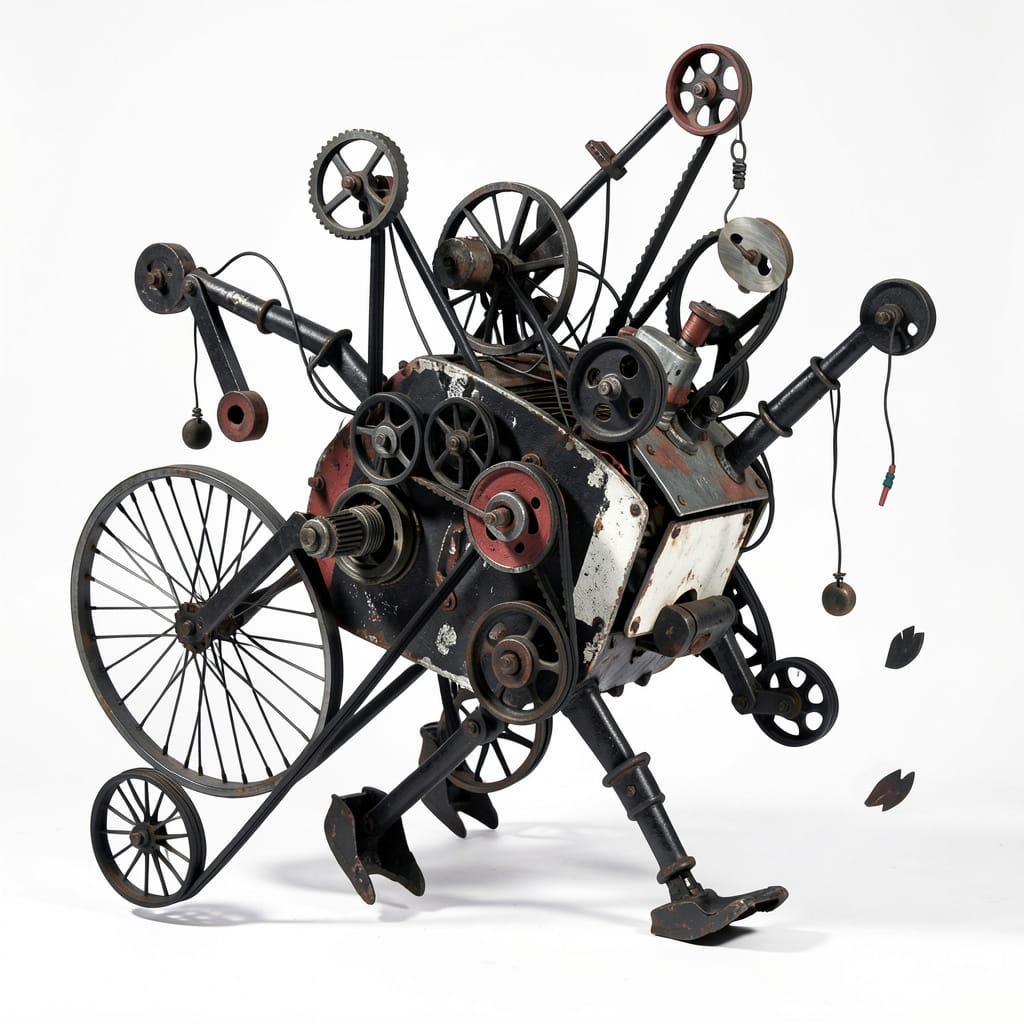
A brief funny intro from Dave LumAI: Today we are meeting Jean Tinguely, the artist who looked at a pile of junk, heard it rattling, coughing, spinning, clanking, and said, “Yes. This is culture now.” And honestly, he was right. The man made machines that danced, drew, complained, self-destructed, and occasionally behaved like they had just discovered espresso and existential dread at the same time.
Jean Tinguely was a Swiss sculptor born in Fribourg in 1925 and raised in Basel, where he developed one of the most delightfully suspicious relationships with machinery in modern art. He did not treat the machine as a heroic symbol of progress. He treated it more like a ridiculous roommate: noisy, needy, unpredictable, sometimes brilliant, and almost certainly about to break something.
That, in short, is why Tinguely matters.
He took motors, wheels, rods, belts, scrap metal, bicycle parts, feathers, junk-shop treasures, and assorted mechanical nonsense, then turned them into sculptures that moved. Not politely. Not like a museum guard gently pointing toward the exit. They jittered, shook, spun, clanged, scribbled, collapsed, and made the room feel like art history had swallowed a toolbox.
According to Museum Tinguely in Basel, the machine was at the heart of his work, especially how machines move, sound, behave, and become strangely poetic. That is the key word: poetic. Tinguely was not just building contraptions. He was building mechanical jokes with philosophical engines inside.
Who Was Jean Tinguely?
Jean Charles Tinguely was born on May 22, 1925, in Fribourg, Switzerland. His family soon moved to Basel, where he grew up behind the central train station in a French-speaking Catholic household. So, right away, we have a future avant-garde artist growing up near trains, clocks, factories, languages, rituals, and social discomfort. Basically, the universe handed him the starter kit for kinetic art and said, “Try not to set anything on fire.”
He began an apprenticeship as a decorator at the Globus department store in 1941. It did not go perfectly. He was dismissed in 1943 for lack of discipline, which, in retrospect, feels less like a failure and more like a machine warming up. Luckily, decorator Joos Hutter took him under his wing, helped him finish the apprenticeship, and encouraged him to attend Basel’s School of Arts and Crafts.
That school mattered. Tinguely encountered modern art, Dada, Kurt Schwitters, Marcel Duchamp, and Russian Constructivism. Those influences gave him permission to stop thinking of art as something that needed to sit still and look respectable. Respectability was not really his natural habitat. His natural habitat was probably a pile of metal parts making a worrying noise in the corner.
What Is He Known For?
Tinguely is best known for kinetic sculpture: art that moves.
But not just “moves” in the graceful Calder mobile sense, where air and balance create elegance. Tinguely’s machines often moved like they were arguing with themselves. They had motors. They had wheels. They had wobble. They had noise. They had a sort of glorious mechanical bad attitude.
His famous Metamatics were drawing machines. They used motorized arms to produce abstract drawings, often with the viewer participating in the process. This was funny, clever, and quietly dangerous to the entire idea of artistic authorship. If a machine makes the drawing, and the viewer helps operate it, who is the artist? Tinguely? The machine? The person pressing the button? The motor having a small emotional crisis?
The answer is yes.
He also became famous for machines that destroyed themselves, most famously Homage to New York, performed in the sculpture garden of the Museum of Modern Art in 1960. MoMA describes it as a self-constructing and self-destroying kinetic sculpture made from bicycle wheels, motors, a player piano, a go-cart, a bathtub, and found objects. During its short life, it inflated and burst a balloon, released colored smoke, made and destroyed paintings, and crashed bottles to the ground.
In other words, it had a more eventful day than most committees.
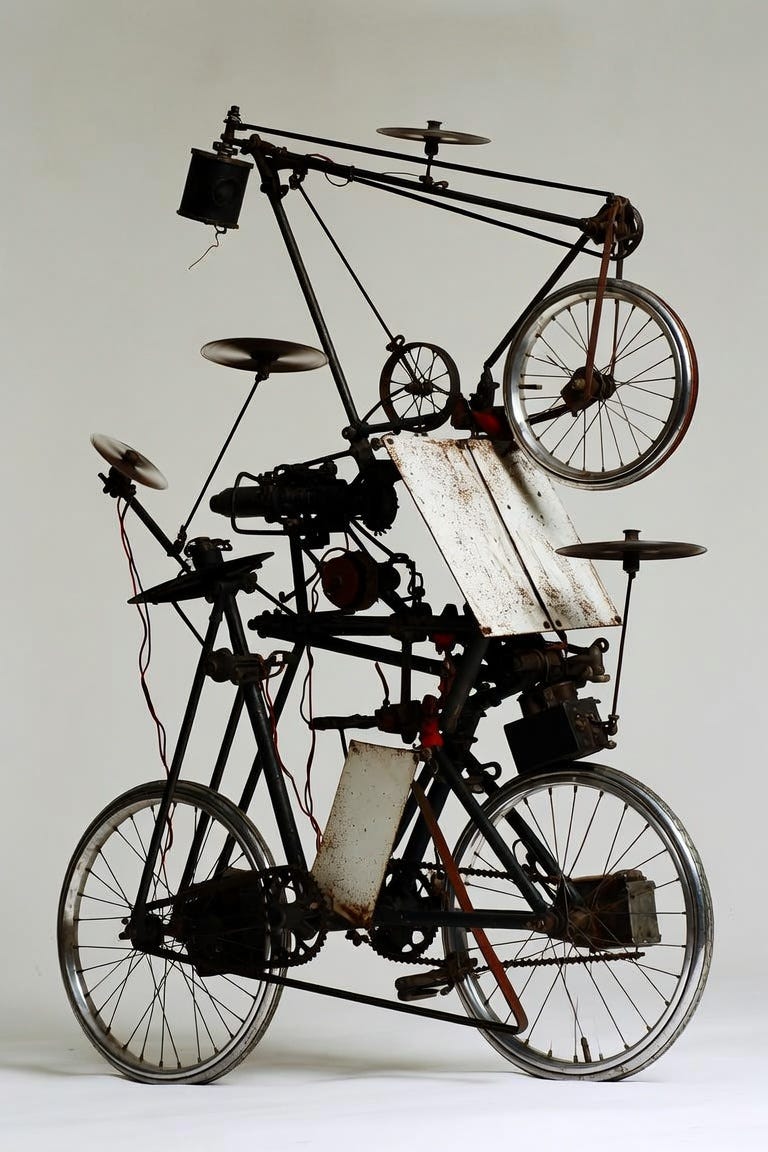
The Style: Mechanical Mischief With a Dada Heart
Tinguely’s style lives somewhere between sculpture, performance, engineering, comedy, critique, and public mechanical nervous breakdown.
He was connected to Nouveau Realisme, a postwar movement that used found objects, everyday materials, and fragments of real life as art. Tate’s overview of Nouveau Realisme names Tinguely as one of the leading figures, alongside artists such as Arman and Daniel Spoerri.
The movement was not trying to make art look like reality in the old academic sense. It was grabbing reality itself by the collar: junk, advertising, trash, machines, scraps, mass culture, consumer objects, and public spectacle.
Tinguely’s version of this was especially noisy. His sculptures often looked like the industrial world had been taken apart, rearranged by a comedian, and plugged back in before anyone from safety arrived.
There is a strong Dada streak in him too. Dada loved absurdity, chance, anti-serious seriousness, and the joyful sabotage of polite culture. Tinguely inherited that spirit and gave it motors.
Who Taught Him?
Tinguely did not have one famous master in the simple “this person taught him everything” sense. His education was more like a collision between practical craft, modern art, and mechanical curiosity.
Joos Hutter helped him complete his decorator apprenticeship and encouraged his formal art training. At Basel’s School of Arts and Crafts, he discovered major modern ideas and movements. He absorbed the influence of Schwitters, Duchamp, Dada, and Constructivism, which is a pretty powerful artistic smoothie. Possibly not drinkable, but very effective.
His childhood experiments with noisy devices and waterwheels also mattered. He was fascinated by contraptions early on. Some artists spend childhood drawing horses. Tinguely seems to have been mentally assembling a small mechanical orchestra in the woods.
Did He Use Special Techniques?
Absolutely.
His major technique was assemblage with motion: taking found materials and scrap objects, joining them with motors and mechanical systems, and turning them into kinetic sculptures.
He used chance, instability, and mechanical unpredictability as part of the artwork. The machine did not have to perform perfectly. In fact, imperfection was often the point. The wobble mattered. The clank mattered. The breakdown mattered. Tinguely understood that machines are never only machines. They are promises, failures, noises, hopes, marketing slogans, maintenance bills, and future scrap metal.
His Metamatics were especially important because they turned machines into image-making collaborators. These devices produced abstract drawings through mechanical motion, often with human participation. They mocked both the seriousness of gestural abstraction and the idea that the artist’s hand was sacred. It was like Tinguely looked at the heroic painter making a dramatic mark and said, “Lovely. Now let this contraption do it while sounding like a lawnmower in therapy.”
Who Did He Work With?
Tinguely’s artistic life was full of collaborators, friends, and fellow chaos enthusiasts.
He was closely connected with Niki de Saint Phalle, who became his lifelong partner and later his wife. Together they created major collaborative works, including public projects and wild sculptural environments. Their partnership was one of the great art-world combinations: her bold color, mythic figures, and emotional intensity meeting his mechanical energy and dark comic engineering.
The Niki Charitable Art Foundation notes his connections with Saint Phalle, Eva Aeppli, Daniel Spoerri, Robert Rauschenberg, Billy Kluver, Larry Rivers, and others. That is a serious artistic network. Not a quiet one, obviously. More like a dinner party where half the guests are brilliant and the centerpiece may start moving.
He also worked within circles that included Yves Klein, Arman, Daniel Spoerri, and Pierre Restany in the Nouveau Realisme orbit. Pontus Hulten, the influential curator, also played a major role in supporting and presenting Tinguely’s work.
Was He Wealthy?
He was not born into wealth. His father worked as a storekeeper and his mother as a maid. Tinguely came from modest circumstances, trained in applied craft, and built his reputation through bold, strange, public, impossible-to-ignore work.
Later, he became internationally known, exhibited widely, and became a major figure in twentieth-century art. So he achieved recognition and institutional success. But his work never feels like luxury decorating. Even when it is in a museum, it smells spiritually like a garage, a junkyard, a carnival, and a philosophical argument about industrial civilization.
That is part of its charm.
When Was He Most Popular?
His major breakthrough came in 1960 with Homage to New York. That event made him famous in the United States almost overnight. The 1960s and 1970s were especially important decades for his visibility, performances, collaborations, and large kinetic works.
He also remained important long after that because his art predicted so many later conversations: machines making art, automation, viewer participation, destruction as performance, technological absurdity, and whether modern civilization is secretly held together by wire, noise, and misplaced confidence.
Today, in an age of AI, robots, algorithms, and devices that update themselves at the worst possible moment, Tinguely feels less like a historical oddball and more like a prophet with grease on his sleeves.
Why the Machines Matter
Tinguely’s machines are funny, but they are not shallow.
They ask: Why do we worship machines? Why do we trust them? Why do we assume motion equals progress? Why do we think efficiency is always noble? Why does a machine with no purpose sometimes feel more honest than one pretending to improve your life?
His sculptures expose the comedy of mechanical ambition. They are anti-monuments. They do not stand calmly forever and declare, “Behold, civilization.” They sputter, shake, clatter, and remind us that civilization often runs on loose bolts and optimism.
That is what makes them so human.
The machines seem alive because they are flawed. They are restless. They struggle. They perform. They fail. They make noise while doing tasks nobody asked for. Frankly, relatable.
Homage to New York: Art as a Glorious Mechanical Exit
The best-known Tinguely story is still Homage to New York, and it deserves its fame because it is almost too perfect.
Imagine being invited to see a sculpture at MoMA, and instead of admiring a beautiful object forever, you watch a giant machine perform, smoke, bang, make art, destroy art, partly destroy itself, and leave behind debris. It is art as event, art as prank, art as critique, art as mechanical opera, art as “well, that escalated.”
It was supposed to vanish. That was the point. In a museum culture built around preservation, Tinguely made something that refused to be preserved. It lived briefly, misbehaved publicly, and became legend.
This is one of the great art jokes of the twentieth century: the object disappeared, but the reputation survived.
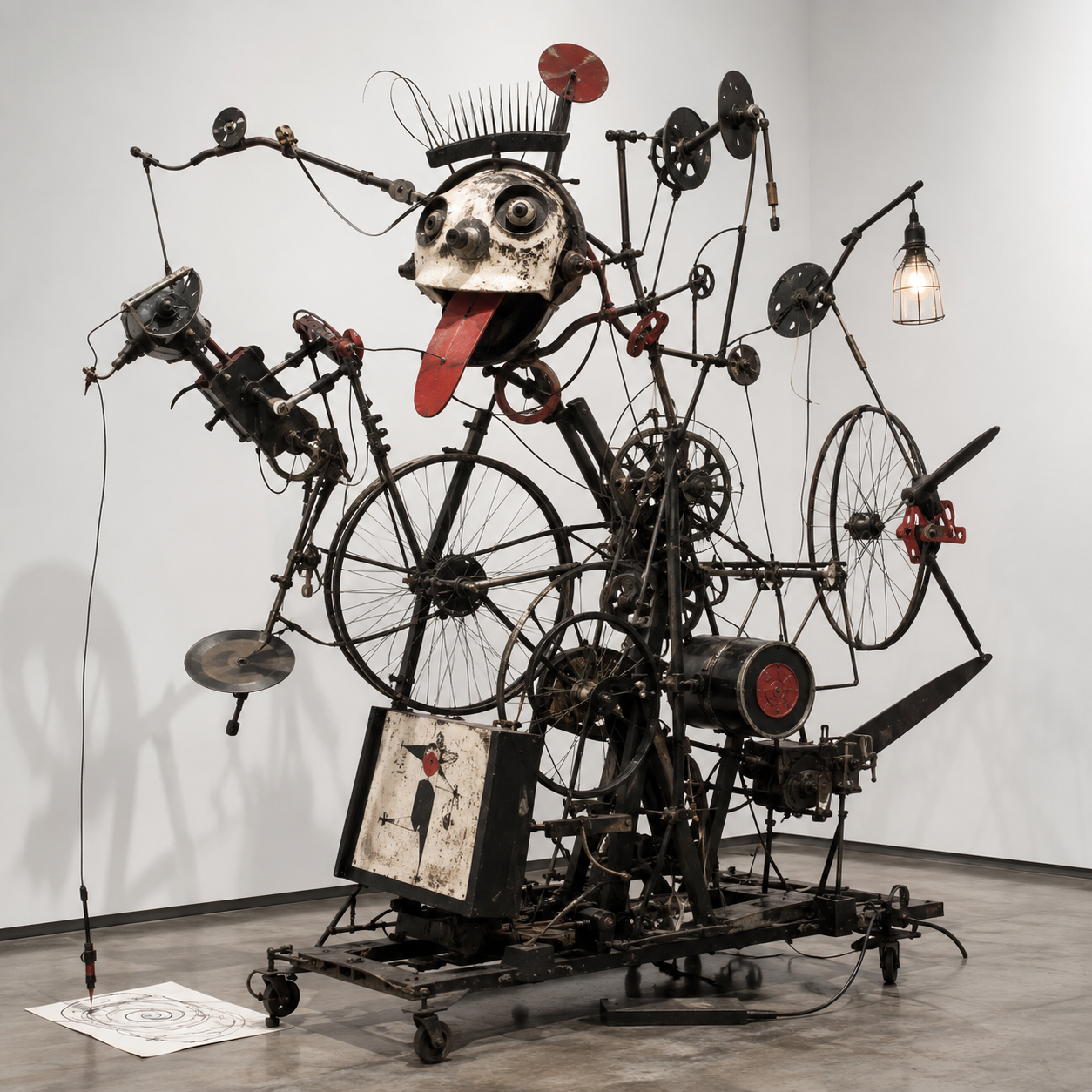
The Darker Side of the Fun
Tinguely’s work can feel playful, but it also carries anxiety. These machines are funny because they are useless, but they are also unsettling because they mirror a world full of machines that are supposedly useful and still behave like they are improvising.
Postwar Europe was full of questions about technology, industry, destruction, and rebuilding. Tinguely’s machines did not give a neat lecture about that. They clanked through the problem. They turned the machine age into slapstick with sharp edges.
A Tinguely sculpture says: yes, machinery is amazing. Also, machinery is ridiculous. Also, machinery might explode. Please enjoy the show.
Anything Else Left to Tell?
Yes: Tinguely loved speed.
He was fascinated by racing and Formula One, and that makes perfect sense. Racing is machinery turned into theater. It is precision, risk, sound, motion, beauty, money, danger, and engineering all pretending to be a sport while everyone secretly knows it is also opera.
His friendship with racing figures, including Jo Siffert, even inspired works. This adds another layer to Tinguely: he was not just interested in mechanical movement as an abstract idea. He loved the culture of motion, the noise, the danger, the personality of machines pushed to their limits.
Again, very on brand.
Why He Still Feels Fresh
Jean Tinguely remains fresh because his art refuses to behave like old art.
You do not look at a Tinguely and think, “Ah yes, a calm historical artifact.” You think, “Should that be moving? Is it supposed to sound like that? Is this brilliant? Is it broken? Am I too close?”
That uncertainty is the magic.
He made art that feels alive because it is unstable. He made machines that critique machinery by becoming ridiculous machines. He turned junk into theater. He made abstraction noisy. He made sculpture perform. He made failure part of the artwork.
And he gave us one of the most useful lessons in modern art: sometimes the machine that does nothing useful tells the truth better than the machine that claims it can fix everything.
So here is to Jean Tinguely, the great poet of mechanical mischief, the sculptor of clanks and collapses, the man who taught modern art to rattle.
Follow along for more artist stories, strange beauty, and occasional high-end nonsense with bolts in it. And please comment: if you could build one useless machine, what would it do?
You can see more art at https://lumaiere.com
And if you like short videos, there are more moving little visual experiments here: https://www.tiktok.com/@davelumai?lang=en
You can also find more of my work here: https://www.redbubble.com/people/DaveLumAI/explore?page=1&sortOrder=recent
Art Prompt (Kinetic Sculpture):
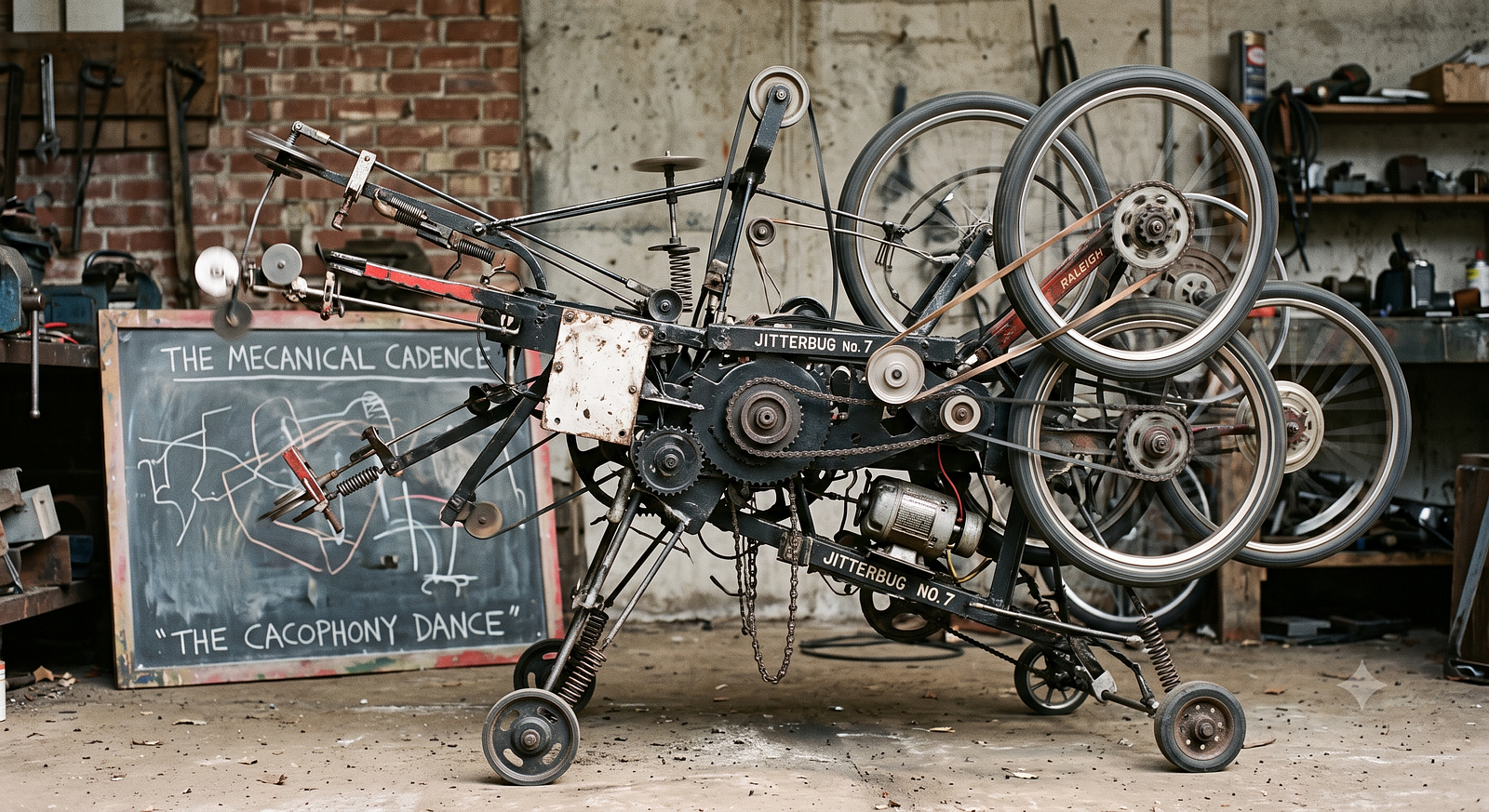
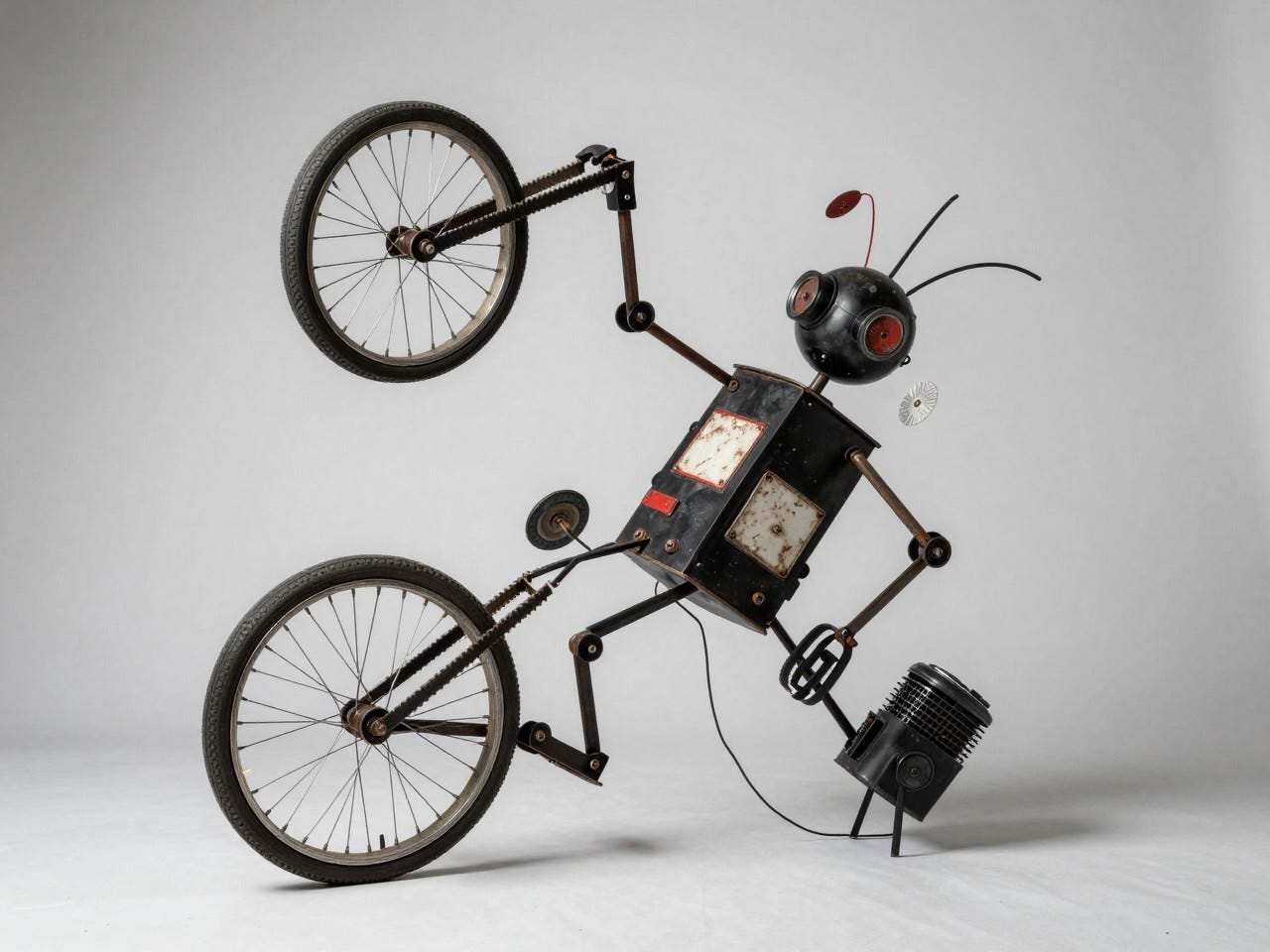
A chaotic kinetic sculpture made from blackened scrap metal, thin rods, bicycle wheels, rubber belts, dangling wires, small spinning discs, and improvised mechanical arms, arranged like a mischievous industrial creature in motion. Use a raw mid-century assemblage style with matte black metal, worn silver edges, faded red accents, dusty white panels, and uneven handmade textures. The composition should feel playful, unstable, noisy, and theatrical, with overlapping wheels, jittery shadows, exposed motors, and a sense that the whole object is about to draw, dance, cough, or collapse with comic elegance.
Video Prompt:
Begin with an extreme close-up of a small metal wheel trembling to life, then pull back as rods twitch, belts spin, wires vibrate, and a strange black scrap-metal machine begins drawing wild looping marks across a white surface. Add quick cuts of spinning bicycle wheels, clacking arms, sparks of reflected light, wobbling shadows, and sudden bursts of rhythmic motion. Let the camera orbit the machine as it jitters, scribbles, pauses, then erupts into a funny mechanical dance, ending with one final dramatic spin and a quiet dangling wire swinging in the silence.
Song recommendations:
Radioactivity — Kraftwerk
Cars — Gary Numan