Let us begin with the kind of question that sounds simple until history walks in wearing sandals, carrying a clay tablet, and asking what we mean by “country.”
What is the oldest civilized country in existence today?
The best answer, if we are talking about a continuous civilization tied to a modern country, is Egypt.
Not because Egypt has had one uninterrupted government since the beginning of time. It has not. Nobody has. Governments are like office printers: eventually they jam, scream, get replaced, and somehow still haunt the building. But Egypt has one of the strongest claims in the world to being the oldest surviving civilization still visibly connected to a modern nation.
The unification of Upper and Lower Egypt is usually placed around 3100 BCE, with King Narmer often credited as the big unifier, the ancient world’s version of “fine, everybody, same letterhead now.” The British Museum describes Egypt’s unification under one ruler at about 3100 BC, and the famous Narmer Palette is often interpreted as symbolizing that moment, though scholars wisely keep a hand on the brake pedal because ancient stone carvings are not exactly notarized PDFs.
So if the question is:
“Which modern country is most closely tied to the oldest continuous civilization?”
Egypt is the answer that strolls in calmly, points at the pyramids, and says, “I brought receipts.”
But Is “Civilized Country” the Same as “First World Country”?
Nope. Different boxes. Different labels. Different historical goblin.
“Civilized country” is not a great modern phrase because it carries a lot of old colonial baggage, the kind that shows up to dinner and explains forks to people who invented irrigation. A better phrase is ancient civilization.
A civilization usually means a complex society with things like cities, organized government, agriculture, trade, writing, social classes, religion, architecture, and someone keeping records badly enough that future historians can argue over them for 5,000 years.
“First World,” meanwhile, is a much newer phrase from the Cold War. It originally referred to countries aligned with the United States and its allies, and today people often use it loosely to mean developed, industrialized, wealthy nations with high standards of living. Investopedia gives a useful overview of the term’s Cold War origin and why “developed” or “industrialized” is usually the better wording today: First World Countries.
So here is the important part:
Egypt is one of the oldest civilizations in the world. Egypt is not usually described today as a “first world country.”
The World Bank currently describes Egypt as a lower middle-income nation, and the World Bank income classification page places Egypt in the lower-middle income category.
That does not make Egypt less historically astonishing. It just means “old civilization” and “modern high-income economy” are not the same measurement. One is about deep human history. The other is about current economics, infrastructure, institutions, and development indicators.
In other words: Egypt is old enough to have watched everybody else invent their national origin stories, but that does not automatically give it a platinum airport lounge membership.
So Who Wins If We Mean “Oldest Country,” Not “Oldest Civilization”?
Ah, now the furniture starts moving.
If you mean the oldest currently existing sovereign state with a continuous political identity, San Marino has a strong claim. UNESCO describes San Marino Historic Centre and Mount Titano as one of the world’s oldest republics and the only surviving Italian city-state.
If you mean oldest monarchy with a legendary founding date, Japan often enters the chat, though the traditional founding date of 660 BCE is wrapped in myth and ceremony, not modern documentary certainty.
If you mean ancient civilization with living cultural continuity, China, India, Iran, and Egypt all have powerful claims, depending on how you define continuity. But Egypt has that dramatic early unification date around 3100 BCE, monuments that still dominate the landscape, and a cultural memory so long it makes “last Tuesday” feel like breaking news.
So the clean answer is:
Oldest civilization tied to a country today: Egypt. Oldest surviving republic/state claim: San Marino. Oldest “first world” style developed country? That depends on definition, but Egypt is not the answer under modern economic usage.
History: where every answer comes with a trapdoor and a bibliography.
What Was Egypt Known For?
Egypt is known for the Nile, pyramids, pharaohs, hieroglyphs, temples, mummies, tomb art, astronomy, mathematics, massive stone architecture, and creating a civilization so visually iconic that a triangle plus a sunbeam still makes everybody go, “Ah yes, Egypt.”
The Nile was the magic conveyor belt. It flooded, fertilized the land, supported crops, moved goods, connected communities, and made centralized control possible. If Mesopotamia was the ancient world’s chaotic startup garage, Egypt was the highly organized river corporation with excellent branding and unusually pointy buildings.
By the Old Kingdom, Egypt had developed many of the artistic, religious, and architectural patterns that shaped pharaonic history for centuries. The Metropolitan Museum of Art’s essay on Egypt in the Old Kingdom explains how earlier concepts developed into the forms that influenced the rest of Egyptian history, including pyramid complexes, relief sculpture, royal imagery, and funerary practices.
Also, let us pause for a moment and appreciate the administrative miracle here. Egypt managed grain storage, labor organization, irrigation, taxation, construction, priesthoods, royal cults, and monumental architecture without spreadsheets. Somewhere, an ancient scribe is still muttering, “We had columns. They were just made of reeds.”
What Was Society Like Around the Founding?
Around 3100 BCE, Egypt was not a modern nation-state with passports, traffic circles, and people complaining about building permits. It was a developing centralized kingdom emerging from smaller regional cultures along the Nile.
People farmed, raised animals, traded, made pottery, buried their dead with grave goods, and gradually built more complex communities. The British Museum notes that annual Nile flooding created fertile land for crops and that advances in technology and social organization produced increasingly sophisticated material culture before unification.
Writing was appearing, too. Hieroglyphic signs developed around this broad period, first for administration. Which is deeply human. We invented writing and immediately used it for management. Humanity: still on brand.
The early state needed records because grain had to be counted, land had to be measured, offerings had to be logged, and somebody had to know who owed what to whom. Bureaucracy, basically, is older than most jokes about bureaucracy. This explains a lot.
What Was Happening in the Rest of the World?
Around Egypt’s unification, the world was busy becoming complicated.
In Mesopotamia, Sumerian city-states were growing in the land between the Tigris and Euphrates. In the Indus region, early Harappan cultures were developing toward the great urban civilization that would later produce cities like Harappa and Mohenjo-daro. In Europe, Neolithic communities were building, farming, trading, and slowly moving toward larger ritual and social structures. Stonehenge’s earliest phase was just around the corner.
No one was tweeting. Civilization still advanced anyway. Very suspicious.
The important thing is that Egypt was not alone in the ancient world, but it became one of the most durable and recognizable civilizations because geography gave it unusual stability. The Nile created a long, narrow, highly connected agricultural zone, protected by deserts on both sides and open to trade through the Mediterranean, Red Sea routes, Nubia, and the Near East.
Egypt was not isolated, but it had a natural moat, a food engine, and a river highway. That is a pretty strong starter kit.
Famous Battles and Ancient Drama
Egypt had plenty of conflict, because no civilization gets to be that old without occasionally finding itself in a Bronze Age group project where everyone brought chariots.
The earliest “unification” story around Narmer may involve conquest, symbolism, or a gradual political process dressed up in royal imagery. The Narmer Palette gives us one of the great visual clues, but it is not a simple “box score” of one battle.
Later, Egypt became a major imperial power during the New Kingdom. One of the most famous battles was the Battle of Megiddo around 1457 BCE, where Thutmose III defeated a Canaanite coalition. World History Encyclopedia has a detailed overview of Thutmose III at the Battle of Megiddo, including the daring choice to take the narrow Aruna road. That is the ancient military equivalent of saying, “The GPS says this is faster,” while everyone else in the chariot is screaming.
Then there was the Battle of Kadesh, fought between Ramses II and the Hittites in the 13th century BCE. The American Research Center in Egypt has a concise description of the Battle of Kadesh, one of the largest chariot battles of the ancient world. Ramses II claimed victory with the subtle humility of a man carving his press release into temple walls, but historians usually see the battle as more complicated, possibly a draw or a strategic disappointment.
And out of the Egyptian-Hittite rivalry came one of history’s great diplomatic artifacts: a famous peace treaty between Ramses II and the Hittite king Hattusili III. So yes, ancient Egypt gave us pyramids, mummies, and the timeless political technique of loudly declaring victory before negotiating.
What Challenges Did Egypt Face?
Egypt’s biggest challenges were the same old monsters with new costumes: climate, food, power, invasion, succession, and management.
The Nile was generous, but not perfectly obedient. Low floods could mean famine. High floods could destroy settlements. Central power could weaken. Provincial governors could become too independent. The Met notes that the end of the Old Kingdom involved several contributing factors, including decentralization, pressure from Nubian populations, and climate change.
Then came foreign powers: Hyksos rulers in northern Egypt, Nubian kingdoms, Assyrians, Persians, Greeks, Romans, Arabs, Ottomans, French and British imperial entanglements, and the modern challenges of population growth, economic reform, water pressure, regional conflict, and climate vulnerability.
This is the part school sometimes smooths over. Egypt was not just “pyramids, pharaohs, Cleopatra, quiz Friday.” It was a civilization repeatedly absorbing shocks, reinventing itself, and getting dragged through world history’s entire obstacle course.
Is This the Subject of Famous Art?
Absolutely. Ancient Egypt is basically art history’s permanent houseguest.
The Narmer Palette is one of the most important early works, because it captures royal power, symbolic unification, visual hierarchy, and political messaging in one carved slab. Smarthistory’s essay on the Palette of King Narmer explains why it is so important and also why it is difficult to interpret.
Egyptian tomb paintings, temple reliefs, colossal statues, funerary masks, and painted coffins became world-famous because they were not just decoration. They were technology for eternity. Images were meant to preserve identity, honor gods, protect the dead, and keep cosmic order from turning into a spilled junk drawer.
And modern Egypt continues to turn its ancient heritage into a global cultural force. In 2025, Egypt inaugurated the Grand Egyptian Museum near the Giza Pyramids, with AP reporting that it showcases over 50,000 artifacts and brings together the full Tutankhamun collection for the first time since the tomb’s discovery in 1922.
That is not a museum. That is a civilization flexing with climate control.
Did Other Periods Use Egypt’s Techniques?
Constantly.
Egypt’s playbook included:
Centralized administration. Count the grain, measure the land, track the labor, keep the receipts.
Monumental architecture. Build big enough and people will remember who signed the work order.
Religious legitimacy. Tie leadership to cosmic order and suddenly tax collection has incense.
Visual branding. Crowns, symbols, colors, poses, scale, animals, gods, repeated imagery. Pharaoh understood branding before marketing departments discovered beige slide decks.
Diplomacy after conflict. Fight, boast, negotiate, write the treaty, display the treaty, tell everyone it was your idea.
Later empires used versions of this constantly. Rome loved monumental architecture and state imagery. Medieval monarchies leaned on sacred kingship. Modern states use museums, memorials, parades, official portraits, infrastructure projects, national myths, and carefully staged ceremonies.
Does anyone use this playbook today?
Yes. Everyone.
Every government that builds symbolic architecture, names airports after leaders, stages national celebrations, displays military history, manages water and food systems, builds museums, negotiates alliances, or prints its symbols on currency is using at least a few pages from the ancient statecraft binder.
Egypt did not invent every page, but it wrote some very early chapters in extremely large stone font.
Things You Probably Did Not Learn in School
First, the pyramids were not built by aliens. I know. Disappointing for people who own shiny documentaries. They were built by organized human labor, engineering, logistics, and state power. Honestly, that is more impressive. Aliens would have had lasers. Egyptians had ramps, ropes, stone tools, planning, and terrifying project managers.
Second, mummification was not fully there from day one. Early burials were much simpler. The elaborate mummification culture developed over time.
Third, ancient Egyptian eyeliner was not just fashion. Smarthistory notes that dark cosmetic lines around the eyes likely helped reduce glare, like an ancient Nile Valley version of athlete eye black, except with more gods and better jewelry.
Fourth, Egyptian art stayed visually consistent for thousands of years not because artists lacked imagination, but because the rules mattered. The goal was not “paint your feelings.” The goal was “preserve order, identity, status, and eternity.” The stakes were slightly higher than choosing a couch color.
Fifth, Egypt was deeply connected to its neighbors. It traded, fought, borrowed, adapted, and influenced. Ancient civilizations were not isolated display cases. They were messy networks of goods, people, ideas, diseases, marriages, rivalries, and scribes trying to spell foreign names without weeping.
So What Is the Final Answer?
If someone asks, “What is the oldest civilized country in existence today?” the best friendly answer is:
Egypt, if we mean the modern country most closely tied to one of the oldest continuous civilizations, dating back to the unification of Upper and Lower Egypt around 3100 BCE.
If someone asks, “Is Egypt the oldest first world country?” the answer is:
No. “First world” is a modern economic and Cold War term, not the same thing as ancient civilization.
If someone asks, “Then why does Egypt matter so much?” the answer is:
Because Egypt helped show humanity how to scale society: farming, writing, kingship, religion, architecture, administration, diplomacy, visual symbolism, and national memory. It made civilization feel permanent, even though history keeps proving that nothing is permanent except paperwork and people arguing about dates.
Egypt is not the oldest modern government. It is not a “first world country” in the current economic sense. But as a civilization with a living connection to the present, it is one of humanity’s grand old monuments to organization, imagination, ambition, and the ancient urge to build something so large that future generations have to stop and say:
“Okay, that is ridiculous.”
And then take a photo.
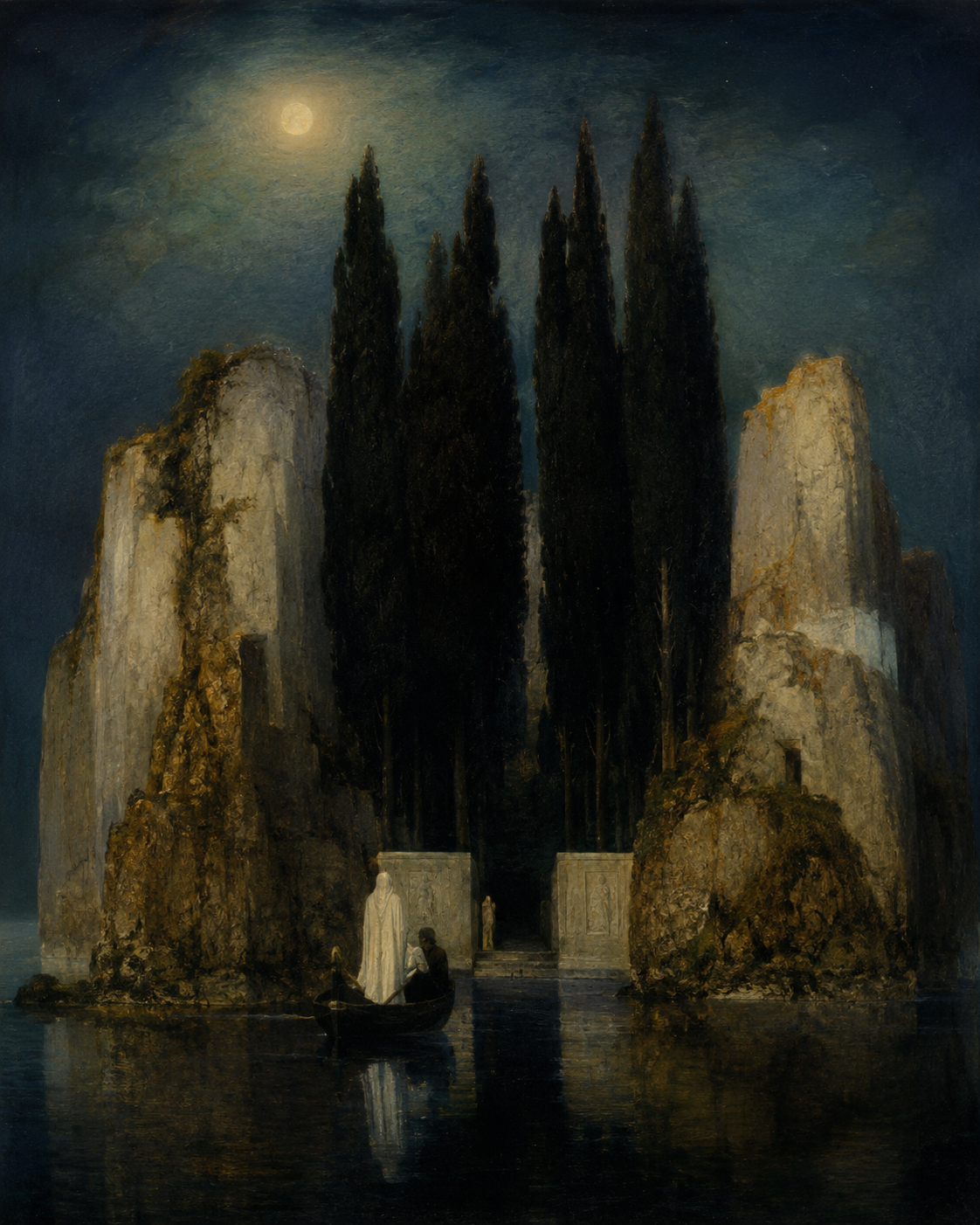
Art Prompt (Symbolism): A haunting dreamlike island rises from black mirrored water beneath a pale moon, with tall cypress trees clustered like silent guardians, sheer white cliffs glowing against a deep blue-green twilight, and a narrow boat gliding toward a shadowed stone passage. Use a solemn Symbolist mood, velvety darkness, muted ivory highlights, still reflections, dense atmospheric haze, and a mysterious composition that feels ceremonial, timeless, and quietly supernatural. The scene should have elegant vertical shapes, heavy calm, soft luminous edges, and the emotional pull of a forgotten myth whispered across water.
Video Prompt: Begin with a sharp moonlit glide over black reflective water as ripples spread in perfect rings, then surge toward a pale island where cypress trees bend and sway like silent sentinels. Let mist curl around white cliffs, stone passages brighten for a heartbeat, and the narrow boat drift forward as if pulled by invisible music. Add quick flashes of moonlight on water, drifting particles, slow-breathing shadows, sudden vertical reveals of the trees, and smooth orbiting camera moves around the island to create a hypnotic, mysterious, cinematic motion piece with a solemn dreamlike pulse.
Song Recommendations
The Funeral — Band of Horses
Sea Within a Sea — The Horrors
If this ancient-history rabbit hole made your brain put on a tiny pharaoh hat, follow along for more art, history, weird facts, and mildly overcaffeinated curiosity. And please comment: which country do you think has the strongest claim to being the oldest?