I do not buy the theory that five solid pieces suddenly wandered into a creative sinkhole and forgot how to be good.
That would be convenient, in a darkly comedic sort of way. It would let us say, “Ah yes, clearly the problem is that all at once the writing collapsed, the art lost its pulse, the topics became secretly illegal, and the reading public collectively decided that memory, Jainism, espionage, Malevich, and algorithmic efficiency were beneath them.”
That is possible in the same way it is possible that my toaster is judging me.
But it is not the most likely explanation.
The more likely explanation is much less dramatic and much more annoying: distribution is not the same thing as quality, and a quiet five-day stretch can happen even when the work is good.
Take a look at the actual lineup: Episode 9: Memory and the Machine, Episode 9: Jainism, Wilhelm Stieber, the Franco-Prussian War, and the Spectacularly Early Prototype of Modern Spy Nonsense, Episode 51: Kazimir Malevich, and Episode 8: Complexity and Efficiency.
That is not a pile of lazy leftovers. That is a buffet assembled by a curious raccoon with a library card.
So what gives?
First, yes, the platform has changed its plumbing. It now talks much more openly about selective indexing in its SEO help page, more detailed story analytics in its newer stats documentation, and distinct distribution buckets in its distribution guidelines. In plain English: publishing something does not automatically mean it gets waved through search, feeds, recommendations, and assorted algorithmic trapdoors at full volume.
That alone can make a good article look like it has been left in a coat closet.
Second, no, your SEO is probably not catastrophically bad. In fact, the weirder issue may be the opposite: some of your titles are interesting enough for humans but broad enough, long enough, or fresh enough that they are not yet getting much search traction. And the platform itself says indexing can take days to weeks, which means five days is not exactly geological time. Five days is barely enough time for the internet to notice a raccoon driving a forklift, let alone properly rank a thoughtful essay on Jain ethics.
Third, no, your writing has not obviously gone downhill. The prose is still lively, the angles are still distinct, and the titles still sound like they were written by someone who has opinions, caffeine, and a functioning sense of humor. If anything, the real risk is not “this is bad,” but “this is varied.” Variety is wonderful for a human mind and occasionally terrible for a recommendation engine that wants to put you in one tidy little box labeled Tech Guy, Art Person, History Goblin, or Spiritual Tourist.
You, inconveniently, keep bringing all four.
That does not mean nobody is interested. It means your audience may be fractured across interests, and fractured audiences do not always show up on the same day wearing nametags.
One reader wants coding fundamentals. Another wants art history. Another wants religion explained without sounding like a textbook in a necktie. Another wants 19th-century spy weirdness. These people all exist. They just do not always arrive at the same door at the same time. Sometimes you are not publishing into a void. You are publishing into five different rooms and each room is briefly pretending it did not hear the doorbell.
Also worth noting: several of these pieces are extremely fresh, and some are behind the member wall. That is not a moral failing. It just narrows the early funnel. The platform’s current earnings model also leans heavily on member reading time, engagement, outside traffic, search, and email activity, as explained in its earnings documentation. So if a post is good but not immediately surfaced, it can sit there looking suspiciously unloved while the machinery decides whether to notice it.
Which is a very elegant system, if your life goal is to make writers stare at dashboards like Victorian astronomers waiting for Mars to apologize.
There is another possibility too, and it is less flattering to the internet than to you: these topics may be good, but not all of them are impulse-click candy. “Kazimir Malevich” is catnip for the right person and complete fog to the wrong one. “Complexity and Efficiency” is gold for people who want it and wallpaper to people who are currently busy watching a duck wear shoes. This does not mean the work lacks value. It means value and instant broad appeal are not the same species.
If there is a practical lesson here, it is not “write dumber.” It is “help the right readers recognize themselves faster.”
That can mean a subtitle that sharpens the promise. It can mean a stronger opening image. It can mean a sentence near the top that tells the casual passerby why they should care before their attention span goes wandering off to admire a spoon.
It can also mean giving each piece a better external shove.
The platform now explicitly rewards outside traffic, search discovery, and email-driven reading, which is a polite way of saying: do not sit there waiting for the house to market itself. Hand the article to people. Nudge it onto other channels. Give it a clean hook. Let it breathe somewhere besides the main feed and hope the algorithm has had enough vitamins.
And no, you are almost certainly not the only person interested in these topics. Human beings have built entire civilizations out of obsessing over religion, art, history, war, philosophy, and how computers store numbers. You are standing in a very old line. The issue is not whether interest exists. The issue is whether the interested people were properly intercepted on their way to looking up chord progressions, Byzantine mosaics, or why their code suddenly throws exceptions like confetti.
If you want a visual metaphor for this whole situation, Edward Hopper’s Nighthawks feels about right: the lights are on, the work is there, the atmosphere is real, and yet somehow the street outside is acting like it has somewhere better to be.
Rude.
So here is my mildly educational, mildly sarcastic verdict.
No, five quiet days do not prove your writing fell off a cliff.
No, they do not prove your topics are worthless.
No, they do not prove nobody cares.
They mostly prove that discovery systems are moody, trust and indexing can lag, broad curiosity does not always package neatly, and early stats are often less “final judgment” and more “temporary nonsense in a trench coat.”
Keep making the work. Tighten the promise where needed. Push it externally. Watch for patterns over months, not a few haunted mornings. And remember that a dashboard can measure traffic, but it cannot measure whether a piece was worth writing.
Those are not the same thing.
Also, if anyone tells you pictures do not help, they are welcome to explain themselves to LumAIere.
If this made you laugh, nod, wince, or feel slightly less like you were publishing into a broom closet, follow along and drop a comment. Tell me which kind of pieces you want more of: art history, computer science, historical weirdness, religion, or the occasional genre-defying intellectual buffet that confuses recommendation systems but keeps life interesting.
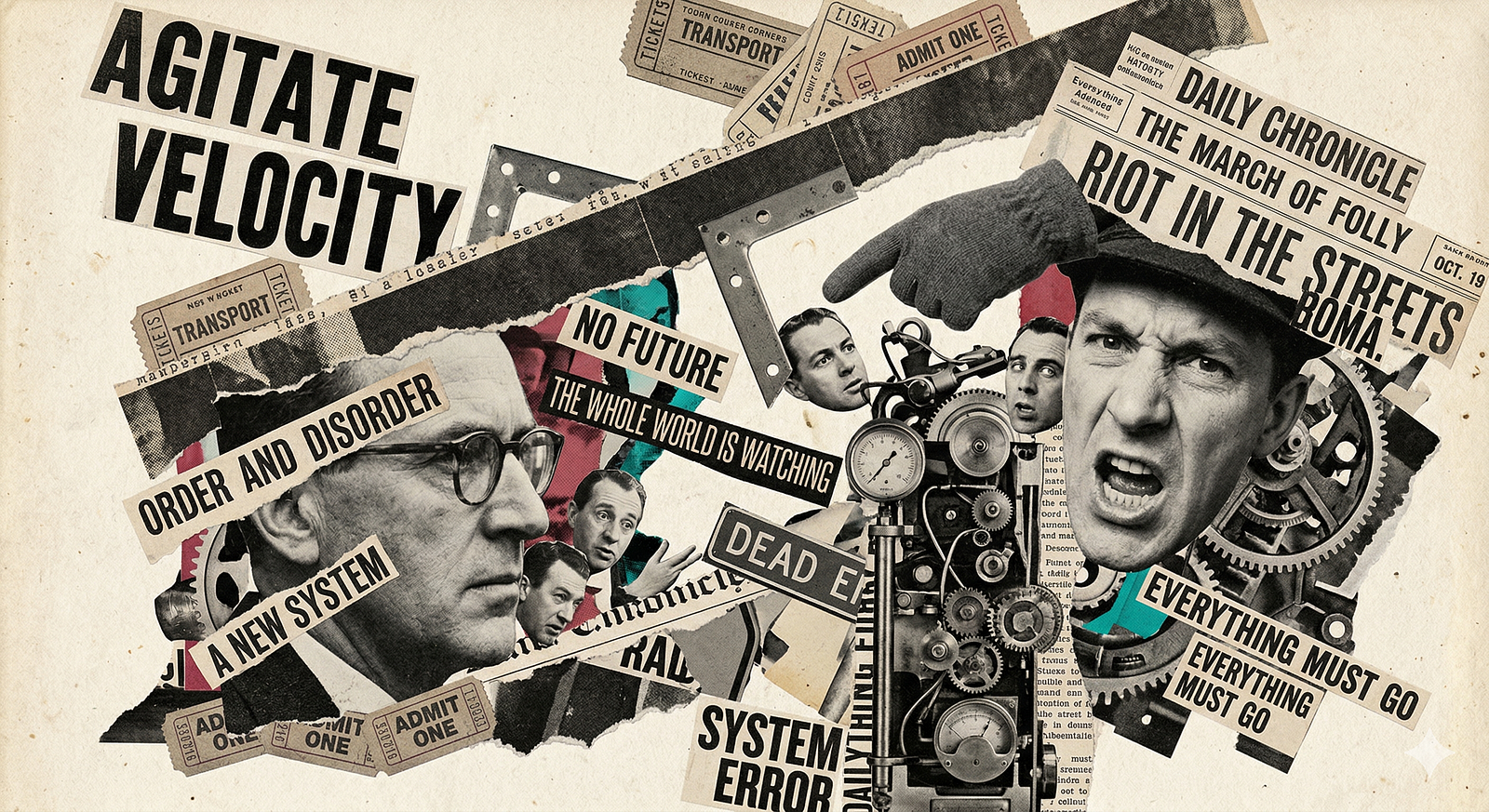
Art Prompt (Dadaism): A feverish photomontage bursting with clipped faces, machine parts, ticket stubs, newspaper fragments, gears, gloved hands, and sharp black lettering scattered across a pale paper ground. The composition should feel deliberately unruly yet expertly balanced, with diagonals slicing through the frame and overlapping fragments creating a sense of political mischief and urban velocity. Use a mostly monochrome palette of charcoal, ivory, smoke-gray, and aged newsprint beige, with tiny jolts of muted crimson and electric teal hidden among the collage pieces. The mood should be witty, anarchic, intelligent, and slightly abrasive, as if the image itself is mocking order while secretly being very good at it. Crisp cut-paper edges, layered textures, vintage print grain, sudden scale shifts, and a feeling that every fragment is mid-argument.
Video Prompt: Open with a burst of paper scraps snapping into frame from all directions, then let clipped eyes, gears, headlines, and hands assemble in rhythmic collisions. Make the motion sharp and addictive: fragments spin, slide, overlap, tear apart, and reassemble on the beat as if a rebellious collage is editing itself in real time. Use whip-fast zooms into halftone textures, type fragments, and mechanical details, then pull back to reveal the full composition before it fractures again. Add subtle flicker like old print machinery, quick shadow pops beneath the cutouts, and occasional freeze-frame moments where the collage seems to smirk at the viewer. Keep it punchy, kinetic, and hypnotic from the first second.
Songs to pair with it:
- Music for a Found Harmonium — Penguin Cafe Orchestra
- Porcelain — Moby
Follow for more art, code, history, odd questions, and stats-based existential comedy. And seriously, leave a comment: when a piece you knew was good got ignored for a while, what finally made people notice?