If you were taught the Franco-Prussian War in school at all, there is a decent chance it came to you as a blur of Bismarck, a telegram, a quick war, a collapsed French empire, and Germany suddenly showing up as a much bigger deal on the European map.
What often gets left out is that lurking behind the uniforms, artillery, and Very Serious Mustaches was one of the more slippery characters of the 19th century: Wilhelm Stieber.
And Wilhelm Stieber was not your standard battlefield hero.
He was a lawyer-turned-police operator, intelligence organizer, fixer, infiltrator, and the sort of man who makes you say, “Ah. So this is why modern states became so weirdly good at surveillance.” Britannica describes him as an aide to Bismarck who helped organize the intelligence functions of the Prussian general staff, and it credits the system under him as the first large-scale espionage organization of its kind. That is not a small footnote. That is a giant flashing sign reading: the modern intelligence state is warming up in the parking lot.
So who was Wilhelm Stieber, exactly?
Stieber was born in 1818 and started out in law before sliding into policing, political surveillance, and secret work for the Prussian state. He became closely tied to Otto von Bismarck, who was many things at once: brilliant, ruthless, patient, impatient, elegant, manipulative, and extremely committed to rearranging Europe like a man flipping furniture in a room he had grown tired of. Stieber became one of the tools Bismarck trusted when subtlety needed a trench coat. Britannica places him squarely in the rise of organized Prussian intelligence, while later intelligence commentary from the CIA’s Reading Room treats him as an early architect of modern secret-police and espionage methods.
That does not mean every legend about him is automatically true. Stieber’s own memoirs have a reputation for being colorful, and with people like this, “colorful” is often a polite historical synonym for “possibly embroidered within an inch of its life.” But even after you scrape away the swagger, the central point remains: he mattered because he helped professionalize intelligence, not just dabble in it. He was less “lone genius spy” and more “administrator of a new kind of state power,” which is somehow even creepier.
What was society like at the time?
Europe in 1870 was a giant pressure cooker wearing a waistcoat.
Nationalism was running hot. Railways, telegraphs, industrial manufacturing, and mass conscription were changing warfare from a royal hobby into something much larger, faster, and more bureaucratic. Governments were learning that if you can move troops by rail and messages by wire, you can also centralize power in ways earlier generations could only dream about. This was the age when cabinets, general staffs, newspapers, financiers, arms makers, and intelligence networks started working together in ways that feel uncannily modern.
France under Napoleon III still liked to think of itself as a major continental power, but it had problems: prestige anxiety, political fragility, and military overconfidence. Prussia, by contrast, had been getting frighteningly efficient. Under the famous triumvirate of Bismarck, Helmuth von Moltke, and Albrecht von Roon, Prussia had already beaten Austria in 1866 and was steadily moving toward German unification. By 1870, a showdown with France was less a surprise than a heavily foreshadowed season finale.
Elsewhere in the world, the United States was in Reconstruction after the Civil War, Italy was completing its own unification drama, Russia was watching Europe with interest, and Britain was doing what Britain often did best: staying out while keeping an eye on the balance of power and pretending not to enjoy the spectacle. The point is that this war did not happen in a vacuum. It happened in an era where modern nation-states were learning how to scale force, propaganda, logistics, and bureaucracy all at once.
What started the war?
Officially, the spark was the candidacy of Prince Leopold of Hohenzollern-Sigmaringen for the Spanish throne. France hated the idea of feeling boxed in by Hohenzollerns in both Prussia and Spain. Diplomacy got tense. Then came the famous Ems Dispatch, where King Wilhelm I’s encounter with the French ambassador was turned into a sharper public insult after Bismarck edited the account for release. Britannica flatly notes that Bismarck’s edited publication was designed to offend and helped precipitate war; the German Historical Institute’s documentation of the original dispatch shows how the message was transformed into political gasoline. France then declared war on July 19, 1870.
This is one of those history moments where everyone at the table is acting offended while at least one person is clearly kicking the table from underneath.
Bismarck wanted a war under favorable conditions because a French declaration would help pull the southern German states into Prussia’s camp. So yes, France declared it. But Bismarck very much helped set the emotional furniture on fire first.
Who were the main players?
On the Prussian and German side, the starring cast was Bismarck in politics, Moltke in strategy, Roon in military reform, King Wilhelm I as the monarch, and Stieber in intelligence and security. Moltke in particular was the architect of the military victories, and Britannica ties him directly to the triumphs over Denmark, Austria, and France. Stieber was not the man deciding corps maneuvers on the hilltop, but he was part of the machinery that gave Prussia better information, better internal control, and a more systematic approach to intelligence.
On the French side, you had Emperor Napoleon III, Marshal Patrice de MacMahon, and Marshal Achille Bazaine. Napoleon III wanted prestige and deterrence but ended up with catastrophe. MacMahon tried to relieve Bazaine at Metz instead of falling back to defend Paris, and Britannica is fairly blunt that the move ended in disaster at Sedan. Bazaine, meanwhile, became infamous for being trapped in Metz and later surrendering with roughly 140,000 men, an act that wrecked French morale and got him sentenced to death after the war, though the sentence was commuted.
What did they do right and wrong?
Prussia and its German allies did a lot right, which is annoying if you are France and fatal if you are studying the campaign map.
They mobilized faster, coordinated better, used railways more effectively, and had a far more competent general staff system. Moltke’s strength was not magical genius in the mythic sense. It was preparation, organization, planning, delegation, and the ability to exploit French confusion before it could solidify into recovery. Their strategic winning formula was brutally modern: fast mobilization, concentrated force, operational flexibility, and relentless follow-through.
France, meanwhile, did the historic version of showing up late to a test, having misread the syllabus, and then arguing with the proctor.
French leadership was divided. Mobilization was sloppy. Political decision-making was emotional. Strategy lurched between aggression and panic. MacMahon’s march to relieve Bazaine, instead of preserving the remaining field army for Paris, ended with the trap at Sedan. Bazaine’s withdrawal into Metz after Mars-la-Tour and Gravelotte helped the Germans achieve exactly what they wanted: pin one large French army in place while crushing the other. Britannica specifically notes Moltke’s astonishment that Bazaine did not counterattack to reopen the road to Verdun. That is one of those moments in history where your enemy is shocked you made his day this easy.
And this is where Stieber becomes interesting again. He symbolizes one of the less glamorous reasons Prussia was so effective: information. Not the romantic cloak-and-dagger kind alone, but the institutional kind. Files, informants, police intelligence, internal security, surveillance, prewar networks, and state capacity. War was not just won by cannons. It was won by systems.
What were the main battles?
The war’s military story is a parade of French misfortune with occasional scenery changes.
The major early disasters included Wissembourg, Spicheren, and Wörth in August 1870. Then came Mars-la-Tour and Gravelotte, which trapped Bazaine in Metz. After that, the truly dramatic climax arrived at Sedan on September 1, where MacMahon’s army was encircled and Napoleon III himself was captured. Britannica calls Sedan a disaster for the French and notes that MacMahon’s failure there brought down the Bonaparte dynasty. Metz then surrendered in late October, and Paris was besieged from September 1870 until January 1871.
Sedan is the battle people remember because it feels almost too symbolic. An emperor captured. An empire collapsing. A war basically decided in one giant, humiliating knot of artillery, encirclement, and bad luck compounded by bad decisions. History occasionally goes subtle. Sedan was not one of those times.
Who benefited most?
Prussia benefited the most. Then the newly unified German Empire benefited even more.
The war ended French hegemony on the continent and brought about German unification, which was proclaimed in the Hall of Mirrors at Versailles in January 1871. That single fact alone practically preloads a century of future resentment. The Treaty of Frankfurt then forced France to cede Alsace and part of Lorraine and pay an indemnity of five billion francs, while German occupation continued until the money was paid. In political terms, Bismarck got his empire. In strategic terms, Germany became the new heavyweight in continental Europe. In emotional terms, France got a national trauma with excellent long-term sequel potential.
Who made money? Arms producers, suppliers, rail interests, financiers tied to state borrowing, and everyone in the broad zone where industrial capitalism and warfare shake hands and exchange invoices. If you want one famous corporate name looming over German arms, Krupp is the obvious giant in the room, though the most famous evidence of its war-profit machine becomes overwhelming later in German history. Even without turning this into a full industrial-finance dissertation, the pattern is clear: modern war rewarded not just generals but the industrial networks behind them.
Who gained control? Bismarck, certainly. Moltke’s prestige rose. The Hohenzollern monarchy reached a new peak. The German state gained territory, money, legitimacy, and enormous confidence. A little too much confidence, if we are being honest with hindsight.

What impact did Stieber and the war have on society?
Stieber’s impact was not that he became the subject of school posters with heroic chin lighting.
His impact was structural. He helped normalize the idea that modern states should gather information systematically, watch enemies at home and abroad, infiltrate movements, and integrate intelligence into war planning. That logic did not end with him. It spread. If you enjoy modern bureaucracies only in very small, carefully monitored doses, he is one of the ancestors of your discomfort.
The war’s social consequences were enormous. France lost an empire and then lurched into the Third Republic. The humiliation of defeat, occupation, indemnity, and territorial loss fed revanchism for decades. The aftermath also helped set the stage for the Paris Commune, which Britannica explicitly places in the wake of France’s defeat and the collapse of Napoleon III’s regime. Germany, by contrast, emerged unified, triumphant, and newly convinced that war could solve foundational political problems. That lesson would age badly.
Have these strategies been repeated throughout history?
Oh, absolutely. Humanity loves a rerun.
The playbook of diplomatic provocation, media manipulation, rapid mobilization, rail-and-wire coordination, intelligence gathering, encirclement strategy, and harsh peace terms shows up again and again. The Ems Dispatch alone feels like a 19th-century ancestor of the modern move where someone edits a message just enough to turn a tense situation into a national meltdown. Same species. Older hardware.
The deeper repeated pattern is even simpler: states that combine better planning, faster logistics, tighter staff work, and more honest self-assessment tend to perform better than states powered by vanity, improvisation, and patriotic overconfidence. This was true before 1870, it was true after 1870, and it continues to be true every time someone mistakes vibes for readiness.
Is Stieber the subject of any famous art?
Not in the “beloved art-world superstar” sense.
Wilhelm Stieber himself is not especially famous as a painted icon, but the war he helped lurk around absolutely is. One notable image is Wilhelm Camphausen’s painting of Napoleon III on the battlefield at Sedan, which German History Intersections explains as part of a visual language celebrating Sedan as the origin story of the German nation. Another is Anton von Werner’s famous depiction of the proclamation of the German Empire at Versailles, which later versions turned into an even more theatrical celebration of Bismarck and empire-building. In other words, Stieber does not get the glamorous canvas treatment, but the political world he helped midwife definitely does.
Anything you probably did not learn in school?
Probably this: the war was not just a battlefield story. It was also a triumph of administration.
The Prussians did not merely fight better. They had built a state that could think in files, timetables, telegraphs, reserves, and intelligence networks. That is much less cinematic than cavalry charges, but it is usually how modern power actually works. Stieber matters because he sits right at that junction between police work, espionage, and state modernization. He is one of those figures who reminds you that history is often moved not only by kings and generals, but by the unsettlingly competent man in the back room with a ledger and a spy list.
Also, the German unification ceremony took place at Versailles, on French soil, after a war France had lost. If you were looking for a detail that practically sends a revenge plot into the future by registered mail, there it is.
References
- Britannica: Wilhelm Stieber
- Britannica: Franco-German War
- Britannica: Ems telegram
- Britannica: Battle of Sedan
- Britannica: Battles of Mars-la-Tour and Gravelotte
- Britannica: Siege of Paris (1870–71)
- Britannica: Treaty of Frankfurt
- Britannica: Achille Bazaine
- Britannica: Patrice de MacMahon
- Britannica: Helmuth von Moltke
- German History in Documents and Images: Ems Dispatch, original
- German History Intersections: Wilhelm Camphausen, Napoleon III on the Battlefield at Sedan
- German History in Documents and Images: Anton von Werner, The Proclamation of the German Empire
- CIA Reading Room: Intelligence for Naval Officers
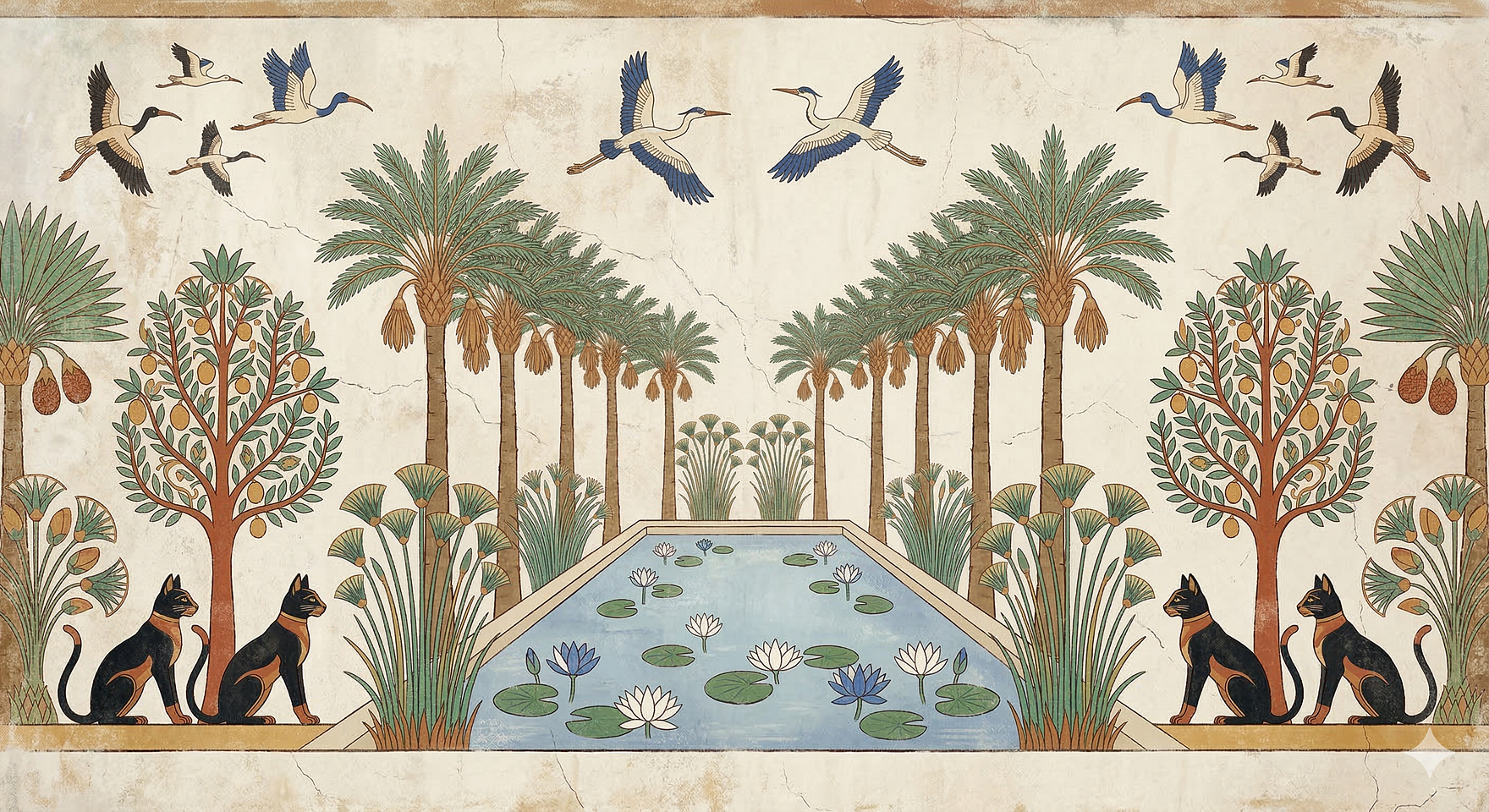
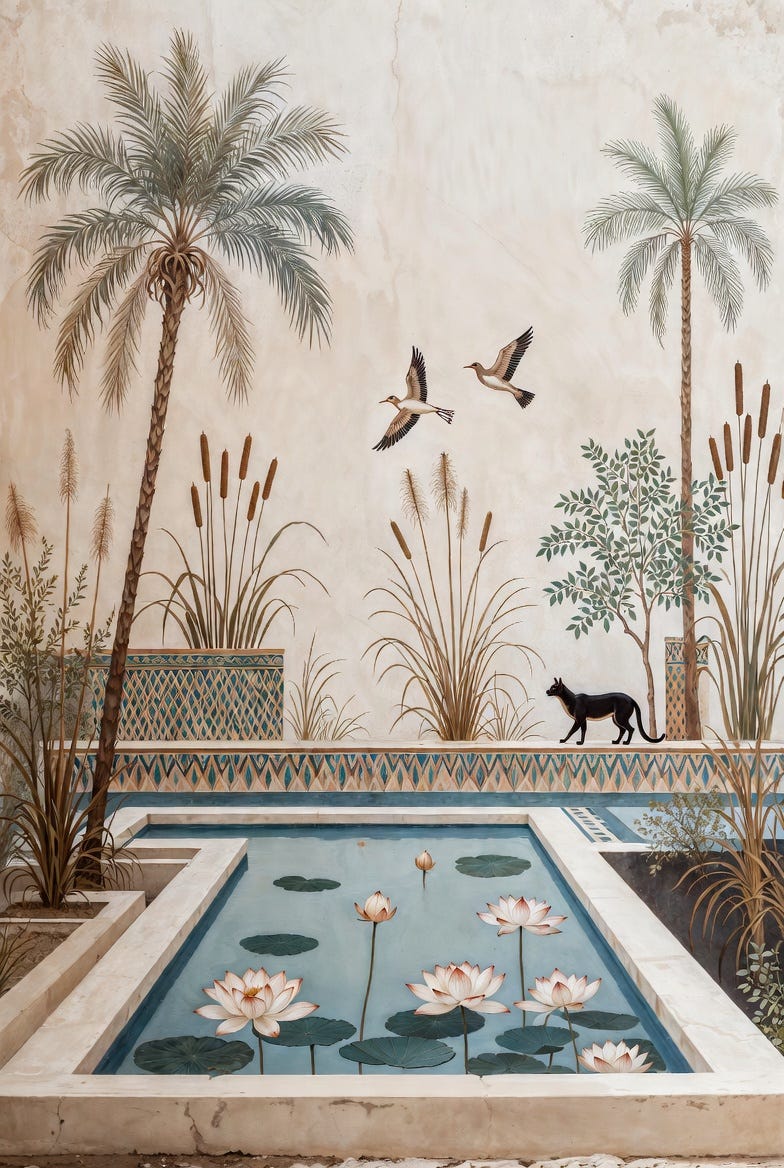
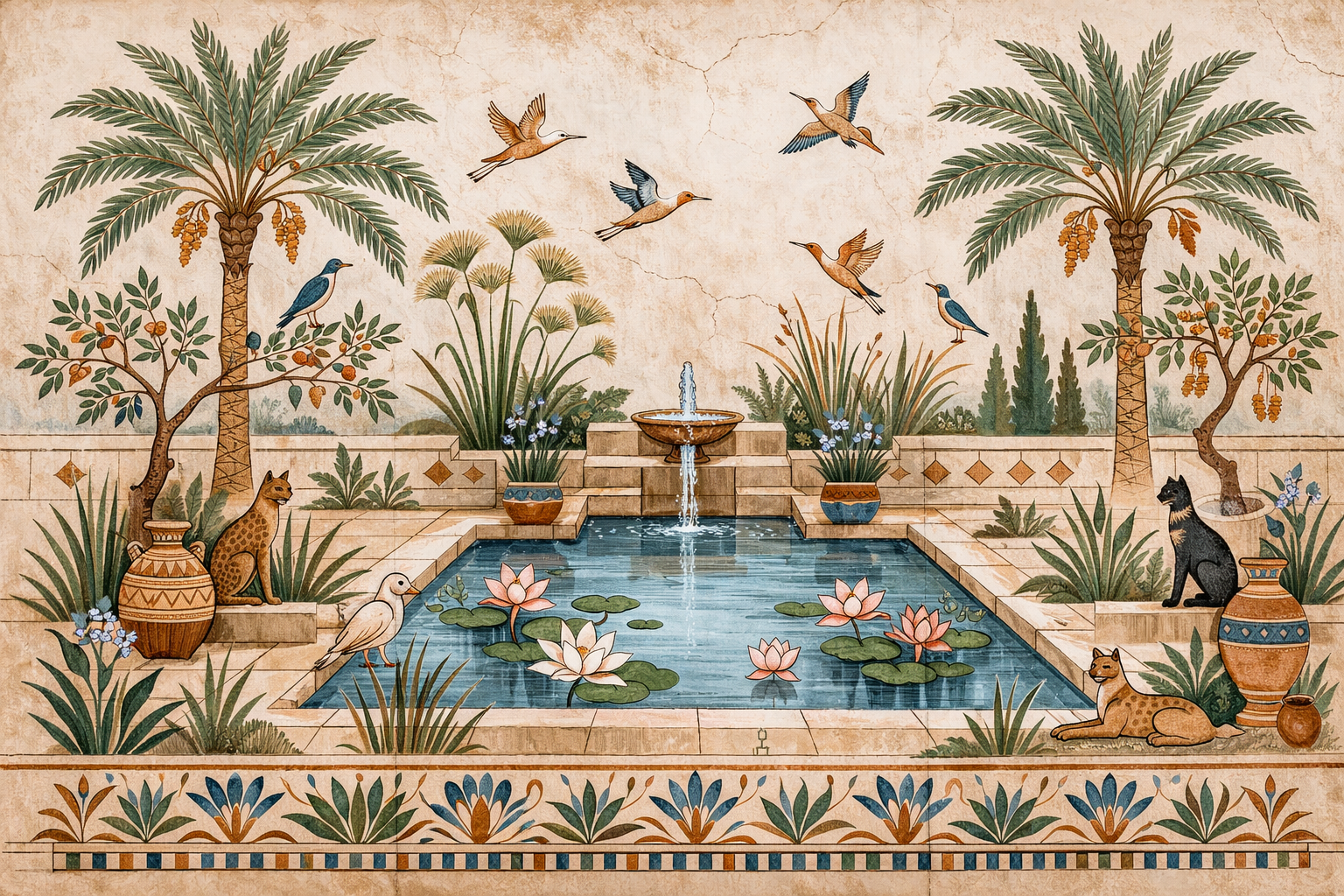
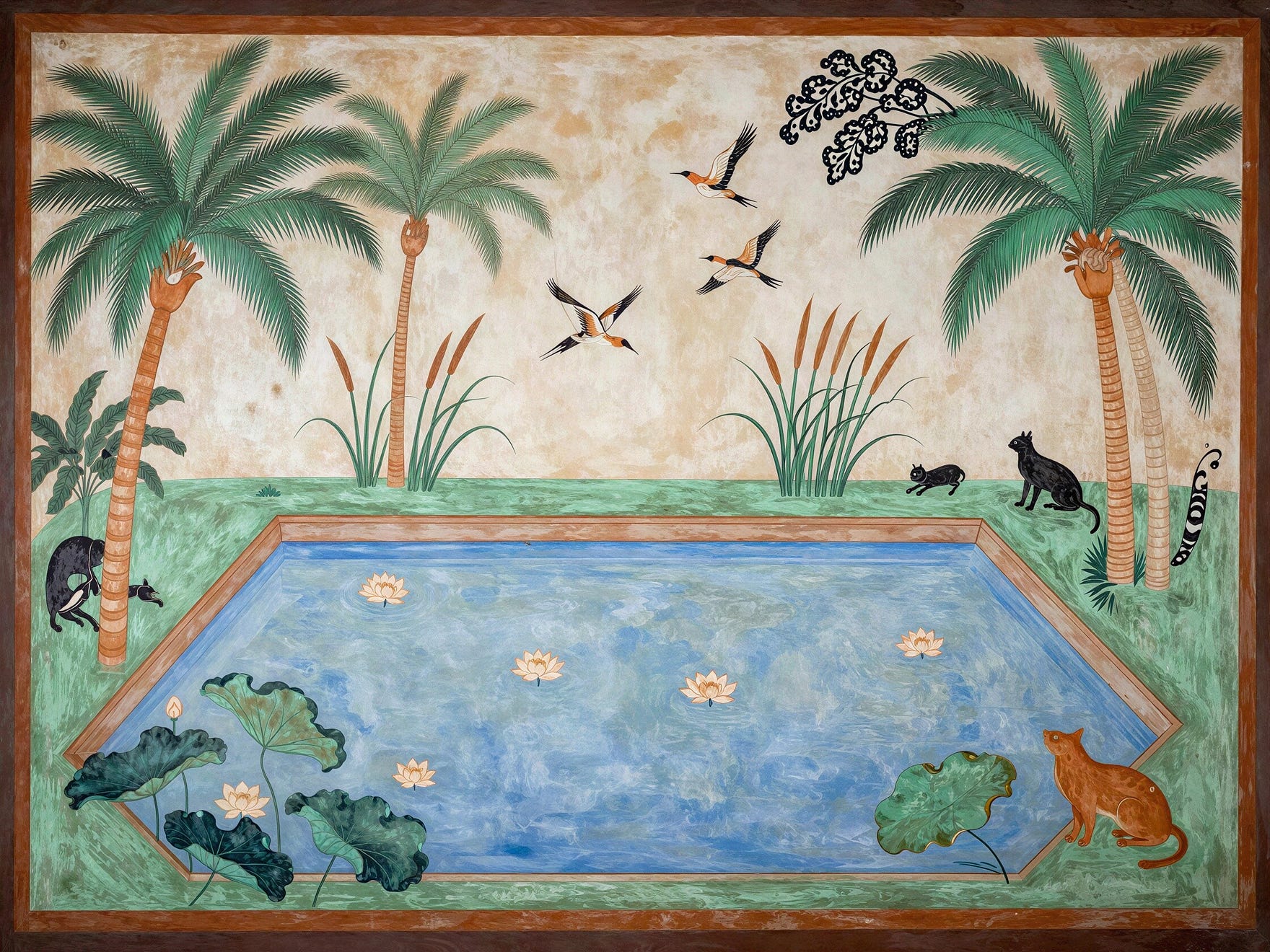
Art Prompt (Ancient Art): A serene wall painting in the style of an ancient river-civilization garden fresco: a still rectangular pool filled with pale blue water and drifting lotus blossoms, surrounded by elegant date palms, papyrus reeds, birds mid-flight, and sleek cats poised beneath patterned trees. Keep the composition formal yet lyrical, with crisp profile forms, flattened space, delicate contour lines, and decorative rhythm across the whole surface. Use a refined mineral palette of ochre, terracotta, malachite green, lapis blue, ivory, and carbon black, with matte plaster texture, faint weathering, and small hairline cracks that suggest age without damage. The mood should feel calm, ordered, luminous, and timeless, like a quiet paradise organized by someone who absolutely loved symmetry.
Video Prompt: Begin with a slow glide across an ancient painted garden wall, as if the fresco has just begun to breathe. Let lotus petals open subtly, reeds sway in a warm invisible breeze, and birds lift from the painted pool in smooth looping motion while their reflections ripple in stylized water. Add gentle camera moves that track along the formal composition, pausing on cats blinking, fish turning beneath the surface, and leaves shifting in precise decorative rhythms. Keep the plaster texture visible, with soft dust motes, faint sunlit warmth, and delicate age cracks catching light. The motion should be hypnotic, graceful, and visually catchy, turning a still sacred mural into a living dream of patterned water, birds, and garden light.
Songs to pair with it:
- Featherstone — The Paper Kites
- A Calf Born in Winter — Khruangbin
Follow for more strange corners of history, and drop a comment with the historical figure you think deserves a spotlight next: the famous one, or the suspiciously effective person standing half in shadow behind them.