Sometimes a series gets big enough that it needs a map.
Not a boring map, either. Not one of those folded glove compartment maps that immediately turns into a paper octopus and ruins your afternoon. I mean a proper table of contents. A launchpad. A historical buffet. A menu for the kind of brain feast where one minute you are looking at cave paintings, the next you are arguing with Aristotle, and somehow by dessert you are trying to decide whether Steve Jobs, Hayao Miyazaki, or Alan Turing had the better creative boss fight.
That is what this is.
The Creators Series began with one wonderfully unreasonable question:
What if we tried to follow the great creators of history from the earliest sparks of human imagination all the way into the cloud-connected, meme-powered, algorithmically caffeinated present?
A normal person would answer that question by reading a book.
Naturally, we made a twenty-part series.
Because why walk through history when you can tumble down the staircase of civilization while carrying a sketchbook, a soldering iron, a lute, a printing press, a marble chisel, and several opinions about genius?
Why This Series Exists
Creativity is not just painting pretty things, composing symphonies, inventing gadgets, or writing books that make future students mutter, “There had better be a movie version.”
Creativity is problem-solving with flair.
It is the cave artist turning a wall into a memory machine.
It is the architect staring at a pile of stone and saying, “Yes, but what if it reached the gods?”
It is the scribe copying manuscripts while wondering why future people will call this a dark age when the margins are absolutely glowing.
It is the inventor, philosopher, composer, mathematician, engineer, filmmaker, coder, and oddball who looks at the world and says, “This is nice, but I think it needs a trapdoor, a theorem, a flying machine, a better bass line, or a blue rectangle.”
The Creators Series is about those people.
Some were famous in their own time. Some died broke. Some had patrons. Some had enemies. Some had chisels. Some had ink. Some had electricity. Some had the dangerous combination of free time and confidence.
And some were anonymous, which is history’s way of saying, “We lost the receipt, but the work still slaps.”
The Complete Creators Series Table of Contents
Here is the whole series, lined up and ready for your highly sophisticated historical binge-reading session.

- The Creators Series: A Lightning Tour of History’s Greatest Geniuses The grand opening act. One dazzling creator per century, give or take a few historical traffic jams. This is the sampler platter, the genius charcuterie board, the “start here before you accidentally spend three hours reading about ancient automata” episode.
- The Genius-Stuffed Renaissance The Renaissance arrives with paint, perspective, anatomy, domes, drama, and enough talent to make every other century quietly update its resume.
- Renaissance Roster: The 1400s and the Explosion of Talent in Florence Florence becomes the creative pressure cooker of the 1400s. Art, banking, architecture, sculpture, and civic pride all get thrown into the same pot, and somehow the result is not soup. It is civilization leveling up.
- Reformation and Reimagination: The 1500s and the Power of Print The printing press turns ideas into projectiles. Suddenly thought travels faster, arguments scale better, and Europe discovers that mass communication is both amazing and wildly inconvenient for anyone trying to control the conversation.
- Baroque and Loaded: The 1600s Get Dramatic The 1600s enter wearing velvet, holding a candle, and whispering, “What if shadows were emotionally aggressive?” Caravaggio, Bernini, Rembrandt, and friends bring the drama so hard the walls need therapy.
- The Enlightened Century: 1700s Minds That Sparked Revolutions Powdered wigs, dangerous ideas, witty philosophers, musical prodigies, and people casually redesigning government while still making time for dinner parties. The Enlightenment was not subtle. It was politely explosive.
- Industrial Inspirations: 1800s Creators Who Wired the World The 1800s bring steam, electricity, evolution, science fiction, and the dawning realization that invention is fun until the machine starts asking philosophical questions.
- The Modernist Mischief of the 1900s The 20th century breaks the frame, bends the rules, questions reality, rearranges the furniture of the universe, and then calls it modernism. Picasso breaks form. Einstein breaks physics. Everyone else breaks into nervous applause.
- Digital Da Vincis: The Late 1900s and the Rise of Silicon Creators The late 1900s give us personal computers, animation revolutions, software empires, and creators who trade marble dust for microchips. The studio, lab, and garage start merging into one suspiciously caffeinated room.
- Creativity in the Cloud: The 2000s and the Age of Networked Genius Creativity goes networked. Collaboration becomes global. Memes become cultural currency. Machines become creative partners. The cloud becomes less of a weather event and more of a civilization strategy.

- Origins of Genius: Prehistoric Creators and the First Sparks of Innovation Before museums, galleries, critics, and comment sections, there were handprints, carved bones, fire, tools, and cave walls. The first creators did not have branding. They had survival, mystery, and excellent use of available surfaces.
- The Bronze Age Boom: Myth, Metal, and Monumental Minds Metal changes everything. Cities rise, myths spread, writing systems mature, and humans discover that shiny materials are extremely persuasive when combined with politics, religion, and architecture.
- Pyramids and Papyrus: Egyptian, Mesopotamian, and African Masters Geometry gets sacred. Writing gets powerful. Monumental design becomes a way to tell time, honor gods, impress neighbors, and make future engineers squint thoughtfully.
- Greek Lightning: Philosophy, Theatre, and the Birth of Science The Greeks show up with drama, philosophy, geometry, democracy, argument, tragedy, comedy, and the bold idea that thinking very hard in public could become a civilization feature.
- Rome Wasn’t Built in a Day: Empire Engineers and Cultural Crossovers Roads, aqueducts, laws, literature, logistics, concrete, conquest, and administrative paperwork. Rome understood scale. Rome also understood that if you build enough roads, eventually everyone has opinions about them.
- Creativity Without Borders: India, China, and the Ancient Inventors Who Shaped the World Zero, paper, surgery, seismoscopes, astronomy, and more. This episode reminds us that genius has never belonged to one region, one empire, or one smug guy in a toga pointing at a chalkboard.
- Illuminated Geniuses: Early Medieval Creators and Hidden Brilliance The so-called Dark Ages were not as dark as advertised. Manuscripts glowed, scholars worked, metalsmiths dazzled, and knowledge survived through patient hands and stubborn minds.
- The Islamic Golden Age: Knowledge Under the Crescent Moon Astronomy, medicine, mathematics, philosophy, optics, translation, and scholarship flourish across a vast intellectual network. It is one of history’s great reminders that knowledge loves crossroads.
- Global Threads: Ancient American, African, and Southeast Asian Creators From the Maya to Great Zimbabwe to Angkor Wat, this episode looks beyond the usual classroom highlight reel and into civilizations that built, measured, organized, and imagined at astonishing scale.
- Full Circle: What Ancient Genius Teaches Us About the Future of Creativity The finale brings the whole strange parade together. Cave walls, clay tablets, cathedrals, engines, computers, networks, and AI all start looking like chapters in one long human habit: making things because the world is not finished yet.
How to Read the Series Without Getting Historically Dizzy
You can read it in two perfectly respectable ways.
First, you can go in episode order, from the grand overview through the later deep dives. This gives you the “camera zooms in, then time folds itself into a pretzel” experience. Very cinematic. Possibly with popcorn.
Second, you can read it chronologically by subject: prehistoric creators, Bronze Age builders, ancient civilizations, Greece, Rome, India, China, medieval creators, the Islamic Golden Age, the Renaissance, the Enlightenment, the Industrial Age, modernism, digital creators, and the networked present.
Either path works.
History is not a hallway. It is more like a crowded studio full of brilliant people borrowing ideas, arguing across centuries, misplacing tools, inventing notation systems, and occasionally discovering that the thing they made to solve one problem will accidentally reshape the next thousand years.

The Big Pattern
The fun thing about studying creators across history is that the tools keep changing, but the impulse stays weirdly familiar.
Cave artists used pigment and stone.
Scribes used reeds, brushes, vellum, and terrifying amounts of patience.
Renaissance artists used oil paint, geometry, anatomy, and patrons with strong opinions.
Industrial creators used steam, electricity, lenses, wires, labs, and occasionally questionable workplace practices.
Digital creators used code, chips, pixels, networks, interfaces, and probably too much coffee.
Today’s creators use cameras, tablets, models, prompts, platforms, software, remix culture, and a global audience that can respond before you have even finished worrying whether the caption is good.
But underneath all of that is the same spark:
“Can this be better?”
“Can this be stranger?”
“Can this be more beautiful?”
“Can I make the invisible visible?”
“Can I turn this idea into something other people can feel, use, remember, argue about, or accidentally turn into a meme?”
That is the thread running through the entire series.
Not perfection.
Not fame.
Not even success.
Creation.
The messy, glorious, risky, ridiculous act of making something where previously there was only a blank wall, a silent room, a block of marble, a missing equation, an unsolved problem, or an empty page staring back with the smug confidence of a housecat.
Why It Still Matters
Studying creators is not just nostalgia with better lighting.
It is a way of understanding how civilization actually moves.
Not in a straight line. Never in a straight line. More like a squirrel with a blueprint.
Ideas get copied, stolen, improved, misunderstood, rediscovered, translated, banned, painted over, reprinted, digitized, and eventually explained in a blog post by someone who definitely should have gone to bed earlier.
Every creator in this series is part of that chain.
Some made art.
Some made tools.
Some made systems.
Some made stories.
Some made theories.
Some made trouble.
The best ones usually made more than one.
And when you zoom out far enough, you start to see that creativity is not a department. It is not just for artists, inventors, musicians, coders, writers, philosophers, or whoever at the meeting says “let’s ideate” while holding a marker like a sacred wand.
Creativity is one of humanity’s core survival strategies.
We imagine, so we adapt.
We build, so we remember.
We design, so we communicate.
We make beauty, so being alive feels like more than maintenance.
That is worth a series.
Honestly, it is probably worth twenty more.
Follow Along, Argue Politely, and Bring Snacks
If you enjoyed this table of contents, follow along for more art, history, technology, philosophy, and whatever happens when curiosity gets hold of a keyboard and refuses to let go.
Also, drop a comment: which episode should someone read first, and which creator do you think history still underrates?
Bonus points if your answer starts a friendly debate and nobody throws a marble bust.
You can also see more art at LumAIere.com.
Suggested songs for the video:
Kiara — Bonobo
Sundream — RÜFÜS DU SOL
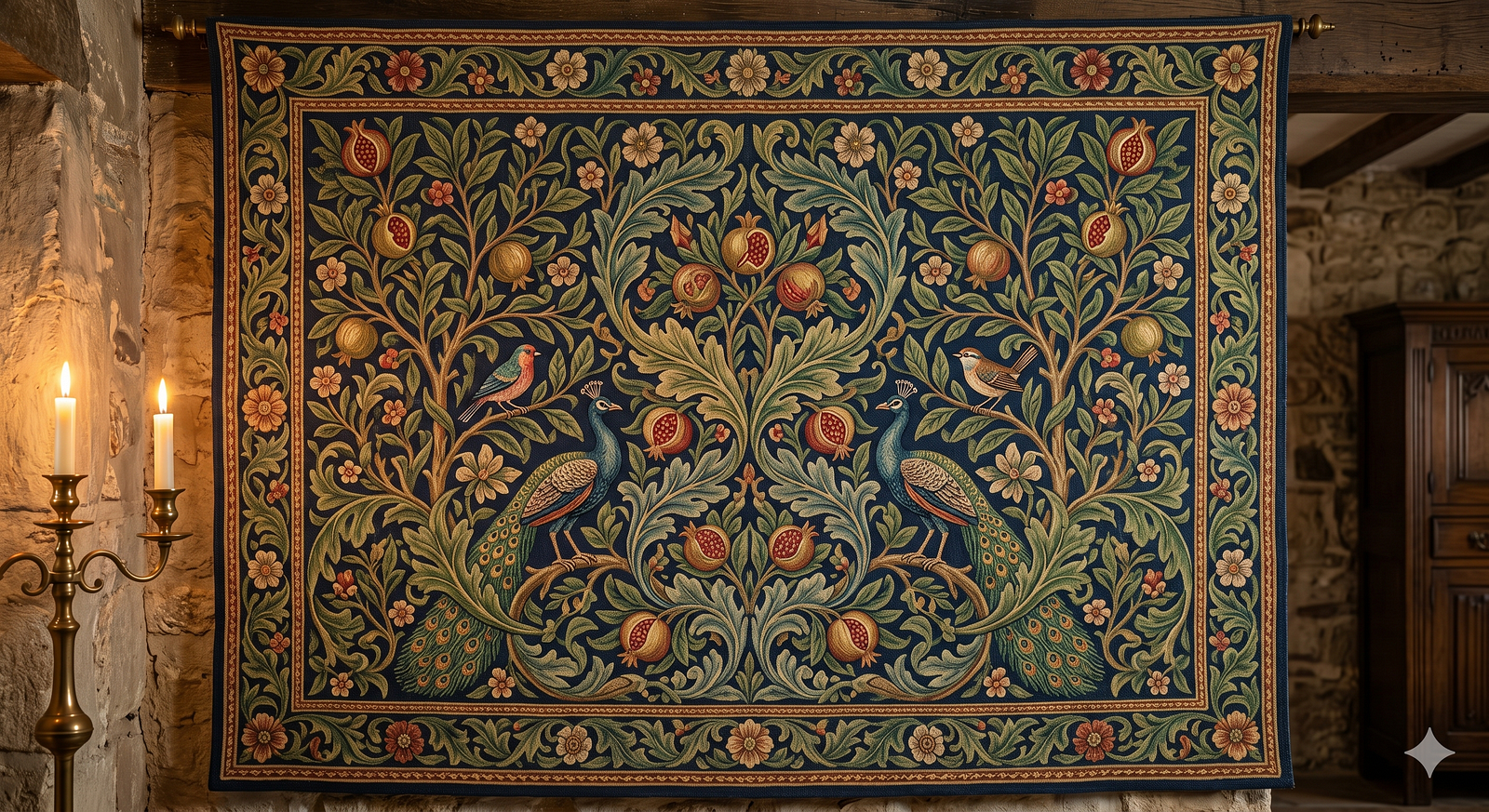
A richly woven Arts and Crafts tapestry scene with dense ornamental foliage, flowing acanthus leaves, pomegranate blossoms, deep emerald vines, and small jewel-toned birds arranged in a graceful mirrored rhythm; the composition should feel handcrafted, medievally romantic, and decorative, with flattened forms, intricate botanical patterning, warm gold, moss green, muted crimson, indigo blue, and soft cream tones; use crisp outlines, delicate textile texture, layered natural detail, and a serene enchanted mood, like a wall hanging glowing quietly in a candlelit room.

A richly woven Arts and Crafts tapestry comes alive as jewel-toned birds dart between curling vines, pomegranate blossoms unfurl in quick rhythmic bursts, and acanthus leaves ripple like embroidered waves across the frame; the camera moves with energetic, elegant reveals through mirrored botanical patterns, gliding past warm gold, moss green, muted crimson, indigo blue, and soft cream details; textile fibers shimmer subtly, decorative borders pulse in time with the motion, and the whole scene feels like a handcrafted wall hanging waking up into a graceful enchanted dance.