
If software methodologies were romantic comedies, Rapid Application Development (RAD) would be the one where everyone’s moving too fast, skipping the “getting to know you” phase, and somehow still living happily ever after. It’s fast, it’s furious, and — spoiler — it works (sometimes). Welcome to Episode 6 of our Software Development Methodology Series, where we dive into RAD: the method that treats software like it’s got a first date and a product launch on the same night.
What Is RAD?
RAD is a software development approach that emphasizes rapid prototyping and iterative delivery. Think: develop a mini-version of your software, show it to users, get feedback, tweak, repeat. It’s less “plan for a year, code for two” and more “build something this afternoon and let’s see what sticks.”
Originating in the 1980s (yes, during the era of shoulder pads and floppy disks), RAD was spearheaded by James Martin who looked at the Waterfall model and thought, “What if we just… didn’t?”
Is It Still Relevant?
Absolutely, though it doesn’t always go by the name RAD anymore. Agile and its derivatives have absorbed many RAD principles — rapid feedback, prototyping, user involvement — while adding structure and ceremonies (hi, standups). But the heart of RAD beats on in hackathons, startups, MVP culture, and that “let’s build it by Friday” energy.
Pros and Cons (Because Love Is Complicated)
Pros:
- Speed: RAD lives on tight timelines. You’re building something usable within weeks, not quarters.
- User Feedback: Since users are looped in constantly, the final product usually hits closer to what they actually need.
- Flexibility: Requirements can shift mid-project without the whole thing collapsing like a flan in a cupboard.
Cons:
- Not Great for Huge Teams: RAD thrives in small, nimble squads. Big organizations tend to swamp it with bureaucracy.
- Dependency on Users: If your users ghost you halfway through, you’re left awkwardly holding an unfinished prototype and a lot of assumptions.
- Documentation? Meh.: RAD isn’t known for detailed specs or meticulous diagrams. Great for speed, terrible when Bob leaves and takes all the project knowledge with him.

Strengths and Weaknesses
Strengths:
- Perfect for user-centric apps, prototypes, and early-stage products.
- Thrives in fast-moving industries like marketing tech, media, and SaaS.
- Great for validating ideas without a full production cycle.
Weaknesses:
- Can result in technical debt if the rapid cycles lack code quality checks.
- Risky for projects that require rigorous security, compliance, or multi-year stability.
What Is It Used For?
RAD is used when speed matters and you want user validation early. Ideal for:
- Internal tools
- Proof-of-concepts
- Startup MVPs
- Early game dev cycles
Need to build a mobile app for your sales team by next month? RAD. Want to develop the next FAA-certified avionics software? Not RAD.

A Real-Life Example?
Let’s say your marketing team wants a web app that lets customers design their own mugs. RAD means:
- You whip up a basic prototype in two days.
- Marketing plays with it, breaks it, suggests changes.
- You iterate on feedback and deploy a working version in under a month.
- MVP success! Followed by months of “what the heck is this code” if you’re not careful.
Alternatives?
- Agile: Think of Agile as RAD’s more organized sibling.
- Waterfall: The antithesis of RAD. Structured, sequential, and allergic to change.
- Extreme Programming (XP): RAD but with rules, tests, and pair programming. We’ll get there in Episode 7.
- Design Thinking: Often used in tandem, but more UX-focused.
- Prototyping-Only Models: Good for pitches, less for production.
Is It the Subject of Any Famous Art?
Only if you count whiteboard sketches and wireframes as modern art. But RAD does inspire that “move fast and scribble things” aesthetic — perfect for a startup mural.
How Popular Is It?
RAD doesn’t trend on LinkedIn, but it’s everywhere in spirit. Startups, agencies, and internal innovation teams live in RAD-mode daily.
Its golden age? Probably the late ’80s through early 2000s, before Agile rebranded all its best moves.
Companies That Use RAD the Most?
- Startups (especially pre-funding or MVP stage)
- In-house enterprise innovation labs
- Product teams at SaaS companies
- Government skunkworks projects (seriously)
Does It Work Well with AI?
Oh yes. AI development benefits from RAD’s feedback loops. When you’re fine-tuning model behavior or building human-in-the-loop systems, RAD lets you test fast, fix faster, and pivot when hallucinations start showing up in your chatbot’s poetry.
Compatible Tech Stack?
RAD is tool-agnostic. That said, it loves:
- Low-code/no-code platforms like Bubble, Retool, OutSystems
- Rapid backends like Firebase, Supabase, Django REST
- Front-end frameworks like React and Vue
- Databases you can spin up in minutes (PostgreSQL, SQLite, MongoDB)
- CI/CD tools for fast deployment
Best Tools to Use With It?
- Figma — For fast UI mockups
- Trello/Jira — For lightweight tracking
- Heroku/Vercel — For click-to-deploy bliss
- Slack — For real-time feedback loops
- ChatGPT — For prototype content, error hunting, and code scaffolding
Tidbits to Drop at Parties
- James Martin wrote a book titled Rapid Application Development in 1991. It was thicker than your average design doc and launched a thousand sprint cycles.
- RAD was the godfather of the MVP model. Long before Lean Startup, it asked, “What’s the least we can ship to prove this thing works?”
- RAD is secretly what most side projects use, even when the dev pretends they’re “doing Agile.”

Art Prompt:
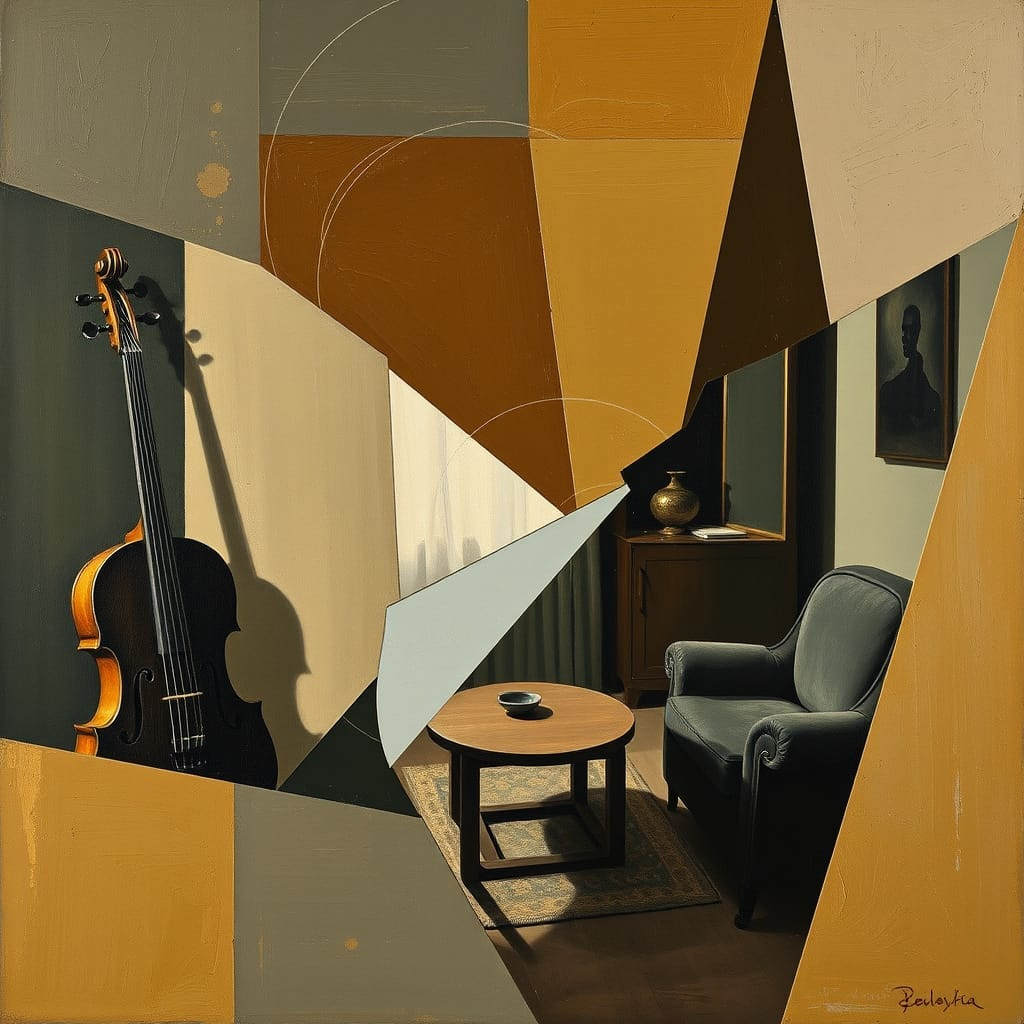
A Cubist exploration of fragmentation and abstraction inspired by Georges Braque. Angular planes intersect in muted olive, ochre, and slate hues, forming overlapping instruments and shadowed furniture in a fractured domestic interior. The composition shifts perspective across every surface, inviting the viewer to decode a world built from puzzle-like shards. The brushwork is deliberate, the palette earthy and intellectual, evoking a quiet, analytical mood.
Video Prompt:
Open with rapid cuts between fractured shapes assembling into a recognizable scene — a violin, a chair, a table — then disassemble and morph into geometric abstractions. Camera pans glide sideways, then break and pivot as the scene folds inward. Transitions slice like broken glass, with soft bursts of ochre and slate unfolding across a shifting cubist dreamscape. Pace is cerebral, elegant, and hypnotic.
Songs to Pair With the Video:
- “Alap” by Talvin Singh
- “We Move Lightly” by Dustin O’Halloran
Drop your thoughts below — have you RAD-ed something recently? Love it? Hate it? Still recovering? Let’s talk. And don’t forget to follow for Episode 7: Extreme Programming — Code Like You Mean It