
What if we told you the guy who helped invent collage as we know it also believed in painting dreams with the emotional precision of a nightmare in formalwear? Welcome to Episode 6 of the Artist Series, where we dive into the gloriously bizarre world of Max Ernst.
Let’s get one thing clear: Max Ernst was not here to paint a nice fruit bowl.
Who Is This Mad Genius?
Max Ernst (1891–1976) was a German-born artist who practically crash-landed into art history with a paintbrush in one hand and a manifesto in the other. He dabbled in Dada, perfected Surrealism, and dabbled again in frottage (which is not as naughty as it sounds — unless you’re into bark texture).
He didn’t attend formal art school, because, of course, he didn’t. He studied philosophy, psychology, and art history. When the rest of us were busy trying to pass algebra, Ernst was busy dissecting Freud and hallucinating birds.
What’s He Known For?
Birds. Automatism. Collage. Textures. Unapologetic weirdness. And an alter ego named Loplop, the Bird Superior. (Yes, seriously.)
Ernst created deeply textured dreamscapes full of ambiguous figures, haunted forests, floating eyes, and inexplicable mechanics. His work looked like the inside of a dream you might have after eating too much blue cheese.
He gave us The Elephant Celebes (1921), a mechanical elephant with a barrel for a torso and some severe emotional issues. He also gave us Two Children Are Threatened by a Nightingale (1924), which sounds like a poem, looks like a diorama, and feels like a therapy session waiting to happen.

What’s His Style?
Ernst was a technical inventor. He pioneered frottage (rubbing pencil over textured surfaces like wood or fabric), grattage (scraping paint), and decalcomania (pressing paint between surfaces). These weren’t just gimmicks — they were about inviting chance and subconscious patterns into the process. It’s like playing Pictionary with your inner demons.
His paintings could be eerie, whimsical, violent, or romantic. Sometimes all four. He was never aiming for beauty; he wanted revelation.
Who Taught Him?
Nobody really — he taught himself. But he soaked in Freud, Nietzsche, and de Chirico like a sponge. His father was a devout Catholic and an amateur painter, so young Max got plenty of early exposure to both dogma and draftsmanship. He later ditched the first and distorted the second.
Did He Collaborate?
Oh yes. He was part of the Cologne Dada group with Johannes Baargeld and Hans Arp. He tag-teamed with André Breton in Paris and helped define Surrealism’s anti-reality vibe. He worked with Paul Éluard (including living with Éluard and his wife — awkward!), and later married Peggy Guggenheim briefly before settling down with fellow Surrealist Dorothea Tanning.
Basically, if Surrealism were a garage band, Max Ernst played lead hallucination.

Was He Loaded?
Not initially. He bounced between Germany and France, was interned as an “undesirable foreigner,” and fled the Nazis. He didn’t have Guggenheim money until — well, until he literally married Peggy Guggenheim.
When Was He Most Popular?
He hit stride between the wars and really soared in the post-WWII period. His style adapted and stayed fresh while others burned out or faded. His sculpture work in the ’50s and ’60s gave him a late-career Renaissance of weirdness.

More?
Ernst had a long fascination with birds — he claimed a traumatic childhood event where his pet bird died the same day his sister was born triggered a mental association between avian life and human emotion. Hence, Loplop.
He made paintings with feathers, painted feathers with brushes, and created birdmen before Marvel made them marketable. He took automatism seriously, letting materials lead the way, long before the AI art trend made that cool again.
He was also the only Surrealist to make a film that looks like it could’ve been storyboarded by a fever dream. Look up Une semaine de bonté. Just maybe not right before bed.

Still Curious?
Art Prompt:
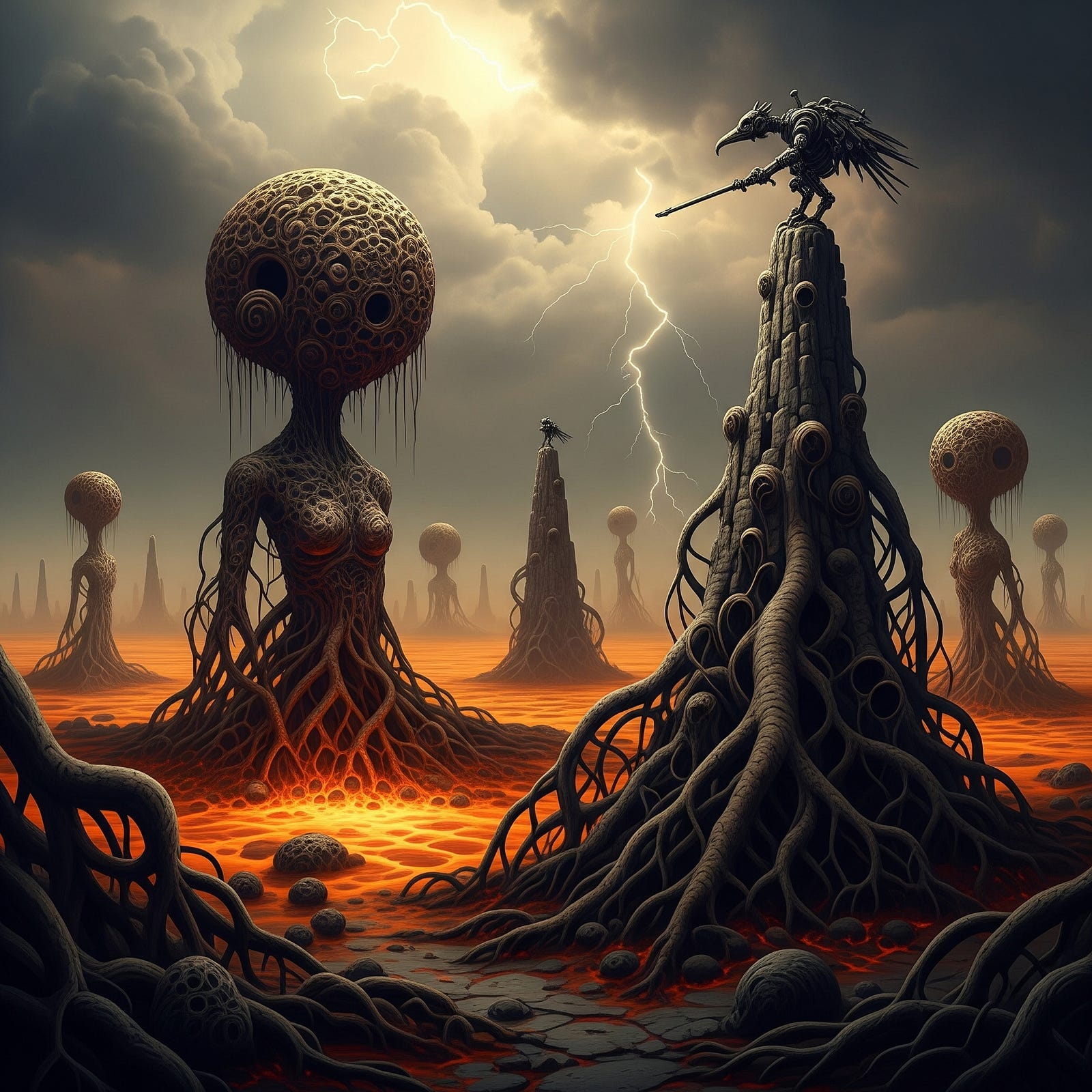
A dreamlike landscape where eerie organic forms rise like fossils from molten earth; twisted roots coil into silent humanoid silhouettes, their surfaces engraved with patterns that resemble bark, bone, and rusted metal. Above, a bruised sky crackles with distant lightning, and a birdlike figure with mechanical wings surveys the terrain from atop a stone spire. The palette shifts between ochre, lead gray, burnt sienna, and faded ultramarine. The composition is dense, layered, and surreal — every corner teeming with textural ambiguity and subconscious menace.
Video Prompt:
Start with a slow zoom into a stormy, bruised sky, then pan across a surreal, fossil-laden landscape. Animate the coiling roots subtly pulsing, birdlike machines gliding overhead, and lightning revealing humanoid silhouettes etched with bark and rust. Let the camera drift upward as the mechanical-winged figure lifts off, vanishing into electric fog.

Suggested Songs:
- Sorrow — The National
- Buried in Water — Dead Man’s Bones
Follow for more surreal dives and mind-bending art prompts. Got a favorite Max Ernst piece? Drop it in the comments.