
If some religions ask, “How should a person live well?” Jainism walks into the room and calmly replies, “First, maybe stop harming literally everything you can avoid harming.”
Which is not a small suggestion.
Jainism is one of the world’s oldest living religious traditions, and it does not do casual ethics. It does not dabble in restraint. It does not flirt with moderation and then wander off for snacks. Jain thought takes moral responsibility and stretches it far beyond the human neighborhood, into animals, insects, plants, and in classical Jain philosophy even forms of life many people would never think to notice at all.
That alone makes Jainism worth paying attention to.
If you are new to this series, the introduction is here: The Modern Religion Series: Many Paths, One Curious Human
And for the official reference you provided, here is the JainWorld site: JainWorld
So when was Jainism founded, and by whom?
This is one of those questions that sounds simple until Jainism politely refuses to fit inside it.
In Jain tradition, the religion is not usually described as something invented on a particular Tuesday by one charismatic founder with good timing. It is understood as an eternal path, rediscovered and taught in different ages by enlightened teachers called Tirthankaras. The most recent cycle includes 24 Tirthankaras, with Mahavira as the 24th and best historically documented figure. Historians generally place Mahavira in the 6th or 5th century BCE, while Jain tradition gives traditional dates of 599–527 BCE. So if you want the careful answer: Jainism is ancient, beginningless in its own self-understanding, but historically associated in its present form especially with Mahavira, while also honoring Parshvanatha before him.

Already, Jainism is making the modern habit of oversimplifying things work a little harder.
Is it growing or shrinking?
In raw numbers, the answer depends on whether you mean globally or specifically in India, where the overwhelming majority of Jains live.
India’s 2011 census counted 4,451,753 Jains, about 0.4% of the population, and studies based on census data have noted that Jain population growth from 2001 to 2011 was only 5.4%, the lowest among India’s major religious communities. Pew has also highlighted how small the Jain community is within India’s overall population. That suggests slow growth in absolute numbers, but relative shrinkage as a share of the population.
Popularity is not quite the same question as population. A religion can remain small while becoming more visible, more studied, or more culturally influential. Jainism seems to fit that second category rather well. It is not a mass-expansion religion, but its ideas about nonviolence, vegetarianism, ecology, restraint, and plural viewpoints have become more widely discussed than its demographic size alone would suggest.
So, no, “numbers” and “popularity” are not exactly the same question. One counts bodies. The other measures visibility, influence, curiosity, and cultural reach. Those can move together, but they do not have to.
What are the core tenets?
If Jainism had a giant neon sign over the entrance, it would probably say: be careful, everything matters.
A few core ideas show up again and again:
Ahimsa — nonviolence, and not in the casual “be nice” sense. This is the centerpiece. Avoid harm to living beings as far as possible.
Aparigraha — non-possessiveness or non-attachment. Own less. Cling less. Be less ruled by appetite, greed, and accumulation.
Satya — truthfulness.
Asteya — non-stealing.
Brahmacharya — chastity or disciplined control of desire, interpreted differently for monastics and laypeople.
There is also the famous Jain emphasis on the three jewels: right faith, right knowledge, and right conduct.
One compact scriptural statement puts it this way:
“Right faith, right knowledge, and right conduct, together, constitute the path to liberation.” Tattvartha Sutra 1.1, attributed to Umasvati/Umasvami, c. 2nd-5th century CE.
And because Jainism likes to raise the moral bar until your excuses quietly leave the building, here is another classic line:
“All breathing, existing, living, sentient creatures should not be slain, nor treated with violence, nor abused, nor tormented, nor driven away.” Acaranga Sutra 1.4.1, in Hermann Jacobi’s 1884 English translation, Jaina Sutras, Part I, p. 36.
That is not vague. That is not symbolic fluff. That is a moral alarm bell with a very long echo.
How does Jainism portray God, the divine, divinities, or the infinite?
Jainism is not a creator-God religion in the usual Abrahamic sense. It does not center everything on one supreme divine being who creates and governs the universe. Instead, Jain thought describes an eternal universe operating through its own realities, with souls moving through cycles of karma and rebirth.
That does not mean Jainism is spiritually empty or allergic to reverence. Quite the opposite. It reveres liberated beings, especially the Tirthankaras, who are honored as perfected teachers and exemplars. But they are not creators who run the cosmos like celestial middle management. They are beings who have overcome karmic bondage and shown the path to liberation.
So if someone asks, “Does Jainism believe in God?” the careful answer is: not in the standard creator-God sense, but very much in a structured spiritual universe, liberated souls, karma, and the possibility of ultimate release.
In other words, Jainism is not short on transcendence. It just organizes it differently.
How has Jainism benefited individuals?

Many Jains would say the tradition offers a disciplined moral framework that gives life clarity, structure, and purpose. Its practices encourage self-restraint, honesty, compassion, mindfulness in consumption, and responsibility for one’s actions. That can be deeply stabilizing for individuals who want an ethics system that does not shrug and say, “Close enough.”
Jainism also offers a serious spiritual psychology. It treats anger, pride, deceit, greed, and attachment not as cute personality quirks but as obstacles that cloud the soul. For some people, that kind of uncompromising moral map is not oppressive. It is clarifying.
And yes, occasionally a tradition’s benefit is simply this: it makes a person pause before doing something cruel, selfish, or stupid. Humanity has never had a dangerous oversupply of that pause.
How has it benefited families?
Jain family life has often been shaped by disciplined habits around food, ethics, charity, self-control, community ties, and ritual observance. Vegetarianism, fasting, care in speech, and generosity are not just abstract principles floating over the dinner table like decorative smoke. They are often built into daily life.
That can create strong intergenerational continuity. Families hand down not only beliefs, but practices: what to eat, what not to kill, how to give, how to restrain appetite, how to think about consequences.
Of course, high-discipline traditions can also create pressure. That is true of almost any religion with standards higher than “try not to be a menace.” But as a family system, Jainism has often offered coherence, continuity, and a strong ethic of mutual responsibility.
What benefits has it created in society?
Jain communities have long been associated with philanthropy, education, temple building, animal welfare, community institutions, and charitable giving. One especially visible expression of Jain compassion is the panjrapole, animal shelters that care for sick, abandoned, elderly, or vulnerable animals. That is what happens when a theology of nonviolence gets tired of staying theoretical.
Jain influence on broader Indian society has also been significant out of proportion to its small size. Jain commitments to vegetarianism, nonviolence, and restraint helped shape ethical conversations far beyond Jain communities themselves. Gandhi was not a Jain, but he operated in a world deeply touched by traditions of ahimsa that Jainism had preserved with unusual intensity.
This is one of Jainism’s recurring tricks: remain small, but leave fingerprints everywhere.
How has it benefited the human race?
That depends on how grandly you want to talk before your coffee gets cold.
At a modest and defensible level, Jainism has contributed one of humanity’s strongest religious arguments for nonviolence, compassion toward animals, disciplined consumption, and moral accountability. In an age where people can industrialize cruelty before lunch and call it efficiency by dinner, a tradition insisting that harm matters at every scale is not a relic. It is a challenge.
Jainism has also preserved a profound critique of possessiveness. That alone feels unusually current. The modern world is very good at wanting more things, faster, louder, and with free shipping. Jainism is one of the traditions standing off to the side, eyebrow raised, asking whether all that grabbing is actually helping.
How has it benefited all living things?
This is where Jainism gets especially distinctive.
Many religions tell humans to be good to other humans. Jainism extends concern much farther. It treats life as morally significant across species and forms. That has encouraged vegetarian practices, compassion toward animals, and an ethic of caution around harm that is unusually wide in scope.
No, Jainism did not single-handedly save every goat, pigeon, beetle, cow, and nervous household spider. But as a religious tradition, it has probably done more than most to insist that nonhuman life is not just scenery for human ambition.
That is not a small civilizational contribution.
How has it benefited the physical universe?
Here honesty matters.
A religion does not “benefit the physical universe” in the sense of improving galaxies, upgrading Saturn, or giving the Andromeda spiral a better user interface. The universe appears to be doing its own thing with admirable indifference.
But Jainism does encourage a way of living that can reduce harm within the living world: less violence, less consumption, less careless destruction, more reverence toward life. That can benefit ecosystems, animals, and human social life in tangible ways.
So the careful answer is: not the universe as a whole in any measurable cosmic sense, but certainly the moral treatment of living beings within the world humans inhabit.
How has it benefited people spiritually?
Jainism offers a path aimed at liberation from karmic bondage. Spiritually, that means the tradition is not mainly trying to make you feel vaguely inspired on alternate Thursdays. It is trying to transform the condition of the soul.
The path is demanding. It asks for discipline, detachment, ethical rigor, and a willingness to question your own appetites. For people drawn to that seriousness, Jainism can provide a deeply coherent spiritual structure: one that links action, intention, consequence, and liberation with almost mathematical firmness.
It is a religion for people who suspect that the soul is not improved by endless excuses.
Has Jainism undergone persecution or discrimination?
Yes.
Historically, Jain communities experienced periods of persecution, loss of patronage, temple destruction, and political marginalization, especially during major shifts in power in the Indian subcontinent. Britannica notes that Jain communities faced persecution and the destruction of important shrines, particularly during periods of medieval political upheaval.
In more modern settings, the story is usually less about mass persecution and more about minority status, legal recognition, visibility, and occasional disputes over whether Jainism is treated distinctly enough rather than being casually folded into broader categories. In India, the Jain community was officially notified as a minority community by the central government in 2014.
So the historical record includes real hardship, but also remarkable resilience.
What conflicts or tensions have resulted around it?
Some tensions are external: political upheaval, temple destruction, minority-status disputes, and the ordinary difficulties that come with being a very small religious community in a very large, noisy country.
Some are internal: sectarian differences, especially between Digambara and Shvetambara traditions; debates over practice, monastic discipline, images, scripture, and questions such as whether women can achieve liberation directly in this life within certain theological frameworks.
And some tensions are simply the result of trying to live by extremely demanding principles in an extremely non-demanding world. Strict nonviolence sounds noble until you remember that ordinary life is basically a parade of consequences. Jainism does not erase that tension. It lives in it.
Any famous works of art related to Jainism?
Quite a lot, actually.
The Kalpa-sutra became the basis for some of the most beautiful illuminated manuscript traditions in South Asia. The Metropolitan Museum of Art has highlighted fifteenth-century Jain manuscript painting as a major artistic tradition, including richly colored folios with gold and lapis details.
Then there is architecture.
The Dilwara Temples at Mount Abu are famous for marble carving so intricate it can make modern stone look like it gave up halfway through. The Ranakpur Jain Temple is another masterpiece of sacred architecture. And the colossal Gommateshwara Bahubali statue at Shravanabelagola is one of the most famous Jain sculptures in the world, because apparently subtlety is not the only sacred aesthetic available.
Jainism has also contributed a tremendous literature of philosophy, ethics, cosmology, commentary, and devotional writing. So if you came looking for art and thought this tradition might be all austerity and no visual drama, surprise: the marble has been busy.
Any other interesting tidbits?
A few.
Jainism’s motto is often given through the line “Parasparopagraho Jivanam” from the Tattvartha Sutra 5.21, commonly rendered as “The function of souls is to help one another.” That is an astonishingly compact sentence. It is also the kind of sentence humanity should probably tape to several governments, a few boardrooms, and the internet.
Jains are also widely known for strong commitments to vegetarianism. Pew reported that 92% of Jains in India describe themselves as vegetarian, which is far above the national average.
And Jain philosophy includes anekantavada, often described as the doctrine of many-sidedness: the idea that reality is complex and that any single viewpoint is partial. Which is a wonderfully humbling idea in an era where everyone would like their half-formed opinion to arrive dressed as absolute truth.
So what do we do with all this?
Jainism is small in numbers, large in moral ambition, and almost suspiciously unwilling to let humans pretend their choices do not matter.
It asks difficult questions.
How much harm are you causing just by moving through the world carelessly? How much of your life is built on appetite? How much of what you call success is really just attachment in a nice jacket? And how often do you excuse violence because it is convenient, normal, profitable, traditional, or hidden behind ten layers of distance?
Those are not comfortable questions. Jainism was not built to be comfortable.
It was built to be serious.
And whether or not one shares its theology, there is something bracing about a tradition that looks at the living world and says, with a straight face and enormous discipline, “Try harder not to harm it.”
Follow for more episodes in the religion series, and drop a comment: which part of Jainism surprised you most, the radical nonviolence, the philosophical subtlety, or the fact that one of the world’s smallest religious communities has had such an outsized ethical impact?
References:
- JainWorld
- Encyclopaedia Britannica: Jainism
- Pew Research: 6 facts about Jains in India
- Pew Research: Population growth and religious composition in India
- Government of India Gazette Notification on Jain minority status
- Metropolitan Museum of Art: Jain Manuscript Painting

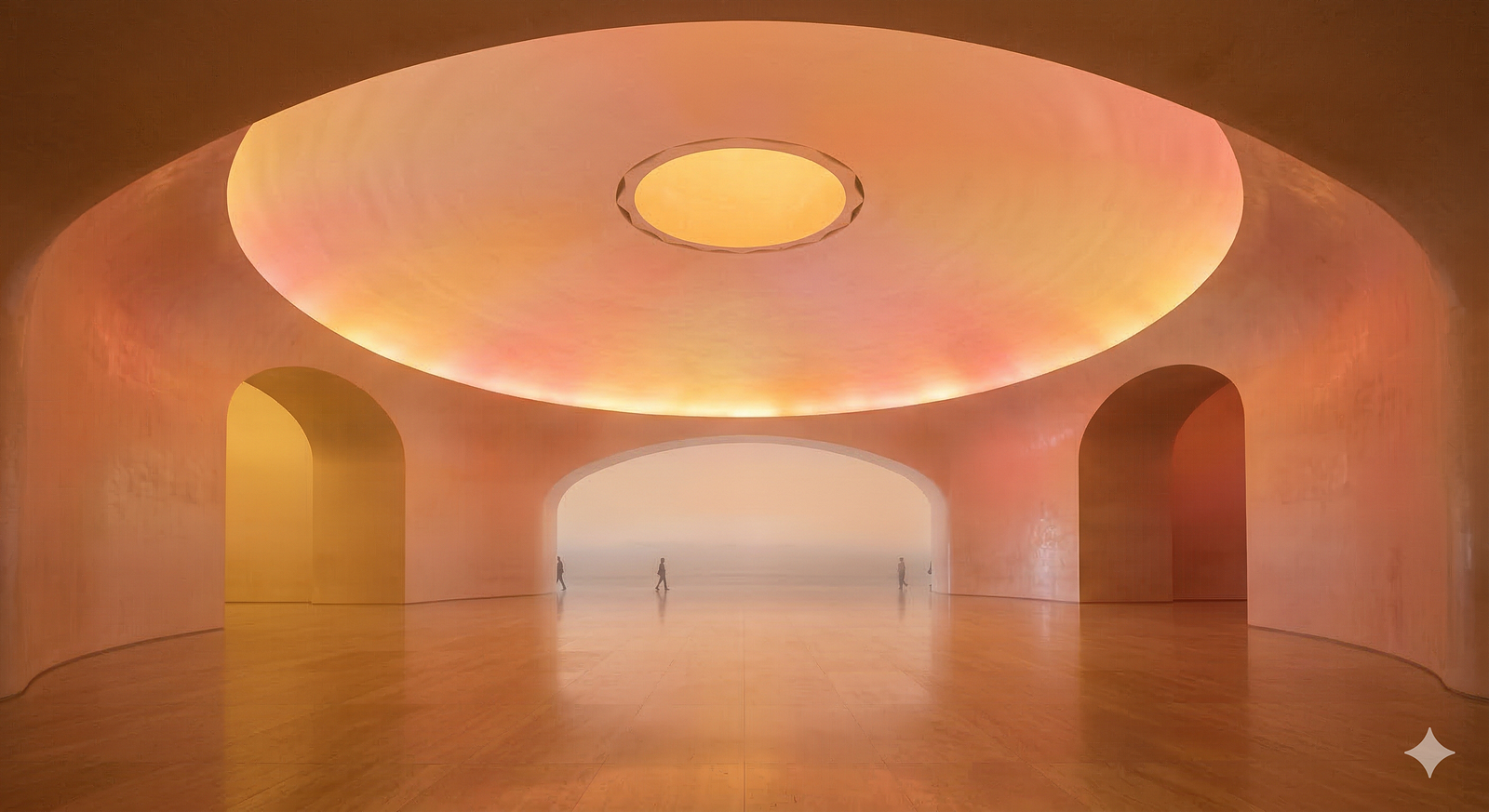
Art Prompt (Conceptual Light): A vast interior transformed into a luminous chamber of perception, where the ceiling seems to dissolve into an endless field of radiant amber and rose-gold light. The architecture is minimal and monumental: clean lines, soft edges, and a barely visible horizon where walls melt into atmosphere. Color should feel immersive rather than painted, shifting from warm saffron to blush coral and pale honey with velvety gradients so smooth they seem almost supernatural. The space is nearly empty except for a subtle geometric opening above, turning light itself into the main subject. The mood is contemplative, hushed, transcendent, and slightly unreal, as if the room has become a threshold between physical space and pure sensation.
Video Prompt: Open with darkness and a thin band of glowing amber at the top of the frame, then slowly reveal a monumental interior as the light blooms outward and downward in seamless gradients. Let the camera drift forward with gentle, floating motion, as if pulled into the space by the glow itself. Add subtle atmospheric haze so the light feels tangible, with color gradually shifting from saffron to blush coral to pale gold. Introduce slow, mesmerizing changes in brightness that make the room seem alive and breathing. Keep motion elegant and hypnotic: long glides, soft tilts upward toward the luminous opening, and a final lingering hold where the viewer feels suspended inside light rather than merely looking at it.
Two songs to pair with it:
- Kusanagi — ODESZA
- Porcelain — Moby
Follow for more, and leave a comment with the next religion you want explored.