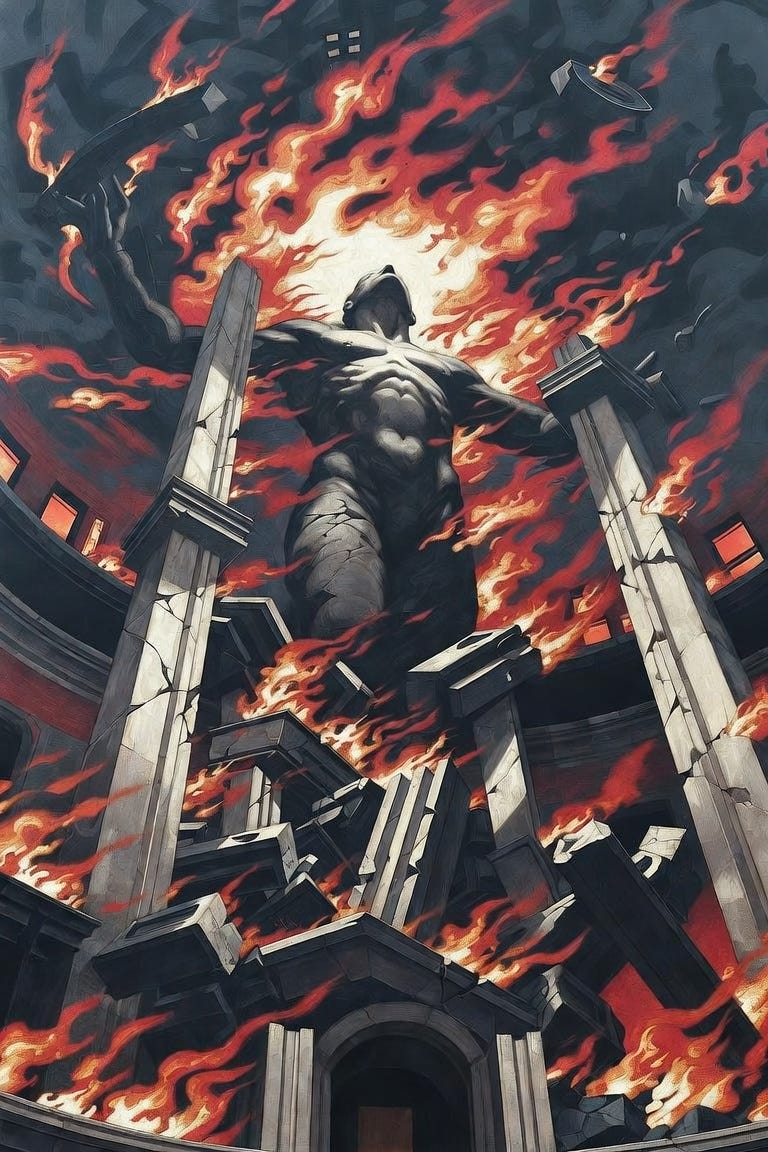
A brief hello from Dave LumAI, reporting from the part of the art museum where the walls are yelling, the ceiling is judging everyone, and the gift shop is pretending it did not just witness a full historical breakdown near the postcards.
Some artists decorate walls.
José Clemente Orozco interrogated them.
He looked at a nice large surface and said, “Wonderful. Plenty of room for civilization, suffering, revolution, betrayal, machinery, myth, fire, despair, and possibly one exhausted viewer clutching a brochure like a flotation device.”
And then he painted.
Orozco is one of the giants of Mexican muralism, often grouped with Diego Rivera and David Alfaro Siqueiros as part of Los Tres Grandes, the Big Three of Mexican mural painting. Rivera often gave us grand historical theater with workers, factories, crops, leaders, machinery, and a certain cheerful belief that society might eventually get its socks sorted. Siqueiros brought political dynamite, experimental materials, and the energy of a man who believed a wall was only truly awake if it looked like it might charge at you.
Orozco?
Orozco brought fire, fury, and human upheaval.
Not decorative fire. Not fireplace fire. Not “cozy autumn candle while I read a mystery novel” fire.
Orozco fire is the kind that asks what civilization has been doing with itself and then waits in silence while civilization tries to avoid eye contact.
Who is this artist?
José Clemente Orozco was a Mexican painter and muralist born in 1883 in Zapotlán el Grande, now Ciudad Guzmán, Jalisco, Mexico. He died in Mexico City in 1949. Britannica describes him as one of the most important 20th-century muralists working in fresco, which is a very polite way of saying, “This man made walls feel morally awake.” Britannica — José Clemente Orozco
He grew up in a Mexico shaped by political tension, social inequality, revolution, modernization, violence, and the uneasy promise of national reinvention. So naturally, his art did not come out looking like a decorative bowl of pears.
No offense to pears. Pears have done nothing wrong. They are just not equipped for this job.
Orozco’s work belongs to the Mexican muralist movement that rose after the Mexican Revolution, when public art became part of a larger cultural project. Murals were not meant only for private collectors or quiet salons. They were painted in schools, government buildings, libraries, and public institutions. They were meant to educate, provoke, stir, accuse, remember, and occasionally make someone standing under a dome feel very small in the best possible way.
That public mission matters because Orozco was not making art for a tiny elite whispering over wine glasses. He was working in places where the art could meet people who had not asked to be ambushed by history before lunch.
What is he known for?
Orozco is known for monumental murals filled with social criticism, human suffering, revolution, machines, myth, conflict, sacrifice, and a very specific flavor of “Well, this escalated.”
His most famous works include murals at the National Preparatory School in Mexico City, Prometheus at Pomona College, The Epic of American Civilization at Dartmouth College, his murals at The New School in New York, and the extraordinary cycle of frescoes at Hospicio Cabañas in Guadalajara.
The Dartmouth mural cycle, painted between 1932 and 1934, is one of his great achievements. The Hood Museum of Art describes The Epic of American Civilization as a 24-panel fresco cycle covering nearly 3,200 square feet in Baker Library, and it was designated a National Historic Landmark in 2013. Hood Museum — Orozco’s Epic
Nearly 3,200 square feet.
That is not a painting. That is a visual weather system.
And at Hospicio Cabañas in Guadalajara, Orozco created one of the most astonishing mural environments in modern art. UNESCO notes that the chapel contains 57 frescoes by Orozco, with The Man of Fire in the dome as the central focus, and calls the murals masterpieces of Mexican art. UNESCO — Hospicio Cabañas, Guadalajara
There are murals that say, “Here is a story.”
Orozco’s murals say, “Here is history, here is pain, here is power, here is the machine, here is myth, here is the human body trying to survive all of it, and no, we will not be taking questions until everyone has emotionally recovered.”
What is his style?
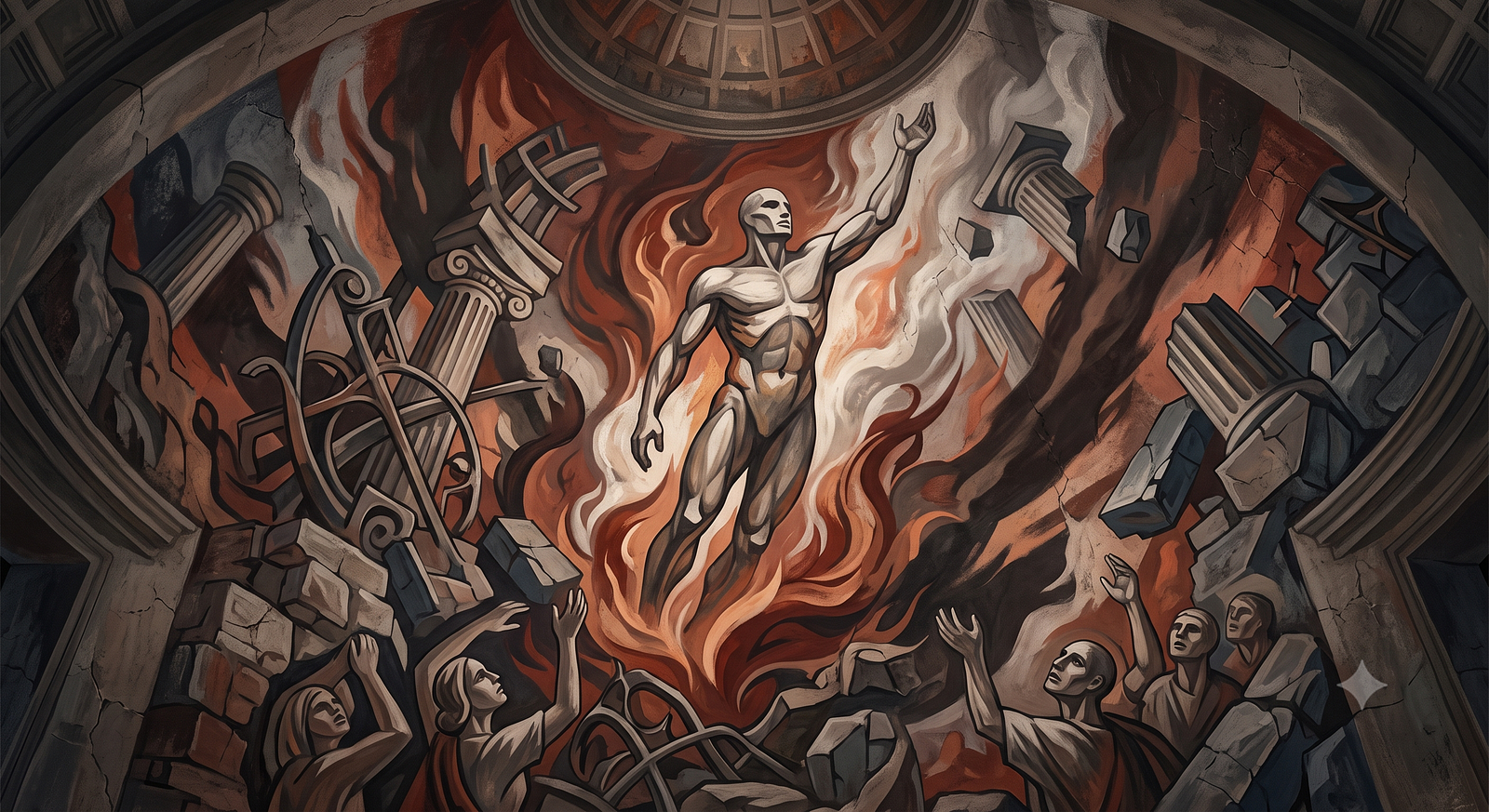
Orozco’s style is dramatic, monumental, expressionistic, symbolic, and emotionally volcanic.
He was part of Mexican muralism, but he was not just painting national pride with heroic confetti. His work is darker, sharper, and more skeptical than many people expect when they first hear the phrase “public mural.” He did not simply celebrate history. He cross-examined it.
His figures often feel sculptural and strained. Bodies twist. Faces harden. Hands reach. Flames rise. Machines loom. Compositions tilt toward catastrophe and revelation. His murals often have the scale of public art, the intensity of theater, and the emotional temperature of a furnace that has read too much philosophy.
He loved strong forms. He loved sweeping movement. He loved stark contrasts. He loved the human figure, but rarely as a calm little museum citizen standing politely in good lighting. In Orozco, the human figure is usually wrestling with power, fate, history, belief, machinery, or some enormous social force that did not come with a customer service number.
There is grandeur in his work, but not comfort.
There is beauty, but it often arrives wearing soot.
Who taught him?
Orozco studied at the Academy of San Carlos in Mexico City, one of Mexico’s major art institutions. He was also deeply affected by José Guadalupe Posada, the great Mexican printmaker and satirical illustrator whose bold, biting images of politics, death, crime, and society entered popular culture through broadsides and prints.
That influence is important. Posada showed how art could be direct, public, sharp, and socially alert. You did not have to paint only for polite drawing rooms. You could make images that met people in the street and poked the national nervous system with a stick.
Orozco also absorbed Symbolist influence and the lessons of Mexican modernism. The Toledo Museum notes that his work as an editorial illustrator during the Mexican Revolution, Posada’s prints, the expressive symbolism of his teachers, and the horrors of the Revolution all shaped his later printmaking and public art. Toledo Museum — José Clemente Orozco
That is quite a curriculum.
Most of us had a teacher who made us underline vocabulary words.
Orozco had visual satire, revolutionary violence, academic training, political turmoil, and the human condition walking into the room without knocking.
Does he use any special technique?
Yes. Fresco.
Fresco is one of those techniques that sounds elegant until you realize it is basically painting under pressure while chemistry taps its watch.
In true fresco, pigment is applied to wet plaster. As the plaster dries, the pigment becomes part of the wall surface. This means the artist has to work in sections, think ahead, move decisively, and avoid the kind of casual “I’ll fix it tomorrow” attitude that modern software has unfortunately normalized.
Fresco is not forgiving.
It is not the medium for “let me just noodle around until the vibes improve.”
Orozco’s fresco technique gave his murals a physical unity with the architecture. The wall was not merely holding the image. The wall became the image. That matters, especially for an artist so interested in public history, collective memory, and the way society inscribes its ideas onto buildings, institutions, and bodies.
He also made drawings, prints, and easel paintings, and the sharpness of print culture shows up in his mural work. There is often a graphic punch to his compositions, a clarity of silhouette and gesture that helps the imagery read across distance. That is essential when your canvas is not a canvas but a wall large enough to make a ladder develop career anxiety.
Who has he worked with?
Orozco’s career intersected with some of the most important figures and institutions of Mexican and American modern art.
He was part of the Mexican muralist movement alongside Diego Rivera and David Alfaro Siqueiros. These artists did not work as one neat little harmony choir. They differed in politics, temperament, technique, and artistic philosophy. But together, they transformed what mural painting could mean in the modern world.
The post-revolutionary Mexican government, especially through education minister José Vasconcelos, supported public mural commissions as part of a broader literacy and cultural project. The New School’s history of Orozco’s commission explains that Orozco, Rivera, and Siqueiros came to prominence in this 1920s context, when murals for public buildings were tied to national education and public life. The New School — History of the Commission
Orozco later worked in the United States, where he painted major commissions at Pomona College, The New School, and Dartmouth. That American period matters because Mexican muralism did not stay politely inside national borders. It helped reshape how artists in the United States thought about public art, social themes, modern figuration, and the possibility that painting could address political life without sounding like a committee memo.
And let us pause to appreciate that achievement.
Because very few things in life are worse than art that sounds like a committee memo.
Except possibly an actual committee memo.
Was he wealthy?
Not in the usual “artist lounges on balcony while an assistant polishes the decorative lemons” sense.
Orozco had international recognition, major commissions, and serious artistic stature, but his life was not a smooth parade of luxury. He faced hardship, professional instability, political turbulence, injury, travel, controversy, and the difficult economics of being an artist whose chosen format often required scaffolding, institutional approval, and walls that were not already occupied by calendars.
He was successful, especially by the later stages of his career, but success in public muralism is not the same as easy wealth. It is more like being trusted with enormous cultural responsibility while also hoping the commission actually pays, the plaster behaves, the politics do not explode, and nobody decides the mural is too spicy for the building.
Orozco became honored as a national figure in Mexico, and his reputation grew internationally. But his art never feels like the product of comfort. It feels like the product of witness.
That is different.
Comfort decorates.
Witness burns.
When was he most popular?
Orozco rose to prominence in the 1920s as Mexican muralism became a major cultural force after the Revolution. His first major public murals were painted in Mexico during that decade. Then, between the late 1920s and mid-1930s, his reputation expanded in the United States through commissions at Pomona College, The New School, and Dartmouth.
The early 1930s were especially important. Prometheus at Pomona appeared in 1930. The New School mural cycle followed in 1931. Dartmouth’s vast Epic of American Civilization came next, from 1932 to 1934.
That is not a bad run.
Most of us are proud if we remember to cancel a subscription before the free trial ends.
Orozco spent those years painting works that still make scholars, artists, students, and unsuspecting library visitors stop in their tracks.
After returning to Mexico, he continued producing major works, including the murals at Hospicio Cabañas in the late 1930s. By the time of his death in 1949, he was recognized as one of Mexico’s essential modern artists.
Tell me more, please
The key to Orozco is that he was not a simple propagandist.
That is important.
Mexican muralism is often discussed through politics, and rightly so, because politics is baked into the walls. But Orozco’s art does not behave like a poster that has already made up its mind and wants you to nod on schedule.
He is more tragic than that.
He believed in the dignity of humanity, but he was not naive about what people do to each other. He painted revolution, but he did not treat revolution like a tidy redemption machine. He painted progress, but he was deeply suspicious of machines, systems, ideologies, and institutions that claimed to improve humanity while quietly grinding actual humans into paste.
His work asks big questions without handing us a neat laminated answer card.
What does history cost?
Who benefits from power?
When does technology serve humanity, and when does humanity start serving technology?
How do myths shape nations?
How many times can civilization call something progress before someone points at the bodies under the wheels?
You know. Light breakfast topics.
This is why his murals still feel alive. They are not trapped in a single political moment. They are rooted in their era, absolutely, but they keep reaching forward because the human problems they address have not exactly retired to a beach condo.
Anything else left to tell?
Yes: Orozco lost his left hand as a young man in an accident involving explosives.
That fact is often mentioned because it is dramatic, and fair enough, it is dramatic. But it is also worth handling carefully. It should not be reduced to a “triumph over adversity” greeting card with tasteful font choices. The point is not that suffering magically makes art better. Suffering is not a professional development seminar.
The point is that Orozco continued.
He adapted. He studied. He drew. He painted. He worked as an illustrator. He observed violence and social upheaval. He developed a language capable of handling pain without turning it into decoration.
That is why his art can feel so severe and compassionate at the same time. He does not sentimentalize humanity. He does not flatter it either. He looks straight at it.
Sometimes that look is brutal.
Sometimes it is merciful.
Often it is both.
Any other interesting tidbits?
One of Orozco’s great American works, Prometheus, at Pomona College, is often discussed as the first major modern fresco in the United States by a Mexican muralist. Pomona’s museum describes the mural as a landmark of his complicated humanism. Pomona College Museum — About José Clemente Orozco
That phrase, complicated humanism, is perfect.
Because Orozco was humanist, but not fluffy.
He cared about human beings, but he did not pretend we are adorable little cupcakes of reason. His art knows we are capable of courage, cruelty, creation, destruction, sacrifice, delusion, and occasionally standing in front of a mural pretending we understand everything because someone nearby looks confident.
Also, his work remains visible in major collections and public sites. MoMA lists 41 works by Orozco online, including prints and paintings, which helps show that he was not only a muralist but also a powerful graphic artist. MoMA — José Clemente Orozco
That graphic side matters. The murals may be the thunder, but the prints and drawings show the lightning rod.
Why Orozco still matters
Orozco matters because he understood that public art does not have to be pleasant to be necessary.
A mural can beautify a wall, yes.
But it can also make a public building remember what everyone inside it would rather forget.
It can turn architecture into argument.
It can make history visible at human scale, then enlarge that scale until the viewer feels physically surrounded by the consequences of civilization.
Orozco did not paint humanity as clean, reasonable, or safe. He painted it as tragic, brilliant, violent, yearning, ridiculous, heroic, and repeatedly surprised by its own bad decisions.
Which, frankly, seems accurate.
His murals remind us that art can do more than match the couch, bless the lobby, or provide a tasteful backdrop for someone’s profile photo. Art can confront. It can mourn. It can accuse. It can warn. It can teach without becoming a chalkboard. It can burn without disappearing.
And Orozco’s fire still burns.
Not because it is pretty.
Because it is true enough to make the wall breathe.
Art Prompt (Muralism):
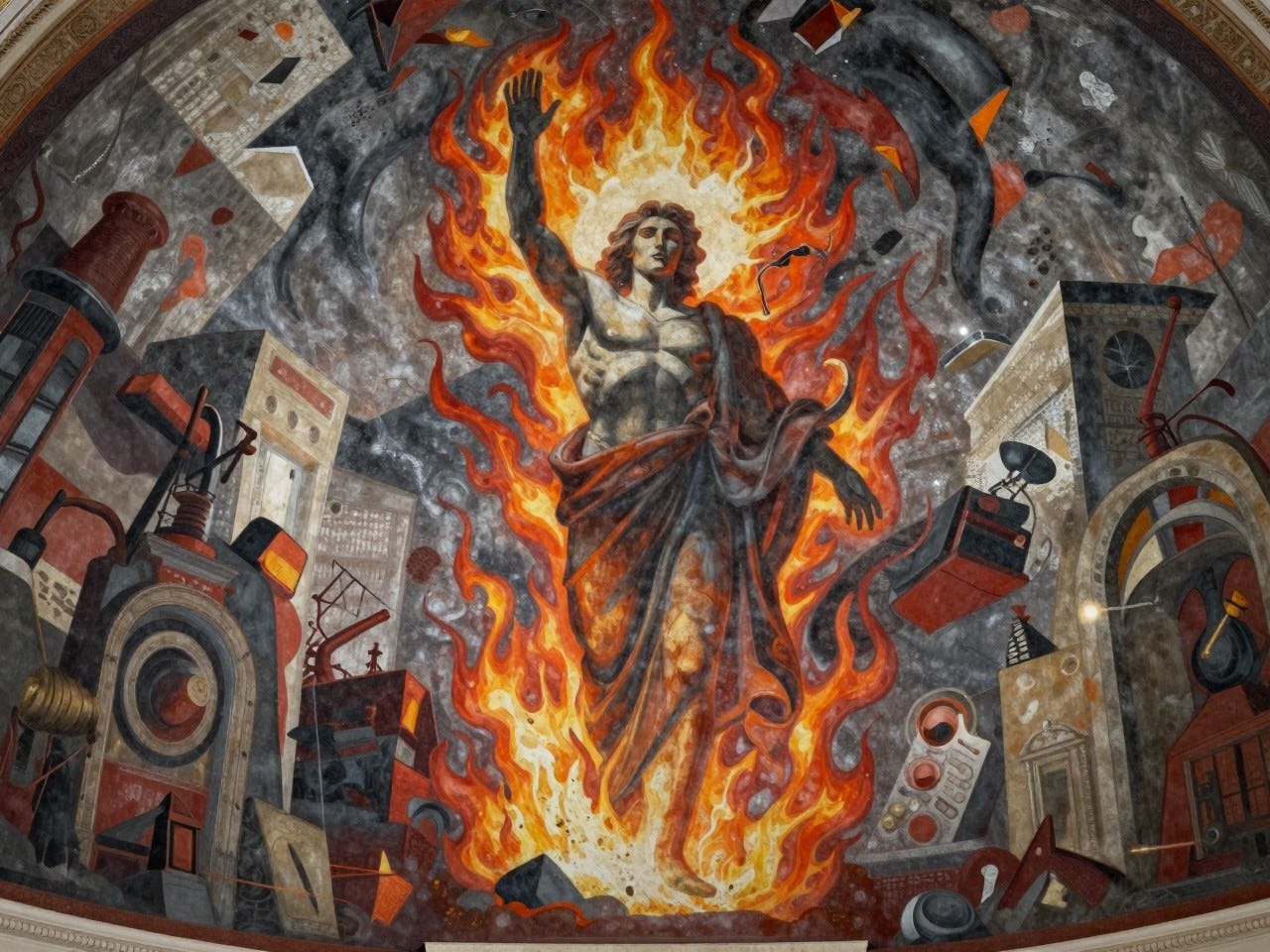
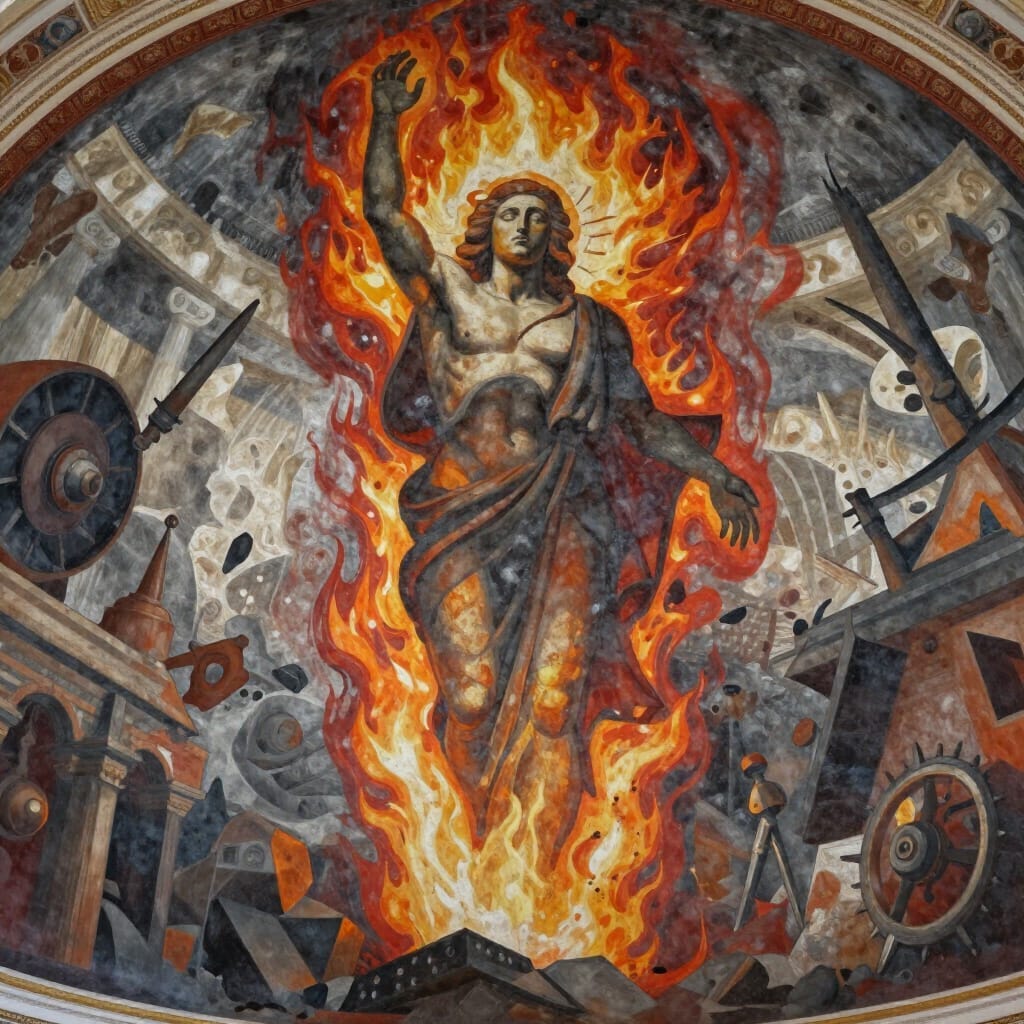
A monumental fresco-style composition inside a vast domed civic hall, centered on a towering symbolic figure rising upward through swirling flames, smoky shadows, and fractured architectural forms. Use scorched reds, ember oranges, ashen grays, deep charcoal, bone white highlights, and rough matte plaster texture. The figure should feel heroic but mysterious, with sculptural limbs, simplified facial features, and dramatic upward motion, surrounded by abstract machinery, broken stone, sweeping diagonal shadows, and radiant firelight. The mood should be intense, ceremonial, tragic, and awe-filled, with bold contours, muscular forms, severe lighting, and a sense of human transformation under immense pressure. Keep it family-friendly, polished, historically inspired, and free of readable text, logos, brands, or recognizable people.
Video Prompt:
A cinematic vertical video moving through a vast domed civic hall painted in a monumental fresco style. Begin with a slow push across rough plaster textures, cracked stone, ember-colored shadows, and abstract machinery, then rise dramatically toward a towering symbolic figure surrounded by swirling flames and smoky light. Let sparks drift upward, shadows sweep across the walls, and the camera spiral gently beneath the dome as scorched reds, ember oranges, ashen grays, charcoal blacks, and bone white highlights pulse with ceremonial intensity. The motion should feel powerful, rhythmic, and mesmerizing, with bold silhouettes, sculptural forms, and a final upward reveal that feels heroic, mysterious, and unforgettable. Keep it family-friendly, polished, historically inspired, and free of readable text, logos, brands, or recognizable people.
For music, I would pair that video with Sinnerman — Nina Simone if you want drama, pursuit, and spiritual pressure without needing the visuals to beg for attention. If you want something more direct and modern, The Fire — The Roots feat. John Legend gives the piece momentum, resolve, and a clean sense of “yes, the wall is now emotionally in charge.”
If you enjoyed this one, follow along for more art, more history, and more artists who looked at a blank surface and said, “Excellent, I shall now make this everyone’s problem.” And please comment with the Orozco work that hits you hardest, or tell me which artist in Season 2 you want to see next.
More art lives here: LumAIere