The American Revolution is usually pictured as two tidy lines of soldiers standing in an open field, firing enormous clouds of smoke at each other while drummers try very hard not to reconsider their career choices.
Morgan’s Rifle Corps preferred a different approach.
They moved through forests, fired from cover, scouted enemy positions, disrupted formations, and generally made themselves difficult to locate, difficult to catch, and extremely difficult to enjoy marching toward.
Commanded by Daniel Morgan, they became one of the Continental Army’s most effective specialist units. They were not invincible woodland superheroes, and their rifles were not magical thunder sticks capable of winning the war before lunch. What made the corps remarkable was the combination of carefully selected soldiers, unusual weapons, flexible tactics, and a commander who understood exactly when to use them.
First, Which Morgan’s Riflemen Are We Talking About?
The name “Morgan’s Riflemen” can refer to more than one group, because Revolutionary War organization was not designed for the convenience of future bloggers.
In 1775, the Continental Congress authorized rifle companies to support the newly forming Continental Army. Daniel Morgan was chosen to command one of Virginia’s companies. His men marched north, joined the army around Boston, and later accompanied Benedict Arnold on the punishing expedition through Maine to Quebec.
The assault on Quebec failed on December 31, 1775. Morgan fought aggressively, assumed greater responsibility after Arnold was wounded, and eventually became a prisoner. He was exchanged in early 1777 and returned to service with an excellent reputation and, presumably, no desire to spend another winter dragging an army through the Maine wilderness.
The unit usually meant by Morgan’s Rifle Corps was created in June 1777. It was a provisional, independent force assembled from experienced riflemen drawn mainly from Virginia and Pennsylvania Continental regiments.
“Provisional” meant it was organized for a particular military need rather than intended to remain a permanent regiment forever. It was the 18th-century version of forming a specialist team because the regular organizational chart had looked at the problem and quietly left the room.
Contemporary figures vary depending on date and battlefield strength. The National Park Service describes approximately 400 riflemen serving under Morgan during the Saratoga campaign. In his own correspondence, George Washington described the corps as having a true strength of 500 men.
The safest description is that Morgan commanded several hundred carefully selected riflemen, generally numbering somewhere around 400 to 500.
Why Did Washington Need Them?
The year 1777 was not exactly relaxing for the American cause.
British General John Burgoyne was advancing south from Canada through the Lake Champlain and Hudson River corridor. The larger British strategy was to reach Albany and isolate New England from the other rebellious colonies.
It was an ambitious plan involving several armies, difficult terrain, long supply lines, uncertain coordination, and the traditional military assumption that everyone else would arrive exactly when expected.
They did not.
General William Howe moved against Philadelphia instead of marching north to support Burgoyne. Burgoyne continued south anyway, burdened by an increasingly miserable supply situation and surrounded by a countryside becoming less cooperative by the day.
Washington remained near the main British army, unsure for a time where Howe’s fleet was heading. Sending away some of his best scouts was a serious sacrifice, but the danger in the north was becoming too great to ignore.
On August 16, 1777, Washington ordered Morgan to march rapidly to Peekskill, travel by boat to Albany, and reinforce the Northern Army. In Washington’s surviving correspondence at the Library of Congress, he explained that no other corps was as likely to slow the enemy in proportion to its size.
Then Washington added a wonderfully sneaky postscript.
He told General Israel Putnam that Morgan’s true strength was 500 men, but suggested spreading the word that the corps numbered twice that many.
This was military misinformation delivered with powdered-wig elegance.
Morgan arrived in the north with a fearsome reputation already marching several miles ahead of him.
What Made the Riflemen Different?
Most soldiers in both the British and Continental armies carried smoothbore muskets.
A musket could be loaded relatively quickly and fitted with a bayonet. It was well suited to disciplined volleys, close formations, and the deeply unsettling experience of watching an entire line of armed people walk directly toward you.
Morgan’s men carried long rifles.
Spiral grooves inside a rifle barrel caused the projectile to spin, improving its stability and making the weapon much more accurate at longer distances than a typical smoothbore musket.
That accuracy came with disadvantages.
Rifles were slower to load. Their barrels became fouled with powder residue. Ammunition was not always standardized because many rifles had been individually made. Most rifles could not accept bayonets, leaving their users vulnerable when enemy infantry reached close range.
The rifle was therefore not a superior replacement for every musket. It was a specialized tool.
Morgan’s genius was understanding the difference.
His riflemen operated in loose formations, used trees and uneven ground for cover, screened larger formations, gathered information, disrupted enemy movements, and fired deliberately rather than depending entirely on massed volleys.
They were Continental soldiers, not an undisciplined collection of people who had wandered out of the woods carrying unusually long hunting equipment. Morgan demanded order, movement, and cooperation. The men needed individual skill, but they also had to function as a coordinated corps.
The Riflemen Still Needed Friends With Bayonets
When Morgan joined the Northern Army, his riflemen were paired with approximately 300 light infantrymen commanded by Major Henry Dearborn.
Dearborn’s men carried muskets and bayonets. They could move quickly through difficult terrain while also protecting the riflemen if the fighting became close and unpleasant.
The National Park Service describes Dearborn’s light infantry as providing close-range defense for Morgan’s accurate but slower-firing riflemen.
This partnership was one of the corps’ greatest strengths.
Morgan’s men could engage at distance, while Dearborn’s infantry supplied faster fire and bayonet support. Each unit covered the other’s weaknesses.
Military history often becomes obsessed with one extraordinary weapon. Saratoga offers a better lesson: the best results frequently come from combining different capabilities and convincing everyone involved not to wander off independently.
Freeman’s Farm: Elite Does Not Mean Indestructible
On September 19, 1777, Burgoyne’s army advanced in three columns near the American defenses at Bemis Heights.
Morgan’s corps was among the first American forces sent forward. His riflemen encountered British troops near Freeman’s Farm and drove back the advance guard.
Then they pursued too aggressively.
The scattered riflemen ran into a stronger British force and were driven from the field. Morgan spent hours gathering and reorganizing his men.
This part sometimes disappears from heroic retellings, but it should not. The riflemen were excellent, yet they could still become disorganized after rushing into an uncertain situation. Being elite does not make surprise any less surprising.
Once reassembled, Morgan’s men returned to the fighting and inflicted serious losses, particularly from wooded positions on the American flank.
The British held the battlefield when darkness arrived, making Freeman’s Farm a tactical British victory. Strategically, however, Burgoyne had gained little and lost more than 600 men he could not easily replace.
He had won possession of a farm while his entire campaign continued sinking into the mud.
Bemis Heights: The Corps Finds Its Moment
By early October, Burgoyne’s supplies were dwindling and the American army was growing as militia reinforcements arrived.
On October 7, Burgoyne sent approximately 1,700 soldiers to examine the American position and gather supplies. The movement was detected, and American commanders launched an attack.
Morgan’s corps struck the British right.
The riflemen helped disrupt British efforts to organize a defense, while other American formations attacked the center and left. Morgan and Dearborn’s men later joined the fighting around the fortified British positions.
The Americans captured Breymann’s Redoubt, exposing Burgoyne’s flank and making his position impossible to maintain. The British withdrew north but were surrounded before they could escape.
On October 17, Burgoyne surrendered his army.
The National Park Service’s account of Saratoga explains how Morgan’s corps participated in both major battles and helped turn Burgoyne’s retreat into surrender.
General Horatio Gates reported that “too much praise cannot be given to the Corps commanded by Col. Morgan.”
Considering how rarely generals believe too much praise has been given to anybody except themselves, this was quite a compliment.
Did One of Morgan’s Riflemen Shoot General Simon Fraser?
One of Saratoga’s most famous stories claims that Morgan ordered rifleman Timothy Murphy to shoot British Brigadier General Simon Fraser during the Battle of Bemis Heights.
Fraser was indeed mortally wounded while trying to rally British troops. His fall damaged British command and morale at a critical moment.
Murphy may have been present with Morgan’s corps, but the dramatic story identifying him as Fraser’s shooter appeared much later and lacks convincing contemporary evidence. The American Battlefield Trust’s examination of Saratoga rejects the traditional Murphy attribution.
It is entirely possible that one of Morgan’s men fired the fatal shot. We simply cannot confidently identify who did it.
History occasionally gives us an unnamed rifleman and then watches future generations become emotionally committed to filling out the name tag.
Even Their Meal Arrangements Were Unusual
Morgan’s corps was not permanently attached to a normal brigade. It was frequently detached and sent wherever its special abilities were needed.
That independence created a highly practical question:
Where were the riflemen supposed to eat?
Washington’s general orders instructed the corps to draw rations from whichever commissary happened to be nearest.
It is a small administrative detail, but it reveals how differently the corps operated. Morgan’s men were expected to move independently, respond quickly, and survive without the normal support structure of a fixed brigade.
Elite woodland warfare is impressive, but somebody still has to determine where the bread is coming from.
Were They Early Army Rangers?
The modern U.S. Army includes Morgan’s force in its historical account of early American Ranger units. The Army’s Ranger heritage page notes that Morgan’s frontiersmen were known in 1777 as a Corps of Rangers.
That does not mean there is a perfectly continuous organizational line from Morgan’s riflemen to the modern 75th Ranger Regiment. Military heritage is often a collection of traditions, tactical influences, and admired predecessors rather than one uninterrupted unit roster.
Still, the connection makes sense.
Morgan’s corps specialized in scouting, rapid movement, independent operations, skirmishing, and fighting ahead of the main army. Those missions fit comfortably within the broader Ranger tradition.
Also, “Corps” is pronounced “core.”
You may now discuss Morgan’s Rifle Corps without accidentally sounding as though he commanded several deceased riflemen.
Cowpens Was Morgan, but Not the Same Rifle Corps
Daniel Morgan later returned to service and won his most famous independent victory at the Battle of Cowpens in January 1781.
The troops at Cowpens were not simply the original Provisional Rifle Corps reunited for one final performance. Morgan commanded a different force composed of skirmishers, militia, Continental regulars, and cavalry.
His plan used several defensive lines. The forward troops fired and withdrew, encouraging British commander Banastre Tarleton to believe the Americans were collapsing. Instead, the withdrawing troops reorganized while the British advanced into a coordinated counterattack and double envelopment.
The Mount Vernon biography of Daniel Morgan describes how he combined militia, regular infantry, and cavalry to defeat Tarleton.
Cowpens showed the same talent Morgan had demonstrated with the rifle corps: he understood the strengths, limitations, and psychology of the people under his command.
He did not ask every soldier to perform the same job. He arranged the battle so that each group performed the job it could do best.
This sounds obvious, which is why organizations have spent the last several thousand years repeatedly failing to do it.
Why Morgan’s Rifle Corps Mattered
Morgan’s Rifle Corps did not win the American Revolution by itself.
It did something more realistic and more useful: it gave the Continental Army a flexible specialist force that could operate where conventional formations struggled.
The riflemen brought accuracy, mobility, fieldcraft, and psychological pressure. Dearborn’s light infantry added speed, musket fire, and bayonet protection. Morgan supplied leadership rooted in experience rather than theory.
At Saratoga, that combination helped stop Burgoyne’s advance and contributed to the surrender of an entire British army. The victory convinced France that the American rebellion had a genuine chance of succeeding, leading to the formal Franco-American alliance in 1778.
Morgan’s men were special not because they ignored traditional warfare, but because they expanded what the Continental Army could do.
They could fight in the woods, screen an army, harass a column, attack a vulnerable flank, and then disappear back among the trees while the British tried to determine why their perfectly respectable campaign had suddenly become a catastrophe.
Would you rather have carried a fast-loading musket with a bayonet or Morgan’s slower but more accurate long rifle? Share your choice in the comments, along with the historical unit you think deserves its own article.
Follow for more friendly journeys into history, where the battles are complicated, the legends are suspicious, and even George Washington occasionally inflated the numbers.
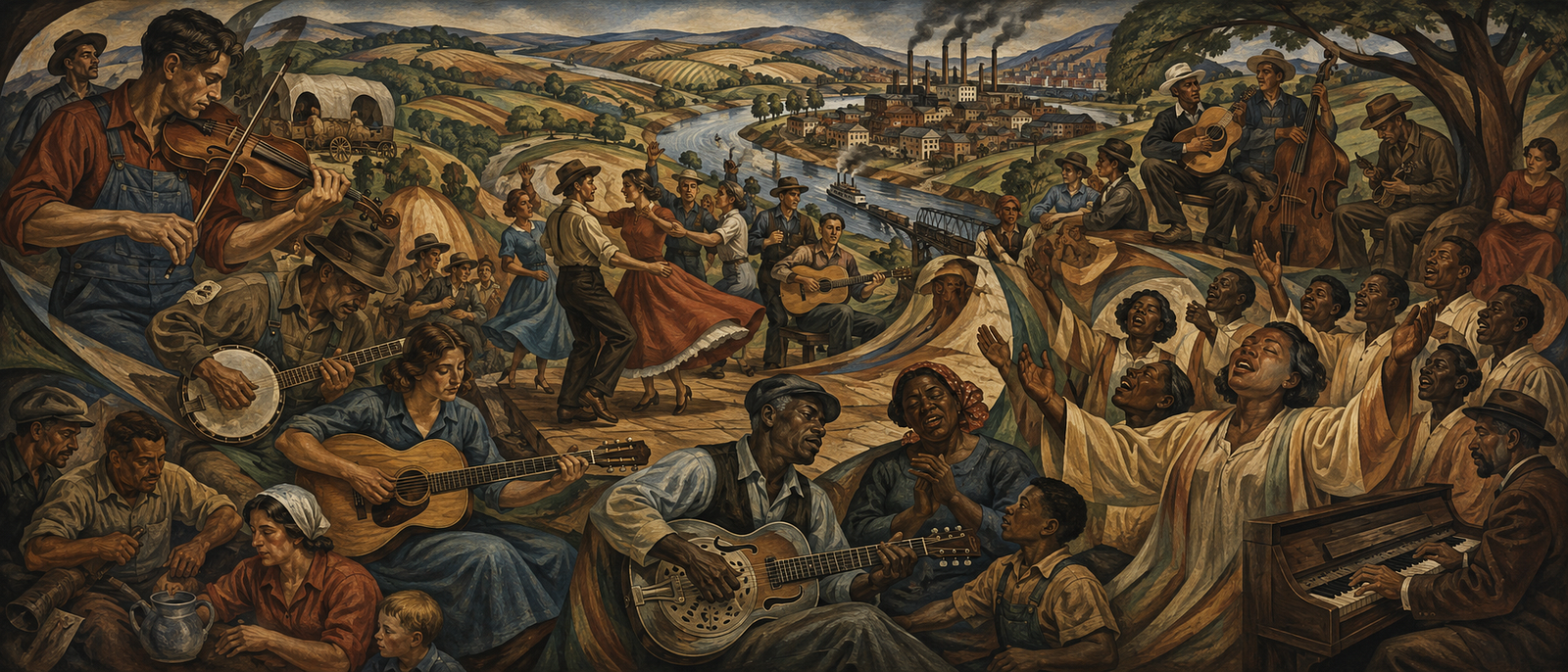
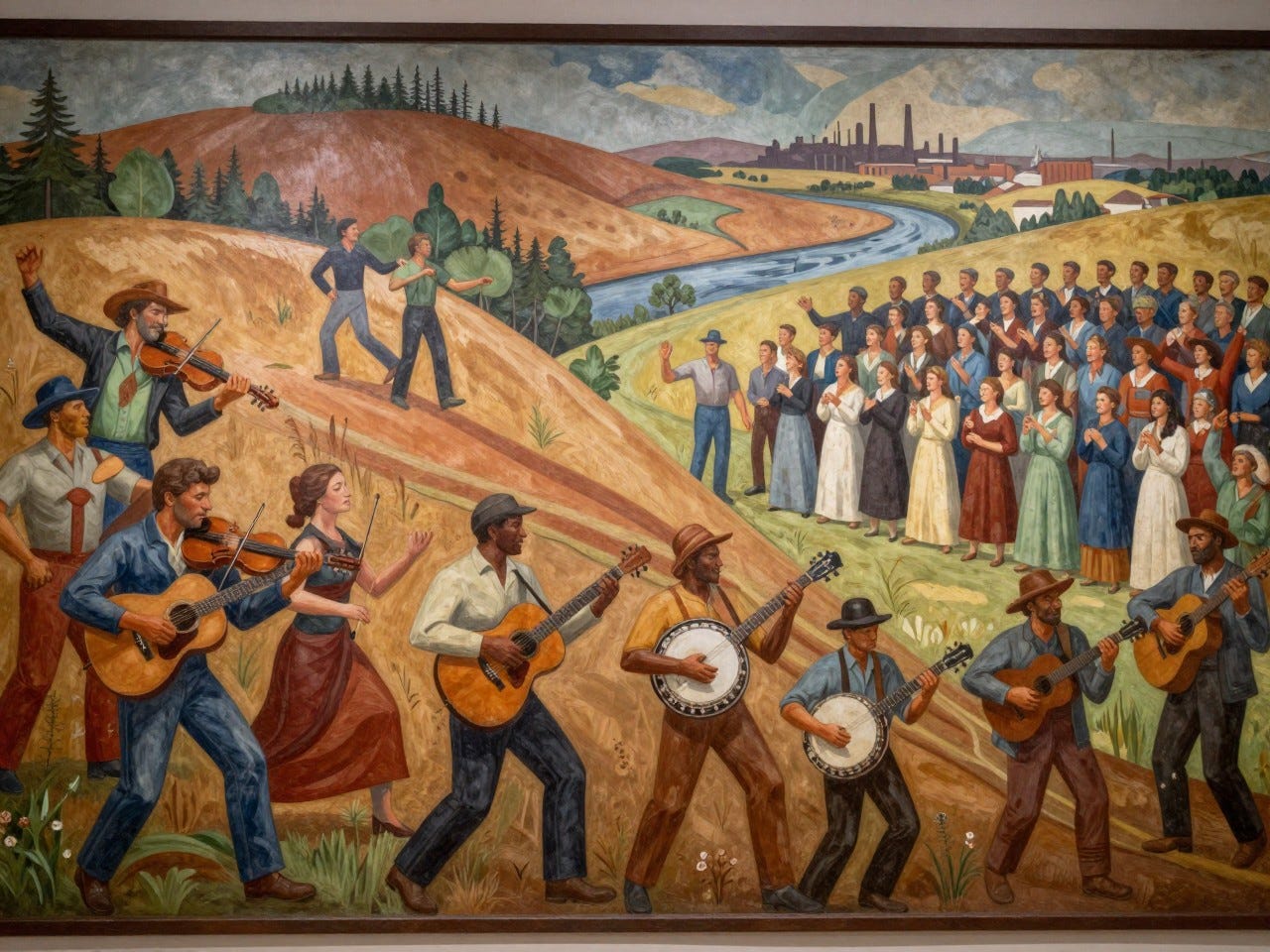
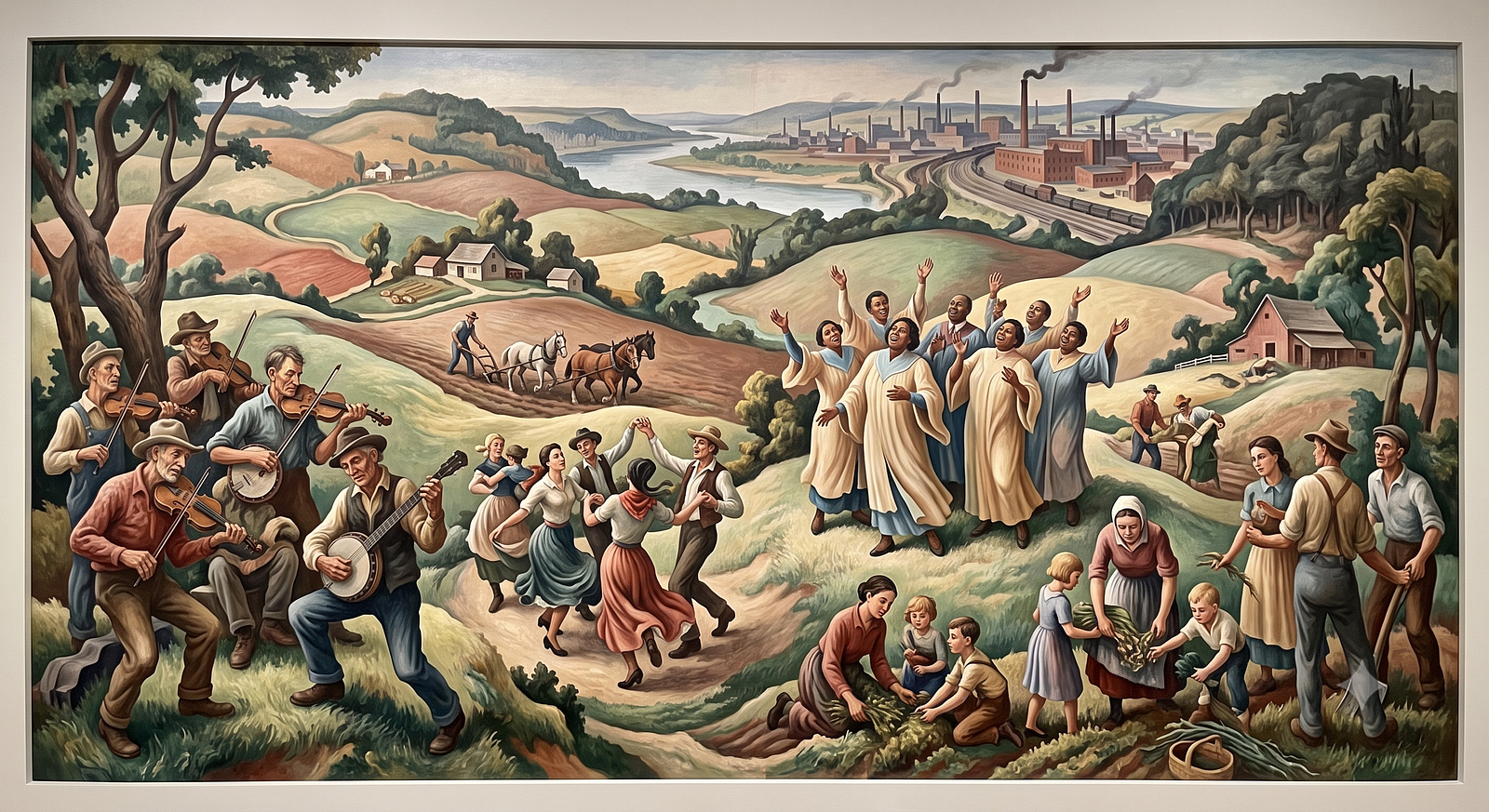
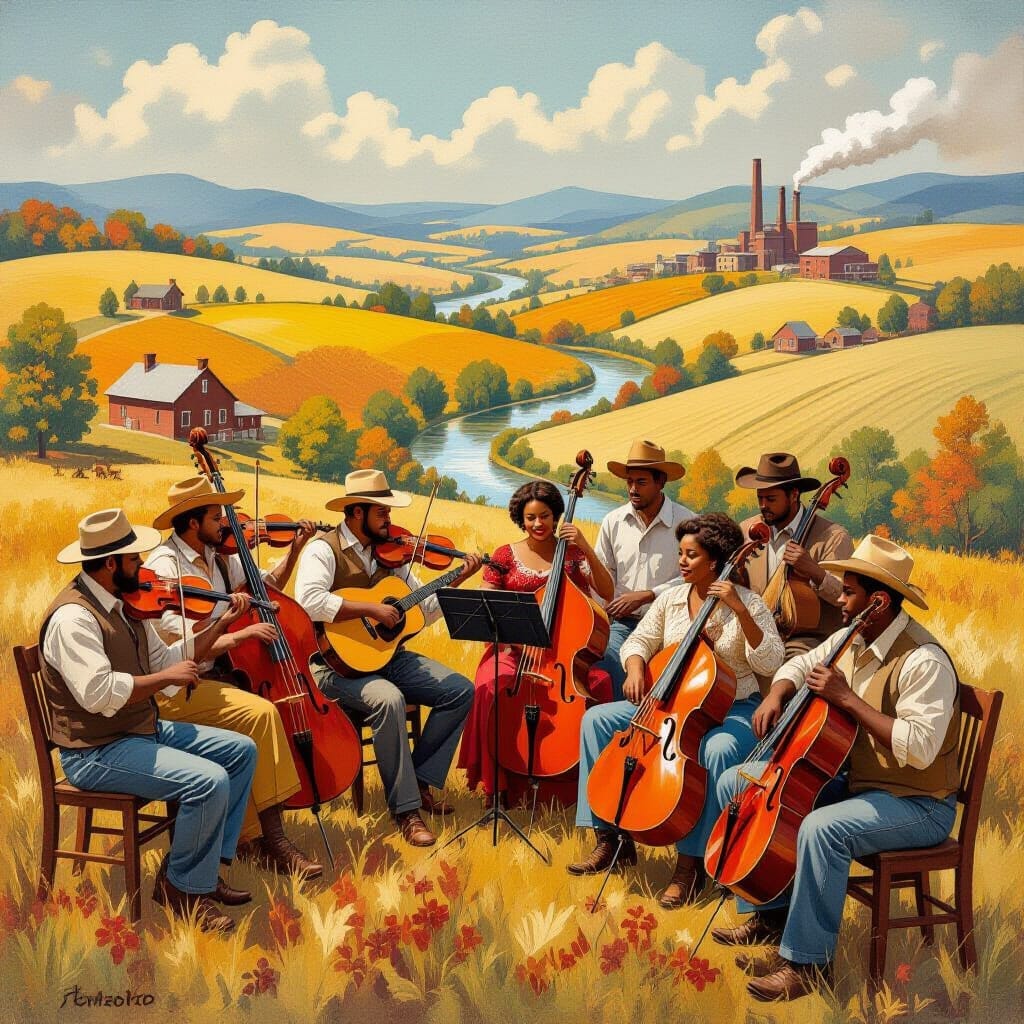
Create a sweeping mural-scale Regionalist scene celebrating the many roots of American music, with fiddlers, banjo players, guitarists, a spirited gospel choir, mountain dancers, and working families arranged across rolling farmland, river valleys, timbered hills, and a distant industrial town. Build the composition from muscular curves, rhythmic diagonals, compressed perspective, and sculptural figures whose gestures seem to carry melodies from one group to the next. Use dusty ochre, rust red, sage green, denim blue, warm cream, tobacco brown, and deep charcoal, with softly modeled faces, sturdy hands, flowing fabric, and richly textured instruments. Let the landscape bend and swell with the same energy as the performers, creating a unified visual rhythm that feels earthy, theatrical, communal, and proudly handmade. Fill the scene with lively movement and affectionate regional detail while preserving the grandeur of a monumental public mural. No readable text, logos, recognizable people, or modern screens.
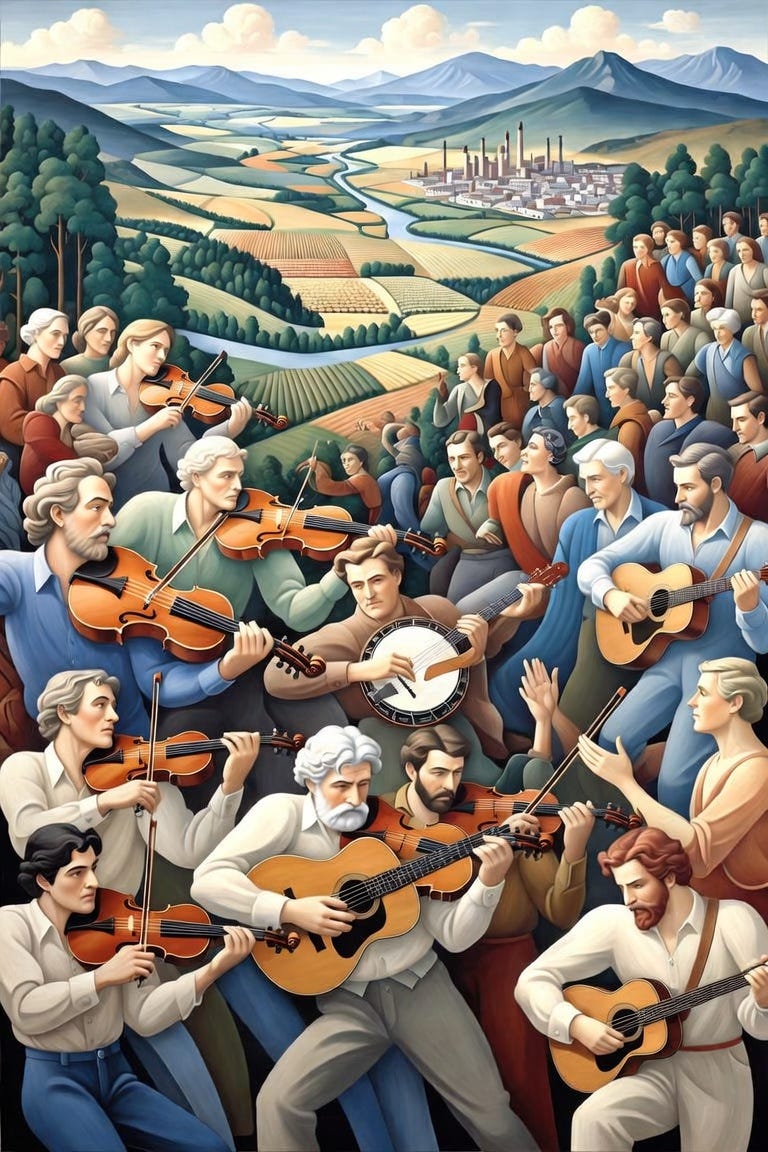
Open on a fiddle bow striking the strings as bright painted ribbons of sound burst outward and race through a living mural. Follow the ribbons as they coil around a banjo, leap between tapping boots, ripple through a gospel choir, and sweep across rolling fields that bend rhythmically with the music. Musicians lean, turn, stamp, clap, and pass the visual melody from one group to another while sculptural figures and curved landscapes pulse in coordinated waves. Use quick camera dives through instrument strings, energetic whip transitions between regions, brief overhead spins above dancers, and dramatic pullbacks that reveal the entire mural moving as one enormous composition. Preserve dusty ochre, rust red, sage green, denim blue, warm cream, tobacco brown, and deep charcoal, with painted textures, muscular contours, compressed perspective, and bold theatrical lighting. End as every ribbon of sound spirals upward, forms one radiant abstract chord above the landscape, and bursts into hundreds of glowing painted fragments. No readable text, logos, recognizable people, or modern screens.
Song Recommendations
Rumble and Sway — Jamie N Commons
Beneath the Brine — The Family Crest