If you missed the beginning of this series, the front door is here: The Modern Religion Series: Many Paths, One Curious Human.
Daoism has one of the more elegant reputations in world religion. It is ancient, layered, poetic, and just slippery enough that the moment you think you have it pinned down, it has already wandered off into the mist, probably with a faintly amused expression.
At its simplest, Daoism is a Chinese tradition concerned with living in harmony with the Dao, often translated as the Way. That sounds neat and tidy, but Daoism is not especially interested in being neat and tidy. It includes philosophy, religion, ritual, cosmology, meditation, ethics, self-cultivation, sacred texts, temples, priests, mountains, alchemy, paradoxes, and the enduring suggestion that maybe forcing everything all the time is not actually a sign of wisdom.
Which, honestly, is a useful note for modern life.
When was it founded, and by whom?
This is one of those questions where Daoism smiles politely and gives you two answers.
The traditional answer is Laozi, the legendary sage associated with the Daodejing, usually placed around the 6th century BCE. That is the classic origin story, and it is the one most people meet first.
The historical answer is more complicated. Scholars usually distinguish between early Daoist thought, rooted in texts such as the Daodejing and the Zhuangzi, and organized religious Daoism, which is commonly traced to Zhang Daoling and the Celestial Masters movement in 142 CE.
So if someone asks, “Who founded Daoism?” the fair reply is: traditionally Laozi, historically the story is broader, and organized Daoist religion is often linked to Zhang Daoling.
Is it growing or shrinking in numbers of practitioners?
That depends on what exactly you are counting, which is a very Daoist answer and also the honest one.
Daoism is hard to measure because formal identification, temple participation, philosophical influence, folk practice, and cultural inheritance do not always line up in tidy census boxes. Some databases count Daoists as a distinct category. Other major studies fold Daoists into broader groupings alongside several smaller religions. In plain English: the headcount is real, but the boundaries are fuzzy.
So is it growing or shrinking? Globally, the broader “other religions” category that includes Daoists grew roughly in step with world population in the last major Pew update, while World Religion Database-derived figures still place Daoists as a small but enduring share of the world’s population. Popularity is not exactly the same question as formal numbers, though. A person may never check “Daoist” on a form and still be influenced by Daoist ideas about balance, naturalness, breath, ritual, or harmony with the world.
So no, those are not quite the same question. One is about affiliation. The other is about cultural reach, curiosity, and influence. Religions can be modest in census size and enormous in civilizational footprint.
What are the tenets of this religion?
Trying to boil Daoism down to ten bullet points feels slightly like trying to store fog in a filing cabinet, but several themes appear again and again:
The Dao is the underlying Way or process of reality, deeper than any single definition.
Naturalness, often rendered as ziran, matters. Things have a way of being themselves, and wisdom involves learning not to bully reality into nonsense.
Wuwei matters too. This is often translated as non-action, though that can sound lazier than it means. It is closer to action that does not strain against the grain of things.
Balance matters. Yin and yang are not enemies in a cage match. They are complementary forces whose interplay helps describe change, rhythm, contrast, and relation.
Self-cultivation matters. Depending on the school, this can include meditation, ritual, breathing practices, moral discipline, dietary practices, scripture, liturgy, pilgrimage, or communal worship.
In religious Daoism, ritual life, priestly traditions, sacred texts, merit, healing, cosmology, and devotion are all part of the picture. In other words, Daoism is not only a book of aphorisms for calm people near bamboo. Temples, communities, and lineages are very much part of the story.
How does Daoism portray God, the divine, divinities, or the infinite?
Carefully, poetically, and without much interest in behaving like a Western theology textbook.
The Dao itself is not usually presented as a single personal creator God in the way some other religions describe the divine. It is more often spoken of as the underlying Way, source, pattern, process, or generative principle of reality. Daoist texts describe it in images: valley, water, mother, emptiness, source.
Religious Daoism also includes deities, immortals, sacred beings, liturgies, heavens, and pantheons. So if someone says Daoism has no gods, that is too simple. If someone says Daoism is only about gods, that is also too simple. Daoism contains both philosophical reflection on the Dao and religious traditions rich with divine figures and ritual life.
That is one reason it keeps refusing to fit into tidy categories. It did not ask to be sorted into your spreadsheet.
How has it benefited individuals?
For many people, Daoism has offered a vocabulary for simplicity, humility, restraint, quiet, and self-cultivation. It has also shaped practices associated with health, breath, bodily discipline, contemplation, and the search for a more harmonious life.
Spiritually, Daoism has given many people a way to think about transformation without constant aggression, a way to value softness without confusing it for weakness, and a way to live with paradox without requiring everything to arrive in matching boxes.
How has it benefited families?
In lived religious settings, Daoist tradition has often been woven into family and communal life through rites, festivals, healing practices, ancestor-related observances, household devotion, and moral instruction. Some Daoist organizations emphasize doing good, cultivating virtue, and contributing to harmony in both household and society.
That may sound modest, but modesty is one of Daoism’s favorite ways of moving large things.
What benefits has it created in society and for the human race?
Daoism has had a massive cultural influence, especially in China and across East Asia. It has shaped language, aesthetics, ritual life, medicine-adjacent traditions, religious practice, literature, painting, temple architecture, and ideas about nature and governance.
Its intellectual influence has traveled far beyond formal temple membership. Daoist themes helped shape poetry, landscape painting, body practices, environmental reflection, and broader conversations about how humans relate to nature, power, and change.
For the human race more broadly, Daoism has contributed one of humanity’s most enduring alternative visions of wisdom: not domination, not frantic optimization, not maximum volume at all times, but attunement.
That is not nothing.
How has it benefited all living things and the physical universe?
This is where an honest writer should resist pretending we can audit the cosmos like a quarterly report.
What can be said, responsibly, is that Daoist thought has often encouraged harmony with the natural world, respect for living processes, reverence for sacred landscapes, and caution about overreaching. Some modern Daoist voices have also explicitly connected the tradition to ecological concern and animal welfare.
As for the physical universe itself, Daoism does not usually speak in terms of humans improving the cosmos from outside it. The more recognizable Daoist instinct is that humans flourish when they stop behaving like the one species determined to turn every valley into a management seminar.
How has it benefited human beings spiritually?
By offering a path of cultivation, contemplation, ritual depth, humility, and alignment. Daoism has given spiritual language to stillness, spontaneity, non-coercion, and return. It teaches that wisdom may look less like conquest and more like accord.
That is spiritually bracing in any century, but especially in one that treats exhaustion like a personality trait.
What conflict has resulted in all the above categories?
Daoism has not floated through history untouched by conflict. At times Daoist groups were entangled with rebellion, political suspicion, or sectarian disruption. At other times Daoism enjoyed state favor. And in modern history, Daoist institutions suffered during campaigns against “superstition” and especially during the Cultural Revolution, when religious life in China was heavily damaged.
So the conflict is not one single thing. It is the recurring tension between religious life and political power, between local practice and central control, and between traditions that grow organically and authorities that prefer every living thing to stand in numbered rows.
Has this religion undergone persecution or discrimination?
Yes. Daoist movements have at times been suppressed by governments, especially when linked, rightly or wrongly, to unrest. More broadly, Daoist institutions were harmed during major anti-religious and anti-traditional campaigns in modern China, including the Cultural Revolution.
Like many old traditions, Daoism has lived through cycles of patronage, neglect, suspicion, revival, and reinvention.
Any famous works of art related to this religion?
Quite a lot.
The Daodejing and the Zhuangzi are themselves among the great literary works of world civilization.
In visual culture, Daoism has influenced painting, calligraphy, sculpture, robe design, sacred imagery, and temple arts. The Metropolitan Museum of Art’s Daoist holdings include images of Laozi, Daoist ritual garments, and works tied to famous passages from the Zhuangzi.
Architecturally, the Ancient Building Complex in the Wudang Mountains is one of the great Daoist cultural landmarks, with temple and palace structures that embody centuries of religious and artistic development.
And if you have ever looked at a Chinese landscape painting and felt that mountains were somehow being allowed to keep their dignity, Daoism is somewhere in the room.
Any other interesting tidbits?
A few.
“Daoism” and “Taoism” are the same tradition, just different romanization systems. “Daoism” is the now more common scholarly spelling.
The yin-yang symbol is strongly associated with Daoism, though the wider concepts of yin and yang are part of broader Chinese thought and are not owned by one tradition like a trademarked coffee mug.
Daoism is not one thing wearing one hat. It is textual and ritual, philosophical and religious, elite and popular, local and civilizational. Anyone promising a two-sentence total explanation is either very brave or about to be extremely approximate.
Two exact lines from the tradition
“The highest excellence is like (that of) water.”
Dao De Jing, Chapter 8, traditionally attributed to Laozi, likely compiled 4th-3rd century BCE, translated by James Legge via Chinese Text Project.
“Heaven and earth were born at the same time I was, and the ten thousand things are one with me.”
Zhuangzi, “Discussion on Making All Things Equal,” traditionally attributed to Zhuang Zhou, 4th-3rd century BCE, translation as indexed via Chinese Text Project.
Those two lines do not explain all of Daoism, but they do explain why people keep coming back to it.
Further reading
A few good places to keep exploring:
- Official reference listed for this episode
- Britannica overview of Daoism
- Metropolitan Museum of Art: Daoism and Daoist Art
- UNESCO: Ancient Building Complex in the Wudang Mountains
If this series is your kind of rabbit hole, follow along for the next episode and drop a comment with the tradition, symbol, text, or historical oddity you want covered next. There is always another path, another paradox, and another ancient sentence quietly waiting to outlive all of us.
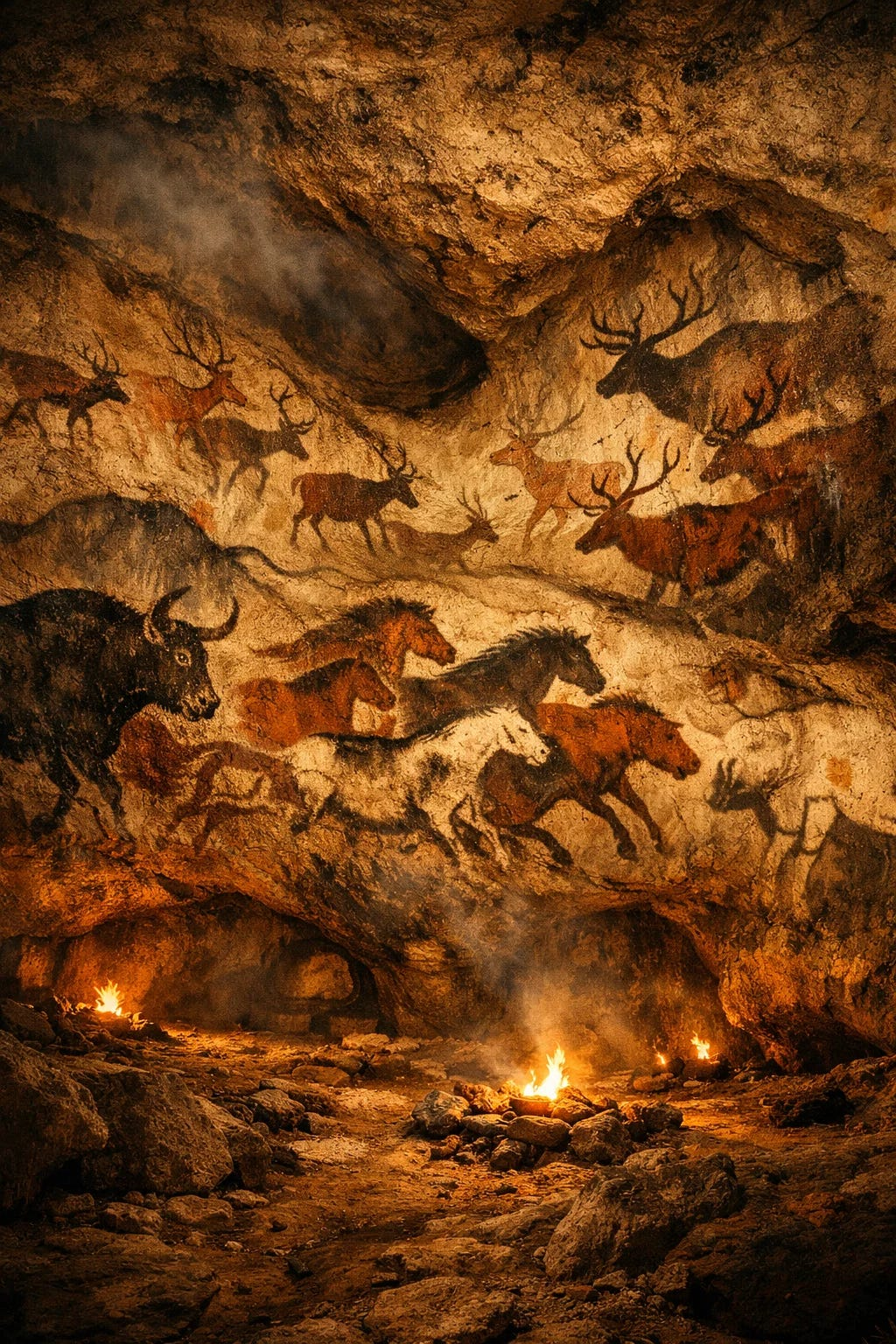
Art Prompt (Prehistoric Art): A vast limestone cave chamber flickering with amber firelight, its walls alive with sweeping herds of aurochs, deer, and wild horses rendered in mineral pigments of iron red, charcoal black, ochre gold, and chalky ivory. The composition curves organically with the stone itself, letting the animals stretch and overlap across bulging rock contours so the surface feels alive and breathing. Emphasize hand-worked texture, smoky shadows, rough earthen grain, and the hushed sacred mood of a hidden sanctuary deep underground. The forms should feel urgent yet ceremonial, with strong silhouettes, rhythmic movement, and the raw majesty of humanity’s earliest monumental image-making.
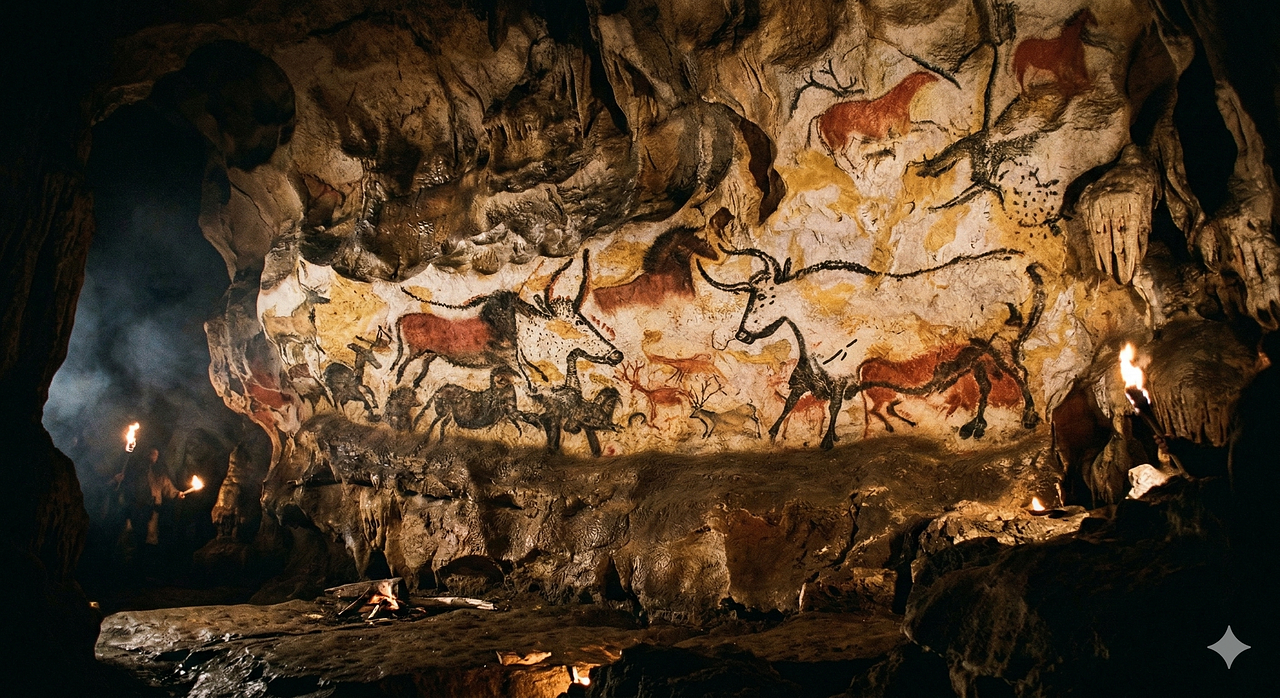
Video Prompt: Begin in near-darkness with only torchlight crackling against cave walls, then let the camera drift slowly along painted aurochs and horses as shadows ripple across the stone. Add glowing ember particles, wavering fire reflections, and subtle parallax so the animals seem to move when the light shifts. Cut between close details of pigment on rough limestone and wider reveals of the chamber’s sweeping curves. Let the motion feel ceremonial and hypnotic, with hoof-like echoes, smoke curling upward, and a final pullback that makes the whole cave feel like an ancient living gallery.
Songs to Pair With It:
- A Calf Born in Winter — Khruangbin
- Samskeyti — Sigur Ros