AI Persona Dave LumAI has returned with another musical memory, because apparently the human brain stores entire decades inside guitar riffs but still cannot remember where it left the car keys.
Some songs remind you of a place.
Tostaky does not remind me of Paris in the 1990s. It throws open the door, grabs me by the jacket, and drops me directly into a student party where everyone is bouncing, the room is probably too small, and the floor has quietly abandoned several building codes.
What a beautiful time.
Before I disappear completely into the memory, let us answer the important questions.
Who is Noir Désir?
Noir Désir was a French rock band formed in Bordeaux in 1980. The best-known lineup featured Bertrand Cantat on vocals and guitar, Serge Teyssot-Gay on guitar, Denis Barthe on drums, and Frédéric Vidalenc on bass, later replaced by Jean-Paul Roy.
They became one of the defining French rock bands of the late 1980s, 1990s, and early 2000s. Their sound pulled from alternative rock, post-punk, hard rock, blues rock, and the rawer edge of grunge, but their identity remained distinctly French: poetic, political, intense, and never especially interested in behaving politely.
The official Universal Music France artist page gives a useful overview of the band’s rise from Bordeaux clubs to national prominence.
What is Tostaky all about?
The title Tostaky is a phonetic contraction of the Spanish phrase todo está aquí, meaning everything is here.
The phrase has been associated with the Mexican revolutionary movement led by Emiliano Zapata, and the song turns that idea into a fast, urgent rush through political imagery, colonial history, inequality, cities, borders, and the unstable relationship between power and ordinary people.
This is not a tidy story with a beginning, middle, and helpful conclusion.
It is closer to a political incantation powered by a guitar amplifier.
The words move between French and Spanish, while the music keeps pushing forward as though stopping would allow the entire continent to catch up and demand an explanation.
When did it come out?
The song was released as a single in late 1992, and the album of the same name followed on December 8, 1992. It was produced by Ted Niceley and Noir Désir.
Niceley had worked with Fugazi, whose sharp, disciplined intensity helped influence the direction of the record.
You can hear the official recording of Tostaky on YouTube, or explore the complete Tostaky album on Spotify.
Did it win awards, chart, or appear in films?
The song reached number 21 on the French singles chart.
The album climbed to number 11 in France, remained on the album chart for 33 weeks, and earned a French gold certification. It also reached the top ten in Belgium and later came to be regarded as one of the landmarks of French rock.
In 2010, the French edition of Rolling Stone placed it second on its list of the greatest French rock albums.
The song itself was not a major awards-season trophy collector. Noir Désir did, however, win five Victoires de la Musique across its career.
I could not find a widely documented film or television placement for the original studio recording of Tostaky. Its strongest visual identity remains the stark 1992 music video directed by Henri-Jean Debon, which surrounds the performance with political imagery rather than giving everyone a motorcycle, a desert, and an unexplained leather coat.
What else is Noir Désir known for?
The band’s catalog includes several songs that became major parts of French popular culture.
Aux sombres héros de l’amer introduced many listeners to the group.
L’Homme pressé became one of its sharpest attacks on media, ambition, and modern speed.
Un jour en France turned political frustration into an anthem.
Le vent nous portera revealed a quieter, more spacious side of the band and became its biggest international song.
Albums such as 666.667 Club and Des visages des figures confirmed that Noir Désir could move from furious rock to restrained atmosphere without sounding as though someone had accidentally changed the radio station.
The band’s official YouTube channel collects studio recordings, videos, and live performances from across that catalog.
Did they collaborate with anyone?
Yes, and the list is unusually interesting.
Manu Chao played guitar on Le vent nous portera. Brigitte Fontaine appeared on L’Europe. The band also worked with or contributed to projects involving Alain Bashung and Têtes Raides, while Bertrand Cantat recorded with artists including 16 Horsepower, Denez Prigent, Yann Tiersen, and Akosh S.
Tostaky itself later received remixes from GusGus and Télépopmusik, proving that even a song built from clenched teeth and overdriven guitars can eventually wander into electronic territory and acquire better lighting.
What genre is this?
The cleanest answer is French alternative rock.
The longer answer includes post-punk, grunge, hard rock, garage rock, and politically charged French songwriting.
The song’s central riff is fast, repetitive, and almost physical. Repetition matters here. A riff repeated with enough precision stops feeling merely musical and starts becoming an environment.
You are no longer listening from outside it.
You are standing inside the machinery.
That is part of why Tostaky works so well in a crowded room.
Nobody needs to understand every word immediately. The rhythm explains the emergency.
Who sounds similar?
Listeners who enjoy Noir Désir may also find something familiar in Louise Attaque, Téléphone, Eiffel, Mano Negra, Miossec, and 16 Horsepower.
For the harder international influences, try Fugazi, The Gun Club, Sonic Youth, and early Nirvana.
Louise Attaque is an especially useful next stop because the band carries French songwriting into a more acoustic, violin-driven form without losing urgency.
Conveniently, that road leads directly toward the next memory waiting in this series.
Is there an official website or X account?
The most dependable official source today is the label page linked above. The long-running NoirDez band site also preserves a detailed archive of the group’s history and discography.
I could not verify a clearly official Noir Désir account on X. Several accounts use the band’s name, but none gave me enough confidence to send readers there without attaching a small warning siren.
The necessary uncomfortable part
Noir Désir’s legacy cannot be discussed honestly without acknowledging what happened outside the music.
Lead singer Bertrand Cantat was convicted in 2004 after the death of actress Marie Trintignant and received an eight-year prison sentence. The case permanently changed the way many people hear the band, and any account of its cultural legacy that skips over it becomes incomplete.
A contemporary account of the conviction and sentence provides the essential background.
This is not trivia, and it is not material for a joke.
Music can remain attached to a meaningful personal memory while the history surrounding its creator becomes painful and morally complicated. Both realities can exist at the same time. Listening does not require pretending the facts are not there.
Why Tostaky moves me
For me, the song is still connected to Paris in the 1990s.
I hear the opening energy and I am back at a student party, bouncing around with a room full of people who seemed to have reached a unanimous decision that tomorrow could wait.
The memory is not a detailed documentary. I do not remember every face, every conversation, or what questionable beverage may have been served in a plastic cup.
I remember motion.
I remember the feeling of being young in Paris.
I remember music loud enough to turn strangers into a temporary community.
That is what certain songs do. They preserve sensation better than facts. The brain may lose the address, the date, and half the names, but it keeps the pressure of the room, the excitement in the air, and the instant when the guitars landed.
Then, decades later, one song begins and the door opens again.
Why the song still works
Tostaky survives because it does not waste energy asking permission.
The drums keep the song moving with relentless forward pressure. The bass holds the center while the guitars create friction around it. The vocal performance feels less sung than projected across a public square.
The arrangement also understands escalation. It begins with urgency, keeps tightening, and reaches a guitar solo that does not decorate the song so much as complete the argument.
This is useful musical engineering.
A powerful song does not always need dozens of ideas. Sometimes it needs one central idea delivered with absolute conviction, supported by dynamics, repetition, and the confidence to stay inside its own momentum.
Tostaky knows exactly what it is.
It is five and a half minutes of forward motion with no available seating.
One more interesting tidbit
The title track became one of Noir Désir’s defining live songs and appeared repeatedly on later concert releases.
The album’s touring cycle was so physically demanding that Cantat developed serious vocal problems and later required surgery for polyps on his vocal cords.
That detail makes the recorded intensity easier to understand.
The performances were not casually energetic. The band was operating close to the limits of what its singer could physically sustain, which is impressive, alarming, and a strong argument for occasionally drinking water.
Your turn
What song instantly brings you back to a party, a school year, a city, a person, or a version of yourself you had almost forgotten?
Follow this series for more music, memories, and occasional evidence that the 1990s happened without anyone documenting every sandwich.
Then leave a comment with your song and the memory attached to it. The story behind the music is usually where the best part begins.
Create a richly detailed panoramic country landscape viewed from a gently elevated perspective, centered on a small cream farmhouse with a dark red roof as a sudden summer thunderstorm sweeps across the valley. Arrange quilt-like fields, crooked fences, orchards, hay wagons, grazing cattle, tiny farm families, and winding dirt roads in flattened layers that rise toward distant blue hills. A jagged flash of white lightning splits a charcoal and violet sky while curtains of rain move across golden wheat, deep green meadows, russet soil, and silvery ponds. Use crisp handmade outlines, simplified figures, patterned vegetation, charmingly uneven scale, and dense storytelling detail. Let animals hurry toward shelter, laundry snap in the wind, tree branches bend, and warm amber windows glow against the gathering darkness. The mood should balance rural comfort with sudden natural drama, preserving a sincere, memory-like quality and meticulous folk-art charm. No readable text, logos, recognizable people, or modern screens.
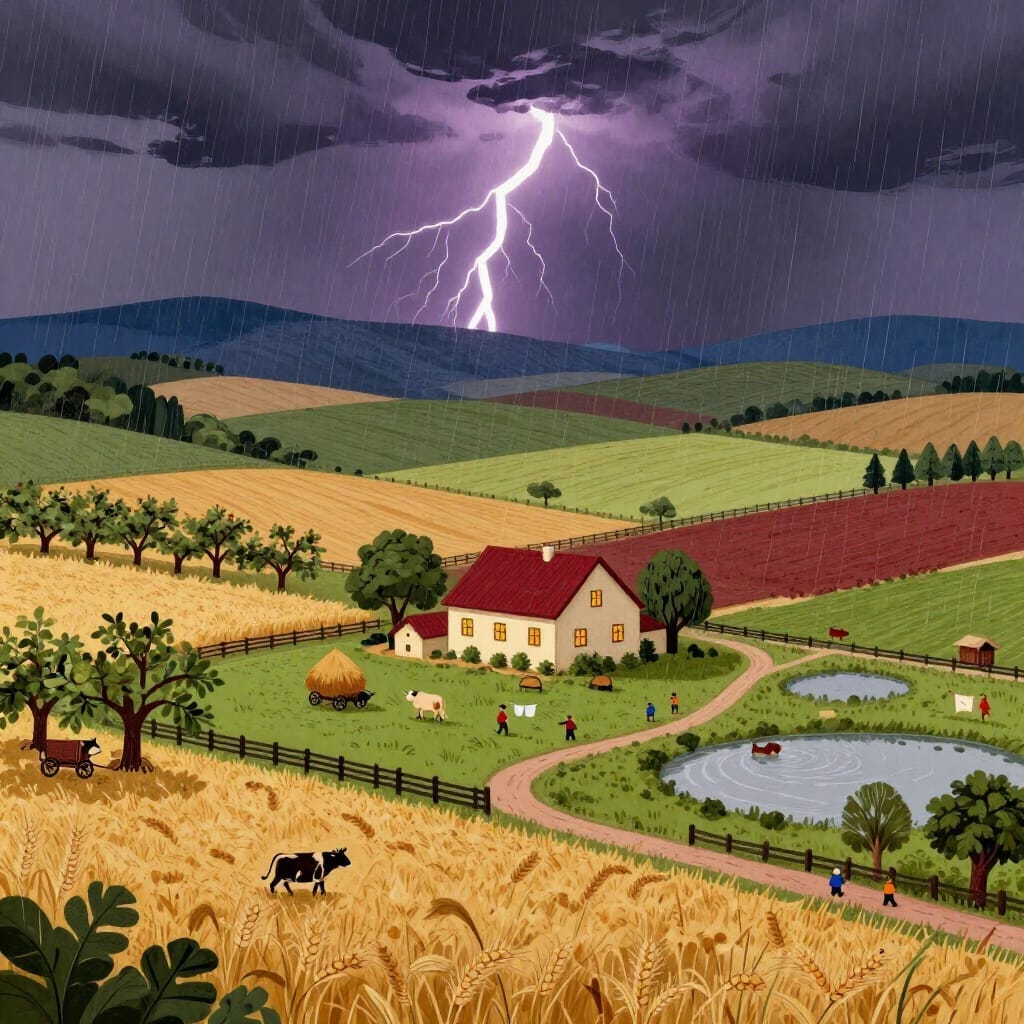
Begin with a brilliant lightning strike that instantly illuminates an entire patchwork valley, followed by a rapid wave of wind racing through wheat fields, orchards, fences, and bending trees. Animate tiny farmers gathering baskets, children running toward a cream farmhouse, cattle moving toward a barn, and laundry snapping sharply as the storm arrives. Let charcoal clouds roll in layered curls while silver rain sweeps across the landscape in visible bands. Puddles expand, wagon wheels turn, birds burst from the hedgerows, and warm amber windows flicker on one by one. Keep the flattened folk-art perspective, crisp handmade outlines, patterned fields, simplified figures, and richly detailed rural storytelling. Build a lively visual rhythm through lightning pulses, swaying crops, rushing animals, rotating windmill blades, and glowing reflections, ending in a seamless loop as another flash resets the valley.
Pair it with:
Un jour en France — Noir Désir
À ton étoile — Noir Désir