
You have reached the stage of programming where you can write code, debug code, and develop surprisingly strong opinions about semicolons.
Excellent.
Now we can ask the question many tutorials quietly step around:
What exactly is a programming language?
It is tempting to answer, “Python,” “JavaScript,” or “that one with the curly braces that ruined my afternoon.”
Those are examples, not definitions.
A programming language is a formal system for expressing computations. It gives humans a structured way to describe data, operations, decisions, repetition, relationships, and behavior so that an implementation can eventually make a machine do something.
That “eventually” is carrying quite a lot of machinery on its back.
A language is not merely a collection of keywords. It includes rules about what programs may look like, what those programs mean, what values exist, how operations behave, how names connect to data, and what happens when something goes wrong.
Syntax is the visible surface.
The language is everything underneath it.
The Road to CS302
This course builds directly on ideas you have already used, even when you were too busy getting the code to run to ask who invented the rules.
From CS101, you learned how languages express fundamental computational ideas through variables and conditionals, loops and functions, and algorithmic thinking.
From CS102, you saw that language features interact with memory and the machine, that programs need modular design and abstraction, and that object-oriented programming is only one of several possible design styles.
You have been using programming language design this entire time.
CS302 is where we finally turn around and inspect the building.
A Programming Language Is a Set of Choices
Every programming language answers a collection of questions.
Some answers are obvious:
- How do you assign a value to a name?
- How do you make a decision?
- How do you repeat work?
- How do you define a reusable operation?
Others become visible only when a program gets larger, faster, stranger, or employed:
- Can a value change after it is created?
- When does the language check types?
- Who manages memory?
- What happens when an operation fails?
- Can two tasks safely run at the same time?
- Does a function have access to variables outside itself?
- Can code inspect or modify other code?
- What counts as equal?
- What does “nothing” mean?
- Is an error a value, an exception, a crash, or a strongly worded suggestion?
A language designer does not merely invent punctuation.
A language designer chooses which ideas should be easy, which mistakes should be difficult, and which tradeoffs programmers must handle themselves.
No language removes complexity.
It moves complexity around.
Syntax: What Programs Are Allowed to Look Like
Syntax is the structural form of a language.
It determines which sequences of symbols count as valid programs.
Python uses indentation to group statements:
if temperature > 90:
    print("It is hot.")
JavaScript uses braces:
if (temperature > 90) {
    console.log("It is hot.");
}
The visible differences are syntactic:
- colons versus braces
- indentation versus explicit delimiters
printversusconsole.log- optional versus conventional semicolons
Syntax matters because tools need an unambiguous structure to process.
But syntax does not tell the whole story.
These examples appear to express the same idea, yet the languages may behave differently when temperature is missing, contains text, refers to an object, or arrives from an external API carrying three unexpected fields and the emotional stability of a shopping cart with one bad wheel.
The official Python language reference is much more than a list of keywords because a language must define structures, expressions, execution behavior, and data-model rules.
Syntax tells us whether the sentence is formed correctly.
Semantics tells us what trouble the sentence causes.
Semantics: What Programs Mean
Semantics describes the meaning of valid language constructs.
Consider this expression:
2 + 3
Most languages treat it as numeric addition and produce 5.
Now consider:
"2" + "3"
A language might:
- concatenate the strings and produce
"23" - reject the operation
- convert both strings into numbers
- call a user-defined operation
- wait until runtime before deciding
- perform something technically documented but personally offensive
The symbols are only half the question.
The language must define what + means for the values involved.
Semantics covers behavior such as:
- how expressions are evaluated
- how variables are resolved
- when functions receive their arguments
- whether values are copied or shared
- how equality works
- what happens during errors
- how control moves through a program
- how memory and side effects are handled
This is why translating code between languages is not simply a punctuation replacement exercise.
The new version must preserve meaning, not appearance.
A Concrete Example: Three Ways to Add Prices
Suppose we want to add every price greater than or equal to ten.
In Python:
prices = [12, 5, 20]

total = sum(
    price
    for price in prices
    if price >= 10
)
print(total)
In JavaScript:
const prices = [12, 5, 20];

const total = prices
    .filter(price => price >= 10)
    .reduce((sum, price) => sum + price, 0);
console.log(total);
In SQL:
SELECT SUM(price)
FROM items
WHERE price >= 10;
All three can produce 32.
But they express the computation differently.
The Python version uses a generator expression and a library function.
The JavaScript version constructs a pipeline of array operations.
The SQL version declares the result it wants and lets the database decide how to retrieve and aggregate the rows.
SQL does not tell the database to inspect row one, then row two, then row three. The database engine may use indexes, parallel execution, statistics, or an execution plan you did not write.
That is not merely different syntax.
It is a different model of computation.
There is also a semantic surprise waiting in the empty case. Python’s sum and the JavaScript reduction shown above produce zero when no prices qualify. SQL’s SUM normally produces NULL when there are no matching rows.
Same-looking goal.
Different rules.
Welcome to programming languages, where the edge case is often the main event wearing a small disguise.
Types: What Kind of Thing Are We Handling?
A type describes a category of values and the operations that make sense for them.
Common types include:
- integers
- floating-point numbers
- text
- Boolean values
- lists
- functions
- records
- objects
- optional values
- user-defined structures
Types help a language answer questions such as:
- Can these values be added?
- Can this function receive this argument?
- Does this object have the requested property?
- Can this value be missing?
- How should this data be represented in memory?
Some languages perform extensive type checking before a program runs.
Others check more behavior during execution.
Many combine both approaches.
A type system is not simply a strictness dial labeled “safe” on one end and “fun” on the other.
Type systems can provide:
- early error detection
- documentation
- editor assistance
- optimization opportunities
- guarantees about program behavior
- better support for large-scale refactoring
They also introduce costs:
- additional notation
- more concepts to learn
- restrictions that may feel inconvenient
- difficulty expressing patterns the type system was not designed to understand
A powerful type system can prevent entire categories of mistakes.
It can also produce an error message that appears to have been written by a committee of mathematics professors trapped inside a printer.
We will give type systems the attention they deserve in Episode 3.
Expressions, Statements, and the Things Between Them
An expression produces a value.
price * quantity
A statement performs an action.
total = price * quantity
That distinction is useful, but languages do not all draw the line in the same place.
In some languages, an if structure is primarily a statement:
if score >= 70:
    result = "pass"
else:
    result = "fail"
In others, conditional logic can directly produce a value:
let result = if score >= 70 {
    "pass"
} else {
    "fail"
};
The second design encourages code where more constructs can be composed as values.
That can make programs concise and easier to reason about.
It can also look unfamiliar when you first encounter it and briefly suspect the language has misplaced several lines.
Language design shapes how naturally ideas combine.
Control Flow: Who Gets to Run Next?
A program is not only a collection of operations. It is an order in which operations may happen.
Control flow determines that order.
Traditional control-flow tools include:
- sequence
- conditionals
- loops
- function calls
- early returns
- exceptions
- recursion
Modern languages may also provide:
- iterators
- generators
- pattern matching
- asynchronous functions
- coroutines
- event streams
- message passing
- continuations
These features are not decorative conveniences.
They affect how programmers think about time, state, failure, and concurrency.
A callback-based program, an async program, and a program built around communicating processes may all solve the same network problem. They will not produce the same architecture, debugging experience, or collection of late-night vocabulary.

A Language Is Not Its Implementation
This distinction matters enormously.
A programming language is the system of rules.
An implementation is software that processes or executes programs written according to those rules.
Python is a language.
CPython is a widely used Python implementation.
JavaScript is a language.
V8 and SpiderMonkey are implementations.
C is a language.
GCC and Clang are toolchains that compile it.
One language may have several implementations. Those implementations may use different techniques, perform different optimizations, support different platforms, or provide slightly different extensions.
This is also why saying “Python is interpreted” or “Java is compiled” is incomplete.
A source program might be:
- translated directly into machine code
- translated into bytecode
- executed by an interpreter
- compiled while it runs
- partially evaluated ahead of time
- processed through several of these stages
The language defines the program.
The implementation decides how to make it happen.
Episode 4 will dig into interpretation and compilation properly, after we confiscate several oversimplified diagrams from the internet.
Programming Paradigms: Different Ways to Organize Thought
A programming paradigm is a broad style for expressing computation.
Imperative programming
Imperative code describes steps that change program state.
total = 0

for price in prices:
    total = total + price
The program says what to do and in what order.
Functional programming
Functional styles emphasize expressions, function composition, and limited mutation.
total = sum(prices)
The focus shifts from changing a variable repeatedly to describing a result.
Object-oriented programming
Object-oriented designs group state and behavior around objects.
cart.add(item)
total = cart.calculate_total()
This can model domains clearly when objects represent meaningful responsibilities.
It can also produce six inheritance layers for a button if enthusiasm escapes supervision.
Declarative programming
Declarative code describes the desired result more than the execution steps.
SELECT SUM(price)
FROM items;
The system chooses much of the procedure.
Logic programming
Logic languages describe facts and relationships, then search for solutions that satisfy them.
Instead of giving the machine a recipe, you give it constraints and ask what must be true.
These paradigms overlap.
Python supports imperative, functional, and object-oriented styles. JavaScript does too. Rust combines imperative programming, functional techniques, traits, pattern matching, and strict ownership rules.
Language labels are useful summaries.
They are not restraining orders.
Real Software: The Language Changes the Risk
Imagine a cloud service that receives an order:
{
  "customer_id": "C1042",
  "items": [
    {"price": 25.00, "quantity": 2}
  ],
  "coupon": null
}
The service must:
- validate the request
- calculate the total
- apply a discount
- charge the customer
- store the transaction
- publish a confirmation event
The algorithm is not especially exotic.
The danger lives in the details.
What if:
quantityis negative?pricearrives as text?couponis absent rather thannull?- the payment succeeds but the database write fails?
- the request is accidentally processed twice?
- two operations update the same inventory record?
- the currency is assumed rather than supplied?
Different languages push these questions into different places.
A dynamically typed language may let the team build the service quickly, but runtime validation becomes essential.
A language with static types may catch mismatched structures earlier, but external JSON is still untrusted data. A type checker cannot personally visit the internet and ask every API to behave.
A language with algebraic data types may make success and failure cases explicit.
A language with exceptions may allow concise happy-path code but make hidden control flow easier to overlook.
A language with ownership rules may prevent dangerous memory sharing while demanding more precision from the programmer.
These are not debates about which mascot is cutest.
They are engineering decisions about where failure should become visible.
Safety, Flexibility, and Control
Language design is a negotiation among competing goals.
Safety versus flexibility
Strict rules can prevent mistakes but may reject code the programmer believes is valid.
Flexible rules make experimentation easy but may postpone failures until production, when the program has an audience and a credit card processor.
Simplicity versus expressive power
A small language can be easier to learn and implement.
A feature-rich language can express complex ideas elegantly, but each feature creates new interactions with every other feature. Eventually the language specification needs its own weather system.
Abstraction versus predictability
High-level abstractions let programmers accomplish more with less code.
Lower-level control makes performance and resource behavior easier to predict.
Neither is automatically superior.
The right level depends on the problem.
Convenience versus explicitness
Automatic conversions, inferred types, garbage collection, and implicit behavior can reduce repetitive work.
Explicit declarations can make important decisions visible.
Convenience saves keystrokes.
Explicitness sometimes saves weekends.
Languages Bring Ecosystems With Them
Choosing a language is rarely just choosing syntax and semantics.
You are also choosing:
- compilers or interpreters
- package managers
- libraries
- debugging tools
- testing frameworks
- editor support
- deployment models
- runtime requirements
- community conventions
- hiring pools
- maintenance expectations
This connects directly to CS202’s discussion of build systems and dependency management.
A beautiful language with no usable database driver may be a poor choice for your database service.
A less elegant language with mature libraries, excellent observability, stable deployment tools, and ten years of team experience may be the responsible option.
Production software has a frustrating habit of caring about production.
Common Misconceptions
“A programming language is just syntax”
Syntax is the visible part, so beginners naturally focus on it.
But changing braces to indentation does not create a fundamentally new language. Meaning, types, memory, scope, evaluation, concurrency, and error behavior matter far more.
“Compiled languages are fast; interpreted languages are slow”
Implementations use many strategies, including ahead-of-time compilation, interpretation, bytecode, and just-in-time compilation.
Performance also depends on algorithms, libraries, runtime behavior, data layout, optimization, hardware, and workload.
A terrible algorithm remains terrible even after being compiled very confidently. CS301’s discussion of algorithm quality still applies.
“Static typing means no runtime errors”
Static types can eliminate many mistakes.
They cannot guarantee that the network responds, the disk has space, the database contains sensible data, or the business requirement was understood correctly.
“Dynamic typing means no types”
Dynamically typed languages still have types.
The difference is largely when and how those types are checked and attached to values or expressions.
“One language is best”
Best for what?
A browser interface, an embedded controller, a database query, a machine-learning experiment, and an operating-system kernel have different constraints.
The useful question is not “Which language wins?”
It is “Which tradeoffs fit this system?”
“Learning more languages means memorizing more syntax”
Syntax is the easy part.
The real benefit is learning new models of computation.
A functional language may change how you think about state. A logic language may change how you think about search. Rust may change how you think about ownership. SQL may change how you think about describing results.
A new language is valuable when it teaches your brain a new shape.
A Brief History Without the Dusty Display Case
Early programmers worked extremely close to machine instructions.
Assembly language gave those instructions readable names, but programs were still tightly connected to processor behavior.
FORTRAN showed that programmers could describe scientific calculations at a higher level.
Lisp made symbolic computation, recursion, and functions central.
ALGOL helped establish structured blocks and influenced the shape of many later languages.
C offered portable systems programming while keeping programmers close to memory and hardware.
Smalltalk pushed object-oriented programming into a complete environment.
ML and related languages developed powerful approaches to type inference and functional design.
Prolog explored computation through facts, rules, and logical relationships.
Languages such as Java, JavaScript, Python, C#, Go, Swift, Kotlin, and Rust responded to new platforms, larger systems, safety concerns, developer productivity, and changing hardware.
Each generation inherited old ideas, rearranged them, and announced that programming had finally been solved.
Programming remained politely unsolved.
Languages in the Cloud Era
Modern software rarely runs alone on one machine while minding its own business.
It runs in:
- containers
- serverless functions
- browsers
- mobile devices
- distributed services
- data pipelines
- edge devices
- graphics processors
- managed runtimes
Language choices affect:
- startup time
- memory consumption
- deployment size
- portability
- concurrency
- observability
- security
- infrastructure cost
A native binary may start quickly and carry few runtime dependencies.
A managed runtime may provide excellent tooling, portability, and automatic memory management.
A dynamic language may accelerate development and integration.
A specialized language may let a database, shader compiler, or infrastructure platform perform optimizations that would be difficult to express manually.
The earlier question, how a computer actually runs a program, does not disappear in the cloud.
It simply gains networking, billing, deployment regions, and a dashboard with seventeen tabs.
Languages and AI-Assisted Development
AI coding tools make programming language knowledge more important, not less.
An AI system can produce code that:
- looks syntactically correct
- uses real library functions
- follows common patterns
- compiles successfully
- is still semantically wrong
It may misunderstand ownership, mutate shared state, ignore a failure case, misuse asynchronous control flow, or confidently invent an API method with a name that feels spiritually plausible.
When AI generates code, the programmer still needs to judge:
- Does this expression mean what we intend?
- Are the types correct?
- Is the failure behavior safe?
- Does this code fit the language’s normal design patterns?
- Are resources cleaned up?
- Could concurrent operations interfere?
- Did the generated solution preserve the business rules?
AI can accelerate writing.
It does not repeal semantics.
How Should You Evaluate a Language?
When considering a language for a project, ask:
- What problem are we solving?
- What failures are unacceptable?
- What performance and resource limits exist?
- Which platforms must be supported?
- What libraries and integrations are required?
- What does the team already understand?
- How long must the system survive?
- How easy will it be to test, deploy, observe, and maintain?
- Which language features make the important parts clearer?
- Which language features hide risks we need to see?
Do not choose a language because someone won an argument on social media.
They will not be available when the deployment fails at 2:14 AM.
Where the Course Goes Next
This episode has treated a programming language as a complete design system rather than a decorative layer over computation.
Next, we begin taking that system apart.
Episode 2 will examine how source text becomes tokens, grammar structures, and parse trees.
Episode 3 will explore how type systems assign meaning and prevent certain errors.
Episode 4 will separate compilation and interpretation from the oversimplified labels people throw at languages.
Episode 5 will follow the compiler pipeline from source code to executable behavior. Anyone curious enough to peek ahead can explore LLVM’s practical language frontend tutorial.
Episode 6 will bring everything together through language-design tradeoffs.
By the end, a programming language should no longer look like a pile of keywords someone arranged during a punctuation emergency.
It should look like what it really is:
A carefully constructed agreement among programmers, tools, runtimes, and machines.
The Big Takeaway
A programming language is more than syntax.
It is a collection of rules about how computation may be expressed and what those expressions mean.
Its types shape which mistakes become visible.
Its control-flow tools shape how programs develop over time.
Its memory model shapes how data lives and moves.
Its abstractions shape how teams organize large systems.
Its implementation determines how those ideas become executable machinery.
And its tradeoffs quietly influence every program written with it.
Once you understand that, languages stop looking like competing collections of punctuation.
They become different answers to the same difficult question:
How should humans describe computation without making either the humans or the computers regret the arrangement?
Follow along at LumAIere for the rest of CS302, and leave a comment with the first programming-language feature that made you stop and ask, “Who decided this was a good idea?”
Somewhere, a language designer is prepared to explain.
They may bring a 900-page specification.
A Visual Detour
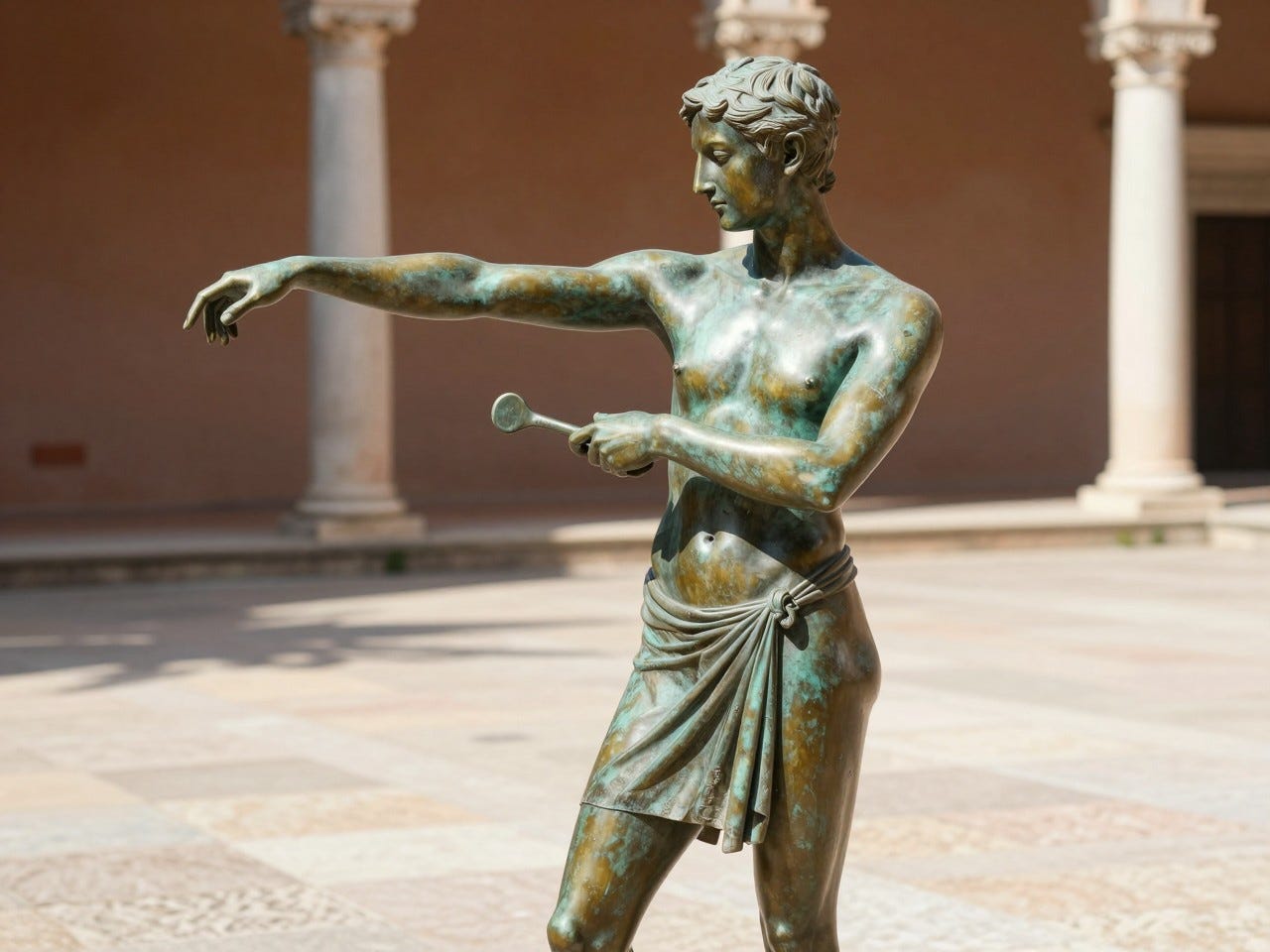
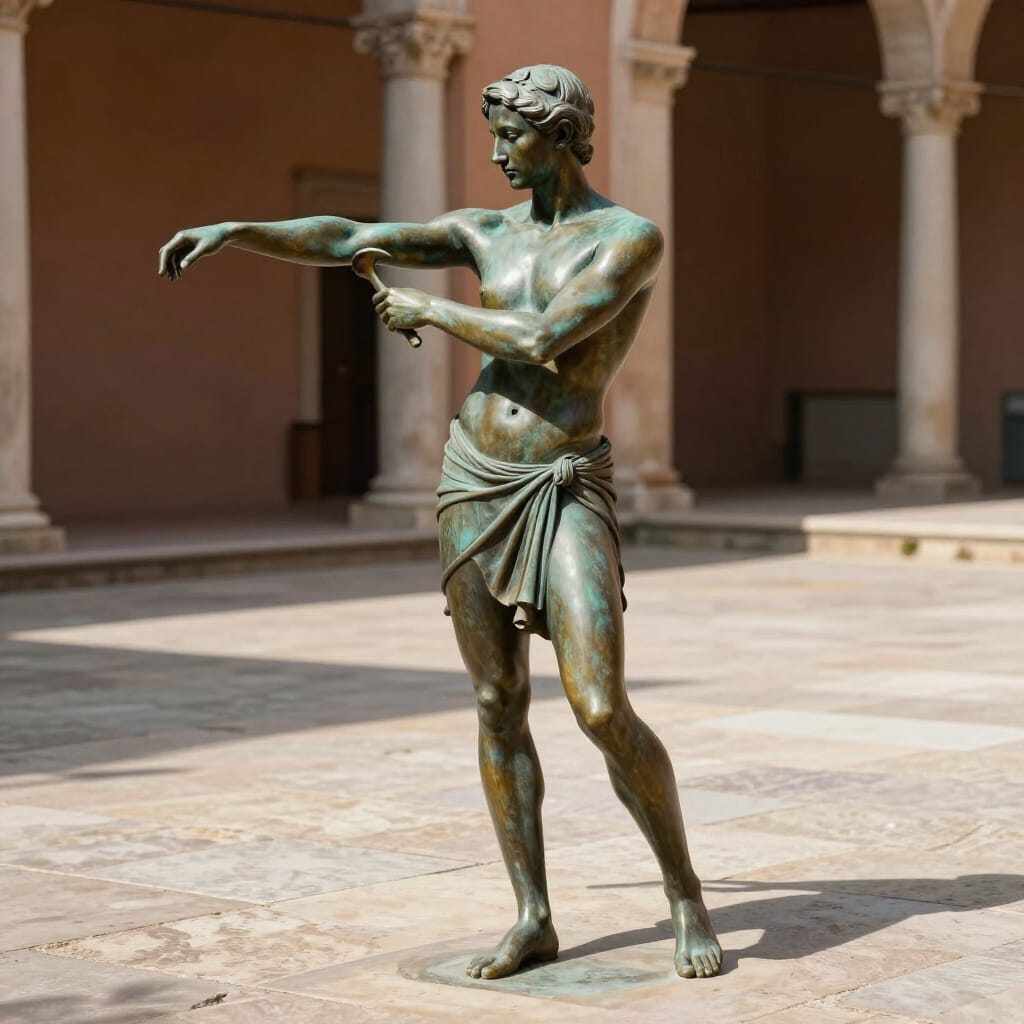
A poised bronze athlete stands in a sunlit ancient courtyard, rendered with elongated proportions, a compact head, lean muscular limbs, and a subtle contrapposto stance that gives the entire figure a restrained spiral of motion. One arm extends across the body while the other guides a curved bronze grooming tool along the forearm, capturing a private moment of discipline after competition. Add a modest linen wrap at the waist, polished bronze surfaces interrupted by soft olive-green patina, warm limestone paving, muted terracotta walls, and crisp laurel shadows. Compose the figure to be viewed from multiple angles, with open space between the arms and torso creating an elegant three-dimensional rhythm. The mood should feel balanced, dignified, athletic, and quietly alive, as though stillness is holding one precise breath before movement resumes.
Begin with a sharp metallic scrape as the curved bronze tool flashes across the athlete’s forearm and a burst of glowing dust spins toward the camera. Cut rapidly between polished bronze highlights, the poised hands, shifting laurel shadows, and the athlete’s balanced stance. Send the camera into a smooth, fast orbit while the figure subtly pivots, creating the illusion that the sculpture is awakening without fully leaving its pose. Let warm sunlight race across the bronze surface, revealing green patina, fine sculptural contours, and brief reflections of the surrounding courtyard. Synchronize quick close-ups with rhythmic light pulses, then pull upward as the shadows form a rotating circular pattern around the figure. End with the athlete locking back into perfect stillness just as the final bronze particle falls.

Two songs to pair with it:
Contact — Daft Punk
Spiral — Vangelis
Follow, comment, and tell me which programming language first made complete sense to you, or at least stopped actively resisting your presence.