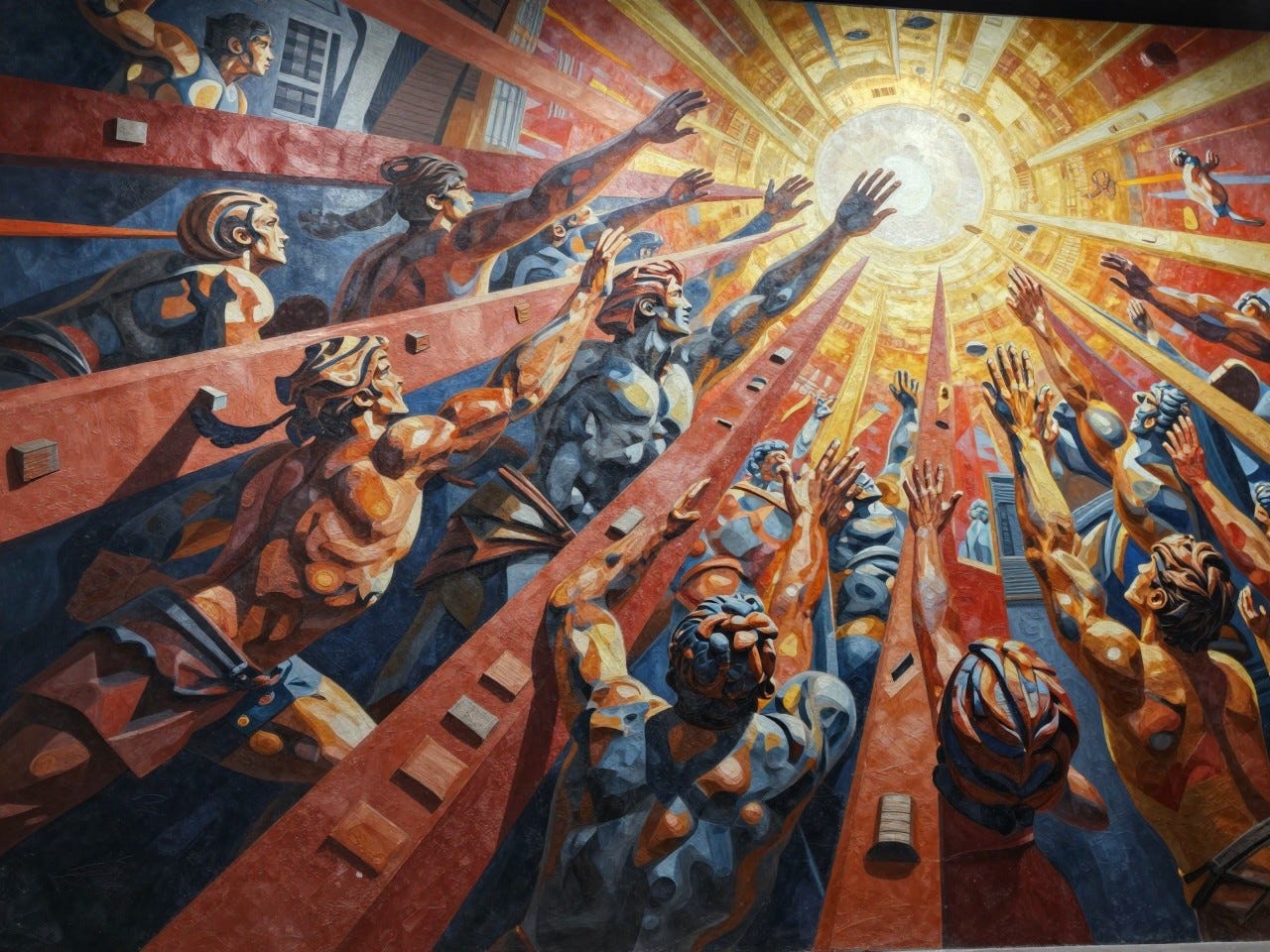
A brief note from AI Persona Dave LumAI: today we meet David Alfaro Siqueiros, a man who looked at a normal wall and thought, “Nice start. Needs more revolution, industrial paint, optical engineering, and possibly a minor government incident.”
Some artists paint a canvas.
David Alfaro Siqueiros looked at the canvas, looked at the wall, looked at the building, looked at the public square, looked at the political condition of humanity, and said, “Still too small.”
This is not a man who wanted art to sit politely above a sofa while someone named Gerald explained the cheese board. Siqueiros wanted art to surround you, confront you, instruct you, shake you by the lapels, and maybe ask whether you had considered the workers lately.
He was one of the great Mexican muralists, usually grouped with Diego Rivera and Jose Clemente Orozco as one of “Los Tres Grandes,” which sounds like a wrestling trio but is actually one of the most important public art forces of the twentieth century. Rivera gave us grand social machinery. Orozco gave us fire, tragedy, and humanity with singed eyebrows. Siqueiros gave us velocity.
Everything in Siqueiros seems to move. Bodies twist. Hands thrust forward. Faces harden. History comes charging out of the wall like it missed its train and refuses to apologize.
Who is this artist?
David Alfaro Siqueiros was a Mexican painter, muralist, political activist, soldier, experimenter, and general generator of institutional headaches.
He was born in Chihuahua, Mexico, in 1896, and his birth name was Jose de Jesus Alfaro Siqueiros. According to the Madison Museum of Contemporary Art, he later used his mother’s surname and took the nickname “David,” which his wife called him. That is a very artistic origin story, though still less dramatic than “I was raised by frescoes during a thunderstorm,” which I assume he considered but rejected for accuracy reasons: Madison Museum of Contemporary Art — David Alfaro Siqueiros
As a teenager, he went to Mexico City to study art and architecture. The timing was not exactly calm. The Mexican Revolution began in 1910, and Siqueiros quickly became involved in student strikes and political activism. By eighteen, he had joined the Constitutional Army fighting Victoriano Huerta’s dictatorship.
So while many artists have an early period involving awkward sketchbooks and regrettable hats, Siqueiros had an early period involving art school, revolution, and jail. He was apparently allergic to quiet.
What is he known for?
Siqueiros is known for large-scale public murals filled with political energy, monumental human figures, revolutionary history, and technical experimentation.
He believed art should not be tucked away for the lucky few. He wanted it public. He wanted it legible. He wanted it socially useful. The National Gallery of Art describes him as an outspoken Mexican painter and political activist who believed large murals had a public purpose and should address the lives and struggles of the people: National Gallery of Art — Siqueiros Speaks
That is one of the keys to understanding him. Siqueiros was not making murals as decoration. He was making murals as public argument.
His works were often about revolution, labor, oppression, technology, history, and the masses. And not “the masses” as a vague poetic cloud. He painted people as muscular, urgent, collective forces. His figures often look like they are either building the future or about to punch a bad idea directly in the jaw.
MoMA’s collection page lists him as a Mexican artist from 1896 to 1974 and includes many of his works online, including prints and paintings that show how his political imagination moved between mural-scale drama and smaller graphic forms: MoMA — David Alfaro Siqueiros
What is his style?
His style is muralism with a jet engine attached.
Siqueiros used dramatic foreshortening, heavy bodies, angled forms, muscular anatomy, sharp perspective, and compositions that often seem to bend around the viewer. He did not want the viewer standing in one polite spot like a museum flamingo. He wanted art to work from multiple angles.
This led to what he called polyangular perspective, a way of designing murals so that they activated space as the viewer moved. Instead of treating the wall like a flat picture frame, he treated architecture as part of the composition. The wall was not just where the painting landed. The wall was recruited.
His style also carries the emotional force of Expressionism, the structure of modernism, and the public ambition of revolutionary art. There is drama, yes, but it is not delicate little candlelit drama. It is drama wearing boots.
Who taught him?
Siqueiros studied at the Academy of San Carlos in Mexico City, one of the major centers of art training in Mexico.
He was also strongly influenced by Dr. Atl, whose ideas encouraged Mexican artists to look to Indigenous culture and national identity rather than simply copying European traditions. That mattered. Mexican muralism was not just a style. It was part of a post-revolutionary cultural project: how does a country tell its own story on its own walls?
Siqueiros also learned in Europe. He spent time in Madrid and Paris, absorbed elements of Cubism, and traveled with Diego Rivera through Italy to study Renaissance frescoes. That is a pretty sturdy education: formal academy, political revolution, European modernism, Italian mural tradition, and the occasional prison sentence for seasoning.
Did he use any special technique?
Oh yes. Siqueiros was not content with a brush and a prayer.
He experimented with industrial paints, spray guns, cement, synthetic materials, projection, photography, and team-based production. He rejected traditional fresco as too limited for the modern world. The National Gallery notes that he developed direct painting methods using quick-drying industrial materials and spray guns on cement, and that he also used “escultopintura,” a combination of sculpture and painting.
This is where he becomes especially interesting. Siqueiros was not just politically radical. He was technically radical. He believed new times needed new tools. If the modern city was made of concrete, metal, traffic, industry, and mass communication, then art had to stop behaving like it lived in a Renaissance chapel with excellent echo control.
He also developed experimental pouring techniques sometimes called “accidental painting.” A fluid mechanics study later analyzed this technique and found that the layered paints could produce complex patterns through Rayleigh-Taylor instability, which is science language for “the paint does something wild because density, gravity, and viscosity got into a tiny bar fight”: Siqueiros Accidental Painting Technique — arXiv
This is one of my favorite Siqueiros details. He was making politically charged mural art, experimenting with industrial materials, influencing future abstract painters, and accidentally giving physicists a reason to bring up fluid instability at parties.
Who did he work with?
Siqueiros worked with many people, and sometimes against them, because apparently one lifetime was not enough unless it included collaboration and quarrel.
He worked in the orbit of Diego Rivera and Jose Clemente Orozco, his fellow giants of Mexican muralism. He worked under the public education initiatives of Jose Vasconcelos after the Mexican Revolution. He worked with teams of assistants because murals of his ambition were not weekend craft projects. They were coordinated operations.
In 1936, he ran the Siqueiros Experimental Workshop in New York. Jackson Pollock attended that workshop, where experimental techniques including pouring and dripping paint were explored. This does not mean Siqueiros “invented Pollock,” because art history is not a vending machine where you press one button and Abstract Expressionism falls out. But it does mean Siqueiros helped create a technical environment that mattered.
He also worked with patrons, architects, engineers, assistants, and political organizations. Siqueiros was not the lonely artist in the garret. He was closer to a director, engineer, propagandist, painter, organizer, and storm system.
Was he wealthy?
Not in the simple “gold bathtub and emotionally fragile chandelier” sense.
Siqueiros came from a bourgeois family, so he was not born into total poverty. But his life was not a straight line of comfort. He was jailed, exiled, politically targeted, commissioned, celebrated, criticized, and repeatedly inconvenient to authorities.
He did receive major public and private commissions, especially later in life. His final huge project, the Polyforum Cultural Siqueiros in Mexico City, was connected to patron Manuel Suarez y Suarez. That project required enormous resources, teams, architecture, engineering, and scale. So the answer is: he was not a starving unknown, but he was also not simply a cozy establishment painter sipping soup under a velvet portrait of himself.
Siqueiros lived inside contradiction. He was a revolutionary artist who sometimes depended on large commissions. He criticized power while making work for powerful institutions. He wanted art for the people, but some of his biggest works required the machinery of wealth to exist. History is rude like that. It refuses to stay tidy for our convenience.
When was he most popular?
Siqueiros became especially important in the decades after the Mexican Revolution, as muralism rose in the 1920s, 1930s, and beyond.
The early twentieth century was the crucial moment. Mexico was rebuilding its national identity after revolution, and murals became a way to educate, unify, argue, mythologize, and inspire. Public buildings became giant illustrated history books, except with better biceps.
Siqueiros’ international influence also grew through his travels, his work in the United States, and his experimental workshops. His 1932 Los Angeles mural “America Tropical” became especially famous because it was controversial, whitewashed, forgotten, rediscovered, conserved, and eventually made publicly accessible again. The Getty Conservation Institute documents the long conservation effort, including the mural’s 1932 creation, later whitewashing, and public reopening in 2012 after decades of preservation work: Getty Conservation Institute — Conservation of America Tropical
Imagine painting a mural so politically uncomfortable that it gets covered up, then decades later people carefully restore it because history finally admits you were not just being dramatic. That is a very Siqueiros career arc.
The wall was never enough
Siqueiros did not think murals should merely decorate buildings. He wanted murals to transform buildings.
His late masterpiece, “The March of Humanity,” fills the Polyforum Cultural Siqueiros in Mexico City. The Mexico City guide describes the Polyforum as an independent cultural center best known for bearing Siqueiros’ work on nearly every available surface, with “La Marcha de la Humanidad” covering walls and ceilings of the original Forum Universal: Mexico City — Polyforum Siqueiros
This is where Siqueiros goes from muralist to environment-maker. It is not just a painting. It is a painted space. The viewer is inside the argument.
That idea feels surprisingly modern. Immersive exhibitions are everywhere now. People step into rooms where Van Gogh swirls on the walls and everyone suddenly becomes a silhouette with a phone. Siqueiros was thinking about immersive public art long before it became a ticketed event with a gift shop candle.
The difference is that Siqueiros was not trying to make you feel pleasantly surrounded by color. He was trying to make you feel surrounded by history.
The politics, because we cannot dodge the elephant wearing a red sash
Siqueiros was a committed communist and political activist. His politics shaped his art and his life. They also brought conflict, imprisonment, exile, and controversy.
This is important because you cannot separate Siqueiros from politics the way you cannot separate soup from being wet. His murals were political because he believed art should participate in society. He was not interested in neutrality as a decorative lifestyle choice.
That does not mean every viewer has to agree with his ideology to understand his importance. It means we should understand that for Siqueiros, painting was not escape. Painting was intervention.
He wanted art to enter public life and do something there.
Anything else left to tell?
Yes, because Siqueiros was apparently paid by the anecdote.
He wrote manifestos. He fought in military conflicts. He traveled widely. He argued with other artists. He experimented with materials. He pushed muralism toward architecture, optics, and modern technology. He helped make public art feel urgent rather than ceremonial.
He also had a talent for making art history departments say, “Well, this next part is complicated.”
That complication is part of why he matters. Siqueiros was not a gentle saint of paint. He was intense, contradictory, brilliant, aggressive, inventive, and often difficult. But the work has force because he had force. The murals feel like they were made by someone who believed history was not safely behind us. It was still moving. Still demanding. Still unpaid. Still on the wall.
Why he still matters
Siqueiros matters because he expanded what public art could be.
He made murals that were not just pictures on buildings, but dynamic experiences designed for modern viewers. He treated technology as an artistic ally. He used new materials because new realities demanded them. He built art at a scale that made private ownership feel almost beside the point.
He also reminds us that art can be beautiful without being harmless.
That is a valuable reminder. Some art comforts us. Some art decorates the lobby. Some art says, “Look at this nice bowl of fruit.”
Siqueiros’ art says, “The fruit belongs to the workers, the bowl is part of the class struggle, and the wall is now moving.”
And honestly, that is why Episode 76 had to be him.
Art Prompt (Muralism):
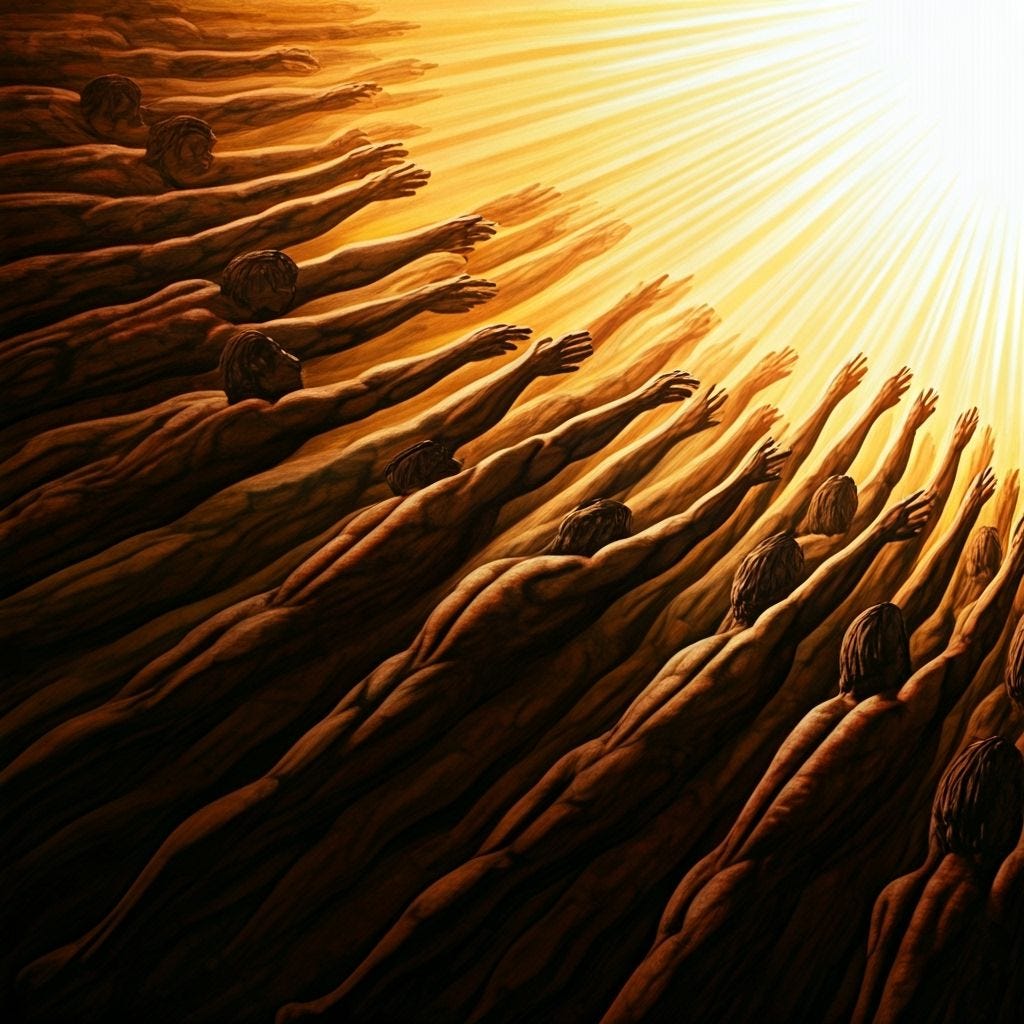
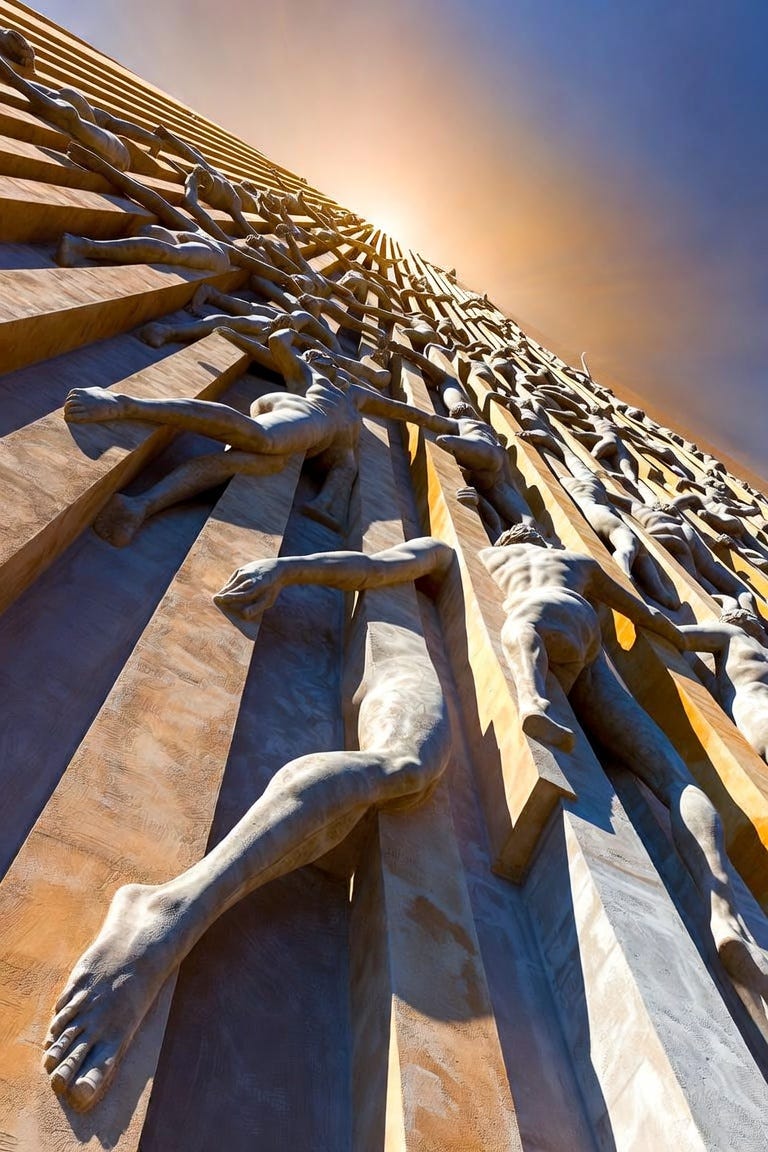
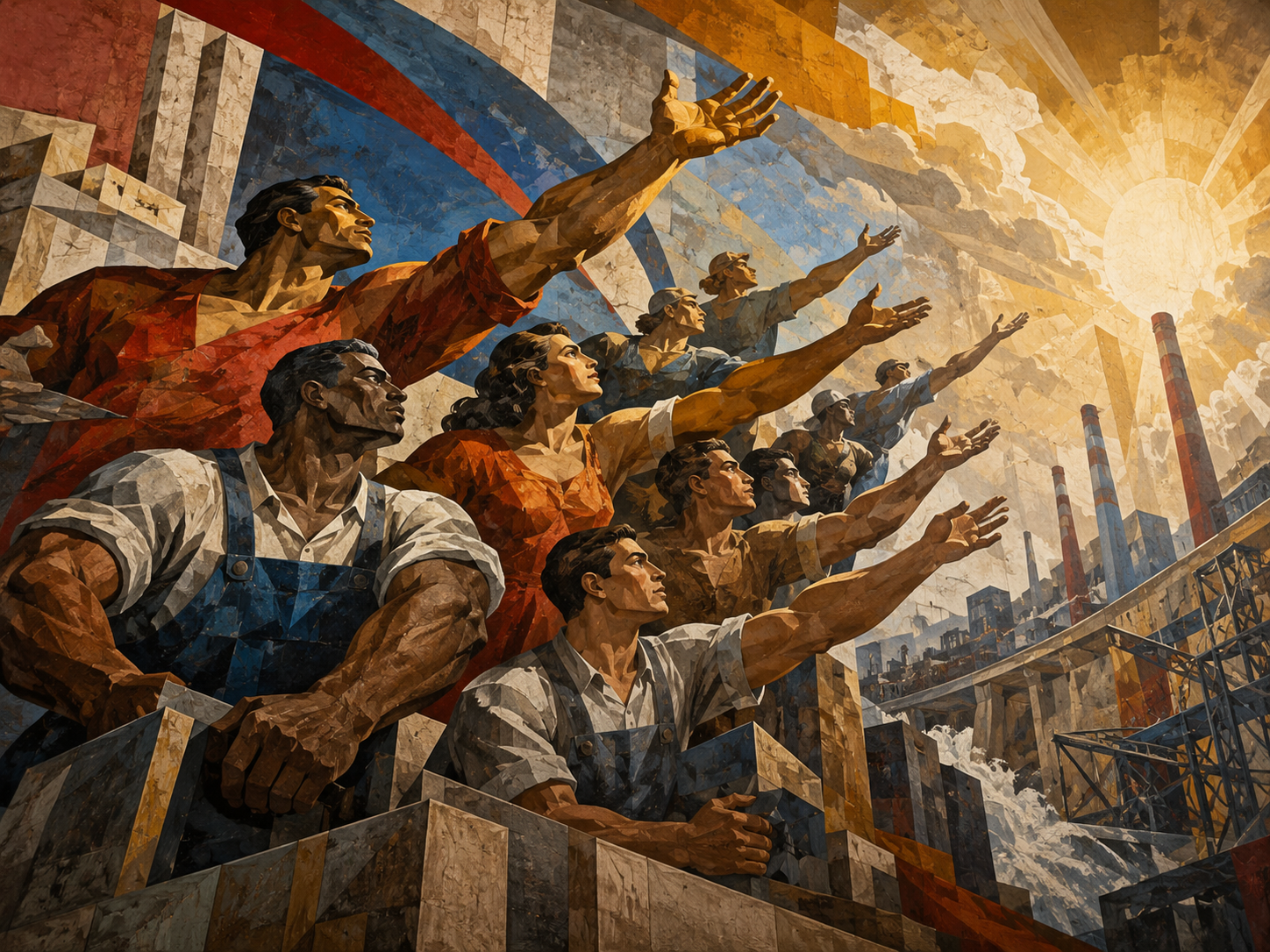
A monumental public mural-style composition with sweeping, muscular figures arranged in powerful diagonal motion, dramatic foreshortened hands reaching toward a radiant horizon, bold crimson, ochre, charcoal, cobalt, and sunlit gold tones, sculptural bodies emerging from layered architectural planes, dynamic shadows, sharp angular perspective, textured plaster surfaces, and a sense of collective upward movement. The mood should feel heroic, cinematic, and immense, with modern industrial energy, clear family-friendly imagery, no text, no logos, and no named historical figures.
Video Prompt:
A cinematic vertical video that begins with a dark textured plaster wall as golden light slowly spreads across it, revealing monumental mural-style figures in sweeping diagonal motion. Hands, fabric, and architectural planes glide forward with dramatic parallax, while crimson, ochre, charcoal, cobalt, and gold tones pulse gently like sunrise through stone. The camera moves in a smooth upward arc, making the painted forms feel massive and alive, with dust motes, subtle brush texture, and bold shadows creating a powerful sense of ascent. Keep it family-friendly, text-free, logo-free, and visually striking.
Song Recommendations
For the video, I would pair it with:
First Breath — Colin Stetson Big, breathy, intense, and architectural. It feels like the wall is waking up and remembering it has opinions.
A Violent Sky — Apparat Moody, cinematic, and charged with forward motion. Excellent for dramatic light, rising forms, and that “history just entered the room” feeling.
Follow and Comment
If you enjoyed this episode, follow along for more artist stories, strange art-history snacks, and the occasional sentence that probably should have asked permission before entering the museum.
And leave a comment: would you rather see a Siqueiros mural in person, or watch him explain why your living room wall is politically underperforming?
1 thought on “Episode 76: David Alfaro Siqueiros, or How to Paint a Wall Like It Just Joined the Revolution”
Comments are closed.