Episode 3: Logic, Gates, and Digital Circuits, or Tiny Electrical Decisions All the Way Down

Welcome back to CS201, the course where we stop politely pretending computers are mysterious thinking boxes and begin noticing that, deep down, they are enormous organized arguments about electricity.
In CS201 Episode 1 — How a Computer Actually Runs a Program, we watched your code descend from source text into something the machine can actually execute. In CS201 Episode 2 — Bits, Bytes, and Data Representation, we saw how numbers, text, images, and other supposedly sophisticated things become zeros, ones, and increasingly specific lies.
Now we go one layer lower.
Not lower as in “scarier.”
Lower as in “oh no, the entire digital civilization is built from tiny yes/no decisions, and somehow this works.”
This episode is about logic, gates, and digital circuits.
Or, said another way: how computers turn true and false into arithmetic, memory, CPUs, GPUs, cloud servers, AI accelerators, and occasionally your laptop fan achieving emotional lift-off.
First, the big idea
A computer does not understand numbers the way you do.
It does not look at 42 and think, “Ah yes, the charmingly overused answer to life, the universe, and everything.”
The machine sees patterns of electrical states.
High voltage. Low voltage.
On. Off.
- 0.
Digital hardware is built around the idea that if we can represent information as reliable two-state signals, then we can build small components that combine those signals according to rules.
Those components are logic gates.
A logic gate is a tiny circuit that takes one or more binary inputs and produces a binary output.
That is the whole magic trick.
Tiny rule boxes.
Millions or billions of them.
All working together at terrifying speed, like a very caffeinated committee that only votes yes or no.
Why logic belongs in a computer science course
At first glance, logic gates feel like electrical engineering snuck into the room wearing a fake mustache.
And yes, there is electrical engineering here.
But computer science needs this layer because every abstraction above it depends on it.
When you write:
if (temperature > 90) {
    turnOnFan();
}
you are thinking in conditions.
When the machine runs it, that condition eventually becomes operations over binary values.
Comparisons. Branches. Boolean decisions. Control signals. Memory reads. Register updates.
The high-level idea is friendly:
“Is this true?”
The low-level implementation is physical:
“Do these voltages combine in a way that produces this output?”
That connection matters because it explains why computers are so powerful and also why they are so wonderfully stubborn.
They do not almost evaluate a condition.
They do not mostly store a bit.
They do not spiritually intend to add two numbers.
They move signals through circuits according to rules, and if the rules are wrong, the machine will preserve your mistake with professional discipline.

A small historical detour, because the past keeps leaving wires everywhere
Boolean logic is named after George Boole, whose work helped turn logical reasoning into symbolic algebra. If you want the historical starting point, George Boole’s work on symbolic logic is one of those “quietly changed everything” moments.
The next major leap was realizing that this logic could be implemented physically.
Claude Shannon, in his 1937 master’s thesis, connected Boolean algebra to relay and switching circuits. The Computer History Museum has a helpful overview of how Shannon helped show that digital computers could be built from logic circuits.
That is a big deal.
It means logic stopped being only something philosophers and mathematicians argued about in rooms with stern furniture.
It became machinery.
The idea “A AND B” could become a physical circuit.
The idea “NOT A” could become a physical circuit.
The idea “if this, then that” could become silicon.
That is the bridge from thought to hardware.
And, as usual, humanity saw a bridge and immediately decided to drive every possible vehicle across it.
Boolean logic: the yes/no grammar of machines
Boolean logic works with two values:
true and false
In digital hardware, we usually map those to:
1 and 0
The three basic operations are:
NOT: flips a value
AND: true only if both inputs are true
OR: true if at least one input is true
That sounds simple because it is.
It is also enough to build the rest of computing, which is both beautiful and mildly suspicious.
Here is a tiny truth table for AND:

AND is strict.
AND says, “Everybody must be present or nobody gets dessert.”
OR is more relaxed:

OR says, “At least one of you showed up, good enough.”
NOT is the dramatic one:

NOT exists to disagree professionally.

Gates: Boolean logic with a physical address
A logic gate implements a Boolean operation in hardware.
So an AND gate takes two input signals and produces one output signal. If both inputs are 1, the output is 1. Otherwise, the output is 0.
An OR gate produces 1 if either input is 1.
A NOT gate flips the input.
There are also other common gates:
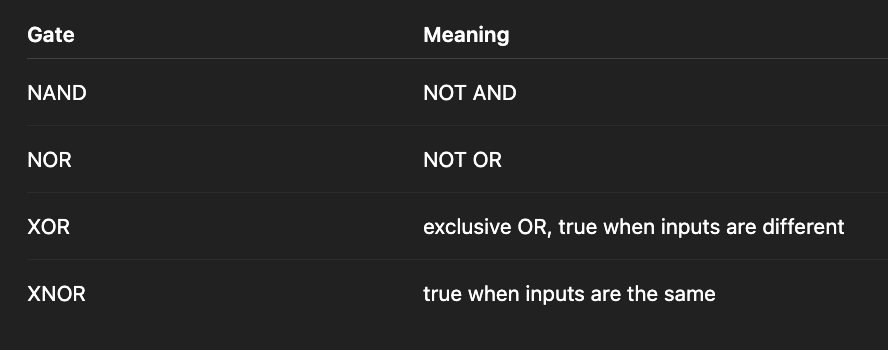
NAND and NOR are especially important because they are universal gates. That means you can build all other logic gates using only NAND gates or only NOR gates.
This is the kind of fact that sounds like trivia until you realize hardware designers care deeply about simplifying what they manufacture.
If one kind of gate can build everything, that is not just elegant.
That is practical.
Fewer component patterns. Easier design rules. More predictable behavior. Better manufacturing possibilities.
Computing history is full of ideas that look like math homework and turn out to be factory instructions.
A concrete example: the overprotective lamp
Imagine we want a lamp to turn on only when two things are true:
- The room is dark.
- Someone is in the room.
Let:
D = 1 when the room is dark
P = 1 when a person is detected
L = 1 when the lamp should turn on
The logic is:
L = D AND P
Truth table:

This is a simple combinational circuit.
Its output depends only on the current inputs.
No memory. No history. No “Well, earlier you said…”
Just immediate logic.
The lamp does not remember your vibe from Tuesday.
It checks the signals now.
Combinational logic: answers without memory
Combinational logic means the output is determined only by the current input values.
You can think of it as a pure function in hardware.
Same inputs, same output.
That connects nicely to earlier programming ideas. In CS101 Episode 2 — Programming Fundamentals Part 1: Variables and Conditionals, conditionals were about deciding what happens next. In hardware, combinational logic is one of the physical foundations of that decision-making.
A combinational circuit can answer questions like:
Is A equal to B?
Is this number zero?
Should this instruction use the arithmetic unit?
Which input should be selected?
What is the sum of these two bits?
That last one matters, because arithmetic is not separate from logic.
Arithmetic is logic wearing a little hat that says “math department.”
The half adder: where addition begins
Let us build the smallest piece of binary addition.
If you add two single bits, A and B, there are four possibilities:

The sum bit is 1 when A and B are different.
That is XOR.
The carry bit is 1 when A and B are both 1.
That is AND.
So:
Sum = A XOR B
Carry = A AND B
Congratulations.
You just met the beginning of hardware addition.
Not a calculator app.
Not a programming language plus sign.
A physical arrangement of logic gates that can add bits.
From there, you can combine adders into larger circuits that add multi-bit numbers. Then you can build arithmetic logic units. Then CPUs. Then entire machines. Then software companies. Then meetings about why the button is still blue.
It escalates quickly.
Why XOR is secretly everywhere
XOR means “one or the other, but not both.”

XOR is useful because it detects difference.
That shows up in arithmetic, parity checks, error detection, cryptography, graphics tricks, and low-level bit manipulation.
In programming terms, XOR is not just “weird OR.”
It is a difference detector.
That is why it appears in places where the machine needs to know whether two bits disagree.
And if you have ever debugged a weird bitwise operation and felt your soul slide down a banister made of bees, XOR may have been nearby.
The important distinction: combinational vs sequential circuits
So far, our circuits have no memory.
Inputs go in. Output comes out.
But computers need memory.
They need to store values. They need to remember the current instruction. They need registers, caches, RAM, counters, program state, and all the little “what was I doing?” details that make execution possible.
That brings us to sequential circuits.
A sequential circuit has memory.
Its output can depend on:
- Current inputs.
- Previous state.
This is where things get much more interesting.
And by interesting, I mean “now timing can ruin your day.”
State: when hardware remembers
In CS102 Episode 13 — State, Bugs, and Program Behavior, state was the stored condition of a program at a moment in time.
Hardware has state too.
A bit of hardware state is a stored 0 or 1.
To store a bit, circuits often use structures called latches or flip-flops. You do not need to become a transistor wizard right now, but you do need the concept:
A flip-flop stores one bit and updates it at controlled times, usually based on a clock signal.
That one idea is enormous.
A CPU register is built from many stored bits.
A program counter is stored bits.
Status flags are stored bits.
Pipeline stages use stored bits.
Memory systems are full of stored bits arranged with great ambition and occasional heat problems.
Once hardware can remember, it can stop being a simple calculator and start becoming a machine that moves through steps.
The clock: the machine’s tiny conductor
Modern digital circuits often use a clock signal.
A clock is a repeating signal that coordinates when state updates happen.
Without a clock, signals can arrive at different times, outputs can flicker while logic settles, and your circuit can become a tiny electrical argument in progress.
The clock gives the circuit rhythm.
At each clock edge, stored elements update.
Between clock edges, combinational logic computes new values.
Then the next clock edge captures the result.
This pattern is everywhere in synchronous digital design:
stored state -> combinational logic -> new stored state -> combinational logic -> ...
That rhythm is part of why processors can execute step after step.
It is also why performance is not just about “make the clock faster.”
If the clock ticks too fast, the logic may not have enough time to settle before the next state update.
That is how hardware reminds you that physics was never actually fired from the project.
Propagation delay: logic takes time
In beginner diagrams, gates behave instantly.
Input changes, output changes.
Cute.
False.
In real hardware, signals take time to move through gates and wires. This is called propagation delay.
It may be extremely small, but “extremely small” times billions of operations is still a real engineering constraint.
If a signal must pass through many gates before the next clock edge, the clock has to be slow enough for the result to arrive reliably.
This is one reason circuit design has tradeoffs.
A deeper circuit may do more work in one step, but it may require a slower clock.
A shallower circuit may support a faster clock, but it may need more steps.
This is the hardware version of a lesson you already met in CS102 Episode 8 — Complexity and Efficiency: correct is not the same thing as efficient.
At the hardware level, “efficient” means time, area, power, heat, complexity, manufacturing cost, and reliability all arguing in a conference room.
Real-world example: your phone deciding whether to wake up
Let us make this less abstract.
Your phone does not want every subsystem running at full power all the time. That would drain the battery and turn your pocket into a small regret rectangle.
So modern devices use hardware and firmware logic to decide when to wake components up.
A simplified wake condition might look like:
Wake = ButtonPressed OR IncomingCall OR AlarmTriggered OR ChargerConnected
That is OR logic.
But maybe the camera should only activate if:
CameraEnable = AppRequestsCamera AND PermissionGranted AND SensorReady
That is AND logic.
And maybe it must not activate if the device is locked:
CameraAllowed = AppRequestsCamera AND PermissionGranted AND SensorReady AND NOT LockedOut
That is NOT joining the party with its usual attitude.
Actual systems are far more complicated, of course. They involve power management chips, operating system policies, interrupts, security models, drivers, and hardware states.
But the foundation is still logical conditions controlling physical behavior.
Software says what it wants.
Hardware logic decides what signals actually move.
This is why systems work when they work, and why debugging them can feel like interviewing twelve suspects who all share one alibi: “the state was different when I got here.”
From gates to CPUs
A CPU is not a single magic object.
It is a collection of circuits organized to fetch instructions, decode them, execute operations, access memory, and update state.
Inside the CPU, logic circuits help answer questions like:
Which instruction is this?
Which registers are involved?
Should we add, subtract, compare, shift, or jump?
Should the next instruction come from the next address or a branch target?
Did the last operation produce zero?
Did arithmetic overflow?
Which value should be written back?
The arithmetic logic unit, or ALU, performs operations using circuits made from gates.
The control unit uses logic to coordinate the rest of the CPU.
Registers hold bits.
The program counter tracks where execution goes next.
In CS201 Episode 4 — Assembly Language and the Machine Model, we will move up one layer and look at registers, instructions, load, store, jump, and compare. This episode is what makes those ideas feel less like vocabulary words and more like machinery.
Assembly language is not floating above the hardware.
It is a human-readable doorway into what the hardware is built to do.
Where memory elements fit
In CS102 Episode 9 — Memory and the Machine, we talked about memory from a programmer’s point of view: variables, addresses, stack, heap, pointers, and the occasional “why is this value now cursed?”
At the circuit level, memory is built from physical storage mechanisms.
Registers are very fast storage close to the CPU’s execution units.
Caches store recently used data to avoid slower memory access.
RAM stores larger working data for running programs.
Different memory technologies use different physical designs, but the abstraction remains:
Store bits.
Retrieve bits.
Try not to lose bits.
The tradeoff is always there:
Fast memory is expensive and limited.
Large memory is slower.
Persistent storage is much slower but survives power loss.
Your program simply says:
“Please give me this value.”
The machine mutters:
“Fine, but this request is going through a hierarchy.”

Circuits and abstraction: why you do not write software by drawing gates
At this point, someone might ask:
If gates are the real machinery, should programmers learn to design everything from gates?
No.
Please do not build your web app out of NAND gates unless you are being punished by a very specific curriculum.
Abstraction exists because humans need layers.
In CS102 Episode 11 — Modular Design and Abstraction, we talked about hiding complexity behind cleaner interfaces.
Hardware is one of the best examples of that principle.
You do not want to think about transistor behavior every time you write:
total = price + tax
You want the plus sign to work.
But understanding gates gives you a better mental model of what is underneath.
You learn that computation is layered:
software expression
compiler output
machine instruction
CPU control signals
logic gates
transistors
electrical behavior
physics, still annoyingly employed
Each layer hides details from the one above it.
But when performance, reliability, security, or weird bugs matter, those hidden details sometimes climb back up the ladder holding a little sign that says “remember me?”
Common misconception: computers are smart because they use logic
Computers use logic.
That does not mean they are wise.
A logic gate has no understanding.
An AND gate does not know what the inputs mean. It does not know whether it is checking a password bit, adding two numbers, routing an instruction, or participating in a spreadsheet formula that should never have reached production.
It just follows its rule.
This is important.
Computers are powerful because we build massive systems out of simple reliable operations.
But meaning comes from interpretation at higher layers.
A bit pattern could be an integer, a character, a color, an instruction, part of an image, or garbage with confidence.
As we learned in CS201 Episode 2, representation matters.
The hardware moves bits.
The system decides what those bits mean.
The programmer often discovers too late what they accidentally meant.
Common misconception: digital means perfectly clean
Digital systems are designed around 0 and 1, but the physical world is not made of perfect rectangles.
Electrical signals are analog underneath.
Voltages rise and fall. Noise exists. Wires have resistance and capacitance. Signals take time. Components vary. Heat changes behavior.
Digital design works by creating safe ranges.
A low voltage range counts as 0.
A high voltage range counts as 1.
The messy middle is avoided as much as possible, because the messy middle is where circuits start making choices with the confidence of a raccoon in a tax office.
This is why hardware has design margins.
It is also why timing, voltage, temperature, and manufacturing quality matter.
Digital abstraction is powerful, but it is still built on physical reality.
Failure mode: floating inputs
A floating input is an input that is not clearly connected to a high or low signal.
That means the circuit may pick up noise and behave unpredictably.
In software terms, this is like reading an uninitialized variable and then acting surprised that it contains nonsense.
The hardware version is just more electrical.
Good circuit design avoids floating inputs by tying signals to known states using pull-up or pull-down resistors or other controlled methods.
The lesson is bigger than hardware:
Unspecified state is where bugs rent a tiny apartment and start inviting friends.
Failure mode: glitches
Because different signal paths can have different delays, a circuit output may briefly change to an incorrect value before settling.
That temporary wrong output is called a glitch or hazard.
In many circuits, this does not matter if the final value is stable before the clock captures it.
But in some designs, glitches can cause trouble.
This is one reason synchronous design is so useful: the clock helps decide when values count.
Without controlled timing, a circuit can briefly tell the truth, lie, apologize, and then tell the truth again, all in a fraction of a second.
Which, honestly, sounds like some meetings.
Failure mode: race conditions
Race conditions happen when the behavior of a system depends on the timing of events.
You will see race conditions again when we discuss threads and concurrency in CS201 Episode 6.
But they exist in hardware too.
If two signals arrive in an unexpected order, the circuit may behave differently.
This is why hardware designers care so much about timing analysis.
A design is not just about what logic should happen.
It is about when signals arrive, when state updates, and whether the whole system remains reliable at the target speed.
Time is part of the design.
Time is not decorative.
Time is the little goblin under the floorboards.
Failure mode: metastability
Metastability is one of those words that sounds like it escaped from a science fiction repair manual.
It can happen when a storage element, like a flip-flop, samples an input that is changing too close to the clock edge.
Instead of quickly settling into a clean 0 or 1, the circuit may linger temporarily in an uncertain state.
Designers cannot completely eliminate the possibility, but they can make it extremely unlikely to cause problems by using synchronization techniques.
The beginner takeaway:
When signals cross timing boundaries, you need care.
This becomes especially important in real systems where different components may run on different clocks.
The machine may be digital, but coordination still matters.
Practical consequence: performance is physical
When programmers talk about performance, they often talk about algorithms, memory access, data structures, and concurrency.
Good.
Those matter enormously.
But underneath all of that is hardware performance.
A processor’s speed depends on design choices like:
- how much work each pipeline stage does
- how fast signals can propagate
- how efficient the cache hierarchy is
- how branch prediction works
- how memory access is handled
- how much heat the chip can safely dissipate
- how many operations can happen in parallel
This is where gates become architecture.
And architecture becomes the practical reality your software runs on.
A beautiful algorithm can still crawl if it fights the memory hierarchy.
A clever loop can still disappoint you if it causes cache misses.
A cloud service can still become expensive if your code makes hardware do unnecessary work at scale.
The machine does not care that your abstraction looked elegant in the pull request.
The machine sends invoices.
Modern relevance: AI, GPUs, and custom chips
Logic gates are not old news.
They are not dusty museum components sitting beside a label that says “before JavaScript discovered itself.”
Every modern chip is built from digital circuits.
CPUs use them.
GPUs use them.
Network cards use them.
Storage controllers use them.
AI accelerators use them.
When people talk about modern AI hardware, tensor cores, neural processing units, or custom silicon, they are still talking about circuits that perform operations on bits.
The operations are more specialized and massively parallel, but the foundation remains digital logic.
AI may feel like magic at the software layer.
At the hardware layer, it is still signals, circuits, memory movement, multiplication, addition, and timing.
A very large number of tiny decisions.
All happening so fast that humans respond by saying things like “the model feels intuitive,” which is adorable.
Hardware tradeoffs: speed, power, area, and sanity
Digital circuit design is full of tradeoffs.
Make something faster, and it may consume more power.
Use less power, and it may run slower.
Add more parallel hardware, and the chip gets larger.
Make the chip larger, and cost and heat become problems.
Add more cache, and some workloads improve.
Add the wrong kind of complexity, and now you own a silicon labyrinth with a thermal management subplot.
Common hardware tradeoffs include:
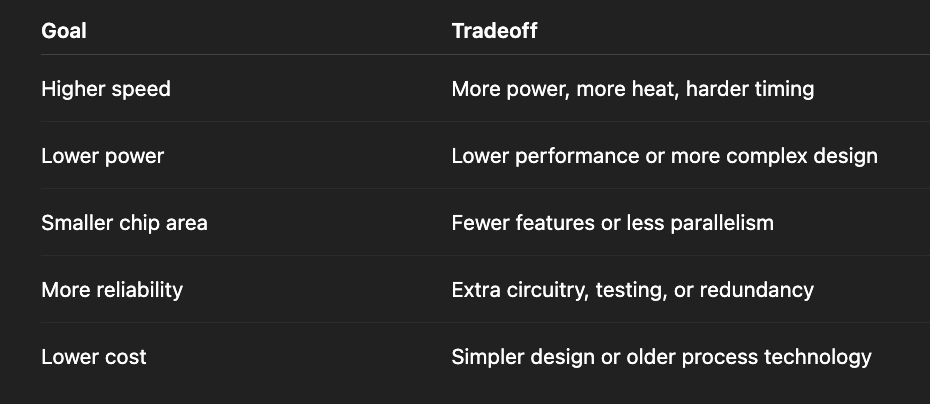
There is rarely one perfect answer.
Engineering is not the search for the one sacred button.
It is the art of choosing which problems you would rather have.
How this connects to programming
You do not need to draw circuits every day to benefit from this knowledge.
Understanding logic and circuits helps you understand:
- why binary matters
- how conditions become machine decisions
- how arithmetic can be built from simple operations
- why memory is physical state
- why timing matters
- why performance is not only a software issue
- why concurrency bugs are not just “programmer drama”
- why abstractions are useful but never free
It also makes bitwise operations less mysterious.
For example:
int flags = 0;

const int CAN_READ  = 1 << 0; // 0001
const int CAN_WRITE = 1 << 1; // 0010
const int CAN_EXEC  = 1 << 2; // 0100
flags = flags | CAN_READ;     // turn on read permission
flags = flags | CAN_WRITE;    // turn on write permission
if (flags & CAN_READ) {
    // read permission is enabled
}
This kind of code makes more sense when you remember that OR can turn bits on, AND can test whether bits are set, and NOT can help clear bits.
These are not arbitrary symbols.
They are software expressions of hardware-friendly logic.
The ladder from CS101 to here
Let us connect the path clearly.
From CS101, Episode 1 — What Is CS101? gave us the big picture of the field. Episode 3 — Loops and Functions showed how programs repeat and organize behavior. Episode 4 — Algorithmic Thinking taught us to reason in steps. Episode 5 — Data Structures introduced the idea that organization affects access and behavior. Episode 6 — History, Debugging, and Problem Solving reminded us that machines, tools, and mistakes all have histories.
From CS102, Episode 7 — Recursion and Problem Decomposition showed how small rules can build larger behavior. Episode 10 — Files, Input, and Output showed how programs interact with the outside world. Episode 12 — Testing and Reliability trained us not to trust a thing merely because it smiled once. And Episode 14 — Object-Oriented and Alternative Design Styles reminded us that the shape of a system affects how humans understand and maintain it.
This episode takes all that and says:
Wonderful.
Now let us see what kind of tiny physical machinery makes the whole parade move.
What you should remember
Logic gates are the physical building blocks of digital decision-making.
Boolean logic gives us the rules.
Gates implement the rules.
Combinational circuits produce outputs from current inputs.
Sequential circuits add memory and time.
Clocks coordinate updates.
Propagation delay and timing make performance physical.
Registers, adders, control units, CPUs, GPUs, and AI chips are all built from these ideas at massive scale.
The miracle is not that computers are mysterious.
The miracle is that so many simple pieces can be arranged carefully enough to create the illusion of one coherent machine.
Your program does not levitate into reality.
It becomes instructions.
Instructions control circuits.
Circuits move signals.
Signals represent bits.
Bits become meaning because we built layers that agree on what they mean.
And beneath every glamorous abstraction is a small electrical decision, doing its job with absolutely no concern for your feelings.
Honestly, respect.
Closing thought
Logic gates are not the whole computer.
But they are the place where computation becomes physical.
They are where true and false stop being ideas and start becoming voltage patterns moving through matter.
That is worth understanding.
Because once you see that, the machine becomes less magical and more impressive.
Not less wonderful.
More wonderful.
The wizard was not fake.
The wizard was a billion tiny switches in a trench coat.
Follow along for the next episode, where we move from gates and circuits into assembly language and the machine model: registers, memory, instructions, jumps, and the delightful realization that high-level code has been standing on a very literal floor this whole time.
And if this made one of the little circuit lights turn on in your brain, follow me and leave a comment. Tell me which part finally clicked, or which part still feels like a tiny electrical raccoon is chewing on the explanation.
A luminous Rococo-inspired portrait scene with soft ivory, powder blue, blush rose, and warm cream tones, featuring an elegant figure in flowing white muslin standing in a breezy garden terrace, surrounded by delicate flowering branches, pale clouds, and refined architectural details; the composition should feel graceful, airy, intimate, and gently theatrical, with luminous skin tones, feathery brushwork, satin-soft highlights, relaxed posture, subtle confidence, and a mood of cultivated calm, freshness, and quiet charm; no direct depiction of computers, circuits, wires, or technology.

Animate the Rococo garden portrait into a short-form vertical video with immediate motion: flower petals burst upward in a playful spiral, gauzy fabric ripples in the breeze, sunlight flickers across ivory columns, clouds drift quickly behind the figure, and tiny golden highlights shimmer across the scene in rhythmic pulses; add elegant hand and head movement, fluttering leaves, and a final sparkling sweep of light across the terrace, keeping the mood graceful, bright, refined, and catchy for social platforms.
Song Recommendations:
Computer World — Kraftwerk
Sweet Talk — Saint Motel