Some artists arrive in art history with a manifesto, a movement, and a small army of men explaining why they matter.
Leonor Fini arrived like a beautifully composed threat.
She painted women who did not look interested in asking permission, men who often seemed decorative by comparison, creatures that felt half myth and half psychological trap, and interiors that looked as though velvet had started keeping secrets. She moved through Surrealism without ever fully joining the club, which was probably the right call. If the room is full of self-important men trying to explain the unconscious to one another, sometimes the wisest move is to sweep past them in opera-level eyeliner and make better art on your own terms.
And that, more or less, is Leonor Fini’s whole energy.
Who is this artist?
Leonor Fini was an Argentine-born, Trieste-raised, Paris-centered painter, designer, illustrator, and theatrical mastermind whose career stretched across most of the twentieth century. If you want the clean museum version, Britannica’s biography gives the essentials; if you want the fuller aura of the woman, the cats, the costumes, the lovers, the masks, the stage work, and the sheer scale of her creative life, the official Leonor Fini biography is excellent.
She was born in Buenos Aires in 1907, raised in Trieste, and later moved to Paris, where she became part of the same wider artistic world orbiting Surrealism. But “part of the world around Surrealism” and “obedient card-carrying Surrealist” are not the same thing. Fini was close to many Surrealists, exhibited with them, argued with them, borrowed what she liked, and declined to become anyone’s mascot.
Which already makes her delightful.
What is she known for?
First, she is known for painting powerful women as if the usual social script had been torn up, set on fire, and then used to light candelabras in a haunted palace.
Second, she is known for sphinxes. Not the dusty textbook kind. Her sphinxes are sensual, watchful, intelligent, faintly dangerous, and often suspiciously close to self-portraits. Britannica’s note on Sphinx Amoureux is a wonderful little window into how often that creature appears in her work and how completely she used it to flip old gender hierarchies on their heads.
Third, she is known for refusing the usual passive role offered to women in a lot of male Surrealist art. In a Leonor Fini painting, the woman is very often not the dream object. She is the dream’s management team.
What is her style?
Her style is Surrealism with better posture.
More seriously, it is a mix of Gothic elegance, meticulous draftsmanship, theatrical fantasy, psychological symbolism, myth, erotic tension, and an almost aristocratic sense of staging. She loved masks, metamorphosis, costume, ritual, and the dramatic possibilities of a figure who looks calm while clearly knowing more than everyone else in the room.
Her paintings often feel less random than a lot of classic Surrealism. They are strange, yes, but not sloppy-strange. They are composed. Controlled. Lit like a private ceremony. Even when something uncanny is happening, it usually feels deliberate, as though the painting has already made peace with its own weirdness and is now waiting for you to catch up.
That is one of the things that makes Fini so compelling. She did not paint dream chaos the way some artists did. She painted dream authority.
Who taught her?
This is where the answer gets fun, because the closest thing Leonor Fini had to a tidy academic pedigree was “no, thank you.”
She had little formal art training and is generally described as largely self-taught. She learned by reading, by looking, by studying old masters in books and museums, and, in one of the least casual art-history details imaginable, by sketching cadavers in the Trieste morgue. That is a very committed way to study anatomy. Most of us stop at buying a better pencil.
So who taught her? Not one master with a beard and a studio full of disappointed apples. Her teachers were Renaissance and Mannerist painting, museum walls, books, her own eye, and later the artistic company she kept in Paris. Giorgio de Chirico’s example mattered, the broader Surrealist atmosphere mattered, and her own nerve mattered most of all.
Does she use any special technique?
Yes, though not in the gimmicky sense of “invented a patented brush that only works during eclipses.”
Her special technique is a fusion of precision and theatrical transformation.
She paints with strong control over faces, bodies, fabric, and symbolic space, but what really sets her apart is how she stages identity. She turns femininity into costume, costume into armor, armor into seduction, and seduction into power. She uses mythological creatures, androgynous bodies, masked presences, and ceremonial arrangements to make gender look less like fate and more like performance with sharper teeth.
She also worked across painting, illustration, decorative design, and stage production, which helped her think like a dramatist as much as a painter. You can feel that in the work. Even a still portrait can seem halfway between portrait, spell, and entrance cue.
Who has she worked with?
Quite a crowd, and not a shabby one.
She moved among artists and writers such as Max Ernst, Paul Eluard, Man Ray, Salvador Dali, Jean Cocteau, and Leonora Carrington. She also worked far beyond easel painting. The official biography notes her collaborations in design and performance worlds, including work for Elsa Schiaparelli, the Paris Opera, the Metropolitan Opera, George Balanchine’s ballet productions, Jean Genet’s plays, Federico Fellini’s 8 1/2, and John Huston’s A Walk with Love and Death.
So if your mental image of her was “niche painter quietly making odd canvases in a corner,” please update the file. She was a serious cross-disciplinary force with one foot in high art, one in theater, and the rest of her somehow still balanced on a staircase at a masquerade.
Was she wealthy?
The honest answer is: glamorous, yes; idle heiress drifting through perfumed fog, not exactly.
Fini moved in fashionable circles, painted portraits for elite clients, designed for luxury and performance contexts, and cultivated a public image that made ordinary bohemian scruffiness look embarrassingly underdressed. But she also worked constantly and across many mediums. Portrait commissions, book illustration, costume design, set design, exhibitions, and paintings were not the habits of someone just killing time until dinner.
So the atmosphere around her was rich, but the career was built. She earned her legend the hard way: by making a huge amount of memorable work and by making herself impossible to ignore.
When was she most popular?
Her first great wave of attention came in the 1930s and 1940s, when she entered the Paris art world, exhibited in New York, appeared in key Surrealist contexts, and became a visibly magnetic public figure. That momentum carried into the 1950s, when her stage, design, and portrait work helped make her not just an artist of paintings but an artist of presence.
If you want a concise institutional marker, MoMA’s artist page confirms her inclusion in the museum’s landmark 1936–37 exhibition Fantastic Art, Dada, Surrealism, which is not exactly the sort of thing that happens while nobody is paying attention.
After that, her reputation did what happens to a depressing number of brilliant women artists: it got fuzzier in the mainstream than it should have. But fuzzier is not the same as gone. Serious people kept paying attention, and the long correction has been underway for a while now.
Tell me more, please
Gladly, because Leonor Fini is one of those artists who gets more interesting every five minutes.
A lot of Surrealist imagery made women into muses, mysteries, mirrors, or elegant emergency exits for male imagination. Fini basically said, “No, absolutely not,” and built a world in which women are the central intelligence. They are priestesses, sphinxes, rulers, guardians, magicians, judges, or beings so self-possessed they make everybody else look like furniture.
And she did this without flattening her figures into slogans. They are not simple symbols of empowerment in the modern poster sense. They are stranger than that. They can be tender, predatory, aloof, erotic, maternal, spectral, or all of those before lunch. Her work understands that power is more interesting when it is psychologically complicated.
She also had an eye for surfaces that is easy to underestimate. Fabrics glow. Skin has a porcelain chill. Hair behaves like it has entered into a private pact with moonlight. Her worlds often feel both tactile and ceremonial, like a palace, a dream, a dressing room, and a myth decided to share rent.
Anything else left to tell?
Several things, because Leonor Fini appears to have treated ordinary living the way most people treat a costume ball with an unlimited budget.
She loved masks. She loved cats. She loved elaborate dress. She understood self-presentation not as decorative fluff but as part of artistic authorship. That matters. With Fini, the line between life and art was not erased so much as choreographed.
She was also a formidable portraitist. If you want proof that she could do more than conjure ritual glamour, look at Mrs. Ambrose Chambers at The Met. The painting shows how sharp she could be with likeness, poise, and social presence while still making the whole thing feel slightly charged, as if civility itself might have claws.
And because she refused to stay in one lane, her imagination spilled into objects and design as well. The Brooklyn Museum’s page on Carlo Mollino’s Tea Table notes that its glass top was traced from a drawing of a woman’s torso by Fini, which is a wonderfully Fini detail: even the furniture is not allowed to behave normally.
Any other interesting tidbits?
Absolutely.
As a child, she reportedly spent time in disguises because of a custody struggle involving her father. Later, after a serious eye condition left her bandaged in darkness for a stretch, she said the experience strengthened her inner image-making. If you were designing the origin story of an artist who would later fill canvases with masks, metamorphosis, theatrical identity, and dream authority, you would probably not dare make it that on the nose. And yet there it is.
She was also one of those rare artists whose public image could have swallowed the work if the work had not been strong enough. Glamour can be a trap. Eccentricity can become a costume people remember instead of the art. Fini survived that trap because the paintings are genuinely good, the visual world is genuinely hers, and the ideas underneath all the velvet and moonlight are much tougher than they first appear.
That is why she matters.
Not because she was colorful, though she certainly was. Not because she knew famous people, though she definitely did. Not because she looked excellent in photographs, though she really, really did.
She matters because she built a visual kingdom in which female identity was not passive, not apologetic, not tidy, and not available for easy ownership. She made authority look glamorous, mystery look intelligent, and beauty look fully capable of winning a knife fight.
Which, frankly, is a wonderful thing to have done with a paintbrush.
If this episode sent you sprinting toward velvet capes, ceremonial cats, and women who look like they have already judged your soul and found your posture lacking, follow along and drop a comment with the artist you want to see next.
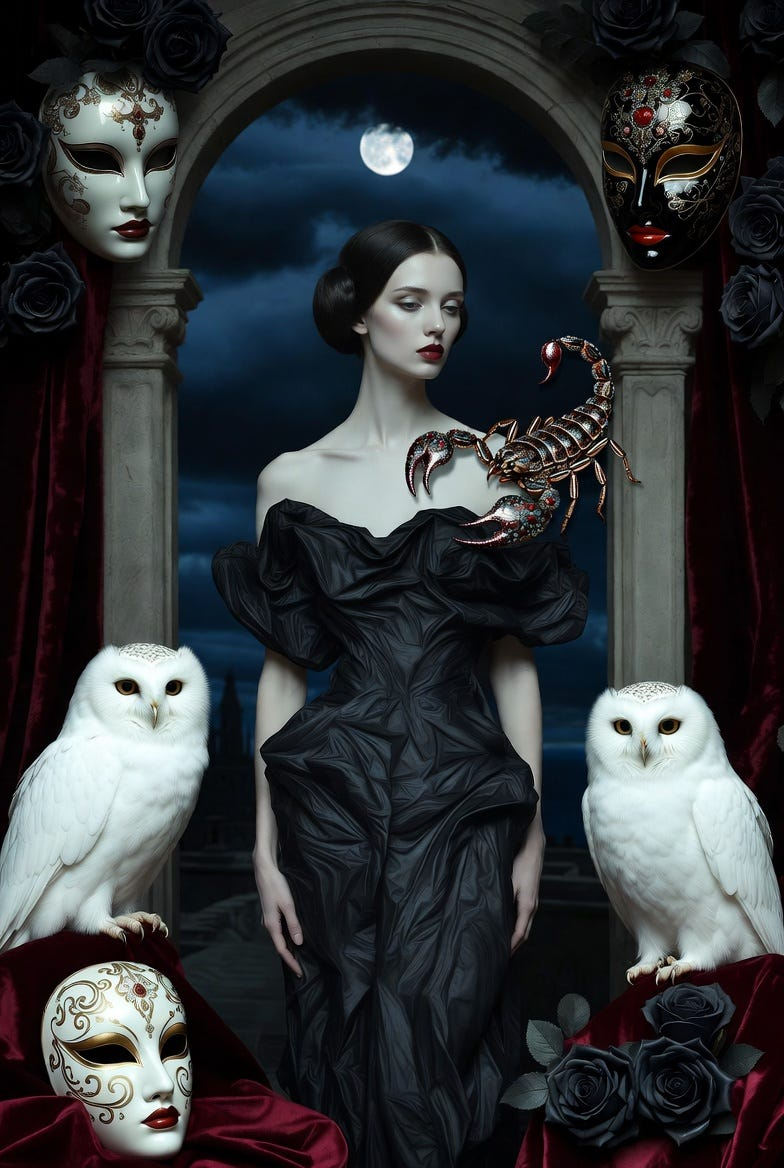
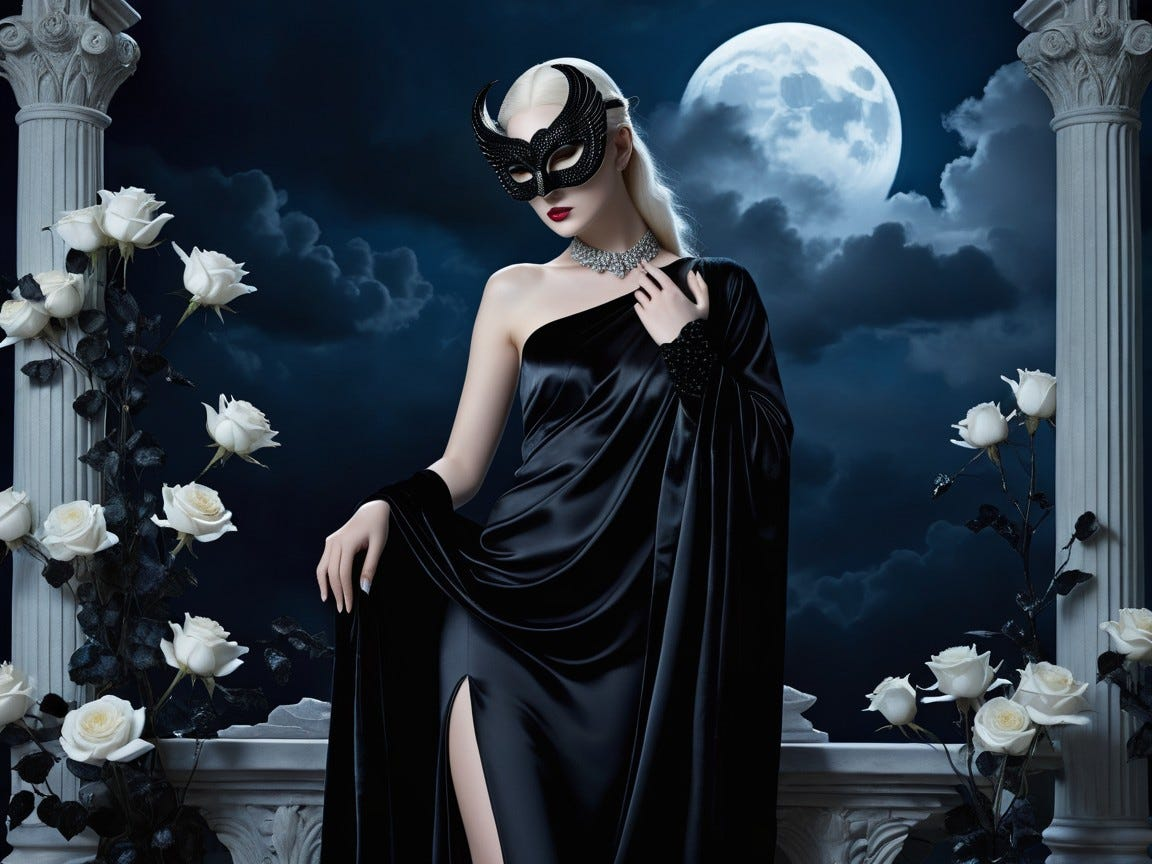
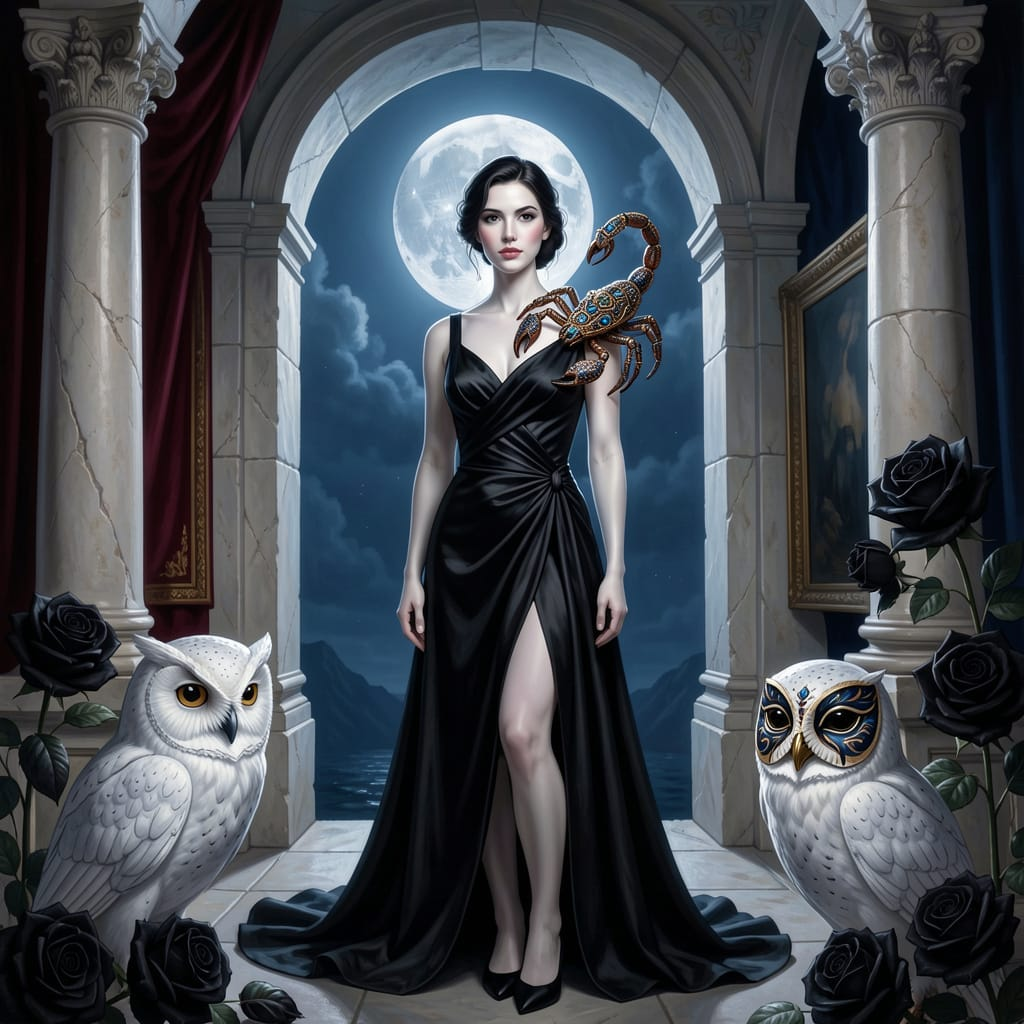
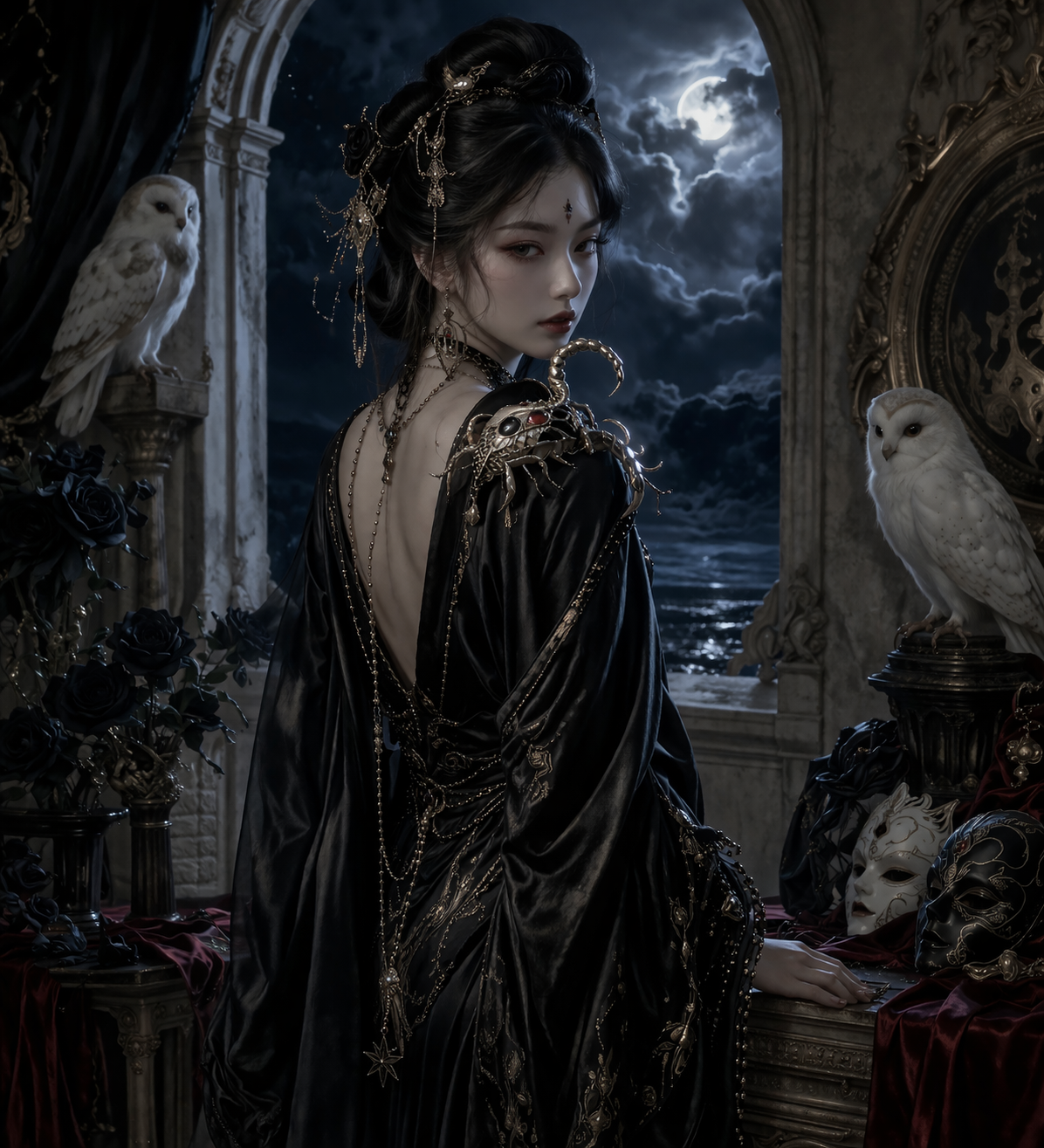
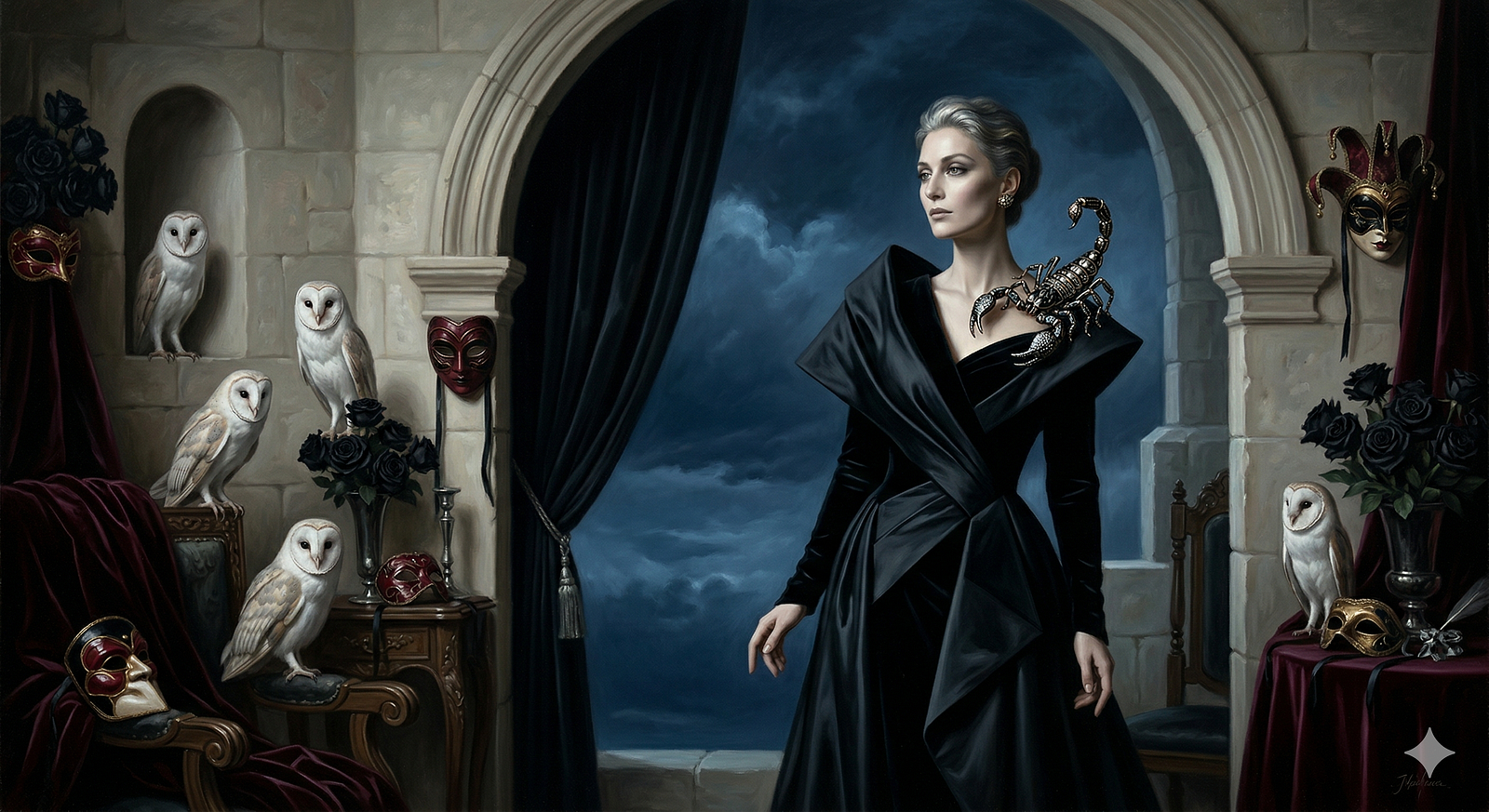
Art Prompt (Surreal Gothic): A moonlit interior of pale stone and shadowed velvet, centered on an elegant and enigmatic figure in sculptural black silk standing before a storm-blue opening to the night. A jeweled scorpion rests like a living ornament on one shoulder while white owls, lacquered masks, and black roses occupy the edges of the scene with ceremonial stillness. Render the composition with immaculate draftsmanship, porcelain skin, smoky silver highlights, deep wine reds, midnight blues, and muted antique gold. Let the atmosphere feel theatrical, aristocratic, mysterious, and gently dangerous, with a balance of sensual calm and dream logic, as if glamour itself has learned occult geometry.
Video Prompt: A moonlit surreal interior of pale stone and velvet slowly comes alive as an elegant figure in black silk turns toward the viewer, a jeweled scorpion glinting on one shoulder. White owls blink from carved perches, black roses tremble in a faint unseen breeze, and lacquered masks catch flashes of silver light as the camera glides in a slow hypnotic orbit. Use rich storm-blue shadows, wine-red accents, porcelain skin tones, antique gold details, drifting smoke, and silky fabric movement to create a luxurious, uncanny atmosphere with strong visual hooks, crisp motion, and a mesmerizing sense of ceremonial suspense.
A couple of songs for that atmosphere: Rabbit Heart (Raise It Up) — Florence + The Machine and Wild Is the Wind — Nina Simone.