Some artists paint a landscape.
Some artists paint a portrait.
Remedios Varo looked at the visible world, gave it a courteous nod, and then wandered off to paint alchemists, owl-faced inventors, mystical seamstresses, impossible vehicles, private laboratories of cosmic nonsense, and women who seem fully capable of repairing the universe with thread, moonlight, and a suspiciously intelligent cat.
Which, honestly, is a much stronger career choice.
Varo is one of those artists who makes you feel as if a medieval manuscript, a science notebook, a dream journal, and a very elegant nervous breakdown all decided to collaborate. Her paintings are intricate without feeling stiff, magical without becoming sugary, and strange without ever lapsing into random weirdness. This is important. Plenty of art can be odd. Very little art is odd with discipline.
And Varo had discipline for days.
Who is this artist?
Remedios Varo was a Spanish-born, later Mexican artist who became one of the most distinctive figures in Surrealism. According to Britannica, she was born in 1908 in Angles, Girona, and became a major presence in the Mexico City Surrealist circle after fleeing wartime Europe. That already sounds like the setup to an extraordinary life, because it was.
She was not merely a painter of dream imagery. She was a builder of complete inner worlds. In her paintings, rooms become engines, forests become thought experiments, and people look like they have been assembled from candle flame, astronomy, and excellent posture.
She belongs to that rare class of artists whose work is instantly recognizable even if you cannot yet remember her name. You see one of her tall, spectral figures leaning over a device that looks half harp, half telescope, half occult filing cabinet, and you immediately think: ah yes, someone here is manufacturing revelation.
What is she known for?
She is known for paintings that fuse Surrealism, science, mysticism, architecture, esoteric symbolism, and unnervingly tidy craftsmanship. MoMA places her within Surrealism and also notes her involvement with drawing and exquisite corpse collaborations, which is fitting because Varo never behaved as though imagination had to stay in one lane.
Her most famous works include Creation of the Birds, The Juggler, The Call, Exploration of the Sources of the Orinoco River, and the triptych that includes Embroidering the Earth’s Mantle. These are not paintings that merely sit there being decorative. They hum. They conspire. They imply that the universe is held together by secret procedures known only to women in towers, celestial mechanics, and perhaps one well-trained ibis.
What makes her memorable is that she did not paint dreams as blurry mush. She painted them as if they had blueprints.
That is a very different thing.
What is her style?
Her style is Surrealism, yes, but not the lazy version of Surrealism where somebody melts a clock and calls it a day.
Varo’s version is precise, intellectual, mystical, and intensely narrative. The figures are elongated. The spaces are often enclosed, arched, towered, wheeled, and labyrinthine. The palette tends toward glowing ambers, dusty golds, mossy greens, smoky blues, ember reds, and those delicious twilight browns that make everything look like it was lit by a candle with a graduate degree.
The National Galleries of Scotland describes the lasting influence of her engineer father and her rigorous training, and that combination explains a lot. Varo did not approach fantasy as chaos. She approached it like an engineer of the invisible.
That is why her paintings feel so convincing. They do not say, “Look how weird this is.”
They say, “This machine of spiritual transformation has been carefully calibrated, and if you would stop fidgeting for a moment, it might explain the cosmos.”
Who taught her?
Her earliest teacher was her father, who taught her technical drawing when she was young. That detail matters more than it may seem. The bones of engineering never really left her work. Even when she painted enchantment, the enchantment had structure.
Formally, she studied at the Royal Academy of Fine Arts of San Fernando in Madrid, one of Spain’s major art schools. So no, she did not simply emerge from a fog bank wearing velvet and announcing herself to Surrealism. She had real academic training, and that is part of what makes her later strangeness so satisfying. It is built on skill, not vibes alone.
In other words, she knew exactly how to draw properly before she began improving reality.
Does she use any special technique?
Oh, absolutely.
Varo’s work is full of meticulous draftsmanship, thin glazes, delicate textures, and carefully built surfaces. A 2023 Art Institute of Chicago article on her work discusses how she scraped paint to reveal smooth gesso beneath, which helps explain the eerie, luminous textures that make her paintings feel both polished and haunted. She also made extensive preparatory studies, which is exactly what you would expect from someone whose dream visions seem to arrive with internal wiring diagrams.
So yes, she used Surrealist imagination, but she delivered it with the hand of a miniaturist and the patience of a watchmaker.
This is one reason her paintings never feel sloppy. Even the strangest image has been thought through all the way down to the tiny architectural details and the soft atmospheric glows. She does not fling mystery at the canvas and hope for the best. She constructs mystery.
Which is much harder.
Who did she work with?
Varo moved among Surrealists in Europe and later in Mexico, but the most interesting answer here is not just a list of famous names. It is the quality of the company.
She was connected with the Surrealist poet Benjamin Peret, and in Mexico she formed a famously close friendship with Leonora Carrington and Kati Horna. The National Museum of Women in the Arts notes that Varo and Carrington met in Paris and became close friends after finding refuge in Mexico City, where their artistic dialogue deepened. The Louisiana Museum of Modern Art goes even further and describes Varo, Carrington, and Horna as so close they were nicknamed “the three witches,” which is frankly one of the greatest accidental group-branding victories in art history.
Imagine being so artistically powerful that history basically gives your friend group a supernatural band name.
She also participated in collaborative Surrealist practices, including exquisite corpse work, which makes perfect sense. Her imagination was individual, but it was never isolated.
Was she wealthy?
Not in the glamorous born-rich, reclining-on-a-chaise, ordering grapes from destiny kind of way.
For years she had to support herself through commercial work and odd jobs. Varo did illustration, design, and restoration work while building her artistic life. Later, after marrying Walter Gruen, her financial situation became more stable, and that stability gave her more room to devote herself seriously to painting.
So the honest answer is: no, she was not born into effortless artistic luxury, but she did eventually reach a period of real success and relative security.
Which is nice, because genius is impressive, but genius with rent anxiety is exhausting to watch.
When was she most popular?
Her great breakthrough came in the 1950s, especially after her first solo exhibition in Mexico City in 1955 to 1956. That was the period when collectors started paying serious attention, critics responded strongly, and her major mature works began to define her reputation. Britannica notes that she created the bulk of her work in the last ten years of her life, and that tracks perfectly with the period in which her artistic voice became unmistakably her own.
Her popularity in Mexico became substantial enough that demand outpaced supply. She painted slowly, so collectors ended up waiting for work rather than just grabbing whatever happened to be on the wall. There are worse artistic problems to have.
Then, after her death in 1963, interest continued in waves, with major retrospectives helping restore and expand her reputation. The Art Institute of Chicago’s 2023 exhibition Remedios Varo: Science Fictions was especially important because it brought her work back into major U.S. museum focus after a long gap.
So her hottest stretch during her lifetime was the 1950s into the early 1960s, but her afterlife in art history has been getting stronger too.
A very on-brand move for someone whose paintings already looked like they had one foot outside ordinary time.
Tell me more, please
Gladly.
One of the great pleasures of Varo is that her paintings feel spiritually busy without becoming visually noisy. A lesser artist would stuff these canvases with symbols until the whole thing collapsed into decorative soup. Varo somehow keeps them elegant. Her towers, cloaks, wheels, laboratories, and strange instruments all belong to the same internal civilization.
And that civilization has rules.
There is often a strong feminine intelligence in her work, but it is not presented as meek, ornamental, or merely symbolic. Her women read, sew, travel, transmute, analyze, observe, escape, invent, and occasionally appear to be one well-aimed moonbeam away from rewriting metaphysics. These are not passive muses. These are operators.
She also had a marvelous sense of visual seriousness that loops around into humor. Not joke-punchline humor. More like: “Yes, of course this woman is using a violin-shaped mechanism to summon birds from starlight. Why are you the one making this awkward?”
That tone is part of her magic. She paints impossible things with complete conviction.
Anything else left to tell?
Quite a bit.
Varo matters because she quietly widened what Surrealism could be. She did not lean as heavily into the macho shock tactics that often cling to famous male Surrealists. Her paintings are no less strange, but the strangeness feels investigative rather than performative. She seems less interested in scandalizing the room than in discovering a hidden operating system beneath visible life.
That makes her work feel unexpectedly contemporary.
A lot of viewers today are drawn to artists who blend disciplines, who refuse the border between science and myth, who make room for intelligence, spirituality, design, and dream logic all at once. Varo was already doing that decades ago, with astonishing finesse and no need to shout about it.
Also, and this should not be ignored, she painted some of the best robes in art history. Absolute luxury wizard tailoring.
Any other interesting tidbits?
A few excellent ones.
She was shaped by exile, and that matters. Her life moved through Spain, Paris, and Mexico under the pressure of political upheaval and war. That sense of displacement probably helped produce the peculiar feeling in her work that everything is both shelter and threshold, refuge and departure.
She also had real literary energy. Her paintings often feel like pages from novels that somehow became visual objects instead of books. You do not simply “look” at a Varo painting. You enter mid-plot and immediately suspect that several important cosmic errands are already underway.
And perhaps most importantly, she managed something very few artists ever achieve: she made highly intelligent art that still casts a spell. Not dry-smart. Not merely symbolic. Not trapped inside theory. Alive.
That is a rare gift.
If you have a favorite Remedios Varo painting, tell me in the comments which one got you first. And if you enjoy art history with a little mischief in the wiring, follow along, because this series is only getting stranger in the best possible way.
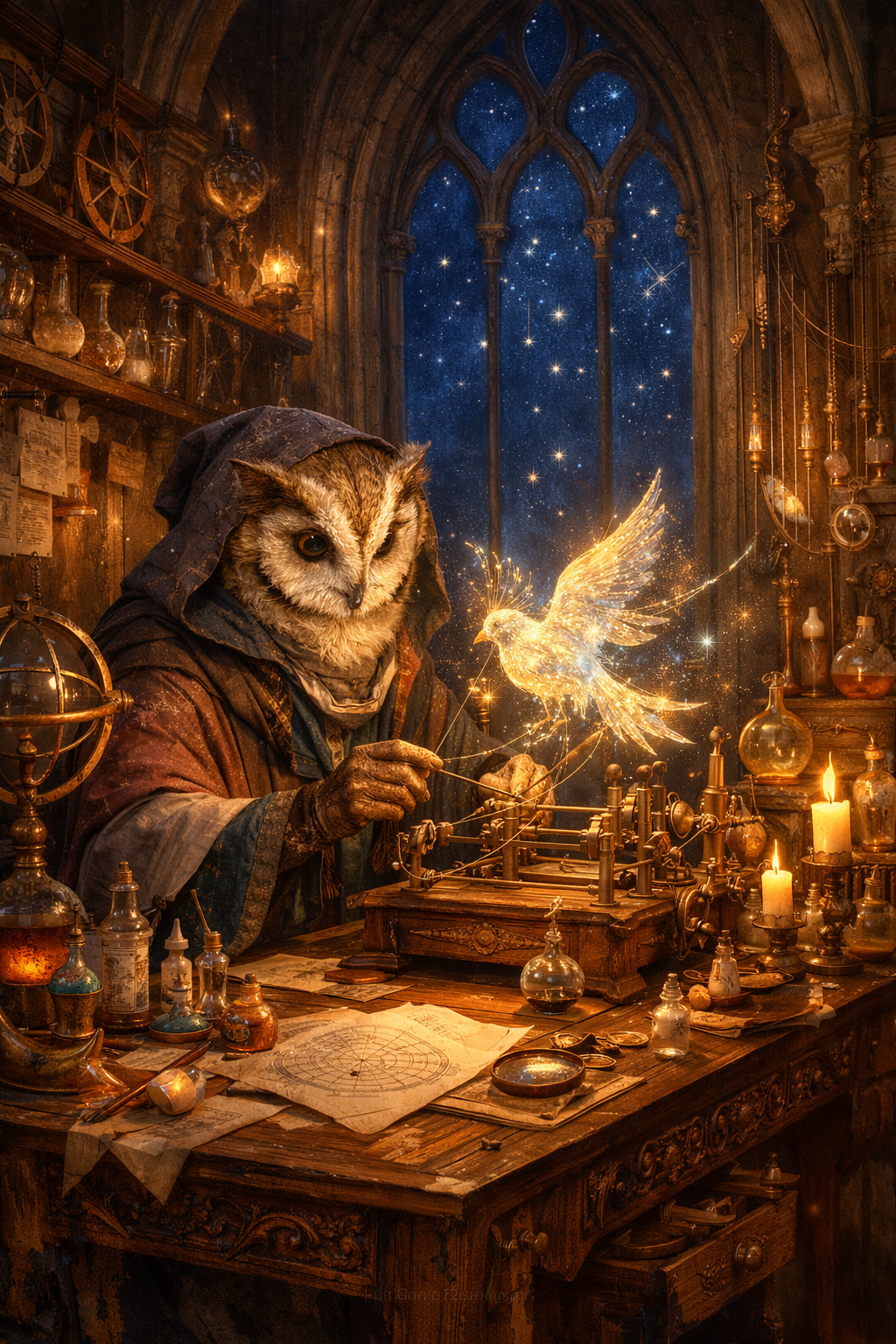
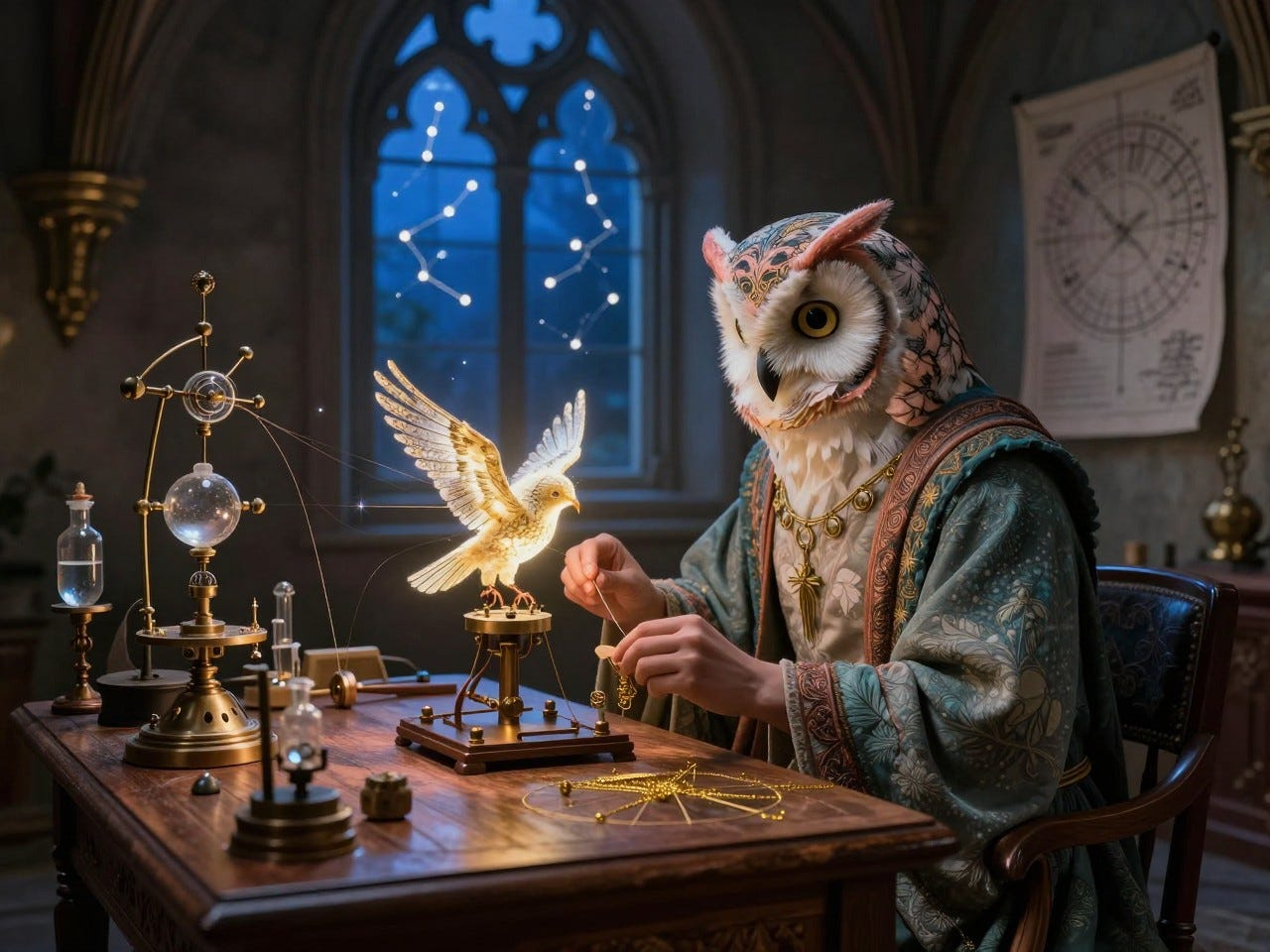
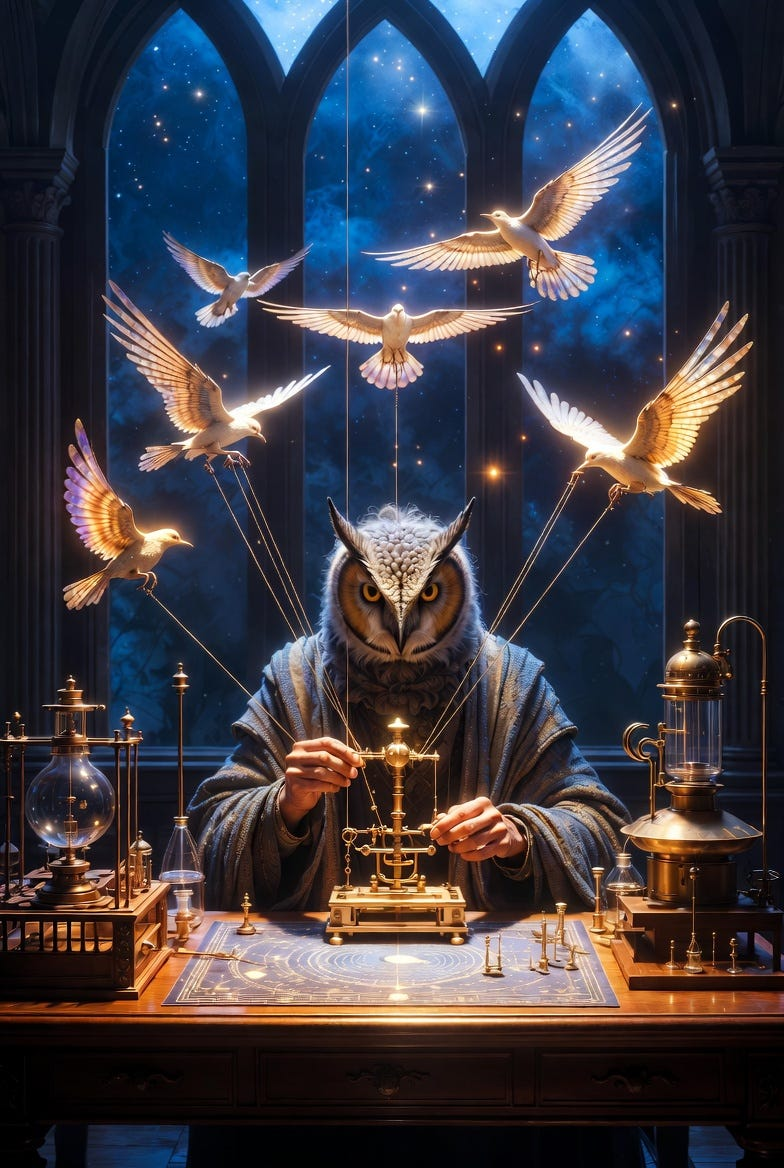
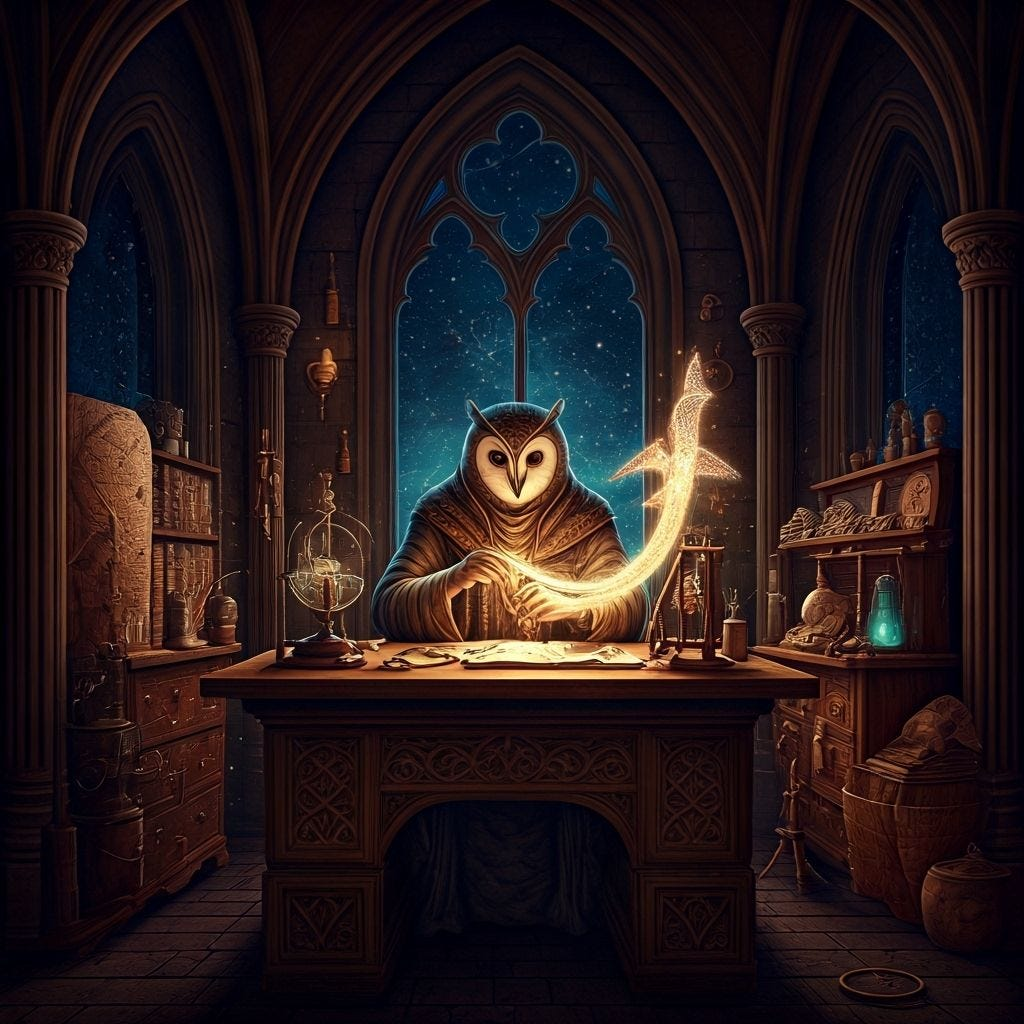
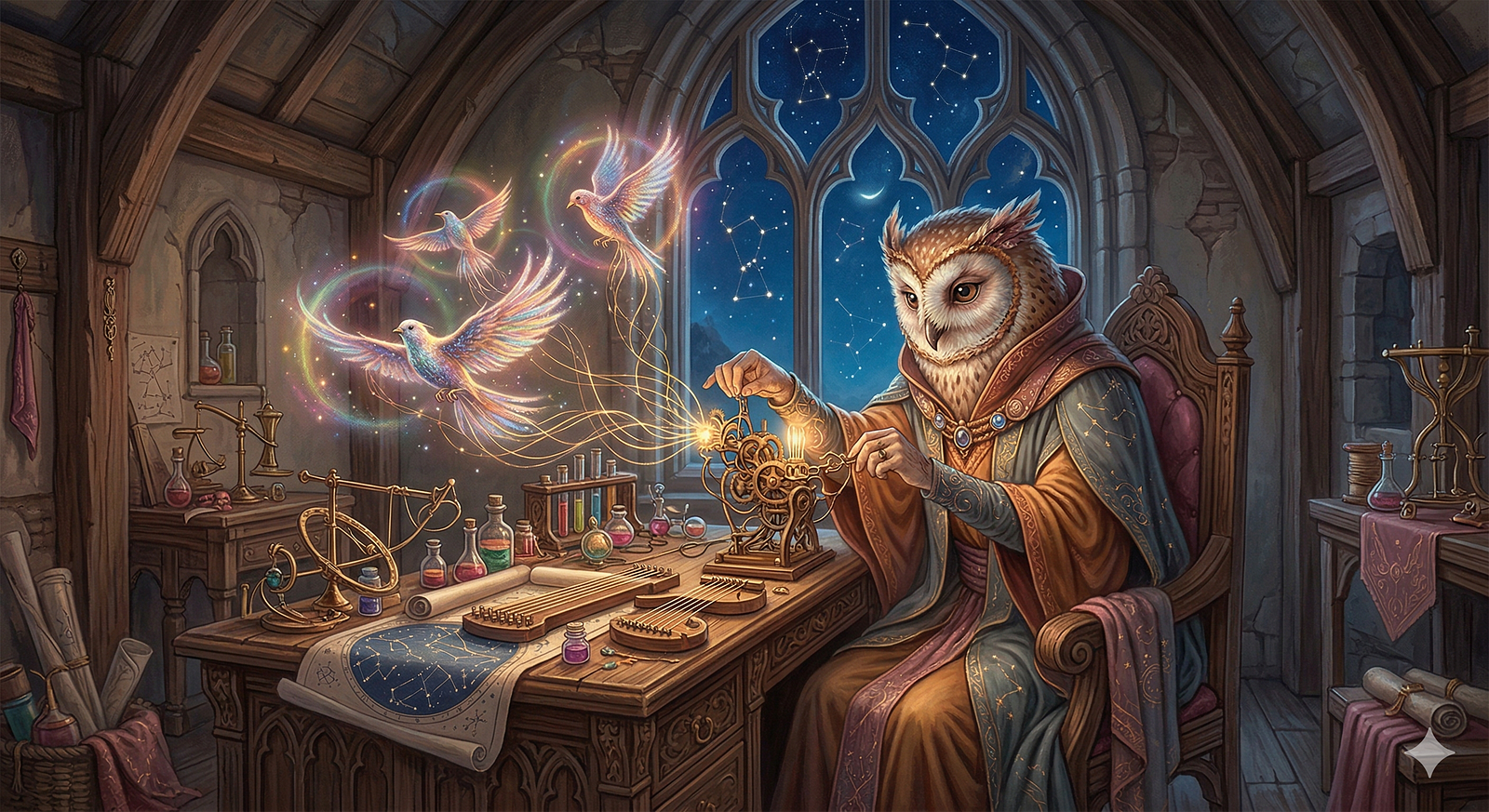
Art Prompt (Surrealism): In a luminous twilight workshop inside a high, narrow chamber, an owl-faced artisan in layered robes sits at a finely carved wooden desk, using a delicate mechanical apparatus to create radiant birds from pigment, starlight, and thin golden threads. The scene glows with amber, copper, smoky teal, dusty rose, and moonlit ivory. Strange scientific instruments, tiny glass vessels, celestial charts, and musical strings are arranged with exquisite precision. Outside a gothic window, a deep sapphire sky flickers with constellations. The composition should feel intricate, mystical, elegant, and quietly theatrical, with meticulous textures, medieval architectural details, soft halos of light, and an atmosphere of alchemical intelligence and enchanted concentration.
Video Prompt: A slow cinematic glide through a candlelit surreal workshop at twilight, where an owl-faced artisan in layered robes uses a delicate machine of strings, lenses, and tiny brushes to create glowing birds from starlight and pigment. Golden threads vibrate, glass vessels shimmer, celestial diagrams pulse softly, and newly formed birds flutter into the air in graceful arcs. The camera drifts through amber haze, past carved wood, luminous dust, and gothic windows opening onto a deep sapphire sky filled with moving constellations. Rich textures, mystical elegance, precise magical motion, dreamy pacing, hypnotic lighting, and a mesmerizing final reveal as radiant birds spiral upward through the chamber.
A couple of songs for that mood: Bells — Nils Frahm and Moon Undah Water — Puma Blue.