March, in strict commercial terms, was a beautifully underachieving masterpiece.
Sales were nonexistent.
That is not a typo, a rounding error, or a poetic interpretation of small numbers. It means exactly what it sounds like. The cash register spent the month in a state of spiritual reflection.
And yet, this was not a dead month. It was one of those months where the money did nothing, the metrics argued with one another, and the content itself kept leaving little clues all over the floor like a detective who is very bad at subtlety.
So let us do what we always do when the dashboard looks slightly unhinged: stare at it until it starts confessing.
The broad picture
On Facebook, views were up 15 percent and reach was up 16 percent, but interactions fell 83 percent, visits dropped 65 percent, and new follows somehow jumped 100 percent. In other words, more people saw the work, far fewer did anything about it, and the people who did decide to follow apparently arrived through a side door.
The most viewed Facebook posts were Programs do not just think… and When Shapes Learn to Breathe….
On Medium, the story was more restrained but also more revealing. Earnings fell 28 percent, views fell 9 percent, reads fell 28 percent, followers rose 3 percent, and subscribers slipped 5 percent. That is not a collapse. That is a month where attention got pickier.
The most viewed and most read article was Swagger vs Redoc: The Ultimate Showdown of API Documentation Titans. The second-most-viewed and second-most-read article was, with almost theatrical consistency, was 10 Politically Incorrect Jokes That Will Make You Laugh. The highest earner was SvelteKit: The Framework That Wants To Be Your Whole Weekend Plan, while another reliable attention magnet remained What Am I Missing About Graph Theory (and Why FAANG Keeps Bringing It Up).
Across LumAIere.com including the blog, page views dropped 17 percent, blog views dropped 19 percent, and active users dropped 19 percent. That sounds grumpy, but the winners were very clear: the most viewed blog was Everything You Ever Wanted to Know About Forging NFTs Without Needing an Anvil, followed by The Chagall Windows in Fraumunster Church, Zurich, In Depth. The most viewed overall page was again the NFT forging article, with the home page, LumAIere.com, close behind.
On X, impressions rose 32 percent, likes rose 6 percent, engagements rose 1 percent, total follows dipped 1 percent, and new follows fell 12 percent. Which means the content traveled farther than the commitment did. The most viewed posts were Breathing Colorfields… and Department D gave Soviet disinformation…. The most viewed post not on my profile was a reply, which is quietly interesting: @grok what conclusions do you draw from this? Reply to @sciencegirl.
TikTok remained TikTok, which is to say both useful and faintly theatrical. Videos over 1000 views fell 10 percent, overall video views fell 5 percent, profile views fell 10 percent, likes rose 3 percent, comments dropped 163 percent, shares dropped 83 percent, total followers rose 8 percent, and new follows doubled. That is a strange little cocktail, but not a meaningless one. The most viewed videos were Cave Wall Cinema… and floating color fields…. The most liked were A dynamic cinematic collage world built from torn papers, old… and When Myth Starts Moving on Clay A grand terracotta vessel….
So what do I conclude from all this?
First, people are still showing up for strong, legible topics.
That was true on Medium, where technical clarity kept winning. It was true on the blog, where the NFT article and the Chagall piece continued doing the kind of dependable work every creator wants from older posts. And it was true on social, where visually distinct posts still pulled attention even when they did not always pull commitment.
Second, March was not a month of broad enthusiasm. It was a month of selective enthusiasm.
People clicked some things. They ignored others. They rewarded clarity more than cleverness, and they rewarded recognizable subject matter more than experiments that asked them to do a little extra interpretive lifting.
Third, replies and conversation still matter. The strongest non-profile X post was not a polished broadcast. It was a reply. That matters because it suggests visibility does not come only from posting at the audience. It can also come from posting into the room where the audience is already talking.
Fourth, the metrics were not universally bad. They were uneven. Uneven is annoying, but uneven is also informative. It tells you what kind of month you actually had instead of letting you flatten everything into one dramatic sentence and go lie on the carpet.
What were the most popular blog articles?
On the blog itself, the clear winners were Everything You Ever Wanted to Know About Forging NFTs Without Needing an Anvil and The Chagall Windows in Fraumunster Church, Zurich, In Depth.
On Medium, the strongest attention grabber was Swagger vs Redoc: The Ultimate Showdown of API Documentation Titans, while the better earner in the data provided was SvelteKit: The Framework That Wants To Be Your Whole Weekend Plan.
What were the least popular blog articles?
The data you gave me does not include a neat bottom-five chart for every platform, so I am not going to pretend the dashboard whispered all its secrets to me.
But on Medium, the strongest clue is already sitting in plain sight: the group of articles called out in Why Are My Last Five Articles Hovering at 0 Reads? Because the Internet Is a Weird Little Goblin looked like the least popular recent pieces in immediate read terms. That cluster included the articles on Memory and the Machine, Jainism, Wilhelm Stieber, Kazimir Malevich, and Complexity and Efficiency.
That does not automatically mean they were weak. It means they were not immediately picked up.
And those are very different problems.
What patterns show up?
A few, and they are hard to ignore.
Technical explainers still work. Art-plus-curiosity still works. Strong visuals still work. Older evergreen pieces still work.
Meanwhile, mixed-topic variety remains both a strength and a distribution inconvenience. One month you are explaining documentation tools, another month you are in a church window, then espionage, then graph theory, then religion, then a Friday night joke detour. As a human creative life, that is lively. As a recommendation system, that is a filing cabinet having a minor episode.
There is also a pattern in what did not convert. Some platforms delivered reach without much downstream action. Others delivered decent engagement without much follower growth. The audience is not absent. It is just selective and platform-specific.
What worked?
Technical clarity worked.
Evergreen pieces worked.
Visually distinct posts worked.
Replies and participation on X worked.
And older content with recognizable hooks kept doing the practical labor of keeping traffic alive while the newer experiments negotiated with the algorithmic weather.
What did not work?
Sales, heroically, did not work at all.
Some newer Medium articles did not get early traction.
A decent amount of social visibility did not turn into proportional follows, clicks, or comments.
And March was another reminder that being interesting is not always the same thing as being immediately distributable. That is rude, but it is useful.
What else is interesting?
One of the more entertaining side quests this month was the moon-trip experiment.
I asked ChatGPT, Grok, and Gemini the same question: what can you tell me about a moon trip?
All three understood the assignment well enough to avoid driving the spacecraft into a cornfield. But Grok clearly won the comparison, with Gemini in second. So if the question is which AI had the best data on the Artemis II mission in this little informal showdown, the answer was Grok.
That is not a grand scientific verdict for all time. It is just what happened in this round, and it was noticeable enough to be worth mentioning.
If you want official Artemis II grounding instead of chatbot pageantry, the cleanest references are NASA’s Artemis II crew page, NASA’s launch day updates, and ESA’s Artemis II mission page.
What got covered in March?
Quite a lot, actually.
The month wandered through graph theory, search engines, build systems, distributed systems, memory, recursion, files and input/output, modular design, testing and reliability, Perl testing, WordPress aggravation, income tax, Department D, Wilhelm Stieber, Kerensky, the Rough Riders, Keith Haring, Jean Arp, Barbara Kruger, Kazimir Malevich, Hinduism, Daoism, Islam, Jainism, Judaism, Crustafarianism, marriage, and at least one very committed Chuck Norris detour.
That is not a niche. That is a small republic.
What is planned for April?
April looks like a month for finishing some strong threads instead of inventing seventeen new trapdoors.
The Artist Series continues.
The Religion Series heads toward its conclusion.
The graph theory series also heads toward its conclusion.
And on the technical side, likely subjects include the Language Server Protocol, REST, object-oriented versus procedural versus functional-style code, and PostCSS.
Which is a healthy little menu: art, religion, graphs, protocols, and the eternal question of how exactly code should behave when left unsupervised.
If you have opinions on what should get covered first, now would be an excellent time to leave a comment and tell me. If you have been reading quietly from the shrubbery, follow along too. The internet notices metrics, but I notice people.
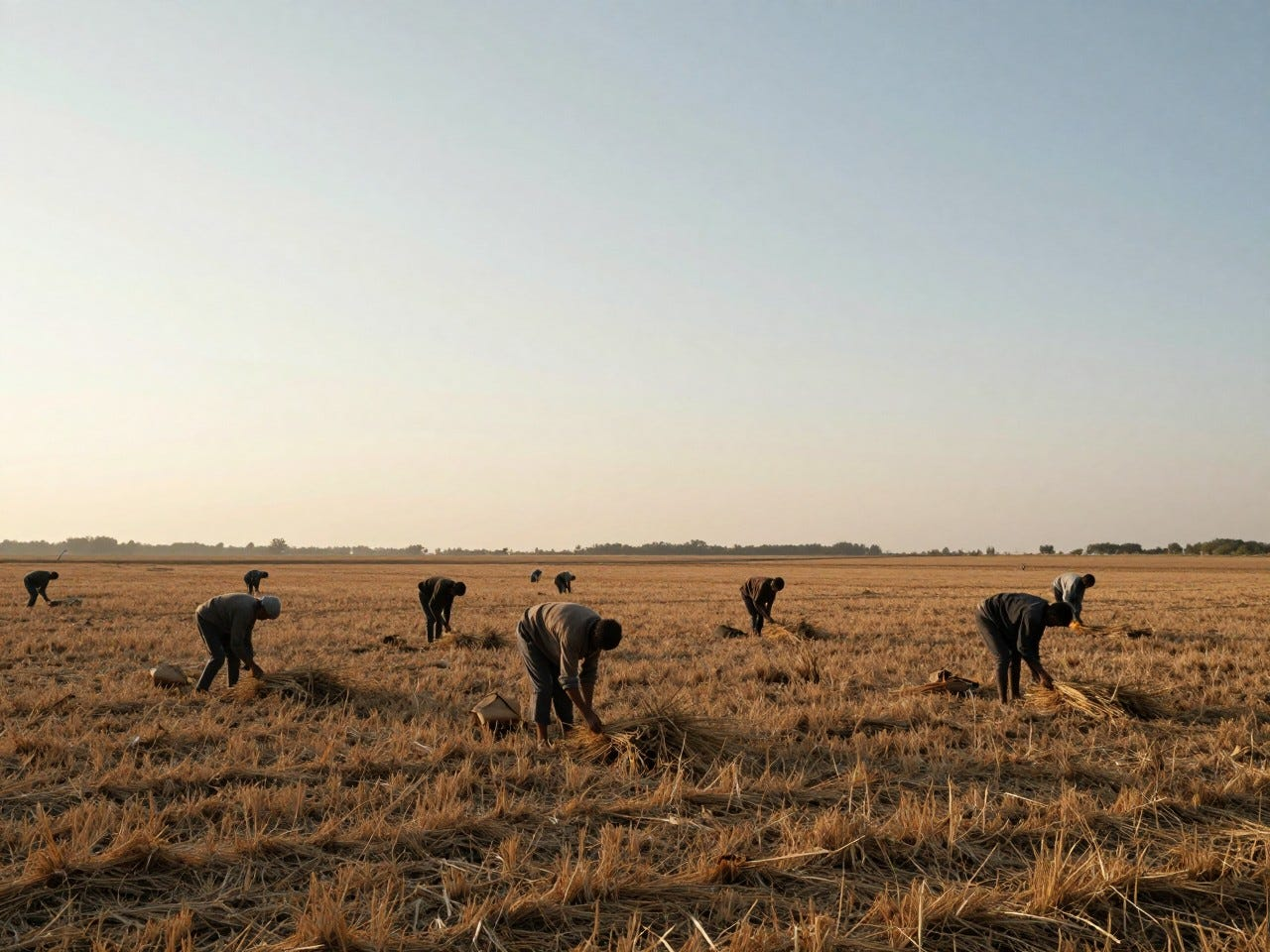
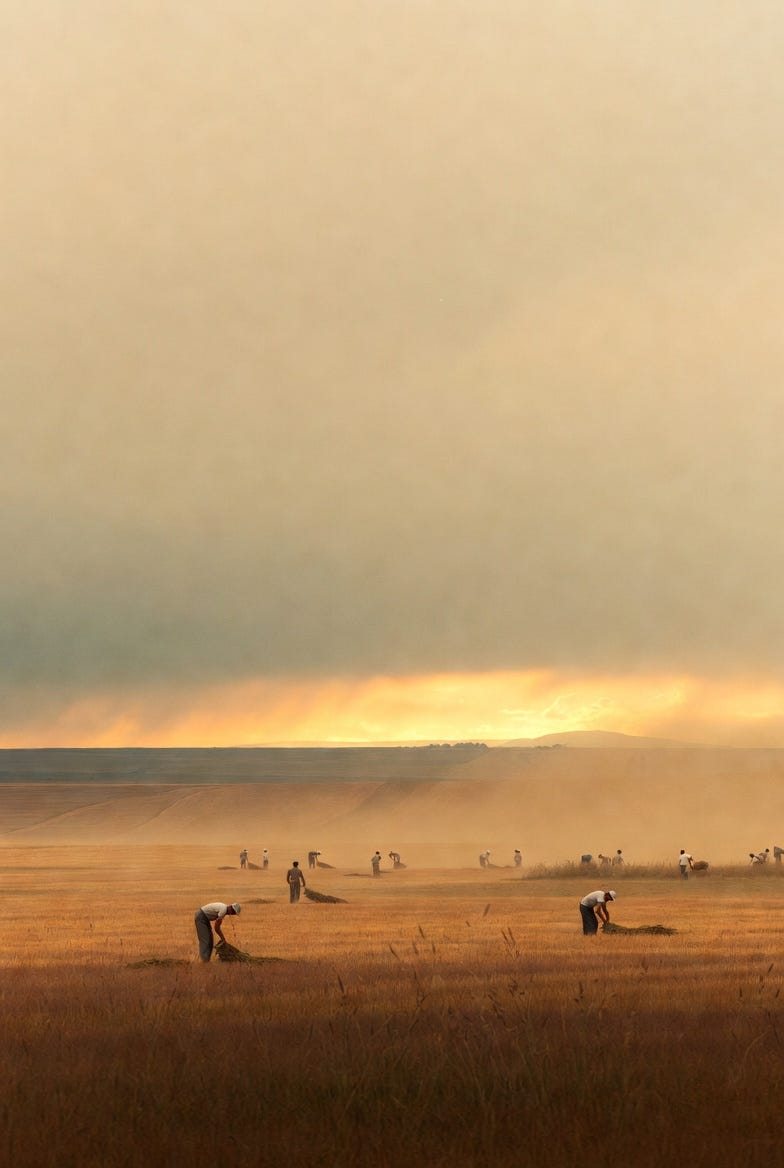
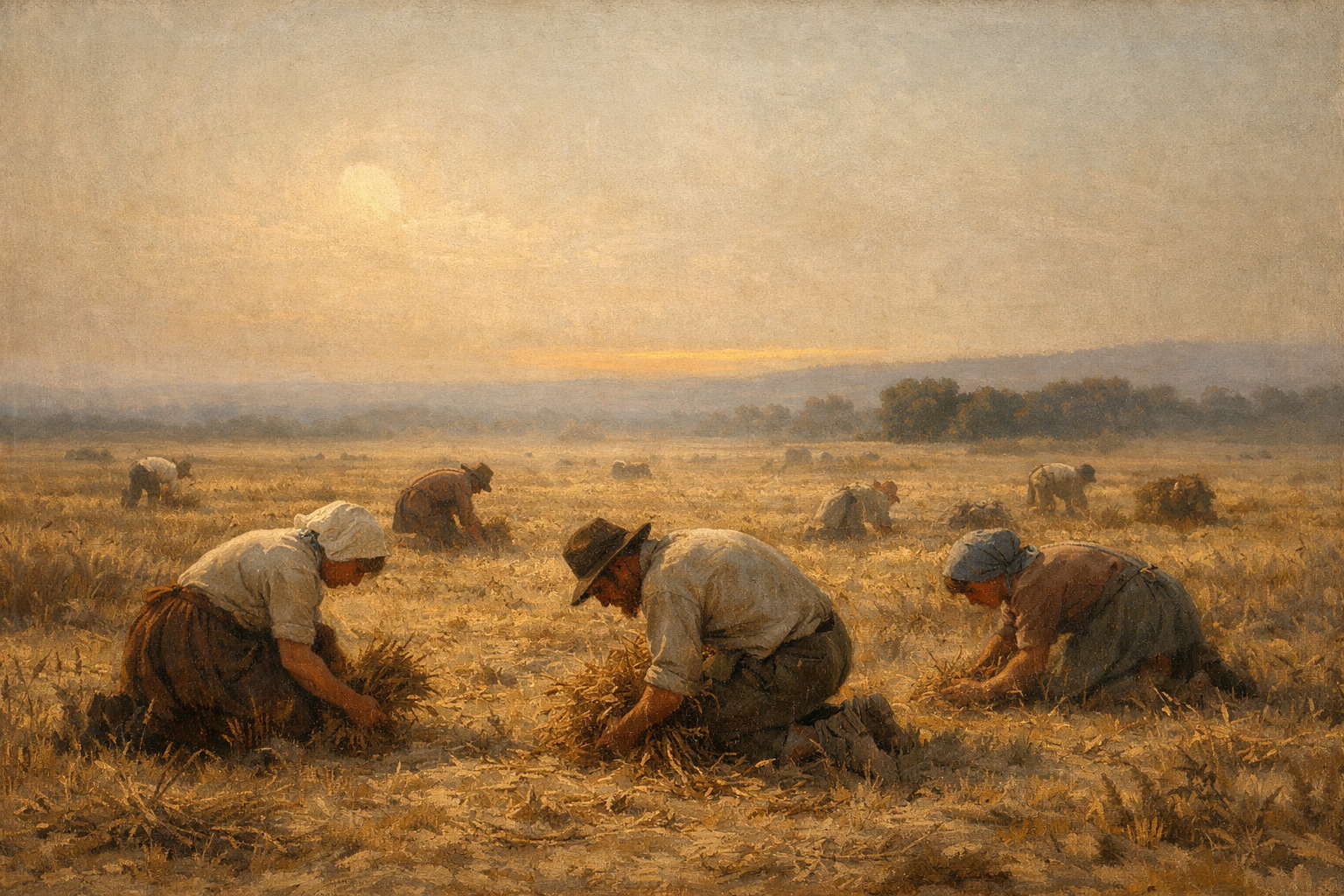
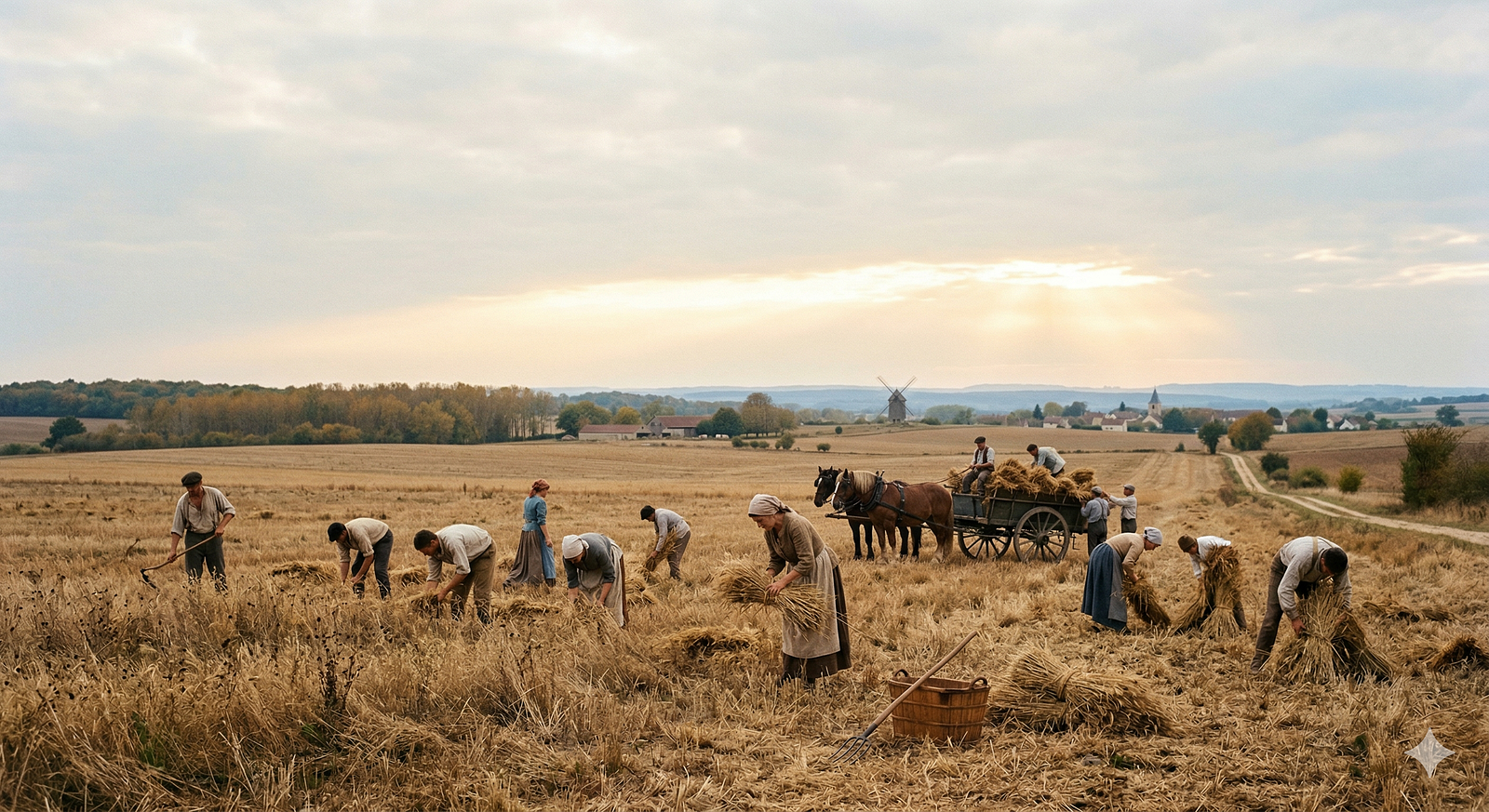
Art Prompt (Realism): A wide rural field stretches beneath a pale, luminous sky, with workers scattered low across the land gathering the last remnants of a harvested day. Use warm ochres, dusty golds, muted earth browns, soft blue haze, and a distant band of sunlit atmosphere near the horizon. The composition should feel grounded and spacious, with the figures placed low against an immense landscape so that labor, weather, and light all seem equally important. Emphasize rough natural textures, humble clothing, dry grasses, and the quiet dignity of repetitive work. Let the mood feel solemn, tender, and deeply human, with realistic proportions, restrained drama, and an almost tactile sense of heat, dust, and fading afternoon light.
Video Prompt: Begin with a low drifting camera moving through dry stalks in the foreground as golden light slides across a broad harvested field. Small figures bend and rise in a calm rhythmic pattern while dust motes shimmer in the air and distant haystacks soften into warm haze. Let the breeze ripple through the remaining grasses, with subtle cloth motion and long shadows slowly stretching across the ground. Build in gentle cinematic motion through parallax, gliding forward movement, and a slow lift toward the horizon so the landscape gradually opens up and the quiet labor feels monumental, serene, and strangely hypnotic.
Suggested songs: Kasbo — The Making of a Paracosm Mogwai — Take Me Somewhere Nice
Follow, comment, disagree, agree, or arrive with a completely different theory about why one article takes off while another sits in the corner like a well-dressed ghost. That is half the fun.