Some artists spend their whole careers proving they can paint a face, a field, a bowl of fruit, or a horse that looks suspiciously better-groomed than most humans.
Kazimir Malevich looked at all that and basically said, “What if we fired the horse?”
And that, friends, is how you end up with one of the most radical artists of the 20th century: a man who helped drag painting away from objects, stories, and respectable visual manners, then handed the world a black square and dared it to keep up.
If you have ever looked at abstract art and thought, “Be honest, is this genius or a prank?” Malevich is one of the main reasons that question became modern art’s favorite party trick.
Who is this artist?
Kazimir Malevich was a pioneering avant-garde painter and theorist, born near Kyiv, who became the founding force behind Suprematism, one of the earliest movements of pure geometric abstraction. If you want the official museum-and-reference version of his life, start with Tate’s artist page and Britannica’s biography.
He was not interested in painting the world as it looked.
He was interested in painting what art could become once it stopped trying to behave.
What is he known for?
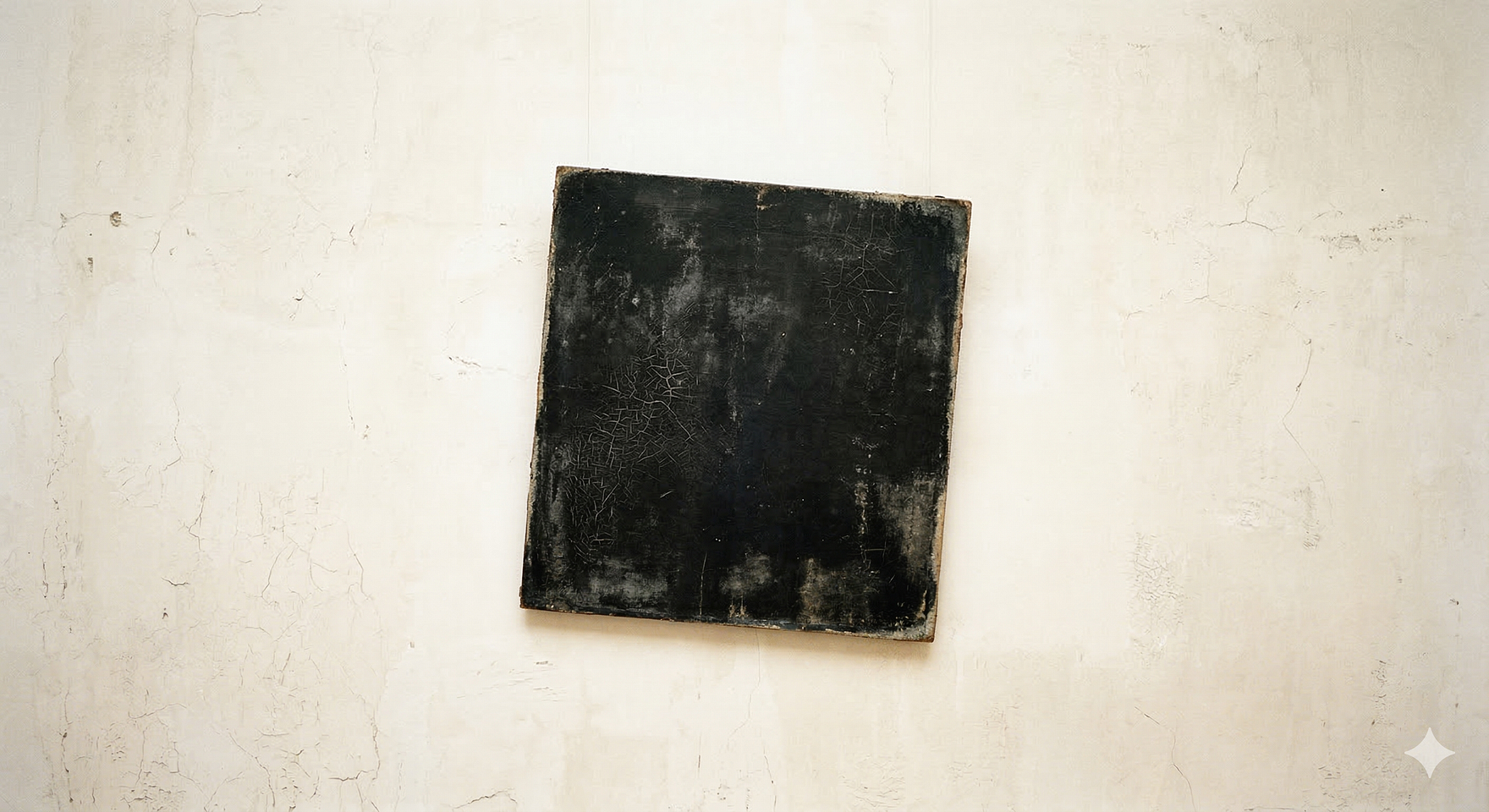
Mostly for detonating a visual bomb called Black Square.
Not a metaphorical black square. An actual black square.
And yet this was not lazy, random, or the historical equivalent of “I ran out of ideas on Thursday.” It was a declaration that painting no longer needed to represent objects at all. No apples. No saints. No moody aristocrats staring off to the side like they just heard disappointing opera news. Just form, feeling, and a direct break with representation.
He is also known for pushing that logic even further in Suprematist Composition: White on White, which is the kind of title that politely warns you the furniture of reality has already been removed.
What is his style?
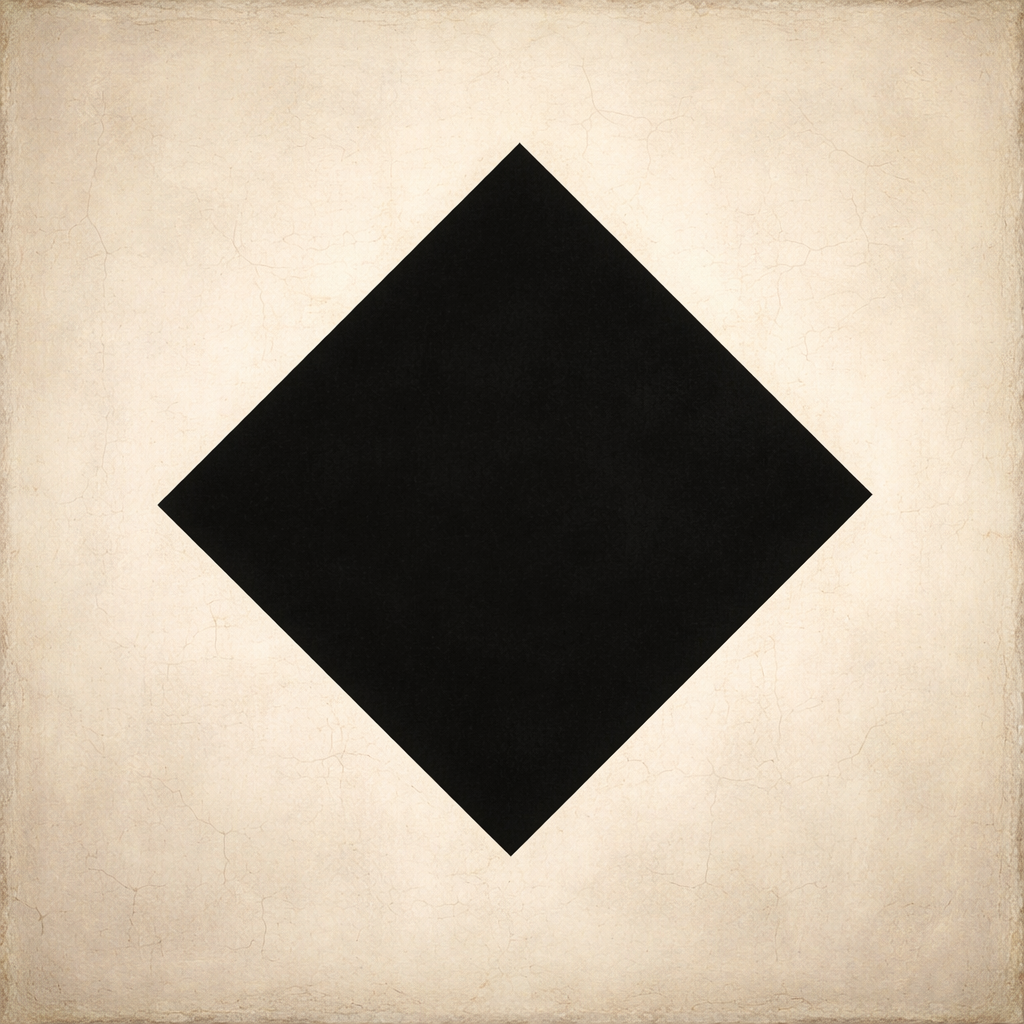
Malevich’s signature style is Suprematism, which sounds dramatic because it is dramatic.
The basic idea: color, line, shape, and pure sensation take priority over depicting things from the visible world. Instead of painting a person standing in a room, you get floating geometry, tilted planes, circles, crosses, and squares suspended in white space like the universe just got very serious about minimalism.
Before he landed there, though, he moved through Impressionism, Symbolism, Cubo-Futurism, and other early modern styles. So he did not begin his career as “square guy.” He earned square guy status the hard way.
Who taught him?
This is one of those questions where the funniest honest answer is: several schools, a lot of experimentation, and the full chaos of modernism.
Malevich studied drawing in Kyiv, then attended the Stroganov School in Moscow and the Moscow School of Painting, Sculpture, and Architecture. So he had real formal training, which makes his later rebellion even better. It is always extra spicy when someone learns the rules thoroughly and then dropkicks them into history.
If you are looking for a single master figure, that is not really the best way to understand him. He was shaped less by one teacher than by the collision of academic training, European modernism, Russian Futurism, and his own increasingly radical ideas.
Does he use any special technique?
Oh yes. Malevich’s special technique was basically visual reduction with the confidence of a man who knew he was about to annoy half the room.
He stripped painting down to basic geometric forms and arranged them with startling precision. Squares, rectangles, circles, and crosses became the whole cast. White space stopped being background and started acting like active space. Tilted angles created movement without needing a single runner, horse, or windswept scarf.
In other words, he treated painting less like a window and more like a field of force.
That sounds grandiose, but with Malevich grandiose is honestly just accurate.
Who has he worked with?
Malevich moved in the thick of the Russian avant-garde, where everybody seemed to be arguing, inventing, exhibiting, and trying to redesign reality before lunch.
He exhibited in the same ferment as Vladimir Tatlin and other Futurist and avant-garde artists, and his ideas directly shaped the orbit of later artists like El Lissitzky. He was also involved in theatre and stage design, including the world around Victory over the Sun, where the black square first showed up in theatrical form before becoming its own full-blown icon.
So no, he was not painting alone in a cave whispering to rectangles. He was part of a larger creative explosion.
Was he wealthy?
Not in the glamorous “eccentric genius with a fabulous estate” sense, no.
Malevich had periods of visibility and influence, but he did not end his life as a triumphant art-market king. Soviet politics turned hard against modernism, and by the end he died in poverty and relative neglect. Which is one of art history’s recurring hobbies: underappreciate the radical person first, then build entire museum wings around them later.
History really loves that move. Very on-brand.
When was he most popular?
Malevich had his great shockwave moment in the 1910s, especially around the rise of Suprematism and the debut of Black Square. That is when he became one of the most radical names in modern art.
But broad fame is trickier than influence.
His work became even more historically important over time, especially after later generations of modern and contemporary artists realized just how much ground he had cleared for abstraction, Minimalism, and conceptual thinking. So if you mean “most disruptive in his own time,” the 1910s. If you mean “most canonized by art history,” that took much longer.
Classic avant-garde career pattern: scandal now, textbooks later.
Tell me more, please
The thing that makes Malevich so important is not just that he painted simple forms. It is that he redefined what simplicity could mean.
A square in his hands was not merely a shape. It was a philosophical argument. A refusal. A reset button. A challenge to the idea that art had to point to something outside itself in order to matter.
That is why people still argue about him.
One person sees transcendence. Another sees a geometry assignment with excellent PR. And honestly, that tension is part of the fun. Malevich created work that makes viewers confront their expectations. If you demand that painting always “show something,” he is there to say, “It is showing you your dependency on showing something.”
Rude. Brilliant. Efficient.
Anything else left to tell?
Yes, and it matters: Malevich was not just tossing shapes around because he liked clean design.
He wrote theory. He taught. He thought deeply about non-objective art and the spiritual and intellectual possibilities of abstraction. He was trying to build a new language for painting in a century that felt like it was breaking apart and rebuilding itself at high speed.
That helps explain why the work can feel so severe. It is not decorative geometry. It is geometry with ambition.
Any other interesting tidbits?
A few excellent ones:
Malevich placed Black Square high in the corner of the 0.10 exhibition, where a religious icon might traditionally hang in a Russian home. Which is a very subtle move if your definition of subtle is “absolutely not subtle at all.”
He later returned to more figurative work, which means his career was not a straight line from object to anti-object. He kept evolving, circling back, and wrestling with the pressures of politics, culture, and survival.
Also, very few artists have managed to make “a square” into one of the most famous mic drops in art history. That is rare air.
Before you go, do me a favor
If this episode made Malevich click for you, follow along for more Artist Series deep dives. And drop a comment with your honest answer:
Was Black Square a revelation, a provocation, or the greatest high-stakes rectangle in museum history?
More writing by Dave LumAI lives here: medium.com/@DaveLumAI
Art Prompt (Geometric Abstraction): A stark, luminous composition built from a slightly tilted dark square suspended against a vast warm off-white field, with delicate craquelure and aged paint texture visible across the surface. The geometry should feel severe but strangely sacred, as if a simple form has been elevated into an icon. Keep the palette restrained: matte black, chalky ivory, soft cream, faint ash-gray undertones, and subtle weathered edges where time has gently worn the surface. The composition should be frontal, balanced, and quiet, yet charged with tension, like a room holding its breath. Museum lighting, minimal elements, no figures, no objects, only pure shape, aged texture, silence, and authority.
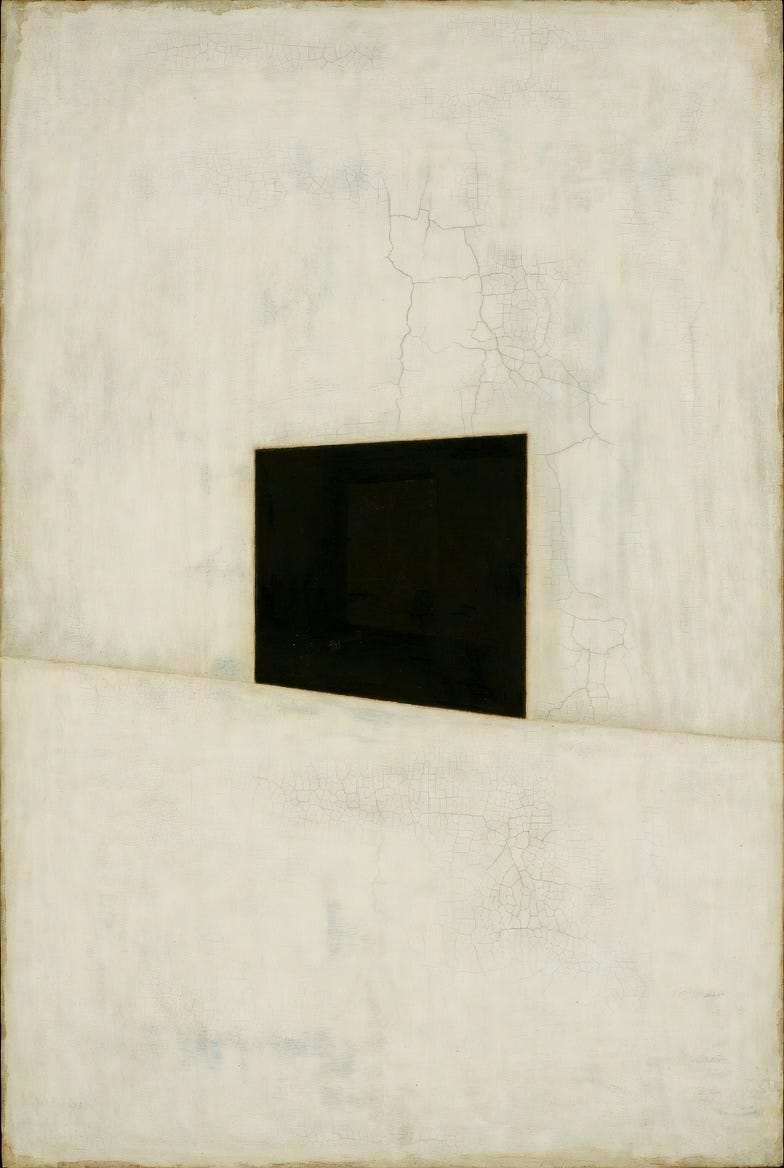
Video Prompt: Begin with an extreme close-up of cracked dark pigment, then slowly pull back to reveal a slightly tilted square emerging from a vast luminous off-white field. Let tiny dust motes drift through soft gallery light while subtle camera movement creates a feeling of reverence and suspended time. Introduce a slow rotational drift of a few degrees, then settle into stillness as the square seems to hover with quiet force. Add delicate texture shimmer across the aged paint surface, faint shadow breathing at the edges, and a measured rhythm of zooms and pauses that make the geometry feel monumental. The mood should be hypnotic, austere, modern, and oddly spiritual.
Songs to Pair With It:
- Blackstar — David Bowie
- Metamorphosis One — Philip Glass
Follow for more art, more visual experiments, and more lovingly overcaffeinated tours through the people who broke painting on purpose. And seriously, comment below: does Malevich blow your mind, confuse you, or both?