
If your microservices are a crowded subway platform, ZooKeeper is the person with the clipboard who keeps everyone from boarding the same train at once. It’s a battle-tested coordination service that gives you a consistent place to do leader election, service discovery, distributed locks, configuration, and other “don’t let two things happen at the same time” tasks. The official project page is here: zookeeper.apache.org.
What is it? ZooKeeper is a replicated, consistent metadata store with a very small API: a hierarchical namespace (“znodes”), ephemeral/sequential nodes, and one-shot watches. Applications build higher-level patterns (locks, queues, elections) on top. The canonical paper is “ZooKeeper: Wait-free coordination for Internet-scale systems” by Hunt, Konar, Junqueira, and Reed (Yahoo!).
Is it still relevant? Yes — especially in ecosystems that standardized on it (HBase, SolrCloud, some Flink HA setups). But momentum for new deployments has cooled as Kafka removed ZooKeeper in 4.0 (KRaft mode by default) and other stacks favor etcd or Consul. Translation: still important, but no longer the automatic first choice.
Pros and cons (a quick, honest list):
Pros: strong consistency; simple primitives; proven under heavy load; rich client libraries (Java/Curator, Python/Kazoo, Go).
Cons: you must run and babysit a quorum (3–5 nodes); watches are one-shot (you must re-register); write throughput is limited (it’s not a general KV database); operational gotchas (ACLs, disk/log tuning) are real. (The paper and Curator docs discuss patterns and caveats.)
Strengths and weaknesses?
Strengths: rock-solid leader election and membership; ephemeral nodes that disappear when clients die; predictable semantics.
Weaknesses: extra moving parts; clients must be designed carefully to avoid “herd effects” on popular znodes; not ideal for large blobs or high-cardinality write paths.
What is it used for?
- Leader election / HA failover (pick one active worker)
- Service discovery / config distribution (keep endpoints and flags in one source of truth)
- Distributed locks / queues (serialize access to scarce resources) Flink, HBase, and SolrCloud all document ZooKeeper for these roles.
Can you give me an example?
Here’s a tiny Python example using Kazoo to take a distributed lock. When the with block runs, you have exclusive access:
from kazoo.client import KazooClient
from kazoo.recipe.lock import Lock

zk = KazooClient(hosts="zk1:2181,zk2:2181,zk3:2181")
zk.start()
lock = Lock(zk, "/locks/video-transcoder")
with lock:
    # do your one-at-a-time work here
    print("I have the lock; transcoding chunk...")
zk.stop()
Kazoo’s docs also include convenient DataWatch/ChildrenWatch helpers if you prefer callbacks over polling.
What are the alternatives?
- etcd (Raft-based; powers Kubernetes’ control plane).
- Consul (service discovery + health checks + optional mesh).
- Chubby (Google’s internal lock service that inspired ZooKeeper; paper only).
- Kafka KRaft (Kafka’s built-in Raft metadata quorum that replaced ZooKeeper).

Is it the subject of any famous art? Not the software. (If you’re thinking of gallery canvases with actual zookeepers and animals — that’s a different career path.)
How popular is it? Is it going up or down? When was it most popular? The project is mature and widely deployed; its GitHub repo has ~12k stars, reflecting long-standing adoption. Popularity for new Kafka clusters is down because KRaft made ZooKeeper optional, then unnecessary, culminating in Kafka 4.0 removing it entirely. HBase/SolrCloud still depend on it, so production footprints remain sizable.
What is its history? Who invented it? Created at Yahoo!, announced in the late 2000s, and published at USENIX ATC 2010 by Hunt, Konar, Junqueira, and Reed; later became an Apache top-level project (PMC established 2010).
What companies use it the most? Historically: Yahoo! (birthplace), Netflix (Exhibitor for ZK management), LinkedIn/Confluent (via Kafka pre-KRaft), and most Hadoop distributions (Cloudera/Hortonworks) where HBase and SolrCloud were common.
Is it similar to anything else? Conceptually close to Chubby; functionally comparable to etcd and Consul for coordination/service registry, but with different trade-offs and ecosystems.
Does it work well with AI? It isn’t an ML framework, but it pairs fine with AI infrastructure — e.g., leader election for model-server primaries, coordinating canary rollouts, or gating access to a shared GPU pool. Many AI stacks lean toward Kubernetes (etcd) today, but if your data platform already runs ZooKeeper (because of HBase/Solr/Flink), you can absolutely reuse it for orchestration.
What tech stack does it work with? Runs on the JVM; clients exist for Java, Python (Kazoo), and Go, plus recipes via Apache Curator. It integrates with Hadoop-era systems (HBase, SolrCloud) and remains optional for some Flink HA modes.
What tools work best with it?
- Apache Curator (batteries-included recipes: LeaderLatch, shared locks).
- zkCli.sh (official CLI) and zookeepercli (handy non-interactive CLI).
- Exhibitor (older Netflix supervisor for ensembles; useful in certain ops contexts).

Any other interesting tidbits?
- Ephemeral nodes vanish when a client session ends — great for live membership tracking.
- Sequential nodes make lock and queue ordering simple.
- Observers allow scale-out reads without taking quorum votes.
- Dynamic reconfiguration exists, but test it carefully before production. (See the official docs and Curator notes for recipes and best practices.)
Alternatives and “do I still need it?” in one breath: If you’re green-fielding on Kubernetes, start with etcd-backed tools or built-ins. If you’re on Kafka ≥4.0, don’t add ZooKeeper. But if you run HBase/SolrCloud — or you already have a reliable ZK ensemble — there’s no shame in continuing to use it where it shines.
Follow & chime in: If this was useful, follow for more deep dives and drop a comment with your most surprising ZooKeeper lesson or war story. Also, find more writing here: https://medium.com/@DaveLumAI.
Useful links (product + docs):
- Project: Apache ZooKeeper
- Paper: USENIX ATC 2010
- Clients: Apache Curator recipes · Kazoo (Python) docs · Go client
- In the wild: HBase needs a ZK quorum · SolrCloud uses ZK
- Kafka’s move away from ZK: KIP-500 · 4.0 without ZK
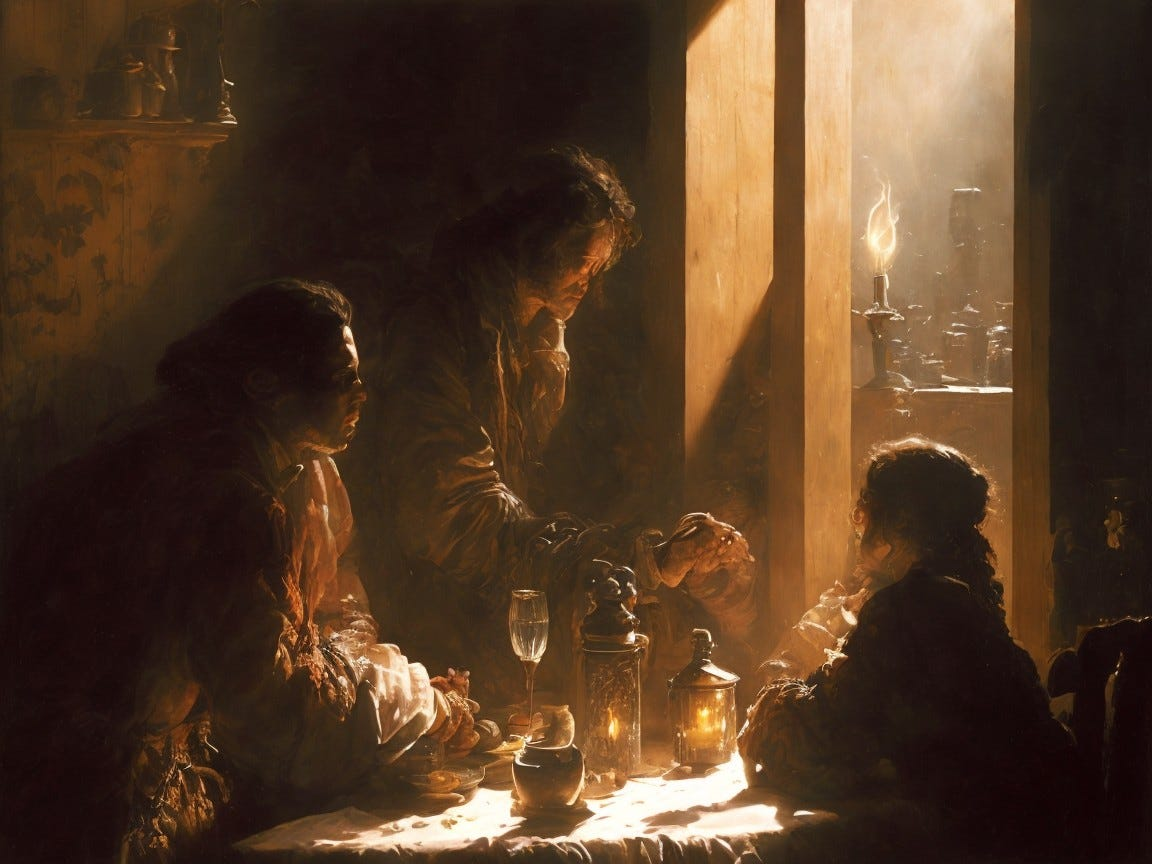
Art Prompt: A dim tavern interior ruptures by a raking beam of warm light that cuts through darkness at a sharp angle; figures seated at a rough wooden table are frozen mid-gesture, their hands and faces suddenly aflame with illumination; deep chiaroscuro carves volume into fabric folds and weathered skin; textures of plastered wall and tarnished metal glint at the threshold of shadow; palette of umbers, olive greens, and crimson accents; composition asymmetric, light entering from frame right to reveal narrative surprise; brushwork tight at focal points, looser at the periphery; solemn, theatrical mood with air thickened by dust motes.
Cut hard from black straight into the light-strike reveal — on beat 1, the beam snaps on and faces pop from shadow; whip-pan left to right across the table as hands gesture; micro-rack-focus between eyes and coins; brief shutter stutter (1–2 frames) to accent flicker; speed-ramp during the whip, then hold a stillness as dust drifts; final pop zoom on the brightest face as the music hits; 9:16, 4K, crisp grain, subtle lens breathing; no slow pans — fast reveals, bold chiaroscuro, end on a freeze with the light cutting the frame at 30 degrees.
The art above leaned into Baroque drama, that moody chiaroscuro world where a single shaft of light can make a whole tavern scene feel like life and death. Pair that visual punch with a soundtrack that balances intensity and warmth:
- On the Nature of Daylight — Max Richter for the swelling, cinematic gravitas
- Sunflower — Rex Orange County to bring in a playful modern counterpoint.
Together, they give your imagination both the shadows and the sunshine to carry this ZooKeeper journey a little further.