
If Web3 were a city, blockchains would be the courthouse: public, tamper-evident, and a little too serious.
But the courthouse is terrible at holding stuff. You don’t store everyone’s furniture in the courtroom.
That’s where Web3 storage and indexing come in:
- IPFS and Arweave: where you stash the furniture
- The Graph and subgraphs: the GPS and search engine so apps can find that furniture fast
Let’s unpack all of this without needing a PhD in distributed systems or a support group for people who lost files in “final_final_v12_really_final.zip”.
1. What problem are IPFS, Arweave, and The Graph actually solving?
Blockchains are fantastic at:
- Tiny bits of data (balances, ownership, state)
- Permanence and audit trails
- Being painfully expensive per byte
They are terrible at:
- Storing big files (images, videos, logs)
- Flexible queries (“show me all swaps from last week where token X was involved”)
So the Web3 stack split the job:
- Decentralized storage (IPFS, Arweave) holds the heavy data.
- Decentralized indexing (The Graph + subgraphs) turns blockchain chaos into queryable APIs.
Think:
- Storage = “where is the thing?”
- Indexing = “how do I search and filter all the things without crying?”

2. IPFS: The Content-Addressed Librarian
What is IPFS?
The InterPlanetary File System (IPFS) is a peer-to-peer protocol where files are identified by what they are (a cryptographic hash of their contents) instead of where they are (a server URL).(Wikipedia)
Instead of:
You get:
ipfs://bafybeigdyr…(a content identifier, or CID)
Anyone on the network who has that data can serve it. It’s like BitTorrent grew up, got a haircut, and decided to be the backbone of decentralized storage.(Filebase)
Is IPFS still relevant?
Yes. It’s the default choice behind a huge amount of NFT media, pinned assets, static websites, and dApps. Tons of gateways and infra providers plug into ipfs.tech so your browser can reach IPFS content without special software.
What’s it used for?
- NFT images, videos, and metadata
- Static websites (e.g., decentralized frontends)
- Backups of public data sets
- General “I don’t want to trust one company’s server” storage
Strengths
- Content addressing = built-in integrity check
- No single point of failure (data can be mirrored across many nodes)
- Works nicely with blockchains: you store just a hash on-chain
- Large ecosystem (Filecoin, web gateways, pinning services, etc.)
Weaknesses
- IPFS doesn’t guarantee your file stays available forever.
- Somebody has to pin and host it.
- Performance depends on who’s online and how widely your content is replicated.
- For production apps, you usually rely on a pinning service (which re-introduces a bit of centralization in practice).
Is it expensive?
IPFS itself is a protocol, so your cost depends on:
- Whether you self-host nodes (infra + ops)
- Or use a pinning provider (usually a monthly fee per GB + bandwidth)
You’re not paying the protocol; you’re paying whoever stores your bits.
Does it work well with AI?
Surprisingly, yes:
- Great for storing model artifacts, datasets, or static assets
- Easy to verify integrity via hashes
- AI agents can fetch and verify content deterministically, especially when you pair IPFS CIDs with on-chain records
Just don’t expect super-low-latency streaming for real-time inference without some caching in front.
3. Arweave: The Web’s Long-Term Memory
What is Arweave?
Arweave is a decentralized network designed for permanent storage. You pay once to store data, and its economic model incentivizes nodes to keep that data available “forever” (or at least a very long time). It uses a “blockweave” structure and a consensus mechanism called Proof of Access, where miners must show they can access random previous blocks to add new ones.(arweave.org)
The idea:
If the network keeps rewarding people for holding old data, that data sticks around.
Is it still relevant?
Absolutely. Arweave underpins the so-called “permaweb” — permanent web apps and content. It’s popular with:
- NFT platforms
- Publishing tools
- Archival projects
- Protocols that must not lose historical data
What’s it used for?
- Long-term NFT storage (more robust than “hope the IPFS pin never dies”)
- Permanent blogs and publishing platforms
- Archiving DeFi and governance data
- Legal, scientific, and historical records
Strengths
- Strong permanence story: the economic design is built around long-term retention
- Content is directly accessible via normal browsers (HTTP gateways)
- Great psychological comfort: “This won’t just vanish when a startup goes broke”
Weaknesses
- You’re committing to “store forever,” which can be overkill for short-lived content
- Upload cost can be higher up front versus rent-style storage
- If “I changed my mind, please delete that” is part of your life plan, permanent storage might not be your best friend
How much does it cost?
Prices fluctuate, but analyses of Arweave’s fee model have historically shown ranges of around $6–$8 per GB to store data, paid once, not monthly.(tts4tdr756jubxgxecqhkyh4slml7vrb5o4gzs2awngqi5ljg5da.arweave.developerdao.com)
Compare that to “$X per GB per month forever” on traditional clouds, and Arweave starts to look like prepaying your storage mortgage.
Does it work well with AI?
Yes, especially where auditability matters:
- Permanent storage of model versions and training datasets
- Immutable audit logs for AI decisions
- Long-term reproducibility of experiments
Just remember: putting sensitive personal data into “permanent” infrastructure is a one-way door. Use it for things that should outlive your laptop.

4. The Graph and Subgraphs: Web3’s Data Concierge
If IPFS and Arweave are where you store stuff, The Graph is how you find and query everything without scrolling through 800,000 blocks manually.
What is The Graph?
The Graph is a decentralized protocol that indexes blockchain data and exposes it via GraphQL APIs. It’s like a Web3 search/index layer so your app can ask:
“Show me all swaps over $1000 in this pool in the last week, grouped by token.”
Under the hood, node operators (Indexers) stake the GRT token, run nodes, and serve queries to consumers.(docs.thegraph.academy)
You can explore the ecosystem and docs via thegraph.com.
What’s a subgraph?
A subgraph is a custom indexing recipe that defines:
- Which smart contracts to watch
- Which events and calls to index
- How to transform them into entities (e.g.,
User,Trade,Position) - How they should be exposed over GraphQL
Subgraph = “custom database + API built from blockchain events.”(Settlemint Console)
Example: A tiny GraphQL query
Once your subgraph is deployed, your app can query it like this:
{
  swaps(first: 5, orderBy: timestamp, orderDirection: desc) {
    id
    trader
    tokenIn
    tokenOut
    amountIn
    amountOut
    timestamp
  }
}
That’s it. No manual log parsing, no 10,000-line JSON dumps. Just a neat GraphQL endpoint.
Strengths
- Massive time saver: no custom indexer infra needed
- GraphQL is developer-friendly
- Decentralized network of indexers and delegators helps with reliability
- Rich ecosystem of ready-made subgraphs for major DeFi and NFT protocols
Weaknesses
- Learning curve: you need to grok GraphQL, mappings, and schema design
- Complex or highly custom workloads may still need your own indexer
- Network pricing and query costs can be non-zero, especially at scale
Does it work well with AI?
Very much so:
- A subgraph turns messy on-chain state into structured, queryable data
- AI agents can hit GraphQL APIs to reason about DeFi, NFTs, and user behavior
- Great foundation for “AI copilot for DeFi”, analytics dashboards, risk models, etc.
5. Popularity, history, and “who’s using this stuff?”
History & inventors
- IPFS was created by Juan Benet and developed at Protocol Labs around 2014–2015.(Wikipedia)
- Arweave was founded by Sam Williams and William Jones (Arweave launched in 2018).(Messari)
- The Graph was launched by Yaniv Tal, Jannis Pohlmann, and Brandon Ramirez, initially focused on Ethereum before expanding multi-chain.(docs.thegraph.academy)
How popular is all this?
Short version: niche but crucial.
- IPFS and its ecosystem (Filecoin, gateways, pinning services) see continuous growth in nodes and data stored.(CoinLaw)
- Arweave has become a go-to choice for projects needing long-term persistence, especially high-value NFTs and protocol archives.(Messari)
- The Graph is quietly powering a lot of DeFi and NFT frontends under the hood — end users never see it, but they absolutely rage-quit when it’s down.(docs.thegraph.academy)
When was it most popular? Is it going up or down?
- IPFS + Filecoin adoption surged alongside the 2021–2022 NFT boom and continues to grow as decentralized storage becomes more mainstream.(CoinLaw)
- Arweave interest spikes in cycles with NFT and “permanent web” narratives, but overall it remains a strong choice for archival use cases.(Messari)
- The Graph’s usage tracks the health of DeFi and NFT ecosystems; as long as people are swapping, staking, and minting, it’s busy.(docs.thegraph.academy)
Who uses these the most?
- NFT marketplaces and launchpads
- DeFi apps (DEXes, lending platforms)
- Analytics dashboards and portfolio trackers
- DAOs and governance tooling
- Long-term archives (projects, institutions, and very serious nerds)
6. Alternatives and cousins in the ecosystem
Storage alternatives
- Filecoin — incentive layer on top of IPFS for long-term storage deals (rent-style).(TechTarget)
- Sia, Storj, Swarm, and others — different trade-offs in cost, decentralization, and UX.(DEV Community)
Indexing alternatives
- Custom indexers using Postgres/ClickHouse + an RPC provider
- Specialized analytics infra (Dune-style platforms, bespoke query engines)
- Other protocol-specific indexers
These alternatives can be faster or more flexible for particular workloads, but you give up the shared protocol/network benefits of The Graph.
7. Tech stacks, tools, and how it all fits together
Typical Web3 stack combining these:
- Frontend: React, Next.js, Vue, etc.
- Smart contracts: Solidity, Vyper, Rust (depending on chain)
- Storage:
Media + metadata on IPFS or Arweave
Hash or URI referenced in contract state
- Indexing:
Subgraphs on The Graph providing GraphQL APIs
- Backend / AI services (optional):
Python/Node.js for AI, analytics, and bots consuming The Graph & storage data
Helpful tools
- IPFS: Kubo (Go implementation), IPFS Desktop, HTTP gateways, pinning providers
- Arweave: Arweave JS/TS SDKs, Bundlr, ArDrive, and various permaweb frameworks
- The Graph: subgraph studio, CLI, hosted services and decentralized network
Rough cost expectations
- IPFS: Depends heavily on provider; often a few dollars per TB per month for storage + bandwidth, or infra costs if you self-host.
- Arweave: Upfront “forever” fee per GB (you can ballpark costs using community calculators and fee tools).(tts4tdr756jubxgxecqhkyh4slml7vrb5o4gzs2awngqi5ljg5da.arweave.developerdao.com)
- The Graph: Query fees + possible subscription or gateway charges, depending on whether you use the decentralized network or hosted solutions.(docs.thegraph.academy)
You’re trading “flat cloud bill” for a more nuanced set of protocol costs — but you get censorship resistance, verifiability, and trust minimization in return.
8. Is this the subject of any famous art?
Not in the “hanging in the Louvre” sense, but:
- Many NFT collections rely on IPFS or Arweave for their media
- Conceptual “data permanence” art and memorialization projects increasingly use permanent storage
- The “art” here is often emergent: massive, evolving collections of on-chain + off-chain content that together form a living, programmable museum
So while you won’t see “Portrait of a Content Identifier, 2025” in a catalog (yet), these protocols quietly support a huge slice of contemporary digital art.
9. Quick example: how it all works together
Imagine you’re launching a new NFT collection:
- Artwork files go to IPFS or Arweave.
- Metadata JSON (name, description, image URI) also goes to IPFS/Arweave.
- Your smart contract stores only the content hashes or URIs.
- A subgraph indexes every
Transferevent, plus your customMintedevents. - Your frontend calls The Graph’s GraphQL API to show:
- Who owns what
- Trait filters
- Activity history
Result:
- Data is harder to censor or lose.
- Your app is snappy and queryable.
- Anyone can build alternate frontends or analytics on top of your subgraph.
And your community gets to argue about floor price in peace, knowing at least the art isn’t stored on a single sad VPS.

10. Final thoughts (and your turn)
Web3 storage and indexing look intimidating, but at heart they answer two very human questions:
- “Where did I put that thing?”
- “How do I find it again quickly?”
IPFS, Arweave, The Graph, and subgraphs give you:
- Durability (files don’t just evaporate)
- Transparency (you can verify content by hash)
- Composability (anyone can build on top of the same data)
If you’re building dApps, NFT projects, AI agents that reason about on-chain activity, or just want your work to outlive your laptop, these are the tools worth learning.
Now I’d love to hear from you:
- Have you used IPFS, Arweave, or The Graph in a project?
- Any horror stories of “oops, we stored everything on one centralized box”?
- Or clever hacks where you mixed these with AI or analytics?
Drop your experiences, questions, and spicy Web3 takes in the comments — and hit follow so you don’t miss the next deep dive into the strange, delightful stack we’re all quietly building together.
Art Prompt (Abstract Expressionism):
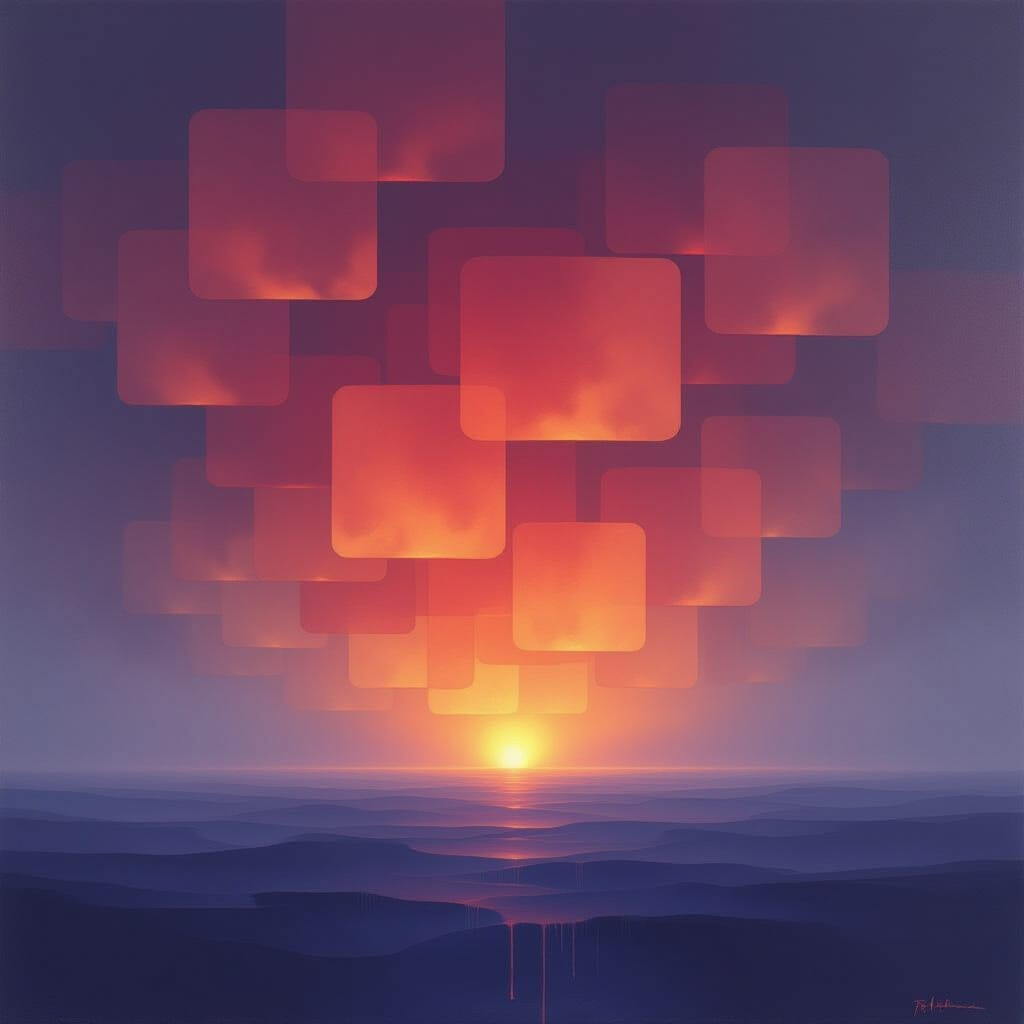
A large vertical canvas dominated by drifting rectangles of deep crimson, burnt orange, and smoky violet, softly stacked like hovering clouds of color, their edges blurred as if they’re gently dissolving into one another; a subtle field of midnight blue hums beneath the surface, occasionally peeking through in thin, luminous seams, while delicate drips and translucent washes accumulate toward the bottom, hinting at gravity and time; the overall composition feels meditative yet intense, as if the colors themselves are quietly arguing, with glowing light at the center slowly pulsing outward, inviting the viewer into a calm, contemplative haze.
Explode straight into a close view of glowing color fields blossoming across a vertical canvas, as blocks of crimson, burnt orange, and smoky violet fade in and out, gently sliding past each other in slow, organic waves; let subtle drips of paint appear and stretch downward in real time, as if gravity is softly tugging at them, while a faint underlayer of midnight blue flickers through thin cracks and seams; have the colors breathe — brightening, dimming, and shifting position with each beat — so the whole frame feels like a living, meditative storm of pigment that loops seamlessly, leaving viewers with the sense of standing inches away from a massive, softly humming wall of light.
Song Pairings for the Video:
- Show Me How — Men I Trust
- Believe In Me — Flamingosis
If you try this combo — art, motion, and music — post a link and tell everyone how it turned out… and don’t forget to follow for more experiments in the beautiful mess where code, art, and Web3 collide.