There is a recurring pattern in life that feels like it should come with a warning label: the faster you grow, the sooner the lights tend to go out. Grow slowly, take your time, stretch things out, and you are statistically more likely to hang around long enough to develop strong opinions about lawn care and weather.
This is not a mystical rule whispered by ancient turtles. It is a well-documented biological pattern tied to metabolism, development speed, and how hard your cells are working behind the scenes. Biologists usually file this under ideas like allometric scaling, which is a polite way of saying that size, growth rate, and lifespan are in a complicated relationship that nobody fully controls.
So let’s get one thing out of the way immediately.
There is no clean formula where “five years of growth equals thirty years of life.” Biology does not do punch cards. But there is a very strong trend: species that grow quickly tend to age faster and die sooner, while slow developers usually enjoy longer lives.
Does this apply to mammals?
Absolutely, and mammals make the pattern very easy to see. Small mammals grow fast, reproduce early, and burn out quickly. Large mammals take longer to mature and generally live longer. Humans and elephants are classic slow-burners. Mice are biological speedrunners.
But mammals also love exceptions, which is why this topic refuses to behave.
Birds often live far longer than mammals of the same size. Bats are tiny, metabolically intense, and yet can live for decades. Naked mole rats look like science experiments that escaped the lab and routinely live ten times longer than expected for their size.
So the rule works… until it doesn’t.

What about plants?
Plants play a similar game, just without the screaming. Annual plants grow fast, reproduce once, and die. Perennials invest in structure and patience. Trees are in a league of their own. Some species are thousands of years old and appear deeply unbothered by the passage of time.
Different kingdom, same underlying strategy: speed costs you longevity.
Who doesn’t obey the rule?
A short, non-exhaustive list of biological troublemakers:
- Bats, especially small species
- Naked mole rats
- Certain turtles and whales
- Species with unusually strong DNA repair and stress resistance
Almost without exception, the species that break the rule live longer, not shorter, than expected. Nature does not reward cheating with early death. It rewards it with absurd longevity.

So how strong is this pattern really?
Strong enough that you can see it clearly when you line mammals up side by side.
Here is a simplified comparison table showing growth time, lifespan, and how many years of life you get per year of growth. These are averages, not promises, and they are meant to reveal patterns, not settle bar bets.
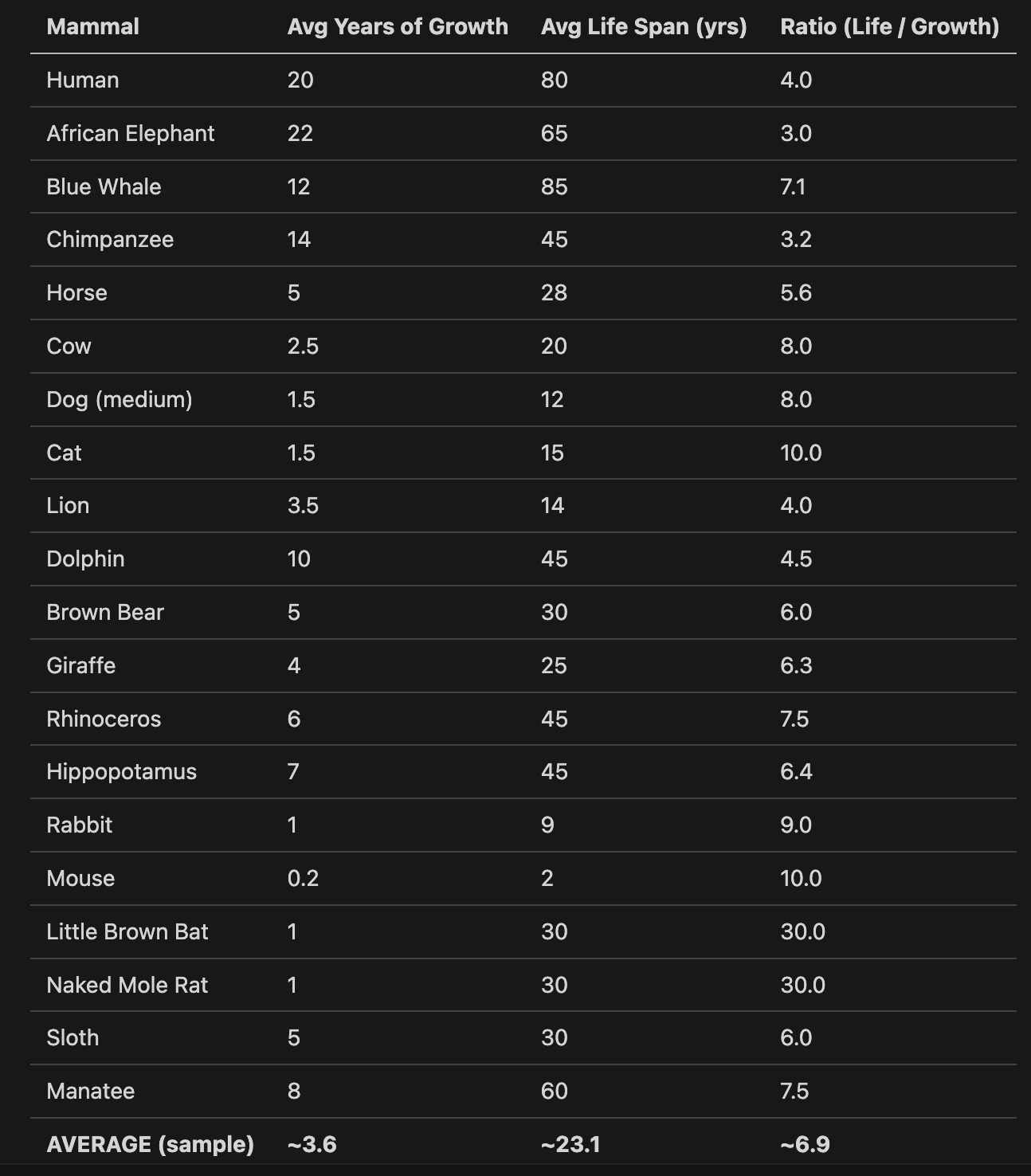
The clustering is hard to ignore. Most mammals land somewhere around six to seven years of life for every year spent growing. Humans and elephants sit low because they take so long to mature. Bats and mole rats cheerfully set the graph on fire.
Can we do this calculation for all mammals?
Not exactly. There are roughly 6,500 living mammal species, and for most of them we simply do not have clean data for both growth duration and natural lifespan. Many species are poorly studied, recently described, or observed only in fragments. Even when data exists, it often mixes wild lifespan, captive lifespan, and maximum observed lifespan, which are not interchangeable numbers.
What scientists can do is model the average behavior of mammals as a group. When they do, they keep landing in the same neighborhood your intuition already spotted: short growth correlates with short life, long growth correlates with long life, and the average mammal gets about six to seven times its growth period in lifespan.

The quiet takeaway
There is no stopwatch governing life, but there is a rhythm. Speed comes at a cost. Patience pays dividends. And the species that cheat the system do so with very expensive biological upgrades.
Which is oddly reassuring. Taking your time is not laziness. It is a strategy that evolution has been quietly endorsing for a very long time.
Follow along for more of these patterns hiding in plain sight, and drop a comment if you have a favorite animal that refuses to age politely.
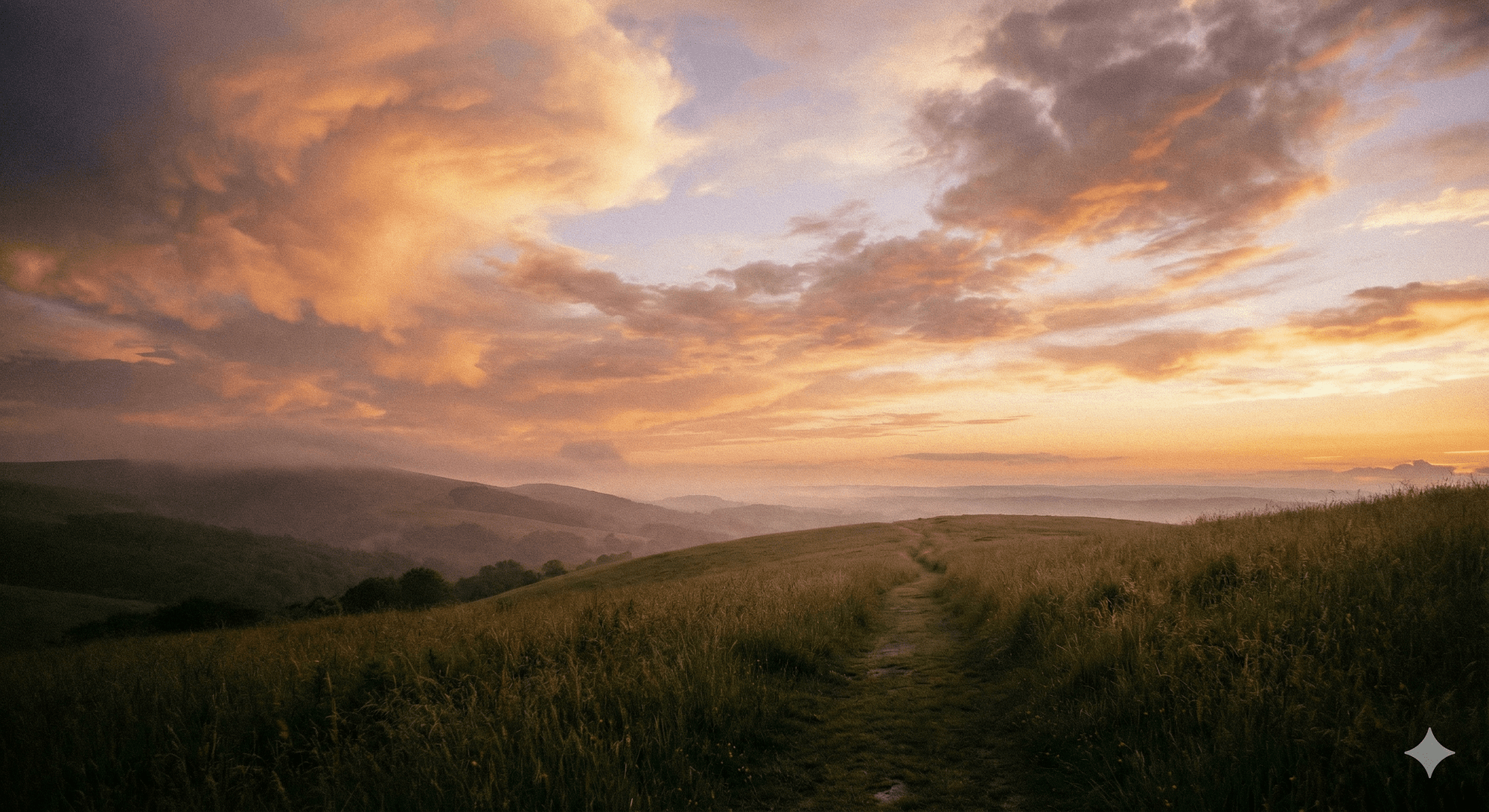
Art Prompt (Romanticism):
A luminous landscape bathed in dramatic twilight, with rolling hills fading into mist beneath a vast, emotionally charged sky. Billowing clouds glow in layers of amber, rose, and pale violet, painted with soft yet expressive brushwork. A narrow path winds through tall grasses in the foreground, subtly guiding the eye toward a distant horizon. Light and shadow interplay gently, creating a sense of quiet awe, introspection, and human smallness against nature’s grandeur.
Video Prompt:
The scene unfolds slowly as clouds drift and stretch across the sky, their colors shifting from gold to lavender. Grasses sway in a soft, rhythmic motion as light ripples across the landscape. The camera glides forward along the path with smooth, cinematic movement, creating a calm, immersive experience that feels expansive, emotional, and unhurried.
Pair the video with these tracks:
- “Fallow” — Keaton Henson
- “Stillness Is the Move (Instrumental)” — Dirty Projectors
Follow for more visuals like this, and tell me in the comments which moment made you pause.