
Between the 8th and 14th centuries, while much of Europe was busy debating whether bathing was heresy, the Islamic world was throwing an intellectual rave that would make the Renaissance look like a school bake sale. Welcome to the Islamic Golden Age — a time when genius wore turbans, math had swag, and libraries had more scrolls than TikTok.
Let’s meet some of the all-stars who turned the medieval Middle East into the Silicon Valley of its time.
Al-Khwarizmi (c. 780–c. 850)
- What is he known for? He basically invented algebra. No big deal.
- Impact on society? Without him, your calculator would be out of a job, and computer science might be called “advanced finger-counting.”
- Awards? While Nobel Prizes weren’t a thing yet, he did get his name Latinized into “Algorithm.” Ever heard of it?
- Financial success? He worked at the House of Wisdom in Baghdad — basically the NASA of the Abbasid Caliphate.
- Fame during lifetime? He was a big name in Baghdad’s scholarly circles, like the Stephen Hawking of the souk.
- Collaborations? Yep — his crew at the House of Wisdom translated Greek texts, crunched numbers, and partied like it was 999.
- Other inventions? Introduced Hindu-Arabic numerals to the West. Thank him every time you don’t have to do math in Roman numerals.
- Other tidbits? “Algebra” comes from his book title. You know you’ve made it when you rename math.

Ibn Sina (Avicenna) (c. 980–1037)
- Known for? His “Canon of Medicine” was the Grey’s Anatomy of its day (and for about 600 years after).
- Impact? He helped establish medicine as a scientific discipline — and did it all while dabbling in philosophy, astronomy, and poetry.
- Awards? Canon of Medicine was used in European universities through the 17th century. Talk about staying power.
- Famous during his life? Oh yeah. Teenage genius alert — he was already curing patients and writing encyclopedias by age 18.
- Collaborations? He corresponded and competed with other scholars, but mostly wrote solo. A true Renaissance man… four centuries early.
- Subject of art? His likeness appears in manuscripts, busts, and more school murals than you’d expect.
- Other inventions? Developed a method for clinical drug trials. You’re welcome, modern medicine.
- Interesting tidbit? He once cured a prince of melancholia by pretending to prepare for his funeral. Drama and diagnostics!

Alhazen (Ibn al-Haytham) (c. 965–c. 1040)
- Known for? The father of optics. He figured out how vision actually works. Sorry, ancient Greeks — light doesn’t shoot out of your eyes.
- Impact? Laid the groundwork for modern optics and the scientific method. He was out here peer-reviewing before it was cool.
- Financial success? Not exactly. He faked madness to escape an impossible dam project. So… mixed results.
- Famous in his time? Known in scholarly circles and later praised by European scientists like Roger Bacon.
- Collaborations? Worked with other scholars via the House of Wisdom network and various patronages.
- Famous art? Depicted in stamps, murals, and those history-of-science posters your physics teacher had.
- Other inventions? Camera obscura studies and the first real analysis of reflection and refraction.
- Interesting tidbit? He got put under house arrest — and used the time to write his most famous book. Take that, procrastination.

Fatima al-Fihri (c. 800–880)
- Known for? Founded the University of al-Qarawiyyin in Fez, Morocco — the oldest continuously operating university in the world.
- Impact? Education powerhouse. Her university taught everything from astronomy to theology to grammar long before Oxford figured out it wasn’t just for monks.
- Awards? Historical legacy is her greatest honor — UNESCO and Guinness World Records both recognize her school.
- Famous during her lifetime? She was respected locally and regionally as a patron of learning.
- Collaborations? Helped organize and structure the university with scholars and architects.
- Other tidbits? She fasted through the construction of the university as a spiritual offering. Talk about project commitment.
Conclusion: Crescent Moon, Full Brilliance
The Islamic Golden Age wasn’t just about golden domes and fancy calligraphy (though, yes, it was very aesthetic). It was about asking questions, building knowledge, and sharing it across borders and centuries. If you’ve ever appreciated libraries, algebra, medical science, or just the ability to see things, you owe a tip of the turban to these creators.

Art Prompt:
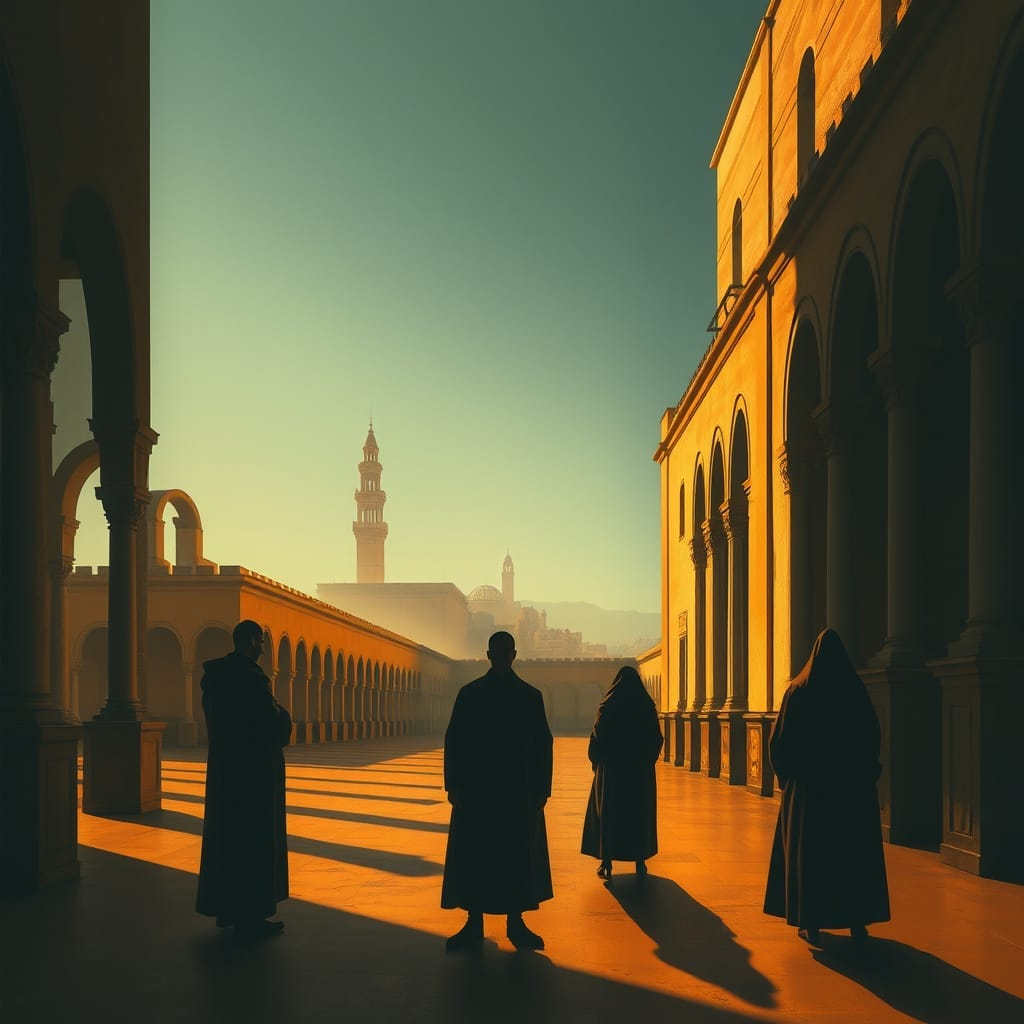
A surreal, glowing composition in the moody palette of Giorgio de Chirico. Architectural shadows stretch long across an empty courtyard bathed in amber and ochre light. Arcades and distant towers rise in dreamlike symmetry while robed figures linger in thought, their forms blurred by dust and dawn. The atmosphere evokes quiet revelation and suspended time, where intellect floats on the edge of the metaphysical.
Video Prompt:
Animate a slow panning shot across an empty courtyard drenched in shadow and gold. Let the towers shimmer with wavering heat. Silhouetted scholars move in and out of archways. Transition into a glowing overlay of mathematical equations, celestial charts, and flickering candles as the figures look skyward. End with an abstract fade into the darkening crescent moon.
Song Recommendations:
- “Night Owl” — Galimatias
- “Infinite Pieces” — Leon Vynehall
If you’re joining us mid-series, check out Episode 1 of The Creators Series to catch up on the genius from the very beginning:
Medium: https://medium.com/@DaveLumAI/the-creators-series-a-lightning-tour-of-historys-greatest-geniuses-317d81bc5532
Blog: https://blog.lumaiere.com/the-creators-series-a-lightning-tour-of-historys-greatest-geniuses/
Follow for more episodes, and drop a comment below: Which creator from this golden age fascinates you the most?