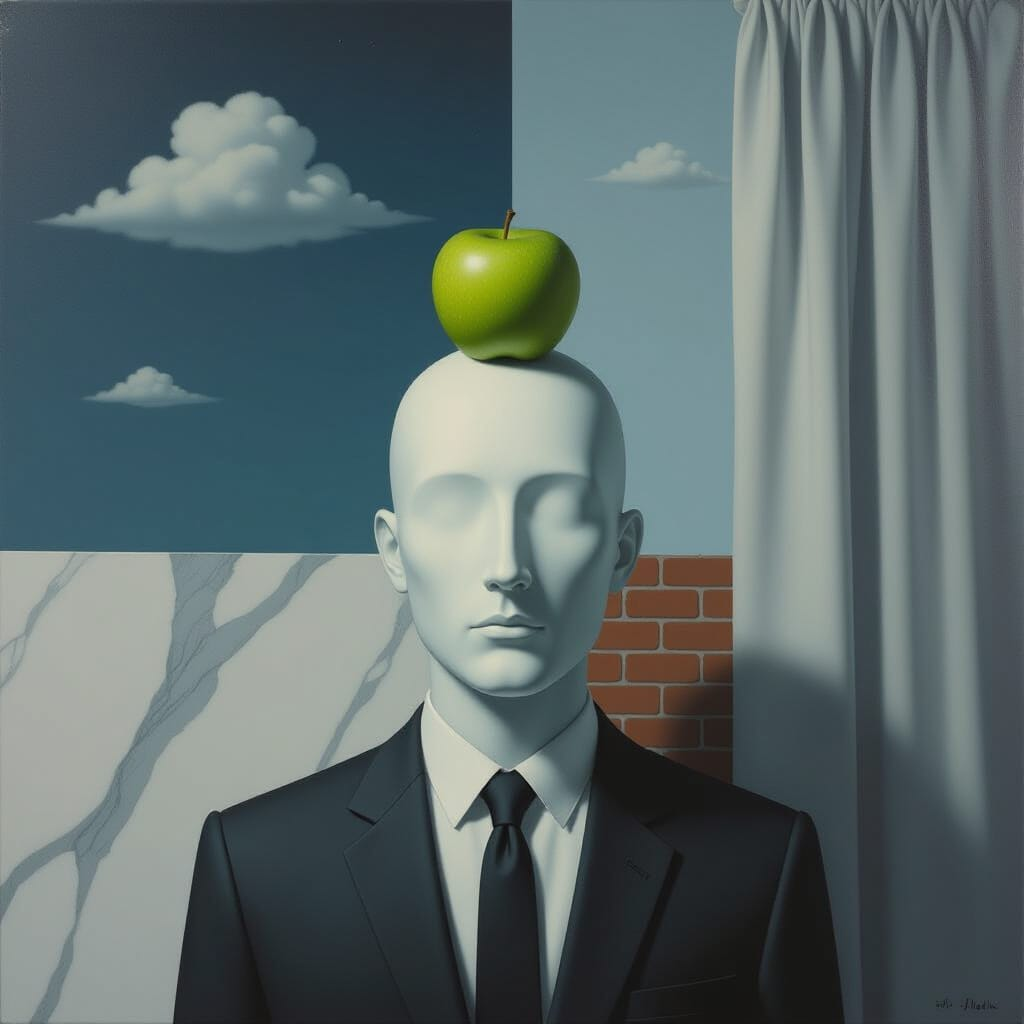

René Magritte: the man who gave every philosophy undergrad a headache and made every museum-goer wonder if the pipe was a lie. Magritte didn’t paint dreams — he painted reality pretending to be dreams pretending to be reality. If you’re confused, congratulations: you’re experiencing Magritte the correct way.
Born in Belgium in 1898, Magritte grew up just as modernism started turning the art world on its cubist head. But he wasn’t interested in slapping paint around like Picasso or screaming into the abyss like Munch. No, Magritte wanted to mess with your mind. And your language. And your expectations. Especially if your expectations involved logic.
This is not a biography
Magritte didn’t care for big artistic tantrums or tortured genius stereotypes. He wore suits. He had a day job at an ad agency. He looked like he could sell you life insurance. But instead, he sold us strange skies full of floating men, apples with identity issues, and rooms where the outside was inside (or maybe the inside was outside?).
If Dalí was the rockstar of Surrealism — melting clocks, wild mustache, all drama — then Magritte was the prankster philosopher. He didn’t want to escape the real world. He wanted to rearrange it just enough to make you doubt it.

Some Magritte-y tricks of the trade
Magritte painted in a crisp, clean style that looked deceptively boring — until, of course, you noticed that the window frame didn’t lead outside, or the mirror reflected the back of your head. He used everyday objects — pipes, bowler hats, green apples, curtains — and twisted their context until they whispered, “Are you sure you understand what you’re seeing?”
Oh, and he hated being psychoanalyzed. Freudians, beware. If you try to interpret his work, he’ll probably roll his eyes from beyond the grave and label your theory “banal.” In fact, he once said, “The mind loves the unknown. It loves images whose meaning is unknown, since the meaning of the mind itself is unknown.” Yep. That tracks.

Friends, foes, and floating objects
Magritte was tight with the other Surrealists — Breton, Ernst, Eluard — but also kind of allergic to their groupthink and Parisian drama. He spent much of his life in Brussels, quietly redefining how art could communicate. Or miscommunicate. Or stare blankly at you with a blank apple face.
His influence stretches far and weird. Conceptual art? Magritte. Pop art? Hello, Warhol and Lichtenstein. Album covers, fashion shoots, even Nike ads? All dipped into the surreal simplicity of Magritte’s mirror-world.
And about that pipe…
You’ve seen it: a meticulously painted pipe with the words “Ceci n’est pas une pipe” (“This is not a pipe”) under it. And no, it’s not a trick. It is not a pipe — it’s a painting of a pipe. A representation. A thing pretending to be the thing. Magritte wasn’t just painting pictures. He was poking at the very structure of how we perceive meaning. That’s not meta — it’s Magritte-a.
What’s left to say?
Well, just this: next time you walk past a cloud shaped like a fish or a door leading to a forest, thank Magritte. He didn’t just paint weird things. He made reality feel weird — and that’s infinitely more fun.

Art Prompt:
A stark, dreamlike scene where a suited man with a blank, featureless face stands under a sky split cleanly into night and day, each half perfectly still. A heavy green apple hovers in front of his face, casting no shadow. Behind him, a marble wall gives way to a painted curtain that reveals a brick room with a cloud floating indoors. Render the entire scene in a smooth, photorealistic oil-paint style with sharp lines, muted blues and grays, and a sense of stillness that suggests something unsettling is just beneath the surface.
Video Prompt:
Begin with a silent frame: a man in a suit standing under a half-day, half-night sky. The camera slowly pans around him as a green apple materializes mid-air, obscuring his face. The curtain behind him parts without wind to reveal a brick-walled room where a single cloud drifts slowly past an indoor lamp. The transitions are smooth, uncanny, and eerie, with subtle zooms and surreal fades to create a sense of quiet disorientation.
Recommended Songs:
- The Rip — Portishead
- In a Beautiful Place Out in the Country — Boards of Canada
Follow for more surreal dives into the minds of master artists — and comment below: which Magritte painting messes with your head the most?