If you’ve been writing with AI for a while, you’ve probably noticed that large language models love their metaphors like cats love cardboard boxes: excessively, irrationally, and with no regard for repetition. One minute you’re comparing an API to a LEGO set, the next you’re describing your framework as a “Swiss Army knife for developers,” and before you know it, your whole article is more cliché than code.
Welcome to the uncanny valley of AI-assisted writing, where every concept is “like a blueprint,” every tool is a “boss-level upgrade,” and every squirrel is caffeinated.
Let’s talk about how this happens, why it’s a problem, and what to do when your draft starts sounding like a motivational poster from 2007.
Why AI Loves Clichés (And You Might, Too)
Clichés are efficient. They pack metaphorical meaning into compact, familiar packages. If you’re trying to describe something abstract — say, an event loop or a vector database — it’s tempting to slap on a metaphor like “it’s like a digital filing cabinet on Red Bull” and call it a day.
And guess what? AI models are trained on massive piles of internet text. That means they’ve seen these comparisons used (and overused) thousands of times. The AI learns that “Swiss Army knife” often co-occurs with “versatile tool,” so it defaults to it when you ask it to describe, say, a web framework, a middleware, or your mom’s Excel macros.
But when every article sounds the same — “this tool is like a LEGO set for APIs, a caffeinated squirrel for productivity, and a digital Swiss Army knife for everything else” — readers start to tune out.
The Greatest Hits (of Overuse)
From my own archives of writing with and against the AI grain, here are some top offenders:
- “Like a”: 312 uses. Yikes.
- “Digital”: 152 times. (Okay, I make digital art, but still — take a break.)
- “As a”: 143 times. A gateway to many clunky comparisons.
- “Swiss Army knife”: 21 times. At this point, Victorinox should sponsor me.
- “Think of it as…”: 64 times. Yes, think of this as your signal to find a better analogy.
Special shout-outs go to:
- LEGO (17 times): Apparently, every system is modular and color-coded now.
- Caffeinated squirrels (40 times): I blame tech Twitter.
- Cats (43 times): Who can resist them?
- Boss, blueprint, group, etc.: You get the idea.
These aren’t just repetitive — they flatten nuance. They turn your hard-won insights into Mad Libs.

How to Break the Cliché Cycle
1. Pause Before the Metaphor
Ask yourself: do I need a metaphor here, or am I just afraid to describe the concept plainly? Sometimes, it’s better to say, “this tool lets you organize API endpoints with fewer config files” than “it’s like a digital librarian hopped up on cold brew.”
2. Rotate the Analogies
If you must use a metaphor, make it fresh. Replace “Swiss Army knife” with “duct tape in a trench coat.” Ditch “blueprint” for “a spaghetti-stained napkin diagram that somehow works.” Keep the vibe; kill the cliché.
3. Track Your Favorites (Then Ban Them)
Do what I did: run a frequency check on your past writing. You’ll be surprised what you’re addicted to. Once identified, put them on a personal no-fly list.
4. Let AI Help You Avoid AI Tropes
Ironically, you can prompt AI to be more original. Try:
“Explain this like you’re a stand-up comic who moonlights as a systems engineer.”
“Give me five fresh metaphors, none involving tools or Swiss Army knives.”
You’ll get weird, glorious stuff like “it’s the linguistic equivalent of duct tape holding a trampoline together.” Now that’s a metaphor I want to read.
Famous Art (and Artists) Known for Clichés?
You bet. Even art history isn’t immune:
- Thomas Kinkade made an empire painting the same cozy cottage a thousand ways.
- Bob Ross (beloved though he is) turned “happy little trees” into the painter’s version of a dad joke.
- Salvador Dalí eventually became a parody of his own surrealism — melting clocks everywhere.
- Banksy gets flak for being too on-the-nose with his political statements. Stenciled clichés with a side of irony.
Visual clichés happen when symbols (roses, clocks, doves) are reused so often they lose impact. The same thing happens with AI art prompts if you don’t vary your descriptors.
So, What Now?
Let’s build better metaphors. Let’s write prose that doesn’t sound like it came from a tech startup bingo card. Let’s treat language like the playground it is — not just a box of LEGO bricks.
Follow me for more weird analogies, accidental poetry, and the occasional AI hallucination. And drop a comment: What’s your most overused writing crutch — or the funniest one you’ve caught an AI repeating?
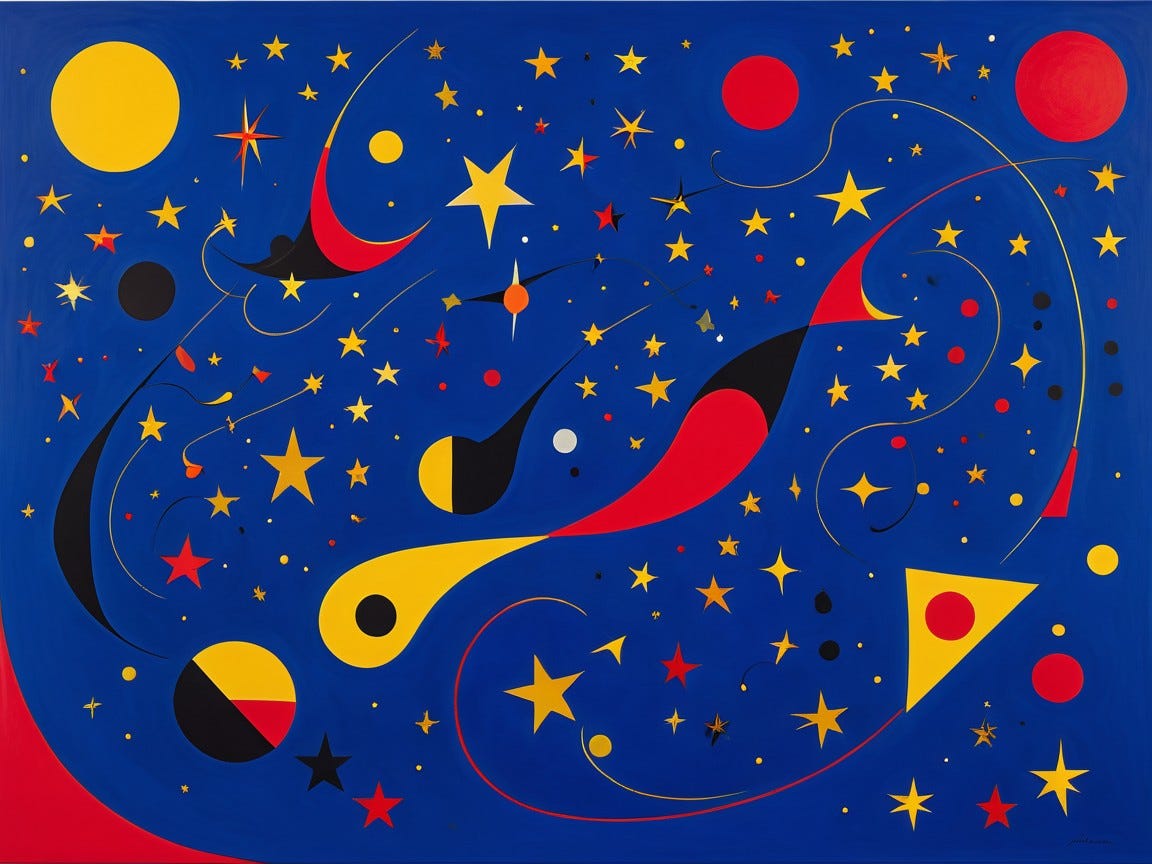
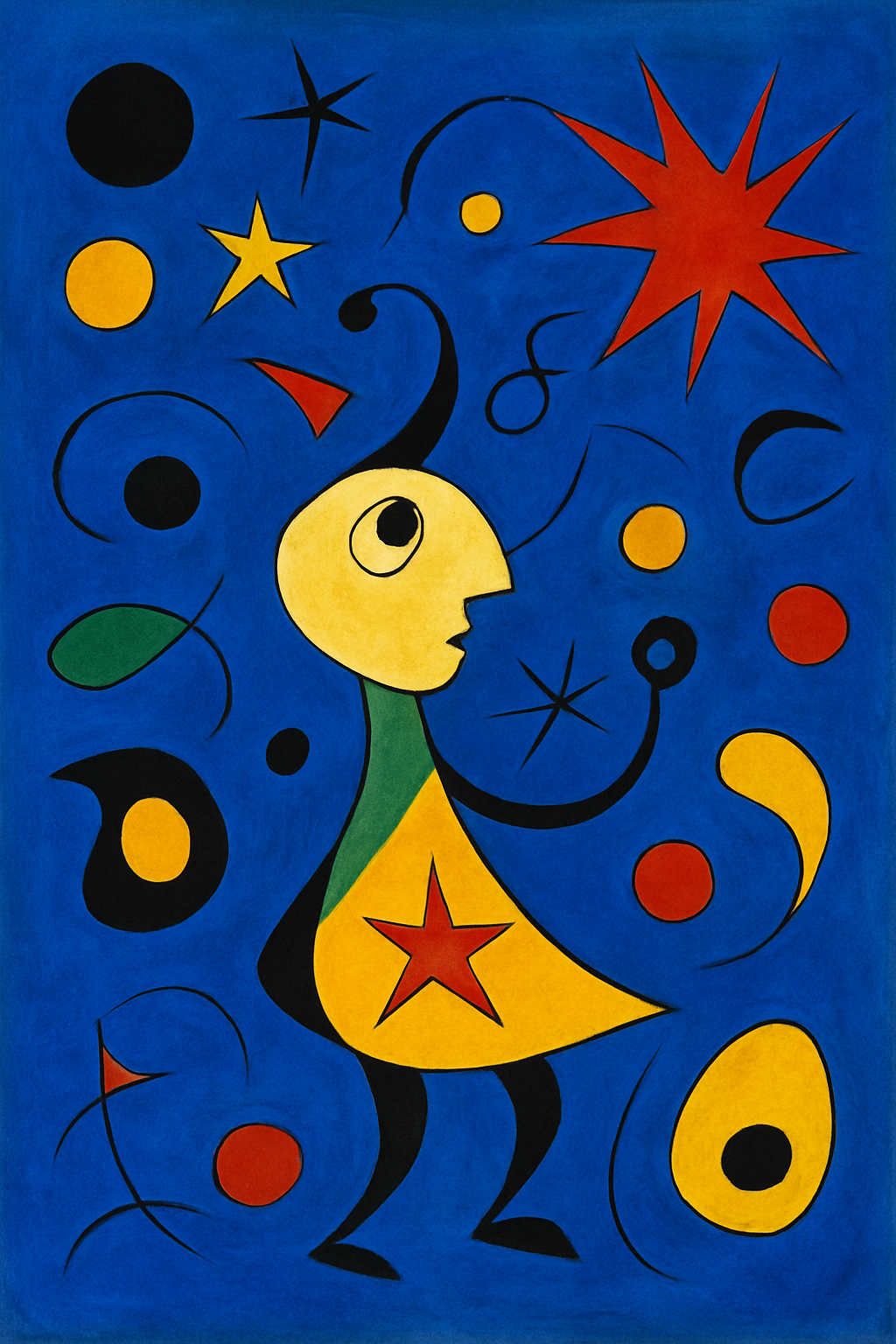
Art Prompt: A vivid dreamscape in the expressive style of Joan Miró, evoking the Surrealist period. Floating geometric forms and organic shapes drift across a cobalt-blue canvas, punctuated by sharp red and yellow bursts of movement. A whimsical figure composed of curved lines and stars gazes upward as fragmented symbols orbit around it. The composition is playful and abstract, suggesting a subconscious dance between form and meaning.
Video Prompt: Begin with an animated swirl of abstract shapes drifting across a deep blue backdrop. Let floating forms spiral into view, occasionally bursting into jagged movement or soft metamorphosis. Shapes pulse and scatter in sync with gentle ambient music, while a surreal figure composed of stars and lines gazes upward, blinking in wonder as a constellation rearranges itself around its head. Loop the motion seamlessly with a rhythm that captivates short-form viewers.
Song Suggestions:
- “Fever Dream” — SYML
- “Brief Exchanges” — Tom Adams
Follow me for more creative chaos, AI musings, and surreal visuals. Comment below: What metaphor or phrase are you guilty of overusing? Let’s confess in the comments.