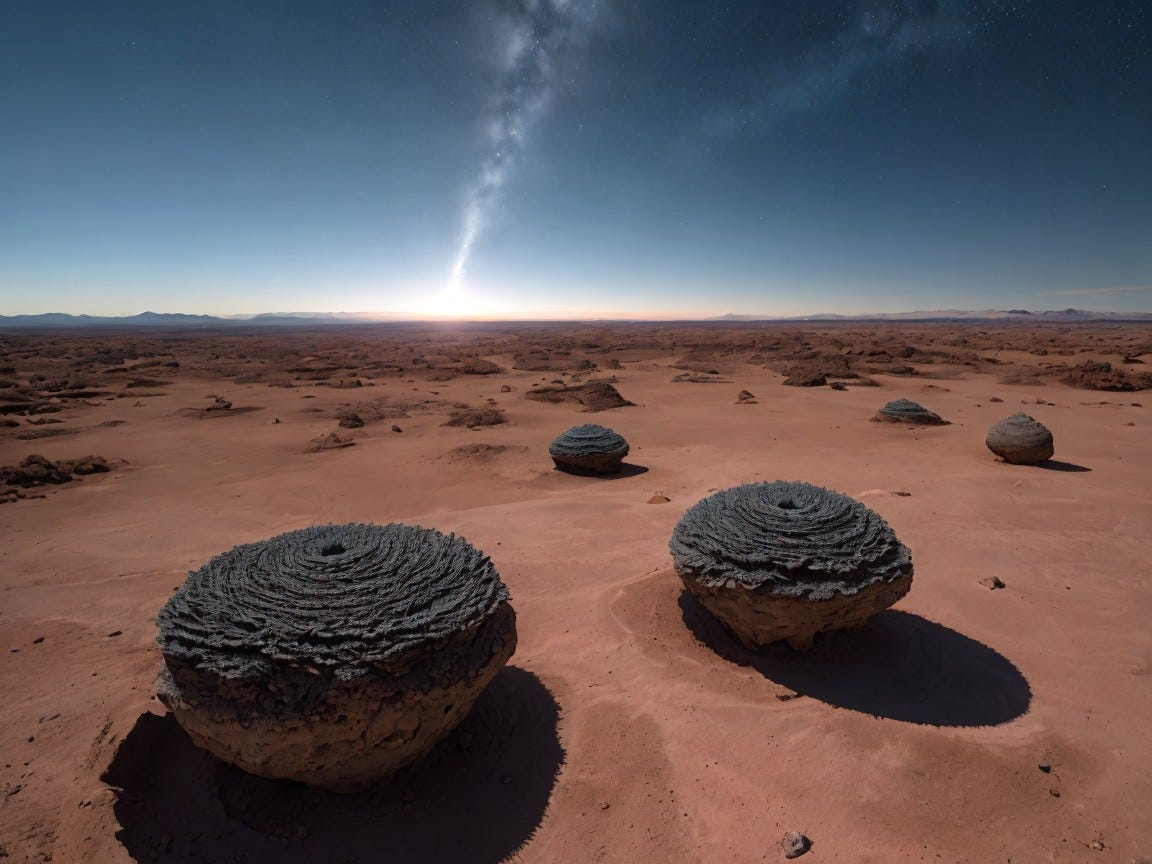

Welcome to the first installment of the Artist Series, where we dig into the minds of artists who made the world weirder, dreamier, and (occasionally) slightly unsettling. First up: Yves Tanguy, the surrealist who painted dreamscapes that look like your subconscious tried to build a diorama with Dali, Escher, and a pile of melted chess pieces.
So, Who Are We Covering in This Series?
Oh, just the usual suspects — plus a few surprises. Think Magritte, Kahlo, Chagall, Leonora Carrington, Max Ernst, De Chirico, Hilma af Klint, and maybe a few digital art renegades who think canvas is a state of mind. But first: Tanguy.
Who Was Yves Tanguy?
Born in Paris in 1900, Yves Tanguy was your classic surrealist rebel. He didn’t attend art school, didn’t really plan to become a painter, and reportedly only took up painting after seeing a work by Giorgio de Chirico and thinking, “Yeah, I’ll do that now.” Respect.
What Was He Known For?
Tanguy was the master of biomorphic abstraction and dreamlike wastelands. His paintings are filled with amorphous, otherworldly objects — sort of like alien fossils arranged by a minimalist ghost. He didn’t just paint a landscape. He painted the feeling of standing on a planet invented by anxiety and subtle jazz.
What’s His Style?
Surrealism, through and through. But not the loud, melting-clock kind. Tanguy’s surrealism is whispery, eerie, and oddly precise. His color palette favored subtle grays, sandy taupes, and haunted blues, with rare pops of rusted red or toxic lime. The lighting is always that weird “storm’s coming” glow.

Did He Have a Teacher?
Nope! Self-taught. He basically walked into surrealism like he owned the place. Which is fair — he eventually became a central figure in the movement.
Any Unique Techniques?
Absolutely. Tanguy painted with obsessively smooth gradients and sharp shadows that make his weird shapes feel hyperreal. He also worked extremely slowly, sometimes spending weeks on a single square inch. Basically, he painted like he was defusing a bomb.
Who Did He Work With?
He was tight with André Breton, the founder of surrealism, and later married fellow surrealist Kay Sage — which means their household was probably filled with deeply uncomfortable dinner parties and extremely abstract domestic disagreements. He also worked alongside Max Ernst and Joan Miró, though his style was distinctively less colorful chaos and more meticulous dream-dissection.

Was He Rich?
Not really. Tanguy didn’t strike gold during his early years, but after moving to the U.S. in the late ’30s and continuing to paint throughout WWII, he gained more recognition and financial stability. By the time he died in 1955, he had a solid reputation and wasn’t starving — at least not artistically.
When Was He Most Popular?
Tanguy gained traction in the 1930s as surrealism hit full throttle in Europe. His popularity expanded further in the 1940s and ’50s, especially after relocating to America. He wasn’t quite a household name, but among surrealists, he was royalty — if your royalty prefers metaphysical seascapes to crowns.
Tell Me More!
Tanguy’s work heavily influenced abstract expressionists like Roberto Matta and Mark Rothko. He brought a quiet precision to the chaotic dreamworld, making him a bridge between subconscious fantasy and mathematical obsession. His paintings don’t just look surreal — they feel like what your brain does when it’s both deeply relaxed and incredibly paranoid.

Anything Else?
Yep — Tanguy named his works with phrases that sound like bad translations of poetry on a haunted typewriter. Titles like “At 4 O’Clock In The Summer, Hope” or “Multiplication of the Arcs” are half the fun. Try saying one out loud at a party and watch the room develop a mild existential crisis.
Follow for more artists you didn’t know you were obsessed with until now.
And drop a comment: Have you ever seen a painting so dreamlike it felt like déjà vu? Or one of Tanguy’s pieces that reminded you of a dream you had after eating questionable sushi? Let’s talk.
Art Prompt:
A barren, otherworldly plain stretches into infinity under a pale, cloudless sky tinged with blue-gray. In the distance, undulating forms resembling fossilized coral or melted chess pieces rise from the ground — some delicate, others grotesquely bulbous. The ground glows faintly with a dusty light, as if lit from beneath. Shadows are sharp and unnaturally long, giving a sense of eerie stillness. The composition is meticulous, each object placed with calculated isolation, evoking the silence of an alien world frozen in time.

Video Prompt:
A slow pan over a desolate, dreamlike plain of bone-colored sand under a vast, washed-out sky. Twisted, biomorphic shapes rise and rotate gently, casting hyperreal shadows that move faster than the sun. Thin wisps of fog curl around the base of each form before vanishing abruptly. Subtle pulsations shimmer across the ground, giving the illusion that the surface itself is breathing. The atmosphere is surreal, contemplative, and a touch ominous — perfect for short-form video that mesmerizes.
🎵 Song Recommendations for the Video:
- Canvas — Imogen Heap
- Time Moves Slow — BADBADNOTGOOD feat. Samuel T. Herring
Follow me for more strange beauty
[Comment if you’ve ever seen a Tanguy in the wild 👀]