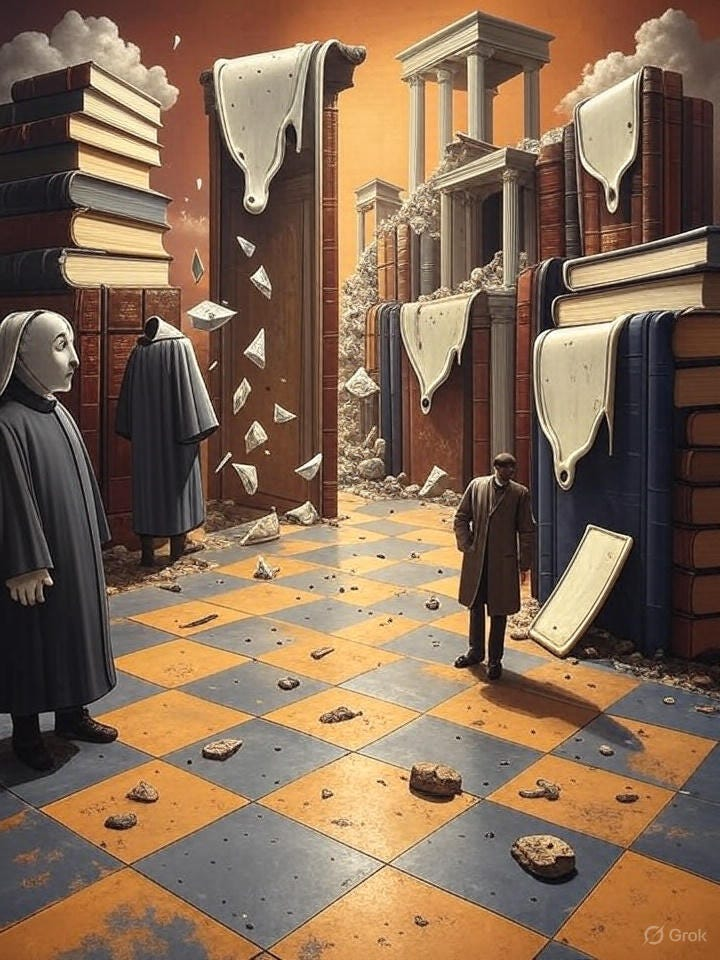

Picture this: it’s 1819, you’re wearing breeches that itch, and your idea of a good time is publishing a vaguely liberal pamphlet about the merits of constitutional governance. Enter the Carlsbad Decrees — Metternich’s answer to “How do I kill the vibe in 38 German states simultaneously?”
What were they?
The Carlsbad Decrees were a series of ultra-fun laws imposed by Austrian statesman Prince Klemens von Metternich after a student named Karl Sand assassinated a conservative dramatist (because apparently political discourse was just too mainstream). In response, Metternich gathered the German Confederation at a spa town — Carlsbad, where men in wigs go to stress-eat pretzels — and pushed through legislation designed to suppress liberalism, nationalism, and people having original thoughts in general.
The decrees mandated:
- Censorship of the press: Because nothing says “free society” like pre-approving every political opinion.
- University oversight: Professors were monitored and could be fired for promoting anything resembling “thinking.”
- Secret police coordination: Because what’s more comforting than men with mustaches filing reports on your poetry reading?
Historical importance?
Imagine the Carlsbad Decrees as the first season of a very bad reality show called Suppress That Youth! — it set the tone for political repression in Europe for decades. These decrees were less about Karl Sand and more about fear of revolution, especially after that pesky French one where heads went rolling and ideas about liberty got contagious.
They effectively stalled liberal reforms in the German states and entrenched the power of the monarchy and aristocracy. In short, they were like Europe hitting the snooze button on progress.

What were the results?
They did what all great acts of repression do: backfired gloriously. Yes, they kept things quiet for a while. But by smothering reform, they actually helped stoke the fire for the revolutions of 1848. It’s like trying to put out a fire with gasoline, but in German.
Lessons learned?
Repressing education and media rarely ends well. Turns out, humans don’t enjoy being told what to think, what to read, or which professors are politically hygienic. The backlash — eventual constitutional reforms, broader press freedoms, and student activism — made it pretty clear: ideas don’t die just because you banned their brochures.

How many times has something like this occurred?
Oh, buddy. Let’s see:
- The Roman Catholic Index of Forbidden Books (1559–1966)
- The Spanish Inquisition’s “book club from hell”
- McCarthyism in 1950s America
- China’s ongoing Great Firewall
- Modern-day social media censorship debates
Basically, anytime you hear “we’re doing this to protect you,” and it involves silencing ideas, you’re probably watching a Carlsbad reboot.
Parallels in modern society?
Absolutely. Whether it’s certain governments cracking down on digital dissent, “cancel culture” flame wars, or laws restricting academic freedom, the spirit of the Carlsbad Decrees is alive and well. They’re a cautionary tale with excellent sideburns and very little chill.
Any famous art on the subject?
While there’s no “The Censorship of 1819” hanging in the Louvre, the Biedermeier art movement grew in this period as a kind of visual retreat — still lifes, cozy interiors, safe apolitical themes. You could call it the Pinterest Board of post-Carlsbad Europe: pretty, peaceful, and not at all revolutionary.

Famous quotes?
- “Revolution is not the enemy of order; it is the enemy of despotism.” — Victor Hugo (Not German, but the vibe fits.)
- “To prohibit the reading of certain books is to declare the inhabitants to be either fools or slaves.” — Claude Adrien Helvétius
Tidbit?
The decrees targeted student fraternities — yes, the beer-loving, philosophy-debating bro squads of 19th-century universities — because they were thought to be hotbeds of revolutionary sentiment. Nothing says “serious government” like fearing a group of kids in matching jackets arguing about Kant.
So, the next time someone tries to squash ideas “for the greater good,” just remember: history has receipts. And they usually come printed on government-issued stationery that smells faintly of desperation and eau de paranoia.
Art Prompt:
A dreamlike surrealist landscape inspired by Salvador Dalí. Melting structures rise against a rust-toned sky, their forms morphing between classical ruins and oversized books. A solitary figure stands on a checkerboard path that fractures into floating shards, surrounded by drifting ink quills and ghostly academic robes. The mood is tense yet poetic, evoking the suppression of ideas and the fragile persistence of thought in a distorted, controlled world.
Video Prompt:
Begin with slow-motion ink dripping onto parchment, then cut to dissolving newspaper pages carried off by wind. Transition into a surreal, shifting dreamscape where books float in suspended animation and classical busts slowly crack apart. Intercut with flickering shadows of students raising candles in defiance. Close with a lone figure walking toward a horizon lined with dissolving censorship stamps and rising sunbeams — hinting at revolution.

Song Recommendations:
- “Taro” — alt-J
- “Persephone” — Allison Russell
Follow me for more tangled tales of history, revolution, and bureaucratic overreactions in wigs. And if you’ve got a hot take on academic freedom, press suppression, or the weirdest thing you ever got censored for — drop it in the comments. Let’s make some noise.
Friday Night Laughs mini:
Guy walks into a bookstore: “Got any books on censorship?”
Clerk says, “We did.”
“What happened?”
“They were all redacted.”
“All of them?”
“Except *Where’s Waldo*. They couldn’t find him to ban him.”
“So you *do* sell banned books?”
“Only the ones people *aren’t* looking for.”
“Isn’t that ironic?”
“Shhh. We’re not allowed to say that word anymore.”