
Let’s start with the question many married people whisper to themselves sometime between the wedding photos and the fourth argument about dishwasher geometry:
Wait, is this it?
Not in a tragic way. More in a mildly confused, sweatpants-adjacent way.
Because marriage has a strange talent for turning two people who once made out in parking lots into co-managers of laundry, grocery logistics, and the mysterious disappearance of all decent Tupperware lids. One minute you are staring into each other’s eyes over candlelight, and the next you are standing in Costco debating paper towel brands like a pair of exhausted assistant managers.
So yes, let’s talk about sex in marriage. Not in the weird, clinical, everybody-put-on-a-lab-coat way. In the normal human way. The funny way. The useful way.
Because the short version is this: the flame usually does not die because love vanished. It dies because life showed up with a clipboard.
First: what is the honeymoon period?
The honeymoon period is that early stretch when your partner is still fascinating even while chewing, every text feels like a tiny fireworks display, and you would gladly drive 40 minutes just to sit near them and pretend not to care that much.
It is less a strict calendar event and more a chemical weather system. For some couples it is a few months. For others it can feel like a year or two. The defining feature is not duration. It is intensity.
During that phase, desire often feels automatic.
Later, it often becomes intentional.
That is not romance dying. That is romance graduating.
Early love says, “I cannot keep my hands off you.”
Long marriage says, “I chose you again, and yes, I am putting that on the calendar because Tuesday is chaos.”
Honestly, that second one is underrated.
So how much sex is normal in marriage?
Here is the least sexy but most helpful answer: “normal” is an extremely suspicious word.
There is no universal marital quota. There is no cosmic referee blowing a whistle because somebody’s household is below league average. Researchers consistently find that married people tend to be more sexually active than unmarried people, but frequency varies a lot by age, health, stress, children, work schedules, medication, resentment, sleep, and whether one of you has spent the last six weeks speaking exclusively in sarcastic sighs.
The broad population picture is that about half of U.S. adults were married in 2023, with Pew putting it at 51% of adults, while the Census and CDC track marriage and divorce patterns separately through their annual data. If you enjoy official statistics with fewer candles and more spreadsheets, you can browse the current numbers at the CDC, U.S. Census Bureau, and Pew Research Center.
As for sex specifically, studies and survey summaries tend to show that married adults are more likely than unmarried adults to be having sex, and that frequency generally trends downward with age, stress, and years together, though not in a neat little staircase because human beings insist on being complicated.
So here is the useful version, not the fake-magazine version:
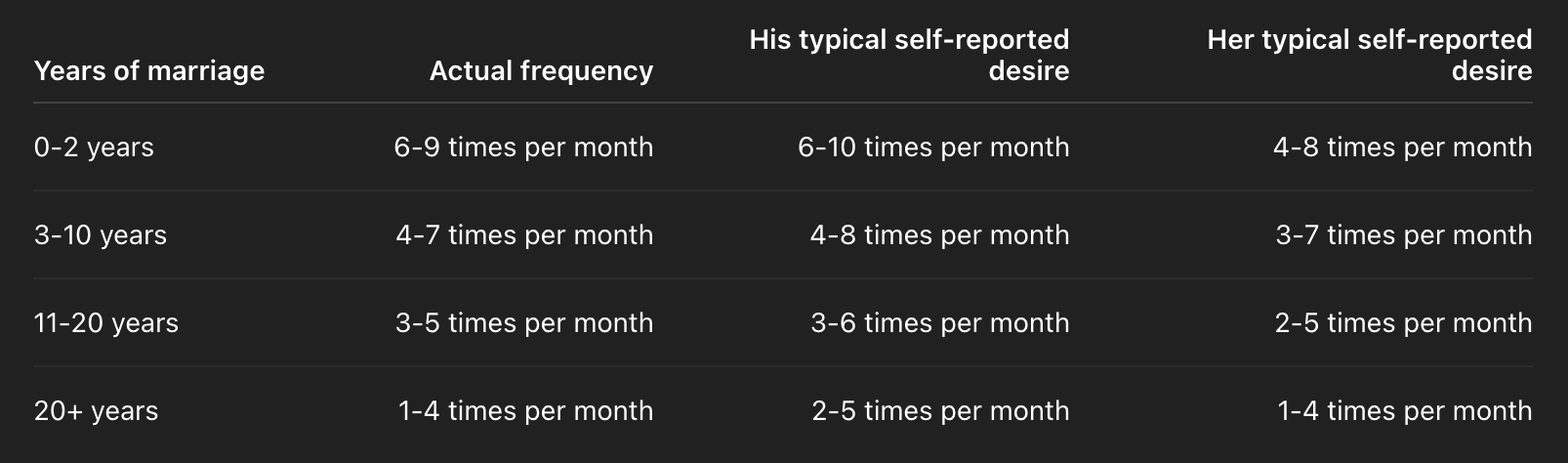
That table is a rough reality map, not a commandment carved into stone by horny accountants. Also, the biggest truth hiding in plain sight is that many couples do not have a “his versus hers” problem so much as a “one of us wants connection when relaxed and the other relaxes only after connection” problem. Which is a very different beast.
The more important question is not, “Are we average?”
It is, “Are we both feeling wanted, respected, and reasonably connected?”
Because a couple having sex three times a month and feeling close is doing better than a couple hitting eight times a month while secretly resenting each other like coworkers on a doomed committee.
Is there an obligation to have sex with your spouse?
Morally, religiously, emotionally, and legally, this answer gets a little layered.
The clean modern legal answer in the United States is that marriage does not erase consent. Sex is not an automatic debt. Marital rape is illegal in all 50 states and D.C., even though some state laws and procedures still treat spousal cases differently than stranger cases in practice. The legal landscape around marriage has also changed dramatically from older doctrines that treated spouses more like duty bundles than actual people with nervous systems and boundaries. Cornell’s overview of marriage is a handy reminder that old “conjugal duty” ideas have largely given way to a more modern consent-based view.
Morally, many couples do feel they owe each other effort, care, affection, and attentiveness. But effort is not the same thing as access. Love can involve generosity. It cannot require surrender of bodily autonomy.
That distinction matters a lot.
A healthy marriage usually includes a real obligation to care about your spouse’s needs. It does not include a right to override their no.
If someone hears “you are not entitled to sex” and translates it into “therefore intimacy does not matter,” they have missed the point so hard they may need a map and a sandwich.
Intimacy matters. Consent matters. Both are true at the same time.

What do religions say about sex in marriage?
Religions are not one giant choir here, but many traditions do agree on one headline: sex inside marriage is generally seen as significant, not trivial.
The Catechism of the Catholic Church frames marital intimacy as a sign of conjugal love and spiritual communion. The USCCB speaks of sex in marriage as unitive and open to life.
Jewish sources often speak of marital intimacy not as an embarrassing side quest but as a meaningful duty and blessing inside covenantal marriage. The Orthodox Union and Chabad both discuss marital intimacy as spiritually and relationally important, not as something to be treated like contraband. See the Orthodox Union and Chabad.
Islamic legal and ethical traditions also place real emphasis on mutual intimacy within marriage. In some schools and texts, sexual access is discussed as a spousal right, but serious Muslim scholarship also stresses kindness, mutual satisfaction, and the broader moral framework of mercy and companionship. A useful window into that discussion lives at Al-Islam and in more contemporary discussion at Yaqeen Institute.
Hindu traditions are more varied and less centralized, but they have never been uniformly anti-sex. The old caricature that Hindu thought is either all ascetic caves or all acrobatic furniture assembly is nonsense. Classical texts and traditions recognize desire, pleasure, duty, and household life as real parts of the human experience. Britannica’s overview of the Kamasutra is useful precisely because it reminds people that the text is broader than a stack of awkward internet jokes.
Scientology generally treats sex in marriage as part of what it calls the “Second Dynamic,” which includes sex, procreation, family, and raising children. In its official materials, the Church of Scientology presents marriage as an essential part of stable family life, describes Scientology weddings as including vows of loyalty and devotion, and says couples are free to decide the size of their family based on what they judge to be the greatest good. Put simply, Scientology does not frame sex in marriage as dirty or accidental; it tends to see it as a meaningful part of married life, family continuity, and mutual commitment.
So the short answer is: most traditions value sex in marriage, but they frame its purpose differently. Bonding, duty, pleasure, children, holiness, companionship, discipline, tenderness, and mutual care all make appearances depending on the tradition.
Which means religion does not really say, “Never talk about sex.”
It usually says, “Please stop acting like it is meaningless.”
What do societal laws say?
Modern law in the U.S. mostly treats marriage as a civil contract with rights and responsibilities around property, inheritance, support, taxes, medical decision-making, and divorce. It does not generally function as a referee for your Tuesday night chemistry.
There is no national “you must have sex X times per month” rule, because even Congress has enough self-awareness not to try that one.
Where the law does show up is around consent, abuse, divorce grounds, alimony, custody, property division, and in a few places, leftover fault concepts that still wander around family law like old furniture nobody has gotten rid of yet.
What are the penalties for infidelity?
Emotionally? Chaos.
Practically? Depends.
In most modern U.S. divorces, adultery matters less than people assume and more than people hope. Many states are effectively no-fault in ordinary practice, but fault can still matter in some jurisdictions for alimony, property disputes, or litigation strategy. Cornell’s divorce and adultery summaries are decent starting points.
A few older adultery laws are still on the books in some states, though they are unevenly enforced and often more symbolic than active. Some civil “heart balm” claims also survive in a small number of states: Cornell notes that alienation of affection and criminal conversation actions still exist in only a handful of jurisdictions. See alienation of affection and criminal conversation.
So the modern answer is not usually “straight to jail.”
It is more often “straight to a very expensive lawyer and a long conversation nobody wants to have.”

Is no sex in a marriage legal grounds for divorce?
Sometimes, yes, depending on the jurisdiction and how the issue is framed.
Historically, lack of sex has shown up under labels like constructive abandonment, cruelty, impotence, fraud, or failure of marital obligations. In modern no-fault systems, couples often do not need to prove that at all; they can simply seek divorce under irretrievable breakdown or similar language.
What does “no sex” mean exactly?
Usually not “we had a slow month because the baby screamed for 29 consecutive nights.”
It means a long-term, serious deprivation of intimacy, often paired with refusal, withdrawal, or breakdown of the marriage relationship itself. Courts are not generally counting candles and issuing report cards. They are looking at whether the marital relationship has functionally collapsed.
So yes, the issue can matter. But legally it is usually folded into the broader question: is this marriage still operating as a marriage in any meaningful sense?
What problems do marriages run into around sex?
Oh, where to begin.
Not because people are broken. Because people are busy, tired, insecure, distracted, proud, defensive, medicated, underslept, annoyed, aging, parenting, commuting, doomscrolling, and occasionally trying to feel desire immediately after someone has just said, “Did you seriously put the cast iron in the dishwasher?”
Here are some of the repeat offenders:
- Mismatched desire
- Resentment dressed up as “just tired”
- Poor body image
- Hormonal shifts
- Erectile issues or pain with sex
- Porn-related distortions
- Unresolved betrayal
- Mental health strain
- Medication side effects
- Children who apparently possess sonar
- Never touching except when initiating sex
- Touching only when hoping it becomes sex
- Communication so vague it should be classified as fog
Also, one of the sneakiest problems is this: couples often stop being flirty long before they stop loving each other.
And desire is a terrible houseguest. It rarely arrives where it feels taken for granted.
Does communication solve everything?
Yes.
Now before the tomatoes leave the vine, let me explain how that can actually be true.
Communication solves everything if we stop pretending it only means talking. In a marriage, communication is not just words coming out of your face while the other person reheats leftovers. It is the whole signal you send: honesty, timing, tone, listening, touch, follow-through, emotional safety, apology, kindness, restraint, curiosity, and the rare miracle of not saying the mean little thing that briefly made your brain feel powerful.
Because look at almost any marriage problem and underneath it you usually find some form of broken communication. Depression that never got named. Resentment that never got aired cleanly. Desire that never got explained. Pain that got hidden. Expectations that stayed invisible. Hurt that got translated into sarcasm until both people were basically exchanging passive-aggressive weather reports.
Even hormone changes, trauma, addiction, exhaustion, and mismatched libido do not improve in total silence. They improve when they are recognized, discussed, handled with care, and responded to like a shared problem instead of a character flaw. That is still communication. Not magic-word communication. Grown-up, messy, repeated, patient communication.
Good communication may not make two people identical, but it can make them allied. And that changes almost everything.
This is why the Gottman camp keeps hammering the same beautiful drum: stable couples turn toward each other, protect friendship, and keep the emotional climate warmer than the argument of the day. Their ideas about the 5-to-1 ratio and turning toward bids for connection matter because sex does not live in a sealed container marked Romance Stuff. It lives in the relationship you have been building all week.
So yes, communication solves everything, provided we are honest enough to admit that communication includes how you speak, how you listen, how you repair, how you show up, and whether your spouse feels loved by you when nobody is trying to be impressive.
In plain English: foreplay starts way before the bedroom and often looks suspiciously like kindness.
So how do you actually keep the relationship spicy?
Good. We have reached the part everybody scrolls for while pretending they came for sociology.
Here is the practical stuff.
1. Stop waiting for spontaneous desire to save you
Spontaneous desire is wonderful. It is also unreliable after ten years, two kids, and a mortgage.
Long marriages often thrive when couples respect responsive desire, meaning desire that shows up after warmth, safety, affection, or context rather than before it.
That means date nights matter.
So do naps.
So does not starting a fight at 9:47 p.m. and then acting shocked that the evening did not become cinematic.
2. Flirt like you are not already legally merged
Marriage is not the end of seduction. It is where seduction either becomes more intelligent or dies under a pile of errands.
Text something playful.
Compliment without a hidden agenda.
Kiss like you mean it.
Look at your spouse with the kind of face usually reserved for dessert menus.
Nobody is saying become a lounge singer. Just stop acting like the romance portion of the relationship was discontinued for safety reasons.

3. Touch that does not demand a sequel
One of the fastest ways to make intimacy weird is to let every affectionate touch feel like a sales pitch.
Hold hands. Hug longer. Rub shoulders. Sit close. Kiss without filing an invoice.
When all touch becomes pressure, the lower-desire spouse starts dodging affection like it is an ambush. That is not sexy. That is tactical retreat.
4. Keep some mystery alive
You do not need to become strangers in matching silk robes. But a little surprise helps.
Try a different setting. Dress with some intention. Plan something your spouse does not expect. Change the script before the script begins to feel like an old training video.
Predictability is good for banking.
Not always for seduction.
5. Make the marriage itself feel safer
People often say they want more sex when what they actually mean is they want more closeness, more appreciation, more fun, more peace, more being-seen.
A spouse who feels criticized all day and pawed at at night is not being invited into intimacy. They are being asked to participate in emotional whiplash.
Admiration, loyalty, humor, gratitude, competence, reliability, and tenderness are not side dishes. They are part of the main course.
6. Learn each other again
Here is a dirty little secret: the person you married at 28 is not the exact person beside you at 43.
Bodies change. Stress changes. Preferences change. Insecurities change. Turn-ons change. Tolerance for nonsense definitely changes.
Long marriage requires periodic rediscovery.
Ask real questions.
What helps you relax?
What makes you feel wanted?
What kills the mood fastest?
What do you miss?
What would feel fun instead of forced?
These are married-people questions, not scandalous questions. The fact that many couples avoid them for years is one of civilization’s dumber habits.
7. Protect the erotic from the administrative
You cannot spend every waking second as co-CEOs of Household Operations and then expect the bedroom to feel like a moonlit rebellion.
Sometimes the spark dies because the relationship has become one long staff meeting.
Talk about bills. Absolutely.
But not only bills.
Talk about memories. Fantasies. Plans. Travel. Ridiculous people. Movies. Things you want to try. The time your uncle burned the turkey. Anything that reminds you that this marriage contains two actual personalities and not just a pair of tax filers.
What do successful long marriages seem to credit?
The longer-marriage literature is surprisingly unglamorous, which is probably why it is useful.
Couples who last often mention friendship, loyalty, humor, shared values, forgiveness, flexibility, and simply liking each other’s company. BYU summaries of long-married couples often boil it down to deep friendship rather than endless fireworks, while newer marriage research keeps returning to couple identity, protectiveness, and commitment. See the older BYU note on long marriages here and a newer summary of flourishing marriage patterns here.
That may sound unsexy until you realize friendship is the part that lets sex age well instead of turning into an awkward quarterly performance review.
People in lasting marriages do not usually say, “The secret was constant novelty and abs like Greek statuary.”
They say things more like, “We kept turning back toward each other.”
Which, frankly, is more beautiful and a lot cheaper than a yacht.
How stable marriage affects family and society
Here we should be careful and not get preachy enough to frighten the furniture.
A stable, healthy marriage is not the only way to build a decent life. Plenty of people outside marriage are excellent parents, decent citizens, and far more emotionally available than some married people who share a zip code and very little else.
That said, a good, stable marriage is associated with real benefits. Research literature often links marital stability with better adult well-being and, on average, better child outcomes in several domains. The key phrase there is stable and healthy. Not “technically still under one roof while everyone silently dies inside.” For broad overviews, see this NIH/PMC review on marriage and child well-being and this more recent study on stable marital histories and later-life well-being.
A strong marriage can create a more predictable emotional climate, more cooperation, more pooled resources, and more resilience when life gets rude.
Which it will.
Life is extremely committed to getting rude.

Average marriage length, reasons marriages end, and other tidbits
Current CDC provisional counts show a little over 2 million U.S. marriages in 2023 and a divorce rate of 2.4 per 1,000 population for the reporting states and D.C. The Census and related family research also show that many adults still marry at least once, but fewer are doing so than in previous generations.
As for duration, there are several different “averages” floating around, which is why casual internet answers often sound like they were written by a blender. If you mean duration at first divorce, family research from Bowling Green State University puts the median duration of marriage at first divorce around 13 years in recent data. If you mean how long existing marriages last, first marriages tend to last longer than remarriages, with BGSU reporting a median duration of 21 years for people in a first marriage and shorter spans for second and later marriages. You can browse those family profiles here and here.
On number of marriages across a lifetime, Census reporting shows most married adults are in their first marriage, with smaller shares in second and third-plus marriages. Translation: the typical person is not collecting spouses like commemorative spoons. The older Census report on number, timing, and duration of marriages is here.
And why do marriages usually end?
Not usually because somebody forgot an anniversary once in 2017.
More often it is the slow accumulation of unresolved conflict, contempt, betrayal, financial stress, substance abuse, chronic disconnection, or simply years of feeling unseen. Affairs matter. But they are often the explosion, not the original gas leak.
Any famous art on this topic?
Absolutely.
If you want marriage with mystery, symbolism, and enough detail to make you squint at a convex mirror for ten full minutes, there is Jan van Eyck’s Arnolfini Portrait.
If you prefer love wrapped in gold leaf like romance has decided to dress dramatically for once, there is Gustav Klimt’s The Kiss.
If you want the less sentimental version, where marriage is also social theater, financial merger, and a setup for disaster with really good tailoring, there is Hogarth’s Marriage A-la-Mode.
Art understood something long before self-help books did: marriage is never just paperwork.
It is tenderness, power, duty, status, longing, comedy, and occasionally a look across the room that says, “I still choose you, but please explain why the dog is wearing my sweatshirt.”
Final thoughts before we all pretend this was purely educational
Keeping sex alive in marriage is not about performing youth forever.
It is about refusing to let the relationship become entirely practical.
It is about remaining curious.
It is about protecting tenderness from routine.
It is about speaking honestly before frustration hardens into sarcasm with a pension plan.
It is about understanding that great married sex is rarely built only in bed. It is built in the little choices that make a spouse feel safe, admired, desired, and not emotionally abandoned next to the person who knows where they keep the receipts.
So yes, communication does solve everything.
But kindness helps.
Friendship helps.
Humor helps.
Touch helps.
Effort helps.
And remembering that your spouse is not just your co-parent, co-payer, co-cleaner, co-scheduler, and occasional witness to your worst hair day helps a great deal.
They are still your person.
Act like it.
If this made you laugh, argue with yourself, or text your spouse something significantly more interesting than “Need anything from Publix?”, leave a comment and follow for more essays here. If you also enjoy art, prints, and wearable aesthetic mischief, there is plenty of that here.
Art Prompt (Realism): A wind-bright maritime scene under a high summer sky, centered on a small racing sailboat cutting across choppy blue-green water with taut canvas straining in the breeze. Youthful figures lean and brace against the motion, their gestures natural and unposed, sun striking their sleeves, cheeks, and hat brims with crisp brilliance. The palette balances clean whites, weathered navy, warm flesh tones, and flashes of ochre in the rigging and boat trim. The composition feels open, breathable, and athletic, with a wide horizon, sparkling wavelets, and a mood of confidence, freedom, and salt-air exhilaration. Paint with sharp observational detail, natural light, and the honest immediacy of a master who loved sea, weather, and human effort in motion.
Video Prompt: Burst straight into motion with a sail snapping full in the wind, sunlight flashing across ropes, polished wood, and quick-moving water. Let the camera ride low beside the hull as spray kicks toward the lens, then swing upward to catch the crew leaning into the gust with lively, beat-synced cuts. Use fast glides across rippling waves, quick zooms on hands tightening line and canvas pulling hard, and a final sweeping arc around the boat as it surges forward under a brilliant sky. Keep the energy crisp, breezy, and irresistibly kinetic, with bright natural light and the feeling of speed, freedom, and summer air.
Songs to pair with it:
- Sea, Swallow Me — Cocteau Twins & Harold Budd
- Heartbeats — The Knife
Follow, comment, and tell me this: what keeps a marriage warm longer, chemistry or friendship pretending not to be the hero?