
Welcome to the so-called Dark Ages — where the candles were indeed dim, but the brilliance was blinding if you knew where to look. This was an era of monks with ink-stained fingers, metalworkers who could make gold sing, and minds quietly reshaping the world while everyone else thought civilization had hit snooze.
Let’s meet a few of the unsung geniuses who proved you don’t need electricity to light up the future.
—
The Venerable Bede (c. 673–735)
What is he known for?
Bede was basically Wikipedia before it existed. A Northumbrian monk, he wrote the “Ecclesiastical History of the English People,” which remains one of the best sources we have on early British history. He also dabbled in astronomy, grammar, theology, and timekeeping.
Impact on society?
Bede popularized the AD/BC dating system and helped standardize how Europe tracked time — because time flies, but only if you know what day it is.
Any awards?
Posthumously named a Doctor of the Church in 1899, which is like the Vatican’s version of a lifetime achievement award.
Financially successful?
As successful as a monk could be — lots of prayers, zero bling.
Famous during his lifetime?
Yes, especially in scholarly and ecclesiastical circles. If medieval monks had trading cards, Bede would’ve been the shiny holographic one.
Collaborations?
His scribes and fellow monks at Jarrow helped compile and copy texts, making his monastery a hotbed of intellectual activity.
Famous art or inventions?
His writing itself is the art. He didn’t sculpt statues, but he carved history into parchment.
Subject of any famous art?
Statues, stained-glass tributes, and more ecclesiastical fan art than you’d expect.
Other tidbits?
He was so dedicated to learning that he died dictating his final work. That’s commitment.

—
Eadfrith of Lindisfarne (d. 721)
What is he known for?
Eadfrith is the scribe and artist behind the stunning Lindisfarne Gospels, a masterpiece of Insular art — think Celtic knots, interlacing animals, and geometry so precise it would make a graphic designer cry.
Impact on society?
He didn’t just copy Scripture — he transformed it into an experience. His manuscript bridged pagan and Christian iconography, influencing art across Europe.
Any awards?
Only the eternal gratitude of art historians and calligraphers.
Financially successful?
He was a bishop, so he was more “respected in robes” than “rolling in silver.”
Famous during his lifetime?
In Northumbria, certainly. The Gospels were revered and paraded like treasure.
Collaborations?
Though likely drawn by a single hand, later scholars and scribes helped bind, gloss, and preserve the work.
Famous art?
Yes — the Lindisfarne Gospels themselves. Each page is a visual symphony of color and complexity.
Other inventions?
Call it an innovation of visual theology: art not just to decorate, but to meditate.
Interesting tidbits?
He likely worked entirely alone — no AI, no Ctrl+Z, just patience and pigment.
—

Isidore of Seville (c. 560–636)
What is he known for?
“Etymologiae,” a 20-volume encyclopedia that tried to summarize all human knowledge. Ambitious? Yes. Slightly overconfident? Also yes.
Impact on society?
His work was a medieval bestseller and served as the educational backbone of Europe for centuries. He basically taught monks what to memorize before Google existed.
Awards?
Named Patron Saint of the Internet in 1997. (No, really.)
Was he financially successful?
Wealthy in wisdom, not gold. He was an archbishop with access to influence, not income.
Fame in his lifetime?
Absolutely. He was considered one of the wisest men of his era. People went on pilgrimages just to pick his brain.
Collaborations?
Ran a network of schools and corresponded with other church leaders and scholars.
Known for any art?
Not directly, but his works inspired generations of manuscript illumination.
Other tidbits?
Tried to catalog everything from theology to farming tools. A true polymath with zero chill.
—

Why This Era Wasn’t So “Dark”
Despite the collapse of the Western Roman Empire and the general vibe of gloom, early medieval Europe was a hive of innovation — just mostly in quiet corners like monasteries. They preserved classical knowledge, advanced literacy, and created art that required as much math as it did faith.
—
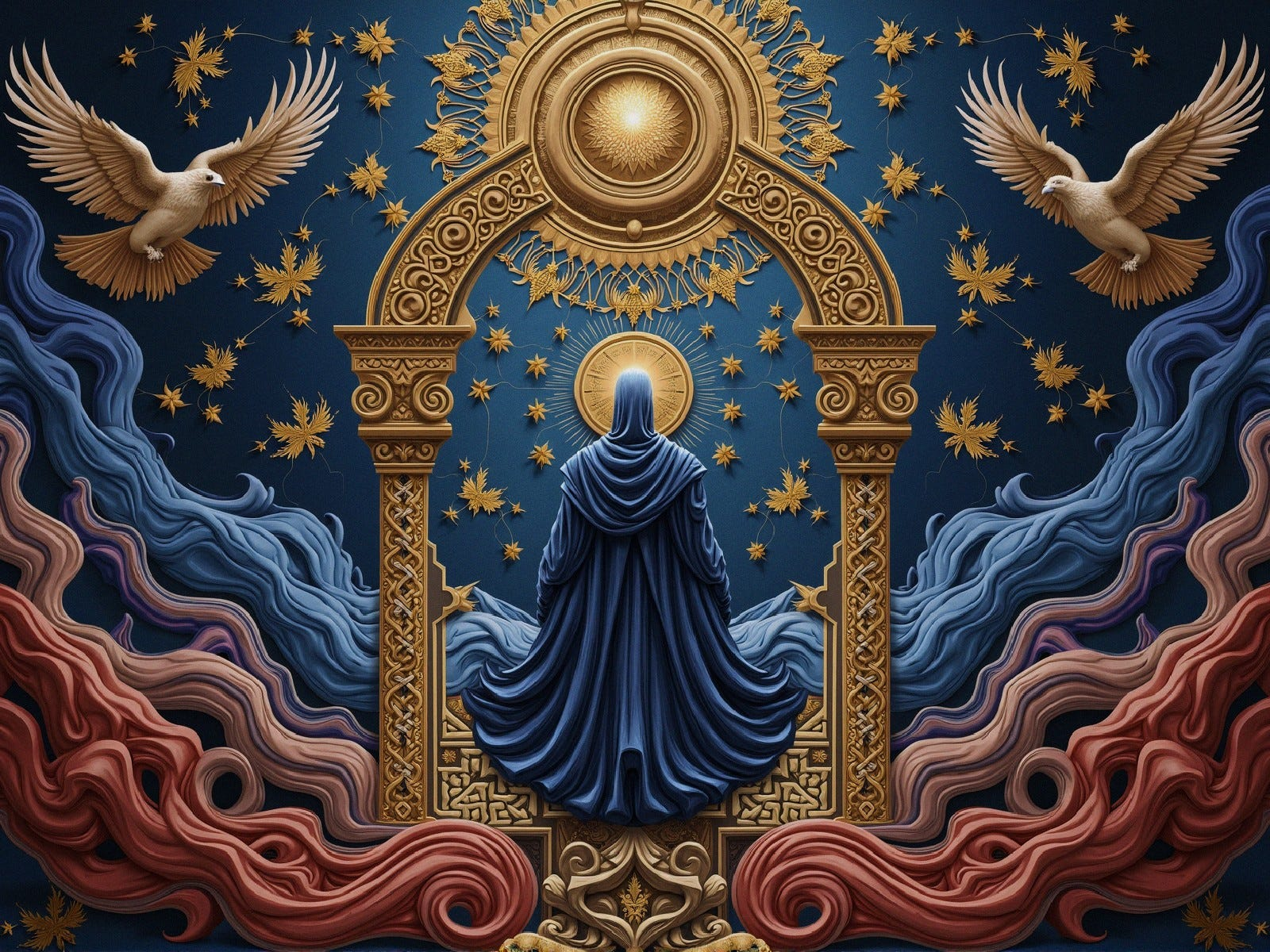
Art Prompt: A radiant composition in the intricate Insular style of the early Medieval British Isles, echoing the ornate patterns of the Lindisfarne Gospels. The image features an illuminated manuscript page depicting a robed figure under a celestial archway, surrounded by swirling knotwork, stylized birds, and interwoven gold filigree. Deep blues and earthy reds dominate the palette, with highlights of shimmering gold leaf. The mood is reverent, meditative, and mesmerizing — each curve a hymn, each symbol a prayer.
—

Video Prompt: Animate a glowing manuscript page as if it comes to life under candlelight. Zoom into intricate knotwork that pulses gently to ambient choral tones. Birds and serpents subtly animate within the margins. A robed monk places down his quill, and golden letters shimmer into form. Background transitions show rolling hills outside the monastery and brief flashes of starlit maps, all rhythmically timed to soft, contemplative music. A visually hypnotic reel, perfect for short-form looped content.
—
Music Recommendations:
- “Agape” — Bear’s Den
- “Song for Zula” — Phosphorescent
—
Joining us mid-series? Start from the beginning and catch up on history’s brightest minds:
Follow for the next chapter, and drop a comment below — who’s your favorite hidden genius from the “Dark” Ages?