
We’ve come a long way from cave paintings and clay tablets, haven’t we? Today, creativity streams from cloud servers, zip-lines through fiber optics, and shows up as viral memes about frogs in sunglasses. But here’s the twist: the more advanced our tools get, the more we start to look — eerily — like our ancestors. It’s as if progress is just us reinventing old ideas with new tech and better fonts.
So what can ancient genius teach us about the future of creativity? Let’s take a scroll down memory lane — and maybe fast-forward a few centuries while we’re at it.
The OG Creators Knew the Power of Constraints
Prehistoric artists didn’t have Photoshop or neural nets. They had burnt sticks, cave walls, and the occasional mammoth bone. And yet, they produced art that still makes us gasp in modern museums. The lesson? Constraints don’t stifle creativity — they supercharge it. When resources are limited, humans get scrappy, clever, and profoundly poetic.
Now think about today’s creators. Between limited attention spans, algorithmic gatekeepers, and an endless race for novelty, we’re back in the cave — but this time it’s digital, and the torch is WiFi-powered. AI, indie games, minimalist design, and 3D printing art — all thrive because of clever constraints. Turns out, a little friction makes fire.

Old School Was All About Community
Ancient creators didn’t work alone. From the architects of Angkor Wat to the guild painters of Florence, creation was a team sport. Sure, we remember the names of a few big shots, but most great works were the product of communal effort, mentorship, and shared purpose.
Fast-forward to now. Open-source software, TikTok duets, collab playlists, Reddit meme chains — this is collaboration 2.0. Creativity in the 21st century is more networked than ever. We’re crowdsourcing culture in real-time. And when we look at ancient genius, it’s clear: this isn’t new. It’s just upgraded.
We Used to Worship Our Creators — Literally
Ancient Egyptians built temples to artists. The Greeks coined the word “muse” for divine inspiration. In many societies, creators were priests, scribes, or oracles. Today’s equivalent? Influencers with Patreon accounts and blue checkmarks. OK, maybe not quite as majestic — but the idea of elevating those who shape culture hasn’t changed.
We crave meaning. We reward vision. And when someone cracks the code of what it means to be human — through a song, painting, code snippet, or meme — we light the modern incense: likes, shares, NFTs.
Every Revolution Is Just the Latest Remix
Writing. Printing. Radio. Film. Internet. AI. Every technological leap has unlocked new creative dimensions. And every time, people panicked that it would “kill” real art.
Spoiler: it didn’t.
Instead, we got the novel, the typewriter poem, the experimental film, the YouTube series, the AI-augmented canvas. New tools don’t kill creativity. They mutate it. And if you think Midjourney or GPT-4 are wild, just wait until your fridge starts doing slam poetry.

So What Can We Learn from the Ancients?
Simple: That creativity is a loop, not a ladder. It doesn’t just climb — it circles back, evolves, absorbs, and reinterprets. The core hasn’t changed: we make things to express, connect, and understand.
Whether it’s a flute carved from bone or a generative music app powered by neural nets, the heart of creation stays the same. We’re just finding newer ways to whisper the same ancient truths: “I was here. I felt this. I made this. Do you see me?”
The future of creativity isn’t a break from the past — it’s a return to it, with better lighting.
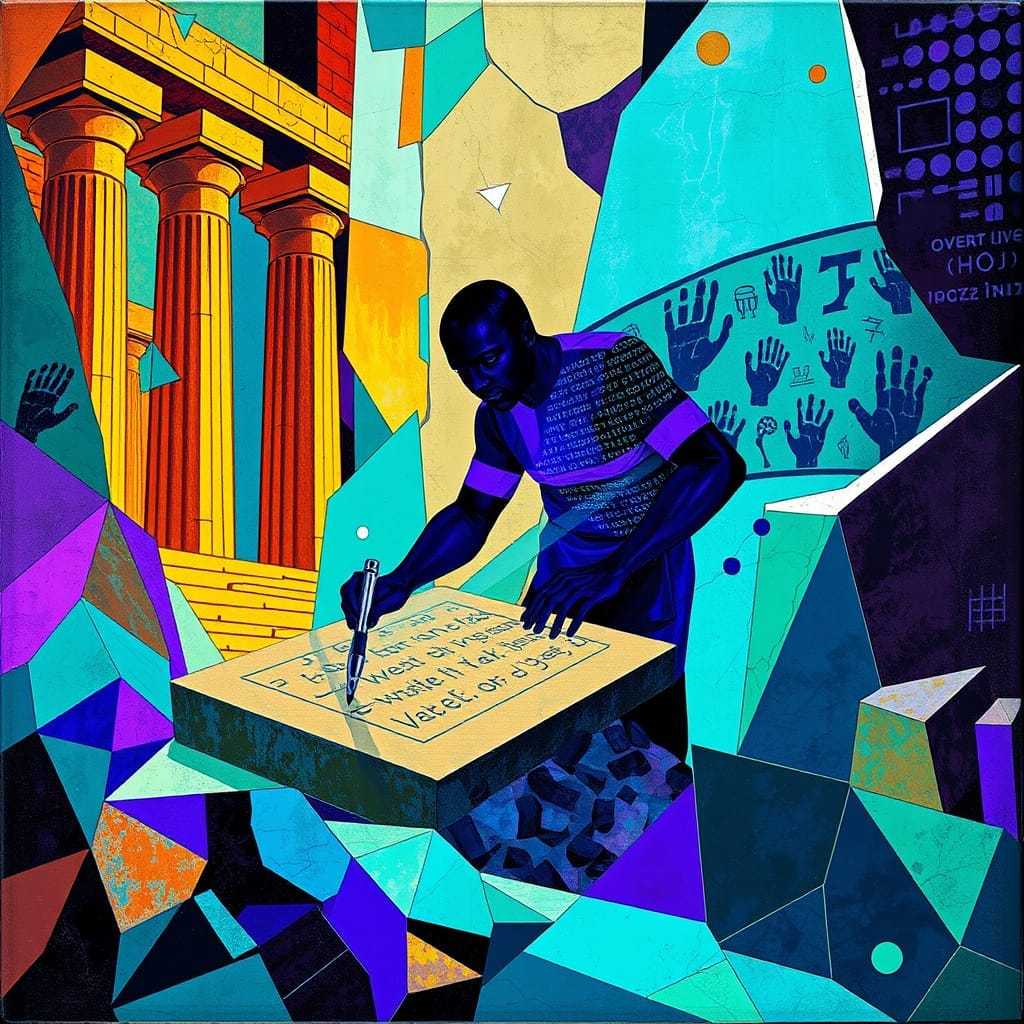
Art Prompt: A Cubist-inspired dreamscape where a figure chisels glowing binary code into a stone tablet. Angular shards of glass and fractured geometry form a surreal environment blending ancient temples with floating circuit boards. The palette bursts with electric teals, ochres, and deep violets, echoing Picasso’s radical fragmentation but infused with digital luminescence. The figure’s shadow stretches behind, morphing into cave wall handprints and hieroglyphs, symbolizing the continuity of expression from the ancient to the synthetic.
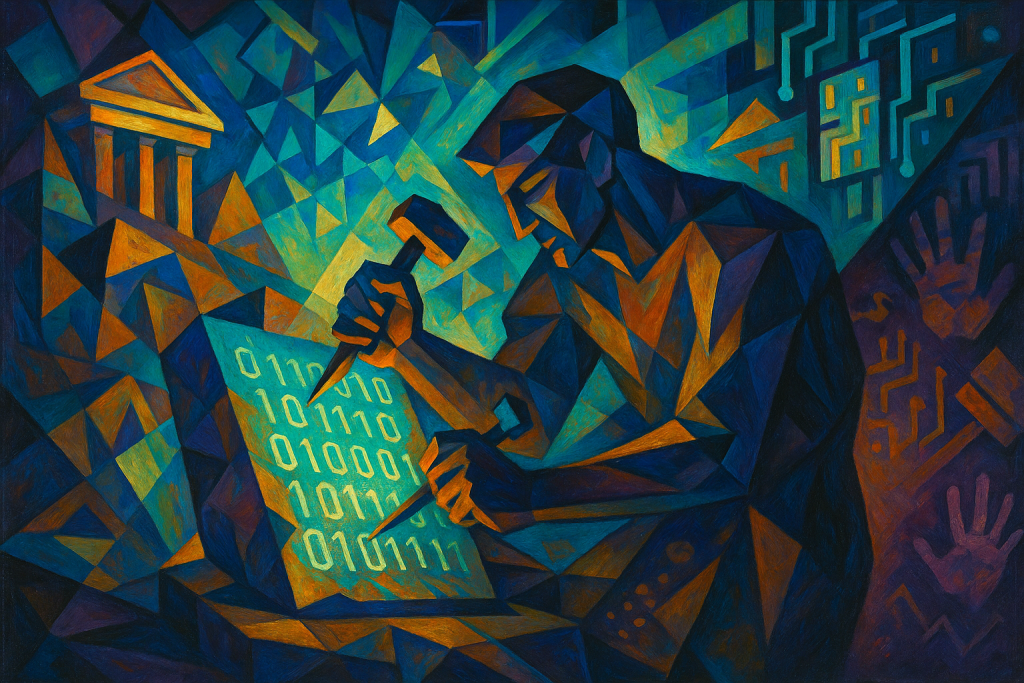
Video Prompt: Begin with a flickering transition from a firelit cave to a glowing digital interface. Merge scenes of a sculptor chiseling stone with flashes of AI-generated code appearing on holographic screens. Cut rapidly between ancient glyphs, Renaissance blueprints, and glitchy pixel art. Use camera rotations and morphing geometry to mimic a cubist collapse of time. End with a quiet pan-out: a creator silhouetted in front of a floating city made of light and memory.
Song Recommendations:
- “We Move Lightly” — Dustin O’Halloran
- “Elegy” — Lisa Gerrard & Patrick Cassidy
If you’re just joining us, you’ll definitely want to circle back to the start of The Creators Series: Medium: https://medium.com/@DaveLumAI/the-creators-series-a-lightning-tour-of-historys-greatest-geniuses-317d81bc5532
Blog: https://blog.lumaiere.com/the-creators-series-a-lightning-tour-of-historys-greatest-geniuses/
Follow for more! Comment below: which ancient innovation feels the most relevant to you today?