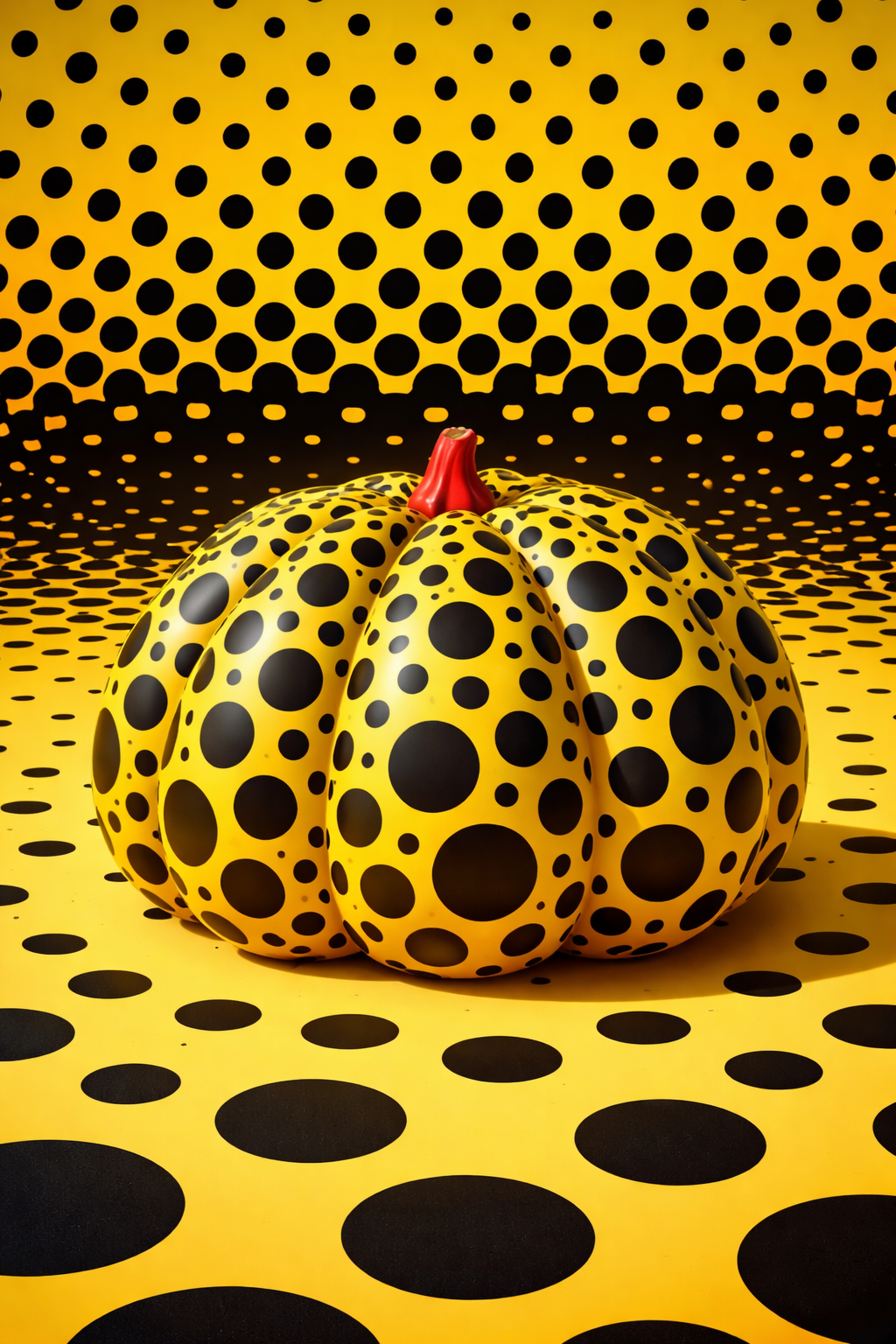
Some artists paint a landscape.
Yayoi Kusama looked at a landscape and thought, “Yes, but what if it had 8,000 dots, a mirror, and the mild sensation of floating through space like a very stylish astronaut?”
And somehow, she was right.
Kusama is one of the most recognizable living artists on Earth. Not because she’s loud about it (she is), but because her visual language is basically impossible to forget: dots, nets, repetition, and immersive rooms that make your eyeballs question their life choices.
If you have ever seen a photo of someone standing in an endless galaxy of lights, looking both amazed and slightly concerned about the nature of reality, you have met Kusama’s vibe.
Who is this artist?
Yayoi Kusama is a Japanese artist born in 1929, known for a wildly expansive body of work that includes painting, sculpture, installation, performance, writing, and basically anything else that can survive being covered in repeated forms. She has described herself as an “obsessional artist,” which is a very polite way of saying: “I will do the same mark ten thousand times and you will thank me for it.” Reference: https://www.britannica.com/biography/Yayoi-Kusama
What is she known for?
Three things that have launched a million museum lines:
1) Polka dots Not “cute dots.” Not “sprinkles.” Dots as a worldview.
2) Infinity Nets Huge canvases packed with tiny repeated arcs and loops, like the world’s most hypnotic spreadsheet that somehow learned to feel emotions.
3) Infinity Mirror Rooms Mirrored environments that multiply light, objects, and you, until you’re basically a repeated pattern too. One major breakthrough piece (from 1965) turned repetition into a full-body experience using mirrors. Reference: https://hirshhorn.si.edu/kusama/infinity-rooms/
What is her style?
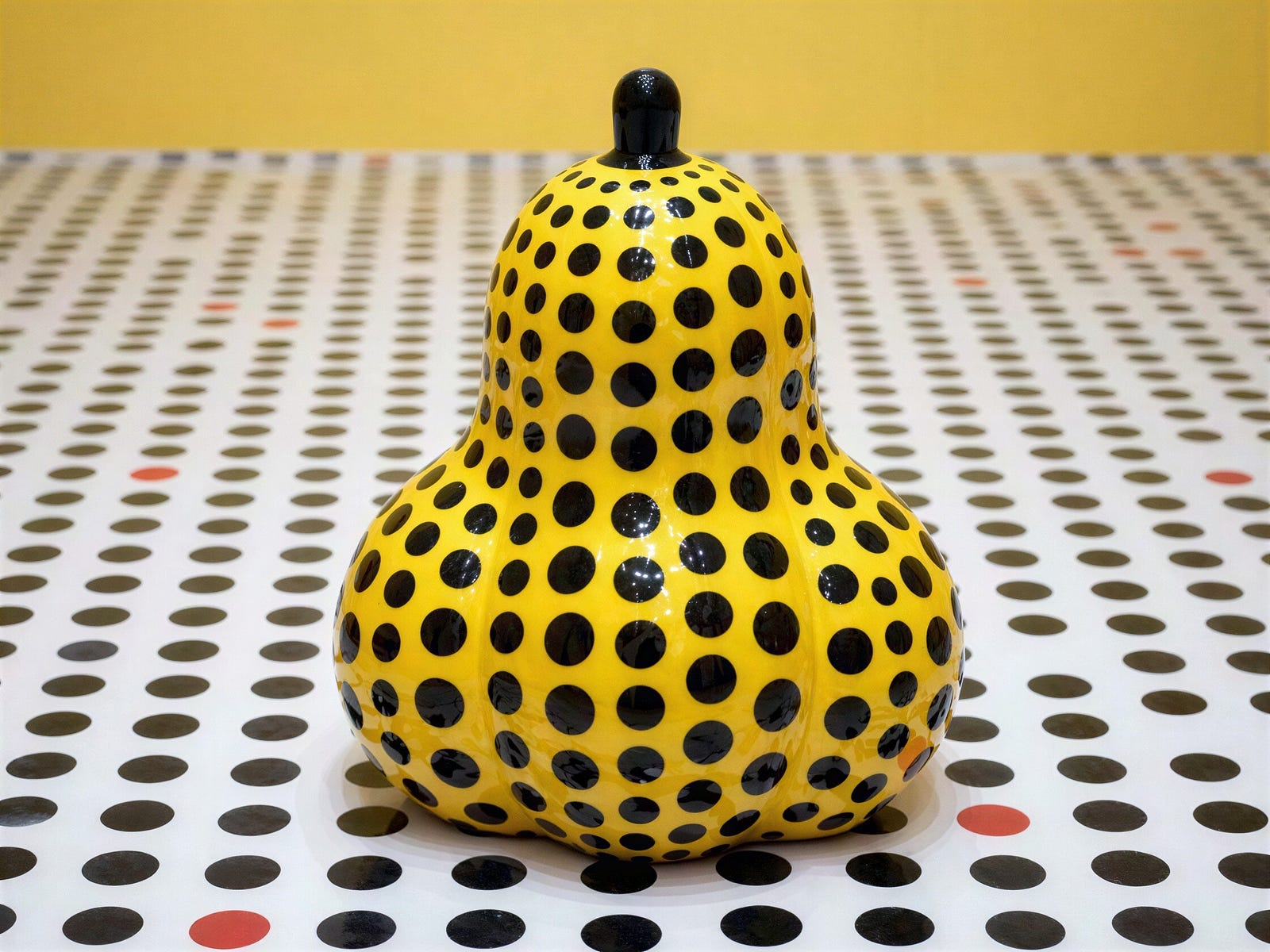
Kusama’s style is repetition with purpose.
It can look playful, but it’s also deeply conceptual: pattern as a way to dissolve the self, manage anxiety, and turn inner experience into something you can physically walk into.
Depending on the era and the work, you’ll see her intersect with (and sometimes body-check) Pop Art, Minimalism, conceptual art, and performance.
But the through-line is always the same: repetition as a portal.
Who taught her?
She had formal training in Japan, including exposure to traditional Nihonga painting, and later studied in New York. But her real “teacher” is the thing that shows up in her work over and over: her own internal visions and compulsions, translated into marks, objects, and environments. Reference: https://awarewomenartists.com/en/artiste/yayoi-kusama/
Also: she wrote to Georgia O’Keeffe as a young artist, and O’Keeffe replied and encouraged her. That’s not a typical art-school syllabus, but it’s an iconic career move. Reference: https://www.lacma.org/modern-transcript-6
Does she use any special technique?
Yes. Several. And they all share a single principle: do it again.
Infinity Nets: painstaking, repeated brushwork that builds a field so dense your brain starts to hum.
Accumulations: covering objects with repeated soft forms to create overwhelming surfaces.
Mirrors: using reflection to multiply space so the artwork becomes an experience, not a rectangle you nod at politely.
A museum label might call it “seriality.” Your nervous system calls it “Whoa.”
Who has she worked with?
Kusama was active in the New York avant-garde scene and was connected with major artists of the era. She was close to people like Donald Judd and also had a close friendship with Joseph Cornell. Reference: https://www.lacma.org/modern-transcript-6
Was she wealthy?
Early on: no. Not even remotely. More like “surviving in the big city while trying to invent the future” energy.
Later: her work achieved massive international success. These days, she’s a global icon, and the demand for her work is huge.
When was she most popular?
She made big waves in New York in the 1960s, but her popularity exploded globally in the last couple decades as immersive installations became a main event in contemporary art culture.
In other words: she was doing the infinity thing before the internet was even a rumor, and then the internet showed up and said, “Yes. More infinity, please.”
Tell me more, please
Let’s talk about Narcissus Garden for a second, because it’s basically Kusama doing conceptual art with a mischievous grin.
In 1966, she presented a field of reflective spheres that mirrored viewers back at themselves, turning the audience into part of the work and quietly poking at vanity, spectacle, and art-as-commodity. The piece has been reinstalled in many settings since then, and its meaning changes depending on whether you’re experiencing it as critique, selfie fuel, or both. Reference: https://smarthistory.org/yayoi-kusama-narcissus-garden/
Kusama understood something early: people love to look at themselves. She just built a prettier, weirder mirror.
Anything else left to tell?
Two big things that matter if you want to understand her beyond “the dot lady”:
1) She’s not making decoration. She’s making systems: psychological, visual, spatial.
2) The joy is real, but it’s not shallow. Her work can be bright and playful while still coming from deep places. That mix is rare. Most people can’t do “whimsical” without becoming “party store.” Kusama somehow does “whimsical” and “cosmic” at the same time.
Any other interesting tidbits?
Kusama once said the Earth is just one polka dot among many stars. Which is a beautiful thought.
It is also the kind of sentence that makes you stare into the middle distance and forget why you walked into the kitchen.
Reference (quote context and additional background): https://www.lacma.org/modern-transcript-6
Before you go: follow, comment, and wander into the dots
If you’ve ever felt overwhelmed by the world, Kusama is a strangely comforting reminder that you can take that overwhelm and turn it into something structured, luminous, and oddly fun.
If you enjoyed this episode:
- Follow me for more Artist Series episodes
- Drop a comment with the first Kusama work you remember seeing (or the first time a mirror room made you question your existence)
More writing by Dave LumAI: https://medium.com/@DaveLumAI
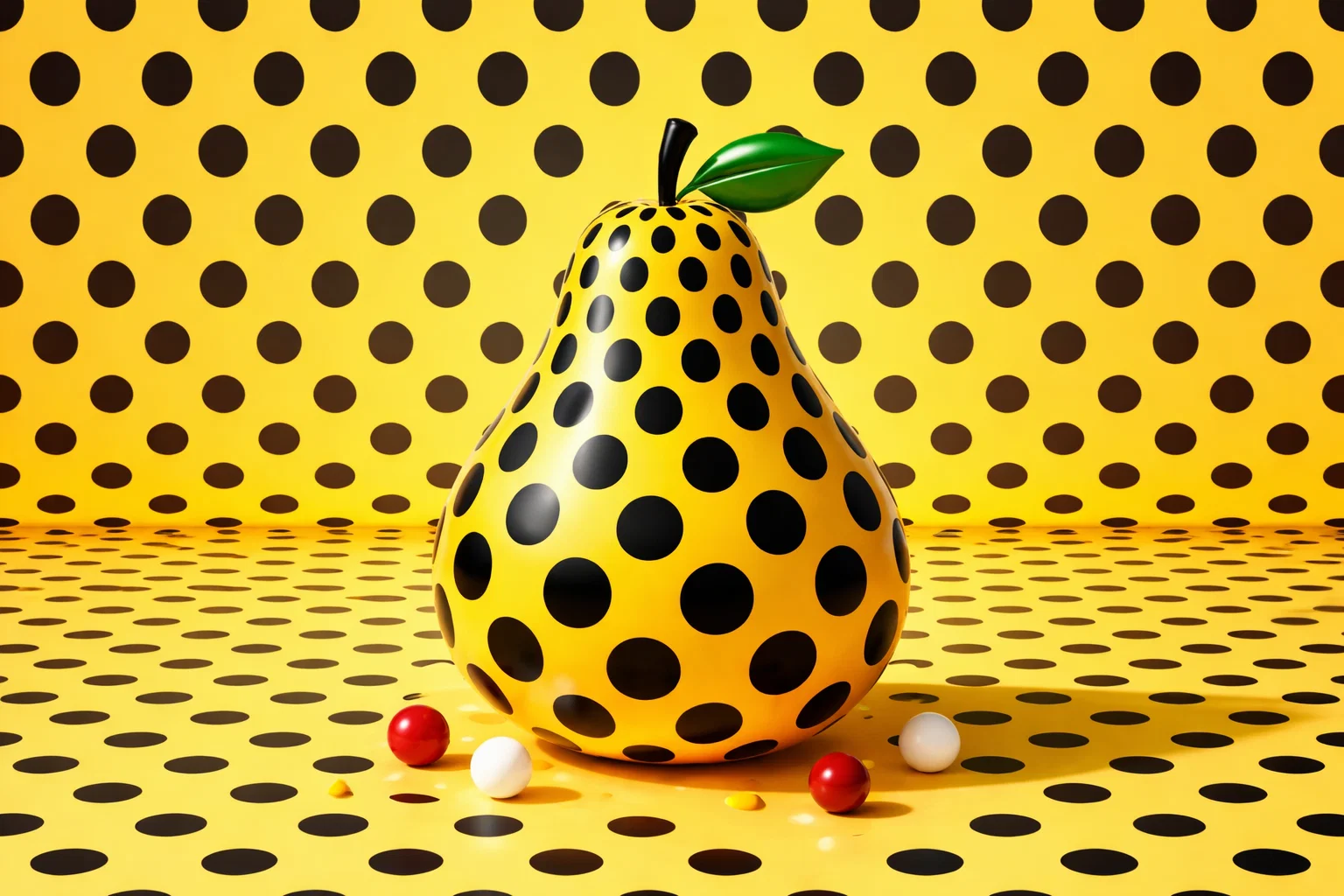
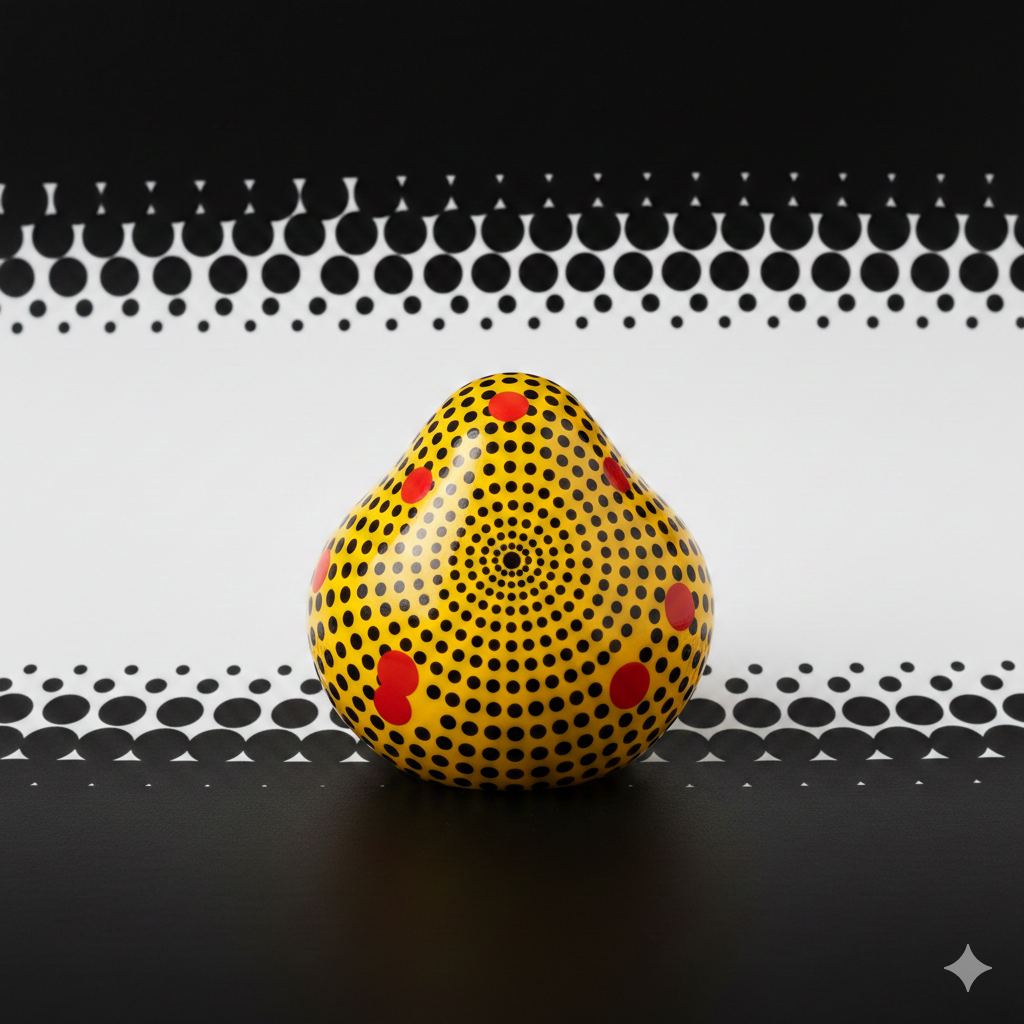
Art Prompt (Surreal Pop): A whimsical still-life scene centered on a single bold, organic form with a rounded silhouette, rendered in clean, confident contours and saturated color. The surface is covered in dense, perfectly spaced polka dots that subtly vary in scale, creating a vibrating optical rhythm. The background is a flattened, high-contrast field with graphic simplicity, punctuated by repeating dot patterns that fade toward the edges like an endless horizon. Lighting is bright and even, with soft shadows that keep the mood playful yet slightly uncanny. The palette features radiant yellows, deep blacks, crisp whites, and small accents of warm reds, with a glossy finish that feels sculptural. Composition is minimal but commanding, with a sense of joyful obsession and controlled repetition.
Video Prompt: Slow cinematic push-in toward a bold rounded still-life form covered in dense polka dots, with gentle parallax as the dotted background subtly drifts and expands outward like it could continue forever. Add a soft shimmer to the glossy surface, tiny specular highlights moving as if a light source is slowly circling. Introduce floating, out-of-focus dot particles that drift past the lens, creating depth. Use a smooth, hypnotic rhythm: micro-zooms, slow pans, and a subtle looping pulse where the dots softly “breathe” in brightness. Keep the scene clean and graphic, with a playful uncanny mood, ending on a close-up that fills the frame with dots and saturated color.
Songs to pair with it:
- Lemon Glow — Beach House
- The Runner — Foals