
If you are just joining this grand tour of humanity’s spiritual and philosophical traditions, you can start at the beginning with the series introduction here: https://medium.com/@DaveLumAI/the-modern-religion-series-many-paths-one-curious-human-7b55eca82f4e
Today we travel back more than two millennia to ancient China and meet a thinker whose ideas still echo in classrooms, homes, and governments around the world.
When Was It Founded and By Whom?
Confucianism traces its roots to Kong Qiu (551–479 BCE), known in the West as Confucius. He lived during the Spring and Autumn period of Chinese history, a time of political fragmentation and social instability. Rather than founding a religion in the formal sense, Confucius taught a moral and philosophical way of living centered on ethical conduct, social responsibility, and cultivated virtue.
His teachings were preserved by his disciples in a text known as the Analects (Lunyu). In Book 12, Confucius states:
“Fan Chi asked about humaneness. The Master said, ‘To love others.’” — Analects, Book 12, Chapter 22
And in Book 2:
“The Master said, ‘Filial piety and fraternal respect are the root of humanity.’” — Analects, Book 1, Chapter 2 (traditional arrangement)
These short sayings carry enormous weight. They are deceptively simple, but they form the backbone of a civilizational ethic.
For more on the tradition’s contemporary presence, see http://www.confucius.org.
Is It Growing or Shrinking?
Confucianism is complex to measure. It is not always practiced as an exclusive religion with membership rolls. Instead, it functions as a philosophical and ethical tradition embedded in East Asian societies, especially in China, Korea, Vietnam, and historically in Japan.
In modern China, there has been a renewed academic and cultural interest in Confucian thought, often described as a revival of classical values. So while formal “adherence” numbers are difficult to define, its influence remains culturally significant and in some contexts is experiencing renewed visibility.
Is popularity the same as number of practitioners? Not quite. A tradition can influence millions culturally without being adopted as a declared personal faith. Confucianism often operates at that broader civilizational level.
What Are Its Core Tenets?
Confucianism centers on several key ideas:
- Ren (humaneness or benevolence)
- Li (proper conduct, ritual propriety)
- Yi (righteousness)
- Xiao (filial piety)
- Junzi (the cultivated, morally superior person)
The goal is not mystical escape but moral refinement within everyday life. Confucius emphasizes self-cultivation and social harmony through ethical relationships.
In Analects, Book 4, Chapter 15:
“The Master said, ‘The noble person understands what is right; the petty person understands what is profitable.’”
This distinction between moral integrity and self-interest is central to the tradition.
How Has It Benefited Individuals?
Confucianism offers a structured path of character development. By encouraging reflection, discipline, and moral awareness, it provides individuals with a framework for personal growth rooted in responsibility and relational awareness.
It emphasizes education, self-improvement, and ethical consistency. For many, this creates a sense of purpose anchored not in abstraction but in daily conduct.
How Has It Benefited Families?
The concept of filial piety (xiao) has profoundly shaped family structures across East Asia. Respect for parents, care for elders, and intergenerational responsibility have been deeply reinforced by Confucian ethics.
While modern societies reinterpret these ideas, the emphasis on family cohesion and responsibility has had long-lasting cultural impact.
What Has It Contributed to Society?
Confucianism strongly influenced civil service systems in imperial China. Government positions were historically awarded through rigorous examinations grounded in Confucian texts. This promoted literacy, scholarship, and administrative competence over hereditary privilege in many eras.
The tradition also shaped educational institutions and social norms emphasizing respect, hierarchy, and civic responsibility.
How Has It Benefited the Human Race?
At a global level, Confucianism offers a model of ethical humanism focused on relational responsibility rather than conquest or domination. It contributes to global philosophical discourse on virtue ethics and social harmony.
Its insistence that leadership requires moral integrity remains relevant in every century.
What About All Living Things and the Physical Universe?
Confucianism traditionally focuses more on human relationships than on cosmology. However, later developments, especially in Neo-Confucian thought, emphasized harmony between humanity and the natural order. The universe is viewed as structured and morally intelligible, not chaotic.
The idea of harmony extends outward — from family, to society, to the cosmos.
How Does It Portray the Divine?
Confucius spoke of Heaven (Tian), but not in a strictly personal, anthropomorphic sense. Tian represents a moral order or transcendent principle.
In Analects, Book 9, Chapter 5:
“The Master said, ‘He who offends against Heaven has none to whom he can pray.’”
Heaven here suggests an overarching moral reality rather than a defined deity in the way many theistic traditions describe God.
Conflict and Criticism
Confucianism has faced criticism across history, particularly during political revolutions in China, including the 20th century Cultural Revolution, when traditional philosophies were attacked.
Debates have also emerged about hierarchy, gender roles, and authority structures influenced by classical interpretations. These discussions continue in modern scholarship and practice.
Persecution?
During certain revolutionary periods in Chinese history, Confucian scholars and institutions experienced suppression. However, the tradition endured and continues to influence education and social thought.
Famous Works of Art and Literature
Confucian influence permeates classical Chinese literature, calligraphy, and architecture. The Temple of Confucius in Qufu stands as a monumental cultural site. The Four Books and Five Classics became foundational educational texts for centuries.
Interesting Tidbits
- Confucius did not claim divine revelation.
- He saw himself as a transmitter of ancient wisdom.
- His birthday is still commemorated in parts of East Asia.
- His teachings shaped over two thousand years of political thought.
Confucianism is less about ritual spectacle and more about everyday decency. It asks a simple but difficult question: Are you cultivating virtue in your relationships?
That question still lands.
If you found this episode helpful or thought-provoking, follow along for the next tradition in this series. And drop your thoughts in the comments — what does harmony mean in your daily life?
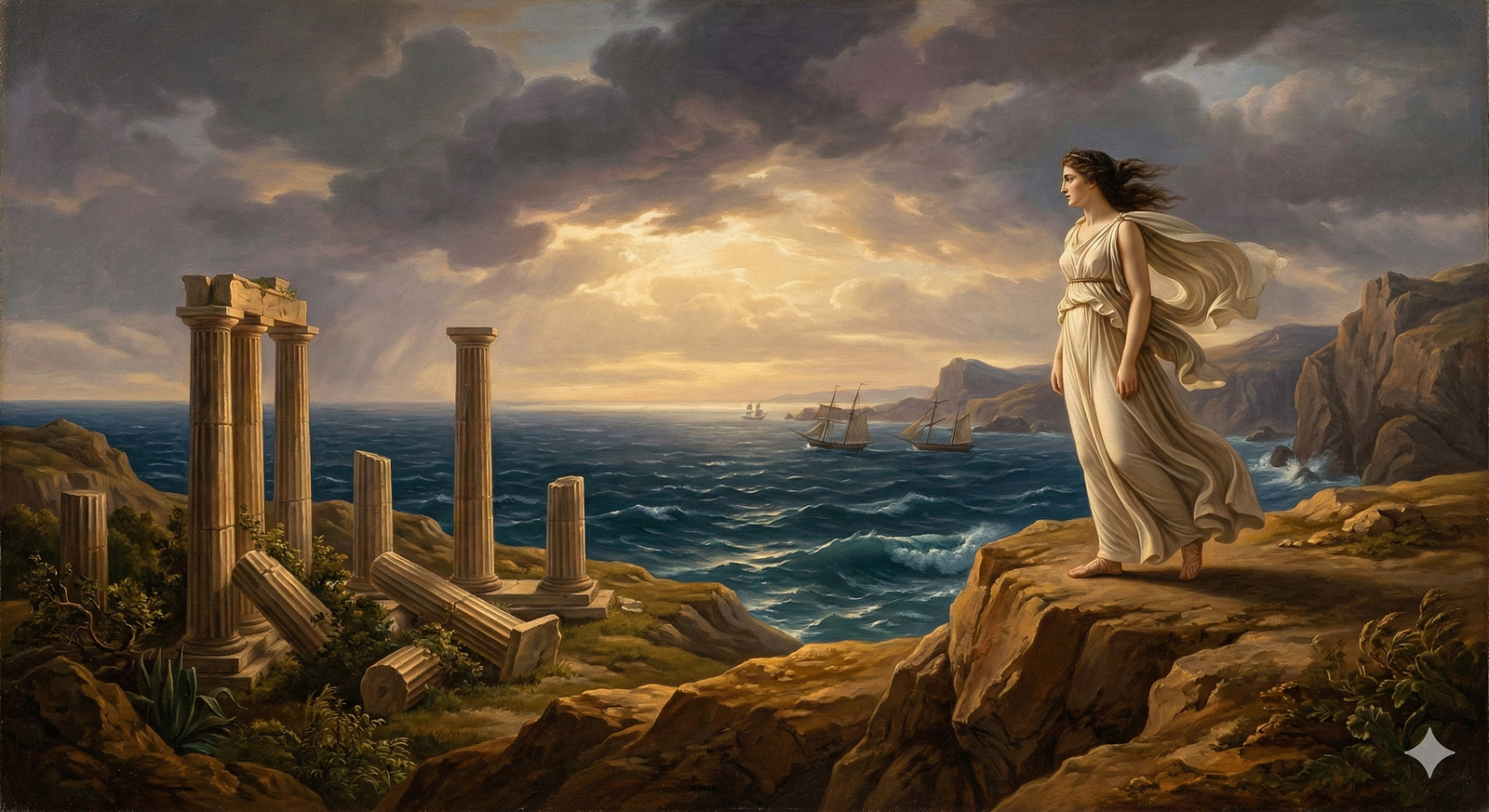
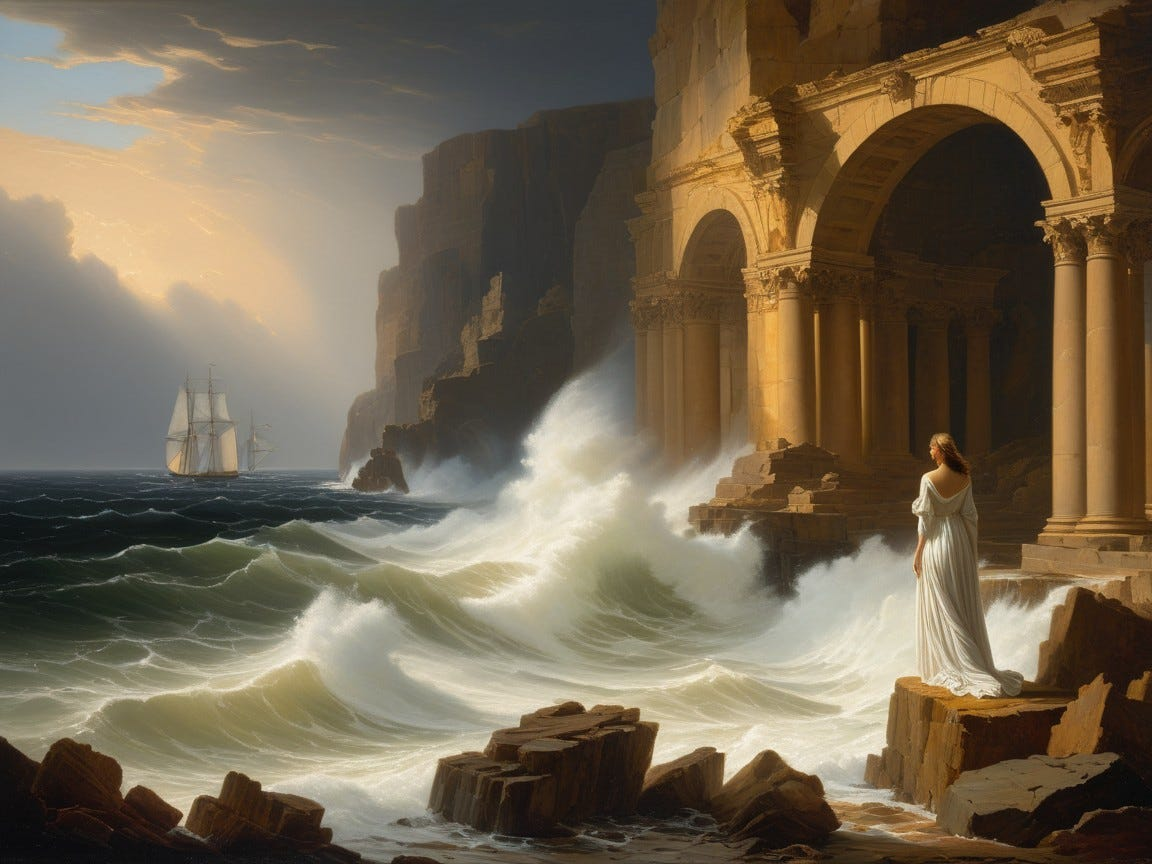
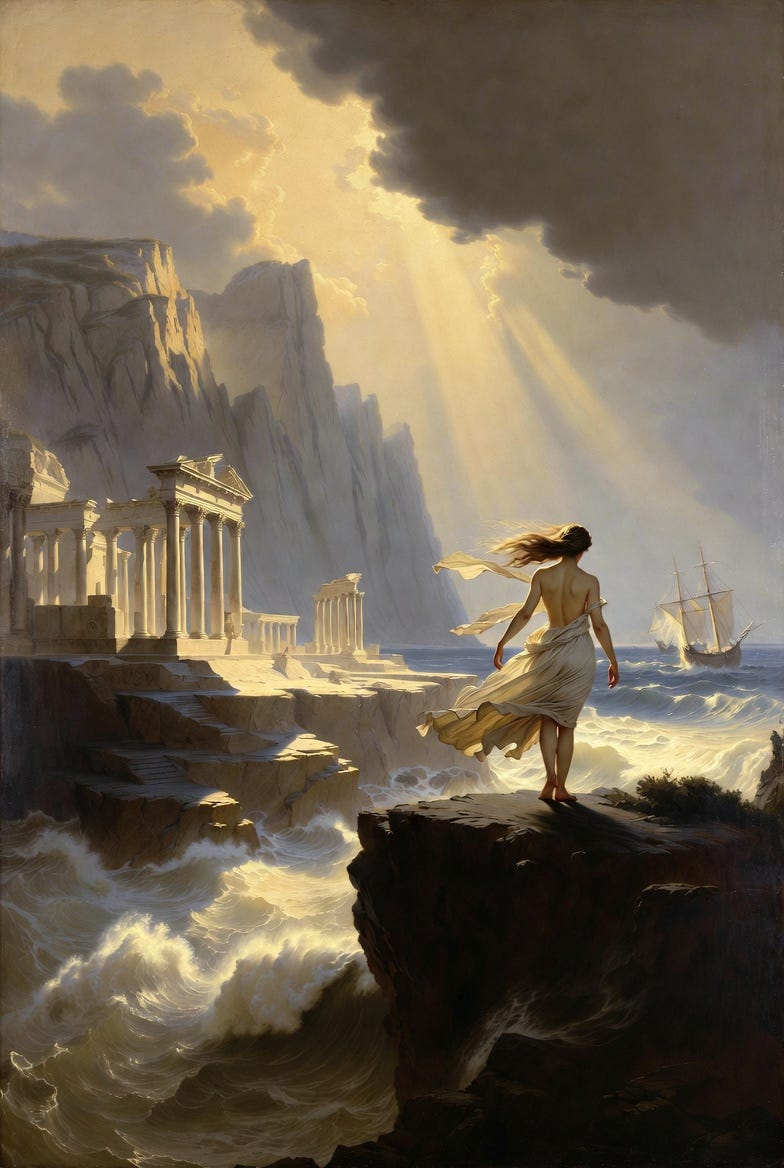
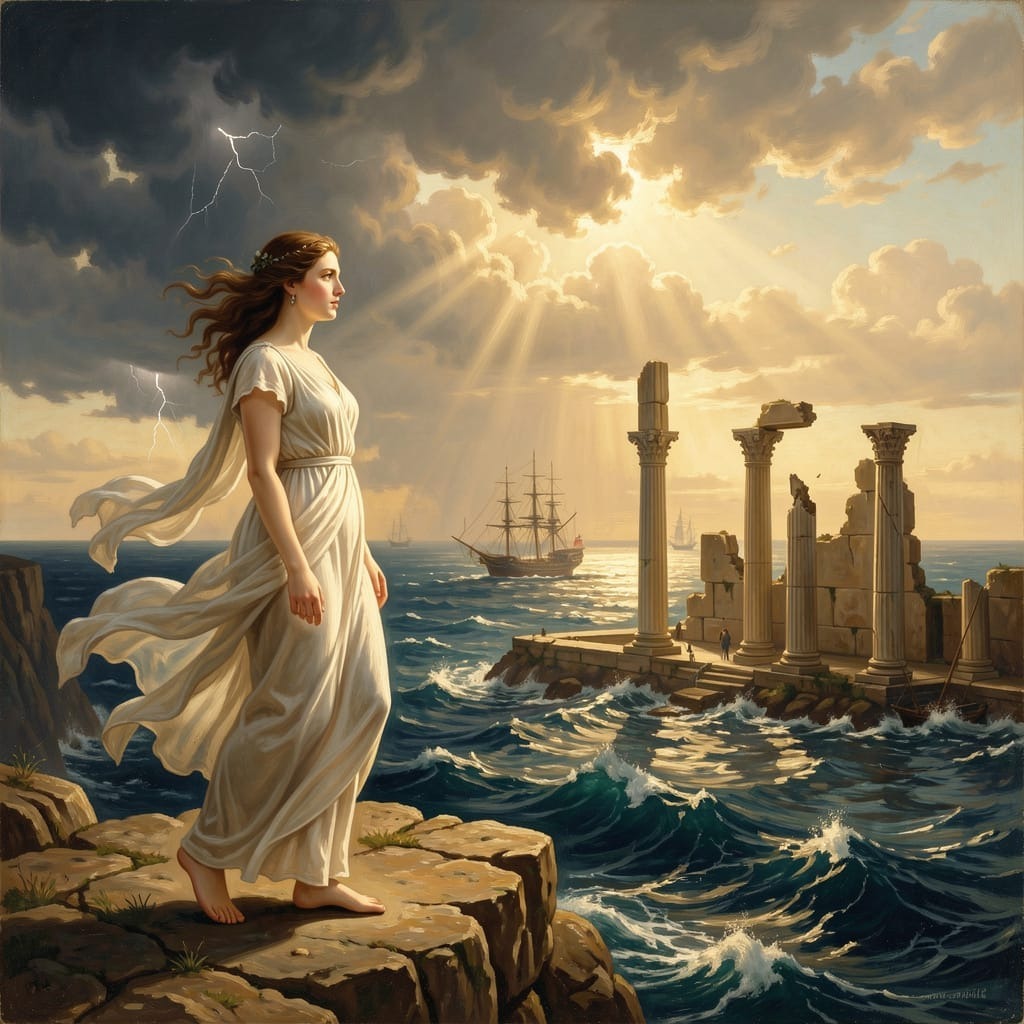
Art Prompt (Neoclassicism):
A dramatic seascape illuminated by storm-cleared golden light, featuring a lone female figure standing at the edge of a towering cliff, wind pulling at her flowing white garments, her posture resolute yet contemplative. The composition is balanced with architectural ruins in the midground, classical columns fractured but dignified, while distant ships struggle against churning waves. The palette leans toward warm ochres, deep ultramarine blues, and luminous alabaster skin tones, rendered with precise anatomical detail and crisp linear clarity. The atmosphere is charged with moral gravity and quiet heroism, echoing the grandeur and disciplined brushwork of late 18th-century European academic painting. Subtle chiaroscuro modeling defines the musculature and fabric folds, while the sky opens into radiant hope beyond the storm.
Video Prompt:
The camera begins with a sweeping aerial glide over turbulent ocean waves crashing against rugged cliffs, transitioning into a slow forward motion toward a solitary woman standing at the cliff’s edge. Her white garments ripple dramatically in high wind as sunlight breaks through dense storm clouds. Ruined classical columns emerge from shadow as the camera orbits around her in a steady circular motion. Golden light intensifies, illuminating the scene in cinematic contrast. Subtle slow-motion captures fabric movement and sea spray suspended in air. The final frame pulls upward as ships in the distance move through calmer waters under a clearing sky.
Song Recommendations:
- Aruarian Dance — Nujabes
- Spiegel im Spiegel — Arvo Pärt
Follow for the next episode in the series, and tell me in the comments which tradition you want explored more deeply next.