
Andre Derain is one of those artists who makes you suspect the early 1900s were basically a long-running group chat called “What if we just… ignored reality?” And then everyone replied with: “Bet.”
He was French, born in 1880, and he helped kick off Fauvism right alongside Henri Matisse which is essentially the art movement that looked at the world and said, “Nice scenery. Now let’s repaint it like it is powered by electricity and questionable decisions.” If Impressionism was a polite conversation with sunlight, Fauvism was sunlight doing parkour.
Derain is the guy you bring up when someone says, “Wait, who started the whole wild-color thing?” Because yes, he absolutely did, and then he immediately went on to do other stuff too, like an artist with commitment issues but immaculate taste.
Who is Andre Derain?
Derain was a painter, sculptor, and general creative chaos agent who helped shape modern art at a time when art was basically speedrunning reinvention. He trained in Paris, studied under painter Eugène Carrière, and met Matisse early on during those formative “we are broke but visionary” years. The Guggenheim has a clean overview of his early training and career arc if you want the museum-approved version of the story: https://www.guggenheim.org/artwork/artist/andre-derain
What matters here is that Derain didn’t just join Fauvism. He helped make it happen, like a co-founder who also designed the logo, threw the launch party, and somehow convinced everyone the dress code was “aggressively orange.”
What is he known for?
Derain is known for:
- Co-founding Fauvism and making color act like it just drank three espresso shots.
- Landscapes and city scenes where the sky is never simply blue. It is blue with intent.
- A fast and dramatic style shift later on when he cooled off the color riot and leaned more classical.
If you’ve ever looked at a painting and thought, “This feels like the world, but emotionally louder,” that’s the neighborhood Derain helped build.
What is his style?
During his Fauvist peak, Derain’s style is basically:
- Bold, non-naturalistic color (grass can be red, and it will be red confidently)
- Simplified shapes and strong outlines
- Brushwork that feels energetic but controlled
- Light that looks like it is glowing from inside the paint
The result is art that feels joyful, punchy, and slightly rebellious, like the painting is smirking at you.
And then later, Derain pivoted. The wild colors settled down. The shapes got more grounded. The vibe shifted from “party in pigment city” to “I have read several old master biographies and now I am thinking serious thoughts.”

Who taught him?
He studied under Eugène Carrière, which is the part of Derain’s origin story that feels like the calm before the storm. Because Carrière’s world is more subdued and tonal, and Derain eventually went in the opposite direction like, “Thank you for the fundamentals. I will now light them on fire with magenta.”
Does he use any special technique?
He wasn’t doing some secret alchemy with paint, but he was doing something that feels like a cheat code:
- Color as structure, not decoration
- Color as emotion, not accuracy
- Color as volume, like you can build depth with intensity instead of shading
When Derain paints a London bridge scene, he’s not trying to recreate what the Thames looked like at 3:17 p.m. He’s trying to recreate what it felt like to stand there while the city hums around you.
The Museum of Modern Art has a great example of this approach in one of his London works: https://www.moma.org/collection/works/79103
And the Met also has a London street scene with useful context on how and why he made those trips: https://www.metmuseum.org/art/collection/search/489974
Who has he worked with?
Derain’s key “creative orbit” includes:
- Henri Matisse, his Fauvist partner-in-crime
- Maurice de Vlaminck, another Fauvist heavyweight and fellow enthusiast of paint that refuses to behave
This wasn’t a “movement” like a corporate brand rollout. It was more like a friend group who kept egging each other on, except the dares were things like, “Make the shadows green. No, greener. No, nuclear.”

When was he most popular?
Derain’s big moment lands in the mid-1900s decade, especially 1905–1906, right when Fauvism hit the public like a paint bomb.
One of the iconic moments for Fauvism is the 1905 Salon d’Automne, where the whole “wild beasts” label got attached to the group. Here’s a readable overview that sets the scene: https://www.historytoday.com/archive/fauves-salon-d%E2%80%99automne
This is the era where Derain’s name is basically synonymous with color bravery.
Was he wealthy?
Not in the “private island shaped like a palette” way.
Like most artists of his era, he did not start out financially comfy. His career did eventually become successful, and his work was supported by serious dealers and collectors, but the early years were very much “sharing studios and surviving on determination” energy.
If you ever feel like your hobbies are expensive, remember: at least you are not trying to invent modern art while also paying Paris rent in 1905.
Tell me more, please
Gladly, because Derain’s story has a fun twist: he’s famous for being wildly modern, and then he spent part of his career pulling in the opposite direction.
Here’s the simplified arc:
- Early years: training, learning, meeting other artists
- Fauvism era: color goes absolutely feral, in the best way
- London series: he takes the Fauvist energy into city atmospheres and light
- Later shift: the work becomes more restrained and classical, like he decided to stop shouting and start speaking in a stern indoor voice
The Courtauld put together an entire exhibition context around his London paintings, which helps explain why those works matter and how they fit into his evolution: https://courtauld.ac.uk/gallery/exhibitions/past-exhibitions/andre-derain-the-london-paintings/
This is part of why he’s so interesting. He isn’t just one vibe. He’s a whole playlist.

Anything else left to tell?
Yes: Derain is one of the best examples of an artist who proves Fauvism wasn’t “random chaos.” It was a deliberate push. It was artists choosing to use color the way composers use sound.
Fauvism wasn’t “oops I painted the trees orange.” It was “I painted the trees orange because your brain expects green and I want to wake it up.”
Derain’s best Fauvist work has that exact feeling: your eyes feel surprised, but your emotions feel understood.
Any other interesting tidbits?
A few fun ones to close out:
- Derain’s Fauvist period is short but explosive, like a firework that refuses to be subtle.
- His London works are a masterclass in painting atmosphere without turning everything into gray fog and sadness.
- His later style shift is controversial to some people, but honestly it just makes him feel more human: he changed, he explored, he didn’t get stuck repeating himself forever.
If you made it this far, you officially qualify as someone who should comment.
Follow me for more art-history episodes with personality, and drop a comment:
- Are you Team “Color Should Behave” or Team “Color Should Cause Minor Panic”?
- Which city should get a Fauvist makeover next?
Also on: https://medium.com/@DaveLumAI

Art Prompt (Fauvist Landscape):
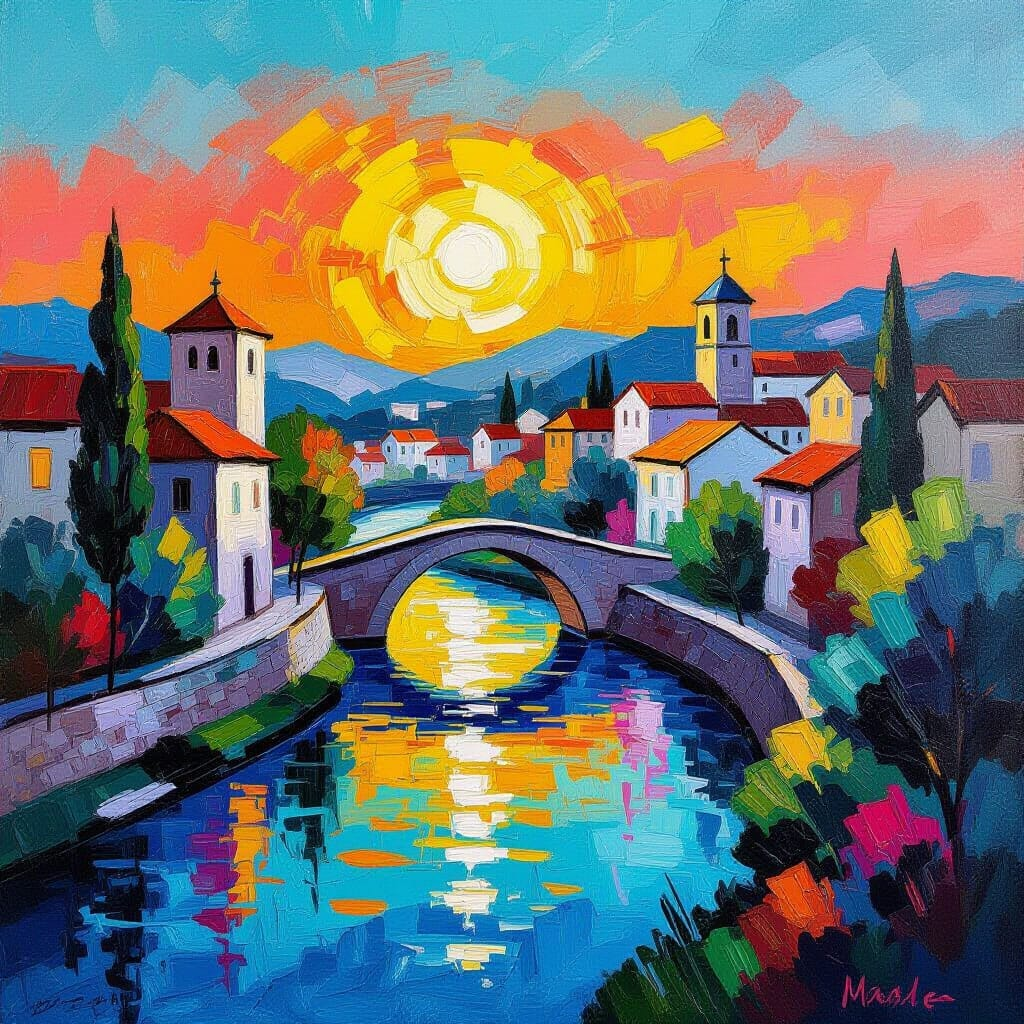
A bold, expressive landscape painting with electrified color and energetic brushwork. A river bends through a sunlit town, with a stone bridge and clustered buildings simplified into strong, confident shapes. The sky glows with saturated turquoise and warm coral, while the water flashes with unexpected streaks of violet, lemon-yellow, and fiery orange. Trees and rooftops are outlined with rhythmic strokes, creating a lively pulse across the scene. The mood is joyful and radiant, with high-contrast shadows and shimmering highlights that make the entire canvas feel alive.
Create a short, eye-catching video that brings a bold, expressive landscape painting to life. Start with a slow glide over thick, textured brushstrokes, revealing a vibrant river curving through a sunlit town with a stone bridge and simplified buildings. Animate the colors as if they are gently breathing: turquoise sky subtly ripples, coral light blooms and fades, and the water flickers with violet, lemon-yellow, and fiery orange reflections. Add a soft, rhythmic camera sway like handheld wonder, with occasional quick punch-in zooms to highlight paint texture and energetic outlines. Include a final sweeping pullback to show the full scene glowing, then end on a satisfying snap-to-still frame.
Song Recommendations:
- The Adults Are Talking — The Strokes
- Anemone — The Brian Jonestown Massacre
