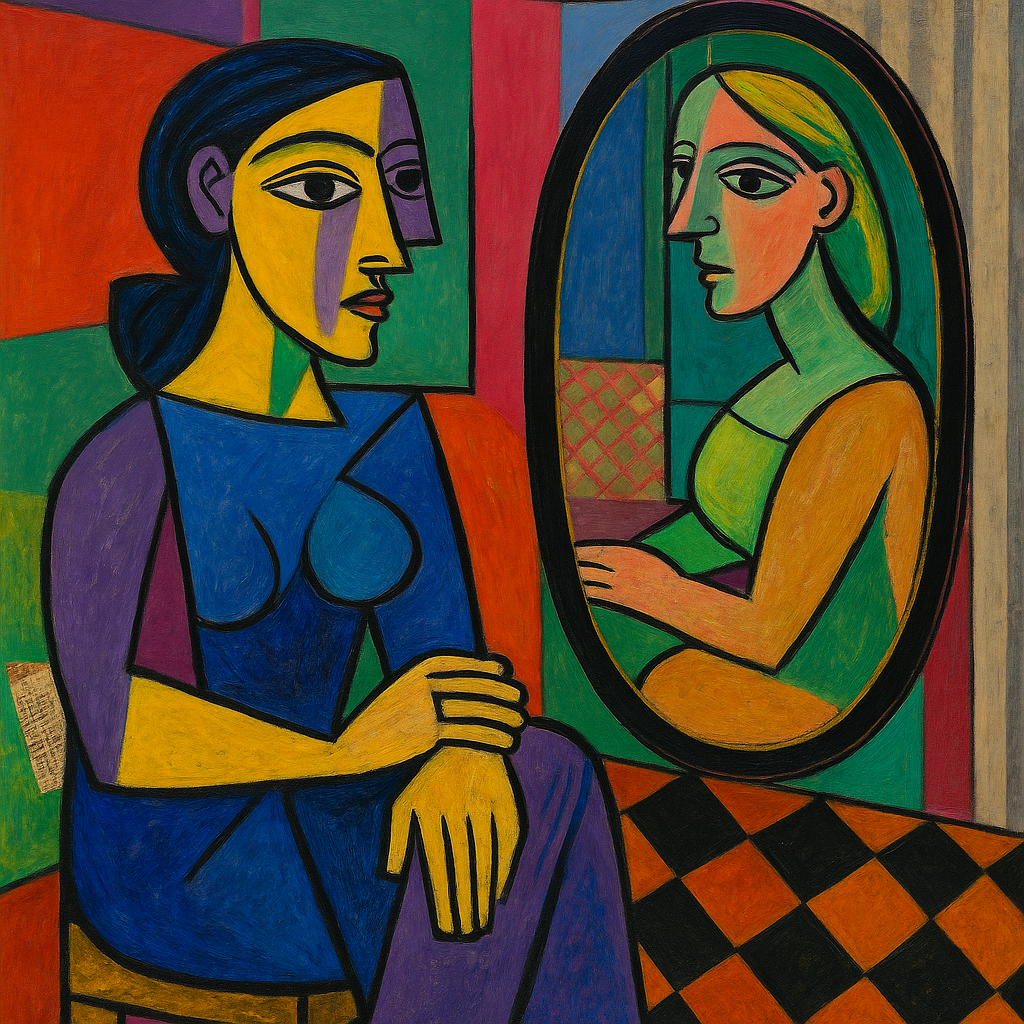

Who was this artist? A malagueño prodigy who outdrew adults before he could tie a tie, who moved from Barcelona to Paris and then proceeded to bend the 20th century like a wire sculpture. He signed “Picasso,” but he started life as Pablo Ruiz; the brand wasn’t born — it was sharpened. For a brisk bio and timeline hop, see Britannica and the museum pages at Musée Picasso Paris and Museo Picasso Málaga.
What is he known for? Exploding how we see. Blue Period sadness, Rose Period warmth, then — boom — Cubism: the great unflattening of flatness. He co-pioneered it, then kept reinventing himself: neoclassical turns, surreal currents, wartime greys, late-career fireworks. A tour of those zigzags lives nicely at Tate and Guggenheim.
What’s his style? All of them, sequentially and sometimes simultaneously. Early on: melancholic blues with elongated forms; then circus pinks; then fractured planes (Analytical Cubism) giving way to brighter, collaged shapes (Synthetic Cubism). Later: mythic bulls and minotaurs, curvy classicism, graphic linocuts, ecstatic ceramics. If you want a gallery hit list, MoMA’s artist page delivers the greatest hits without the crowds.
Who taught him? First and most importantly, his father, José Ruiz y Blasco, a painter and art instructor who gave him both discipline and a studio stool. He briefly studied at art schools in La Coruña, Barcelona’s La Llotja, and Madrid’s San Fernando, then left syllabi behind to learn from cafés, ateliers, and the entire city of Paris.

Does he use any special technique? Several, and a few he more or less invented.
- Papiers collés (collage): gluing newsprint, wallpaper, sheet music — art plus breakfast table.
- Assemblage sculpture: guitars from cardboard and string; later welded metal, wood, and found objects.
- Analytical → Synthetic Cubism: from muted, faceted dissection to colorful, shorthand reconstruction.
- Ceramics & linocuts: post-war Picasso loved clay and lino like a kid with new crayons, only with 50 years of engine behind him.
Who has he worked with? “Worked with” in Picasso-land means “collided with creatively.” Georges Braque was the Cubist co-pilot. Juan Gris polished Cubism’s grammar. Dora Maar photographed his process and challenged his eye. Dealers and patrons like Daniel-Henry Kahnweiler and Gertrude Stein helped put fuel in the rocket.
Was he wealthy? Eventually, yes — very. He became one of the rare artists who didn’t just shape culture; he shaped the market that sold it. By mid-century he had fame, studios, and enough clout to make a single drawn line feel like an event.
When was he most popular? Popularity for Picasso is a long plateau: first shock waves in the 1910s–20s (Cubism), massive public recognition by the 1930s–50s, and a legacy that refuses to retire. “Most popular” is basically “yes.”
Tell me more, please. He treated style like a revolving door: enter sorrow, exit acrobat, enter geometry, exit myth. He dated works obsessively, turning his oeuvre into a diary. Bulls charge through his mythology; women appear as muses, equals, arguments, and mirrors. Politics shows up too — he painted a monumental anti-war cry in grayscale, and its echo still rattles galleries.
Anything else left to tell? Two big ones. First, he proved that reinvention can be a method, not a midlife crisis. Second, he demonstrated that art can be both experiment and billboard — high theory in one corner, mass recognition in the other, same canvas.
Any other interesting tidbits? He once said, “It took me four years to paint like Raphael, but a lifetime to paint like a child.” Whether the line arrived polished or paraphrased, the point stands: unlearning is an art form. Also, his productivity stats are wild — tens of thousands of works — making your camera roll look minimalist.
If this made you smile, squint, or start collecting cereal boxes for a sculpture, tap that follow, share it with a friend who still thinks Cubism is a Minecraft setting, and drop your hottest Picasso take in the comments. For more art, code, and playful brain stretches: lumaiere.com and More by Dave LumAI.

Art Prompt (cubism): A vibrant, room-sized composition of interlocking planes and split profiles where a seated figure faces a tall oval mirror; the figure’s face is divided into sunlit yellow and twilight violet halves, each eye drifting to its own angle; in the mirror, a luminous counterpart leans forward, skin turning melon pink and sea-green, with checkerboard textures sliding across cheeks; bold black contours snap like guitar strings; fragments of newsprint and striped wallpaper peek from beneath paint; background blocks of fuchsia, jade, and tangerine pulse around a diamond-pattern floor; gentle glazing softens hard edges, while crisp, decisive lines carve geometry into feeling — intimate, electric, and strangely tender.
Video Prompt: Begin on a close-up of bold black contour lines that flick into existence like ink summoned by a magnet. Pull back as faceted shapes snap together, assembling a seated figure whose face tilts — one side sunlit yellow, the other twilight violet. A tall oval mirror slides into frame; the reflection brightens into melon pink and sea-green, swapping expressions with the original in quick, playful beats. Checkerboard textures ripple across cheeks, then dissolve into floating strips of newsprint. Camera orbits smoothly while planes rotate like hinged shutters, revealing flashes of fuchsia, jade, and tangerine. Cut to a rhythmic sequence of shapes locking and unlocking to the beat, then finish with a gentle push-in: the figure and reflection align for a split second before fracturing into confetti-like geometry that drifts upward.
Songs to pair with the video:
- Glósóli — Sigur Rós
- What Else Is There? — Röyksopp