
Paul Cézanne is the painter who looked at apples, mountains, and bathers and quietly muttered, “I can rebuild you.” He didn’t chase stardom; he rebuilt painting from the inside out — one blocky brushstroke, one tilted tabletop, one stubborn apple at a time. If Impressionism caught the sparkle of a passing moment, Cézanne asked: what if we give that moment bones?
Who is this artist? Born in Aix-en-Provence (1839–1906), Cézanne was the relentlessly experimental Provençal who turned everyday motifs — fruit, bottles, card players, and a certain mountain — into laboratories for seeing. He spent much of his career away from Paris, gnawing on the problem of how to make painting feel solid and true from multiple angles at once. Read a crisp overview at Britannica.

What is he known for? For being called the “father of modern art,” not because of a marketing campaign, but because Cubism and much of 20th-century art springs from his experiments. Picasso reportedly said Cézanne was “the father of us all,” and when you look at the fractured planes of early Cubism, you can see why. The National Gallery (UK) has a compact intro with key works.
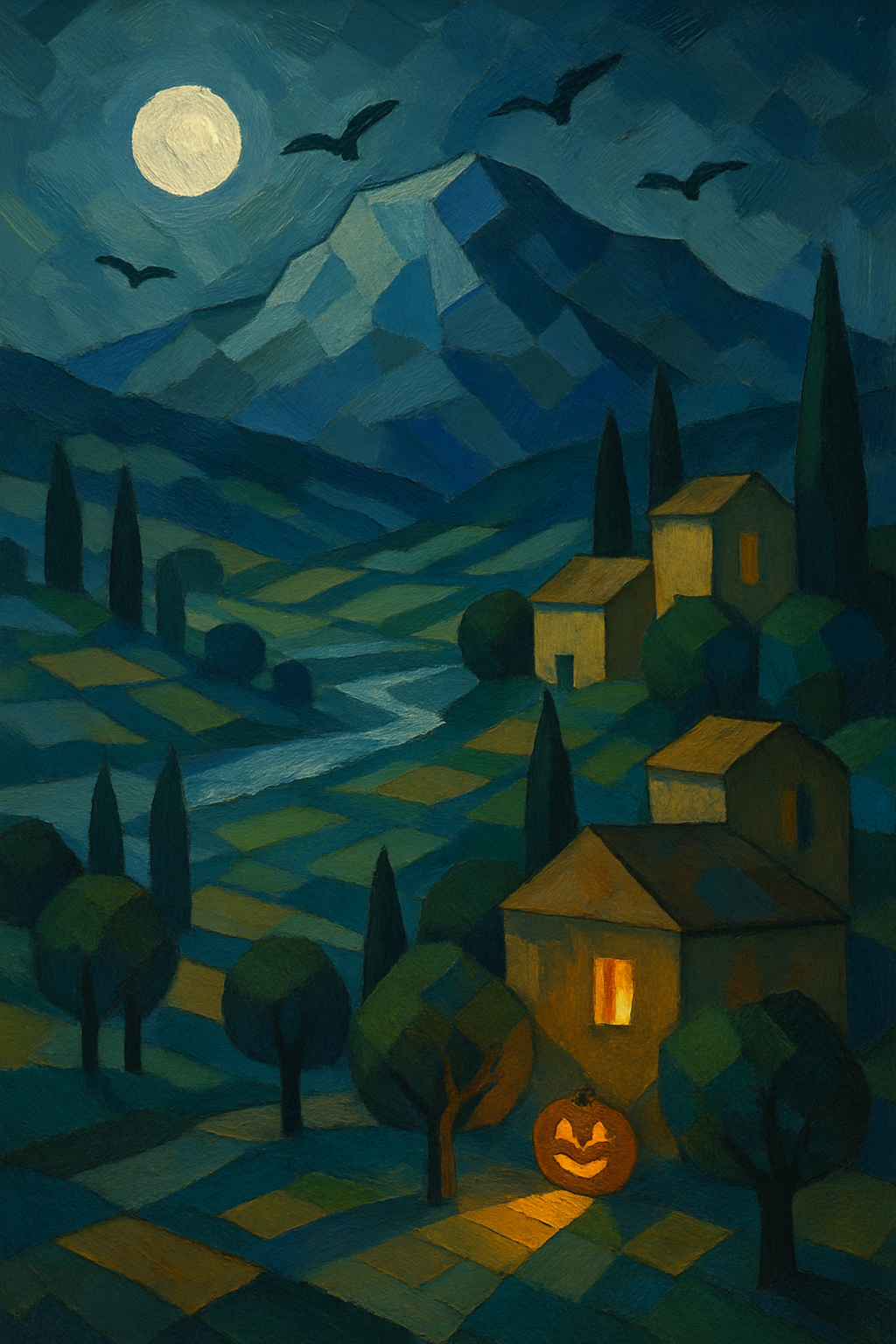
What is his style? Post-Impressionist. Think “constructive brushstrokes”: short, angled patches of color that stack like little bricks. He used cool blues and greens against warm ochres, simplifying trees, hills, faces — even cakes — into sturdy geometric forms. The result is calm, weighty, and slightly off-kilter in a way that keeps your eye awake. Explore his approach through Musée d’Orsay’s exhibition.
Who taught him? Formally, he studied at the Académie Suisse after moving to Paris, but the strongest “teachers” were the Louvre and his peers (Monet, Pissarro, Renoir). Camille Pissarro in particular was a mentor-friend who encouraged outdoor painting and a lighter palette — vibes you can spot early on. For a broader catalogue context, see MoMA’s artist page.

Does he use any special technique? Yes: those “constructive” strokes. Instead of blending to smoothness, he laid down discrete patches of color that lock into each other, like facets on a low-poly mountain. He also loved complex still-life setups with subtly tilted tables and oddly balanced plates, siphoning drama out of fruit. Over time he worked wet-over-dry, revisiting canvases for years, letting color do the structural heavy lifting.
Who has he worked with? He wasn’t a collab guy; he was an orbit guy. He exhibited with Impressionists and traded critiques with Pissarro, Renoir, Monet, and Degas, but the studio was his dojo. His “collaboration” is easiest to see in reverse: the generations after him (Picasso, Braque, Matisse) sparred with his ideas and built upon them.
Was he wealthy? Comfortable enough to paint stubbornly. His father was a banker; an inheritance later in life gave Cézanne the freedom to pursue his vision without chasing quick sales or pleasing the salon jury. That cushion let him be patient — and patience is baked into his canvases.

When was he most popular? The late 1890s–early 1900s saw recognition catch up with his innovations, culminating in the landmark 1907 retrospective (posthumous) that detonated across young Paris. That show lit the fuse for Cubism. For a taste of the impact of his late works, peek at The Courtauld’s “The Card Players” highlight.
Tell me more, please. Pick any theme and he’ll turn it into a weightlifting routine for form:
- Still lifes: Apples that feel like they have a gravitational field. Bottles that lean just enough to make you lean back.
- Landscapes: A certain Provençal mountain becomes a lifetime sparring partner, shifting with light and weather, reduced to majestic planes.
- Bathers: Human forms simplified into architecture, bodies as volumes, space as a gentle puzzle.
Anything else left to tell? His reputation grew steadily among artists long before the public got it. Collectors like the Barnes assembled troves because even “quiet” Cézanne radiates authority. Take a stroll through holdings via The Barnes Foundation’s collection entry.
Any other interesting tidbits?
- He often painted from life but aimed for permanence, not a snapshot.
- He could be gruff and shy, but his canvases are surprisingly tender to time — like they’re listening as much as looking.
- He loved repetition. Not copy-paste, but iteration: paint, rethink, repaint, refine.
Art Prompt (Post-Impressionism):
A moonlit Provençal landscape built from faceted color planes: silvery-blue mountain mass rising behind terraced orchards; cypress and stone farmhouses simplified into sturdy geometric blocks; brushstrokes laid like masonry, cool blues and greens countered by warm ochres; a river of mist threading the valley; jack-o’-lantern glow tucked among trees, casting amber wedges of light; bats skimming the sky in small arcs; perspective slightly tilted so slopes feel alive; atmosphere crisp, lanterns tremble, and the night hums with quiet, Halloween-soft suspense.
Video Prompt:
Nightfall over a faceted hill country: start with a slow push-in over terraced orchards as blocky brushstrokes assemble in real time; lantern lights blink on like embers, casting shifting amber wedges across cool blue-green planes; gentle parallax of trees and rooftops as the camera drifts, then rises to reveal a silvery mountain; mist curls through valleys, bats arc briefly across the moon; strokes bloom and settle with each beat, edges pulse from soft to crisp, and the final moment holds on the lantern glow warming the cool geometry of the night.
Songs to pair with the vibe:
- Heads Will Roll — Yeah Yeah Yeahs
- Wicked Game — Chris Isaak

Friday Night Laughs Mini
- Why did the ghost go to art school? To learn transparency!
- What do you call a stylish skeleton? A grim-setter.
- Why did the vampire refuse abstract art? Not enough body.
- How do pumpkins critique paintings? They give gourd reviews.
- What’s a witch’s favorite museum wing? The broom-impressionist gallery.
If this gave you fresh eyes for apples and mountains, follow for more episodes and drop a comment with your favorite Cézanne moment or a piece you want covered next. Your notes shape the next brushstrokes.