Before we begin, if you are just joining this exploration of the world’s religions, the introduction to the full series lives here: https://medium.com/@DaveLumAI/the-modern-religion-series-many-paths-one-curious-human-7b55eca82f4e
Christianity centers on the life and teachings of Jesus Christ and has become one of the most historically influential religions in the world. It is diverse in expression, global in presence, and rooted in texts that have shaped art, law, philosophy, music, and daily life for nearly two millennia.
Let’s walk through it with curiosity and clarity.
When was it founded and by whom?
Christianity emerged in the 1st century CE in Roman-occupied Judea. It began with the life and ministry of Jesus of Nazareth and continued through the teachings of his earliest followers, particularly the apostles.
A foundational text states:
“For God so loved the world, that he gave his only begotten Son, that whosoever believeth in him should not perish, but have everlasting life.” — The Holy Bible, King James Version, John 3:16 (1611)
The earliest Christian communities formed shortly after the death of Jesus, traditionally dated around 30–33 CE. Over the next several centuries, Christianity spread throughout the Roman Empire and beyond.
Is it growing or shrinking?
Globally, Christianity remains one of the largest religions in the world. Growth patterns vary by region. In parts of Africa, Asia, and Latin America, it is growing in numbers. In some areas of Europe and North America, formal affiliation has declined.
Is “popularity” the same as number of adherents? Not necessarily. Numbers reflect demographic trends. Popularity can reflect cultural engagement, influence, or social visibility. Those are related, but not identical, measures.
What are the tenets?
Core Christian beliefs vary by denomination, but several principles are widely shared:
- Belief in one God.
- Belief in Jesus Christ as central to salvation.
- The authority of the Bible.
- The importance of love, forgiveness, and moral living.
- The concept of grace.
From one of the earliest Christian creeds:
“We believe in one God, the Father Almighty, Maker of heaven and earth…” — The Nicene Creed, 325 CE (Council of Nicaea)
And from the New Testament:
“A new commandment I give unto you, That ye love one another; as I have loved you…” — The Holy Bible, King James Version, John 13:34 (1611)
How has Christianity benefited individuals?
Many believers describe:
- A sense of meaning and purpose.
- Moral framework and guidance.
- Community and belonging.
- Hope in suffering.
- Structured spiritual practice (prayer, worship, reflection).
Historically, Christian spiritual writings — from Augustine’s Confessions (c. 397–400 CE) to later devotional works — have influenced personal reflection and introspection across cultures.
How has it benefited families?
In many Christian traditions, family life is emphasized as a foundational social unit. Teachings on mutual care, fidelity, and forgiveness have shaped household structures across centuries.
From the New Testament:
“And be ye kind one to another, tenderhearted, forgiving one another…” — The Holy Bible, King James Version, Ephesians 4:32 (1611)
What benefits has it created in society?
Historically, Christianity has been associated with:
- The establishment of hospitals and charitable institutions.
- The development of universities in medieval Europe.
- Large bodies of sacred music, architecture, and literature.
- Social reform movements influenced by Christian ethics.
Many cathedrals, universities, and relief organizations trace their origins to Christian institutions.
Official resources and primary documents can be found at: https://www.vatican.va
How has it benefited the human race?
From an intellectual standpoint, Christianity has influenced:
- Western legal systems.
- Philosophical discussions about human dignity.
- The development of human rights language in some historical contexts.
The concept of inherent human worth has been a recurring theme in Christian theological writing.
How has it benefited all living things?
Some Christian traditions emphasize stewardship of creation. For example:
“And God saw every thing that he had made, and, behold, it was very good.” — The Holy Bible, King James Version, Genesis 1:31 (1611)
This verse has been interpreted in various traditions as grounding care for the natural world.
How has it benefited the physical universe?
Theologically, Christianity often presents the universe as purposeful and created. Historically, many early scientists in Europe operated within a Christian worldview that assumed an orderly cosmos, encouraging investigation.
How has it benefited man spiritually?
For believers, Christianity offers:
- A path of reconciliation with God.
- Structured spiritual disciplines.
- A narrative of redemption.
From the Gospel of Matthew:
“Blessed are the pure in heart: for they shall see God.” — The Holy Bible, King James Version, Matthew 5:8 (1611)
How does Christianity portray God?
Christianity teaches belief in one God, often understood in Trinitarian form: Father, Son, and Holy Spirit. The divine is described as both transcendent and personal.
“God is love.” — The Holy Bible, King James Version, 1 John 4:8 (1611)
What conflict has resulted?
Christian history includes theological debates, denominational divisions, and entanglements with political power. Differences in doctrine, authority, and interpretation have shaped history in significant ways.
Has it undergone persecution?
Yes. Early Christians were persecuted within the Roman Empire. Later in history, Christian communities in various regions have also faced persecution depending on political context.
Persecution and conflict are part of the historical record and vary widely by era and geography.
Famous works of art
Christianity has inspired an enormous body of art:
- Michelangelo’s Sistine Chapel ceiling (1508–1512).
- Leonardo da Vinci’s The Last Supper (c. 1495–1498).
- Johann Sebastian Bach’s St Matthew Passion (1727).
- Dante Alighieri’s Divine Comedy (c. 1308–1320).
Its artistic footprint spans architecture, painting, music, literature, and film.
Interesting tidbits
- Christianity spread primarily through local communities before becoming legally recognized in the Roman Empire in 313 CE (Edict of Milan).
- The Bible has been translated into thousands of languages.
- Christianity contains numerous denominations, including Catholic, Orthodox, and Protestant traditions, each with distinctive governance and theological emphases.
Christianity is not a single cultural expression but a global family of traditions that have developed across continents and centuries.
If this sparked a thought, a question, or a respectful disagreement, leave a comment. Follow along as we continue exploring the many paths humanity has taken in its search for meaning.
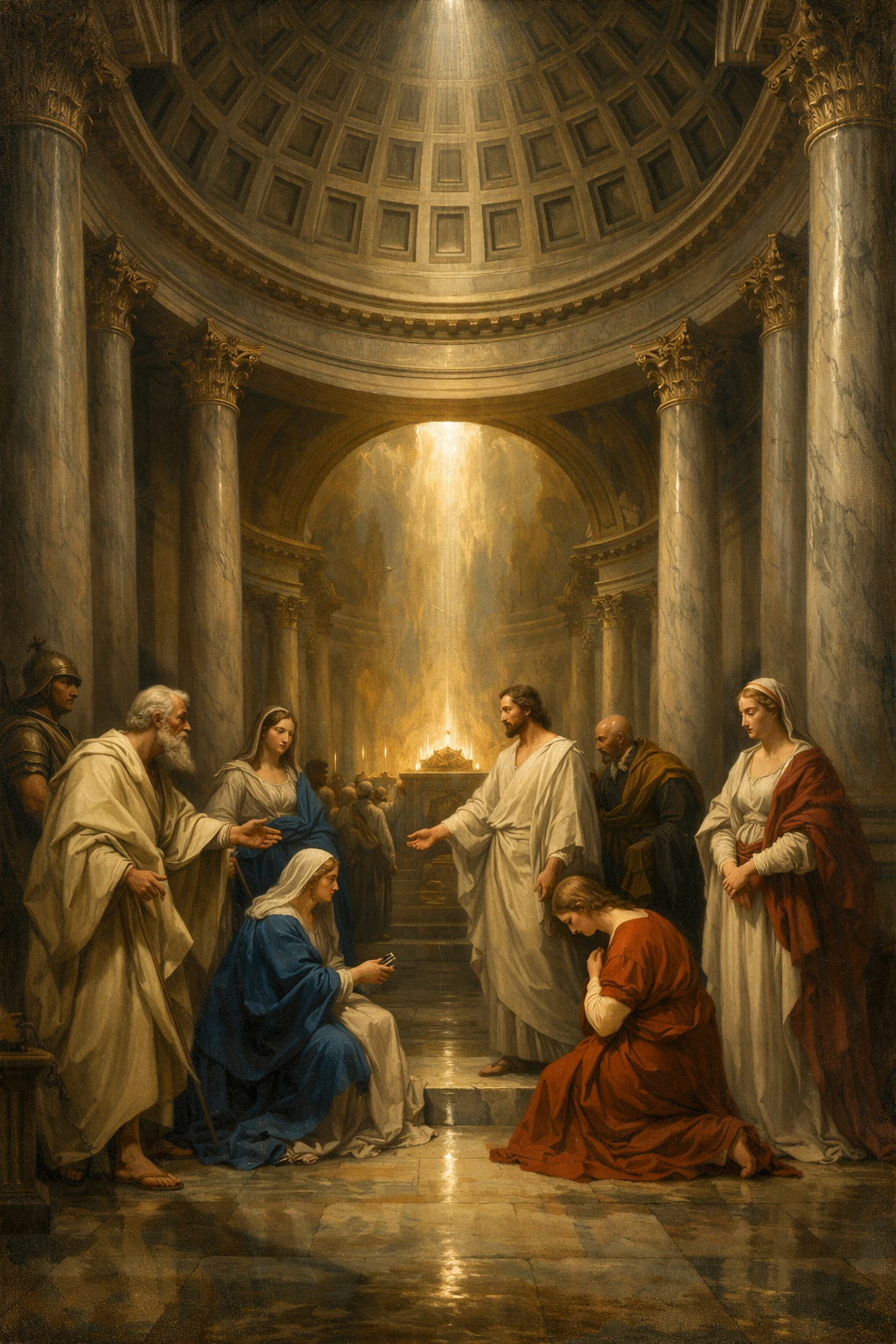
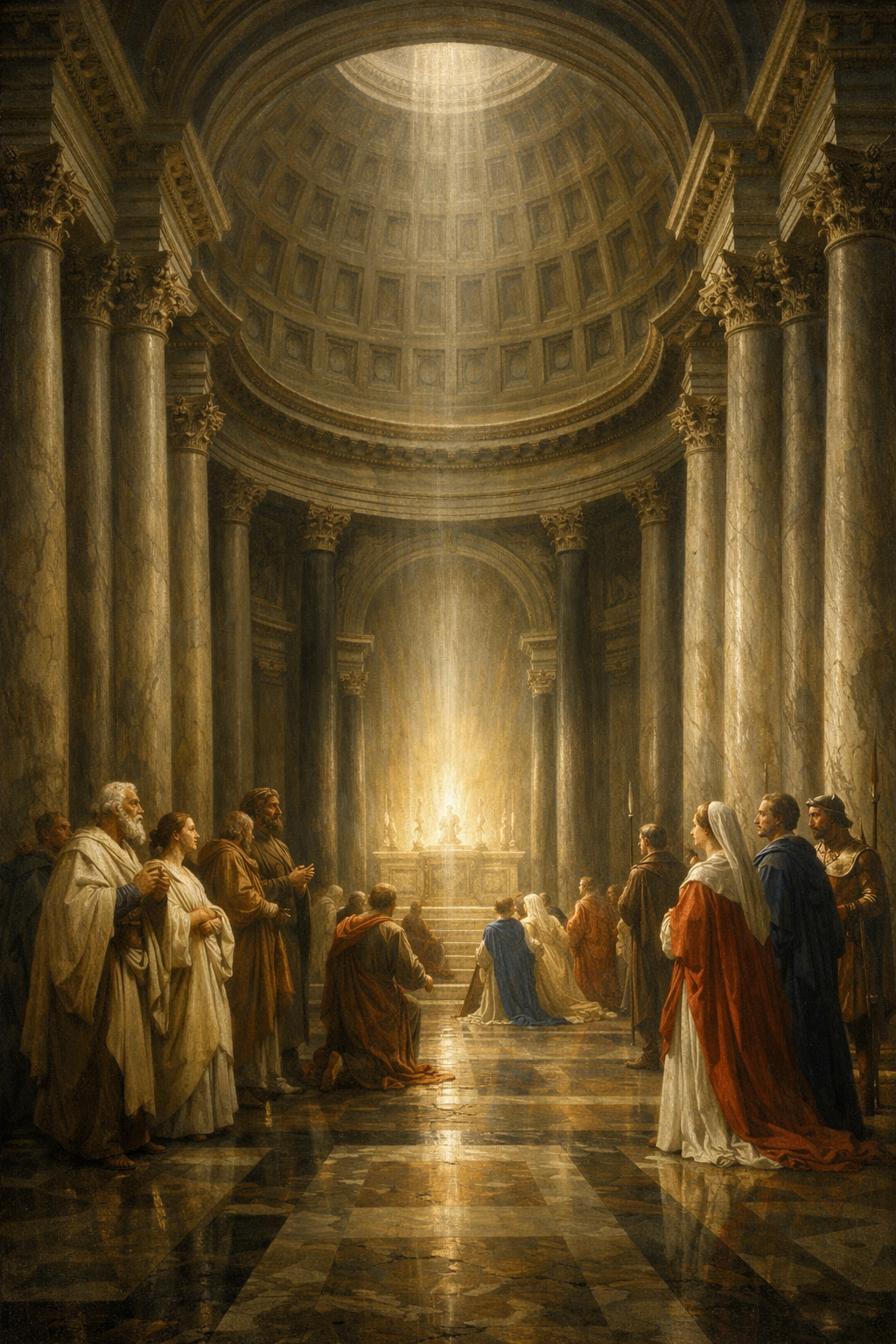
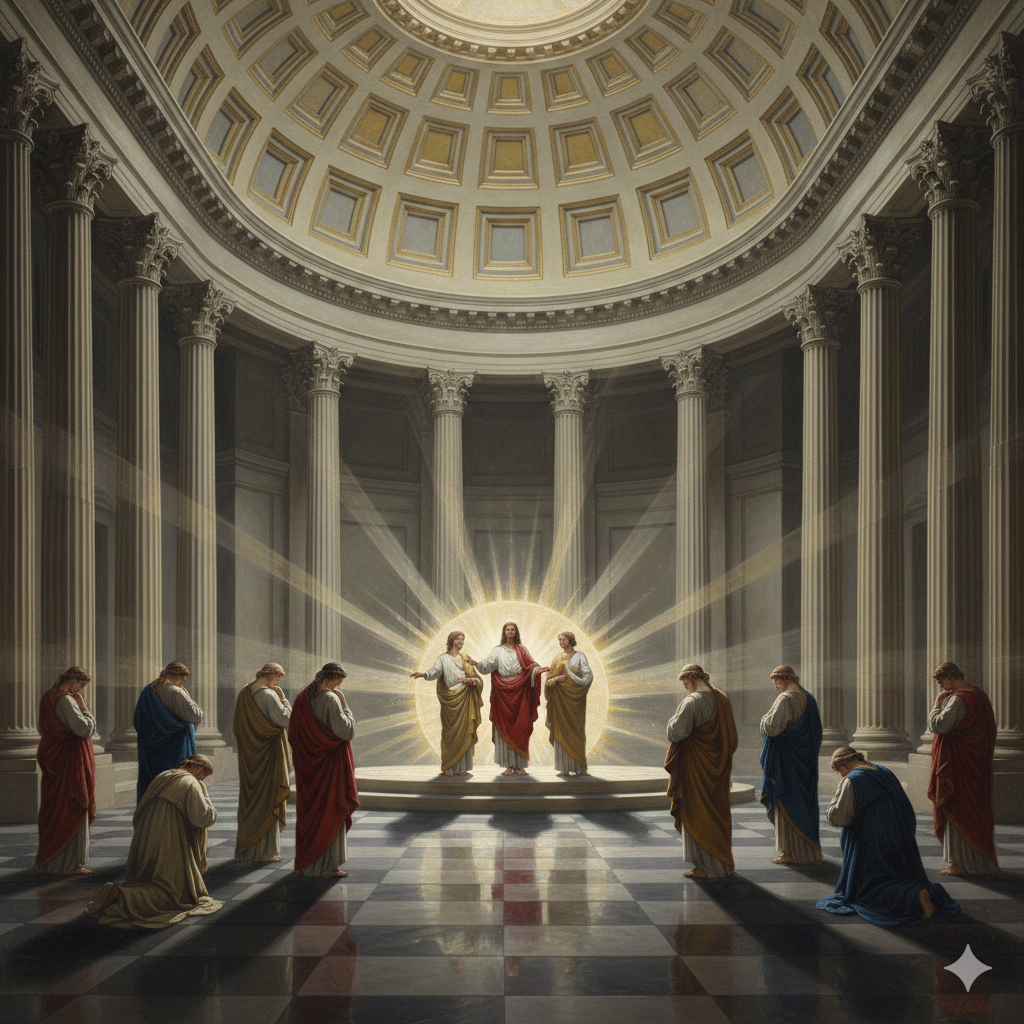
Art Prompt (Neoclassicism)
A dramatic oil painting set within a vast architectural interior framed by towering marble columns and a coffered dome overhead. The composition is balanced and symmetrical, with strong linear perspective guiding the eye toward a luminous central focal point. Figures are arranged in poised, statuesque postures, their garments flowing in sculptural folds of muted ivory, deep ultramarine, and restrained crimson. The lighting is crisp and directional, carving sharp highlights across polished stone and casting deliberate shadows that heighten emotional gravity. Skin tones are rendered with smooth, refined brushwork, while the background architecture glows in pale gold and soft gray. The overall mood is solemn, dignified, and contemplative, evoking moral seriousness and classical restraint.
Video Prompt:
Begin with a slow cinematic dolly-in through towering marble columns beneath a grand domed ceiling. Light streams dramatically from above, catching floating dust motes. Statuesque figures shift subtly, garments rippling as if stirred by a quiet current of air. The camera glides in symmetrical arcs, revealing sculptural folds and precise geometry. Shadows lengthen across polished stone floors. Add gentle, rhythmic camera pulses timed with a swelling orchestral score. End with a radiant overhead shot that pulls upward, revealing the full architectural symmetry in a breathtaking final frame.
Song Pairing for the Video
- Experience — Ludovico Einaudi
- Lux Aeterna — Clint Mansell
Follow for the next episode. Comment with what surprised you most about this one.