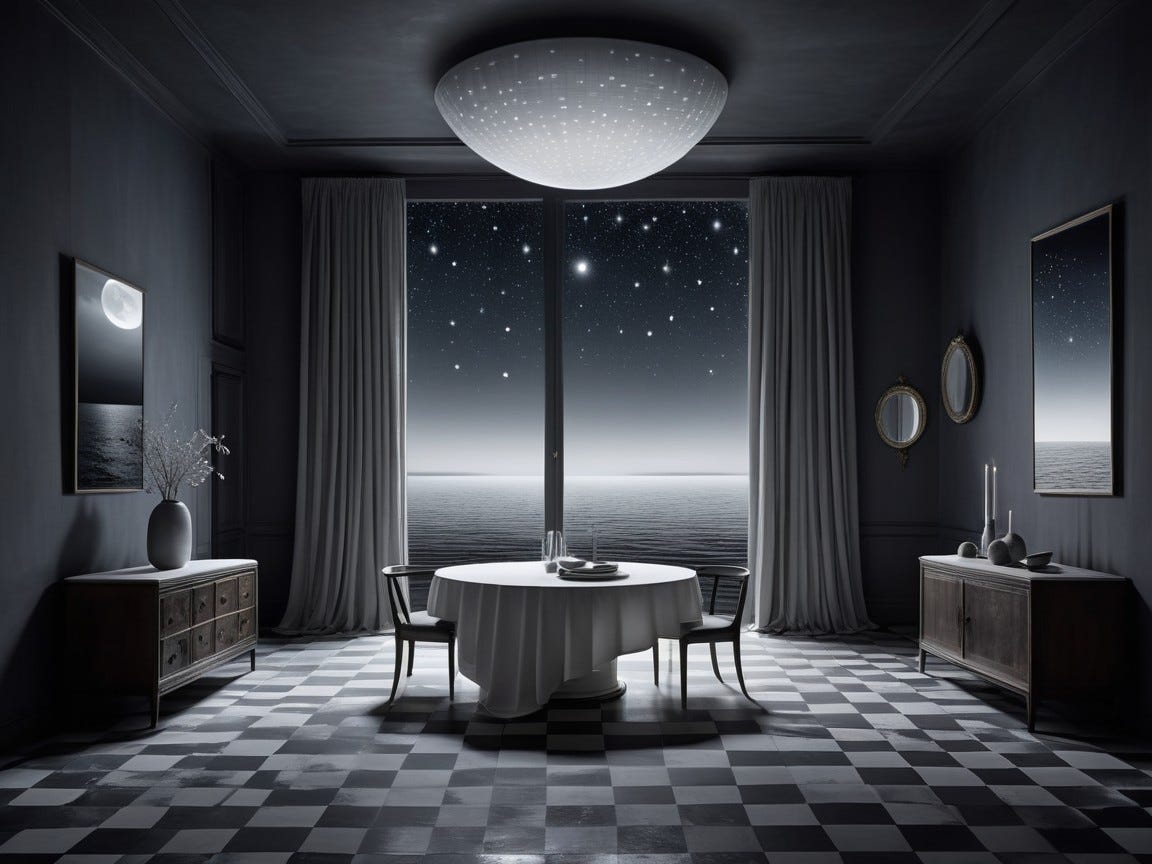

Paul Éluard didn’t just write poems — he slipped secret passwords into people’s pockets. Born Eugène Émile Paul Grindel in 1895, he helped invent Surrealism’s voice, then turned that voice into a bullhorn for resistance. If the movement had dream mechanics, Éluard was the guy who left the escape hatch open.
Who is this artist? A French poet and pillar of Surrealism. He was there for the wild early years with André Breton and Max Ernst, and later became a conscience for occupied France.
What is he known for? Two big peaks: Surrealist love-and-dream lyrics that made the subconscious feel like a furnished apartment, and “Liberté,” a resistance poem that became morale-boosting contraband during World War II.
What is his style? Intimate, lucid, and dream-bright. He fused clear, simple language with oneiric leaps — love poems where doors open onto sky, and ordinary nouns quietly disobey gravity. His landmark book Capitale de la douleur paired tenderness with vertigo, a blueprint for elegant delirium.
Who taught him? No single master. He read deeply (Apollinaire and beyond), found his tribe in the Surrealists, and sharpened his craft in that combustible lab of Breton, Ernst, Aragon, Tzara & co. Think less “pupil and teacher,” more steel meeting flint.

Does he use any special technique? Surrealist methods galore: associative leaps, image juxtapositions, and collaborative experiments (including exquisite corpses and book-objects with artists). He often wrote in deceptively plain diction, making the strange land softly.
Who has he worked with? Plenty of art-world Avengers:
- Max Ernst (illustrated collaborations like Les Malheurs des immortels)
- Man Ray (photo-text projects; see Facile, inspired by Nusch Éluard)
- Pablo Picasso (friendship & mutual admiration)
- And he once married Gala, who later became Salvador Dalí’s muse. The Surrealists kept it… complicated.
Was he wealthy? Not particularly. He had periods of relative stability thanks to family support and publishing success, but he was a working poet, not a tycoon. Fame brought influence more than fortune.
When was he most popular? Mid-1920s with Capitale de la douleur (1926) cemented his Surrealist stature; early–mid 1940s his wartime poetry (especially “Liberté”) made him a public voice far beyond the art crowd.

Tell me more, please
- Nusch Éluard, his second wife, was a crucial muse — appearing in Man Ray’s photos and haunting Éluard’s verse with calm electricity.
- He joined, left, and rejoined the French Communist Party as political winds and personal ethics shifted; the constant was his anti-fascist conviction.
- His clarity is his stealth: lines look simple on the surface, but the metaphors unfold like pocket universes. He could pivot from intimate love lyric to public hymn without losing his timbre.
Anything else left to tell? Yes: “Liberté” wasn’t just printed — it was air-dropped as leaflets over occupied territory. Imagine your poem parachuting into history.
Any other interesting tidbits?
- His pen name “Éluard” came from his grandmother’s surname.
- He loved collaborative “livres d’artiste,” where poems and images tango on equal footing.
- He died in 1952; thousands attended his funeral — poetry as public ritual, not private whisper.

Art Prompt (Surrealist Collage):
A moonlit interior dissolves into an open seascape: long, velum-thin curtains breathe toward a horizon stitched with faint constellations; a white table floats slightly above a checkered floor, casting two shadows that refuse to intersect; paper feathers drift upward like reversed snowfall; a porcelain key lies half-submerged in a bowl of midnight; use cool grays, pale cerulean, and soft bone-white, with gentle, matte textures and quiet, balanced asymmetry; the atmosphere is serene, weightless, and slightly impossible.
Video Prompt:
Start on the checkered floor as its tiles ripple like water; tilt up to curtains that inhale and exhale, revealing the seascape beyond; slow push toward the levitating table while paper feathers rise in gentle spirals; cut to a close-up of the porcelain key rocking in a dark bowl, sending tiny concentric waves; final pullback merges room and coast into one continuous space; loop seamlessly by letting the curtains close and reopen to the first frame.
Song pairings for the edit (fresh picks):
- “Le temps de l’amour” — Françoise Hardy
- “Heroes” — David Bowie

Follow for more sly art history deep-dives and oddball prompts, and drop your favorite Éluard line in the comments — let’s crowdsource a tiny museum of dream-sentences. Want more of my work? Peek at my profile and say hi.