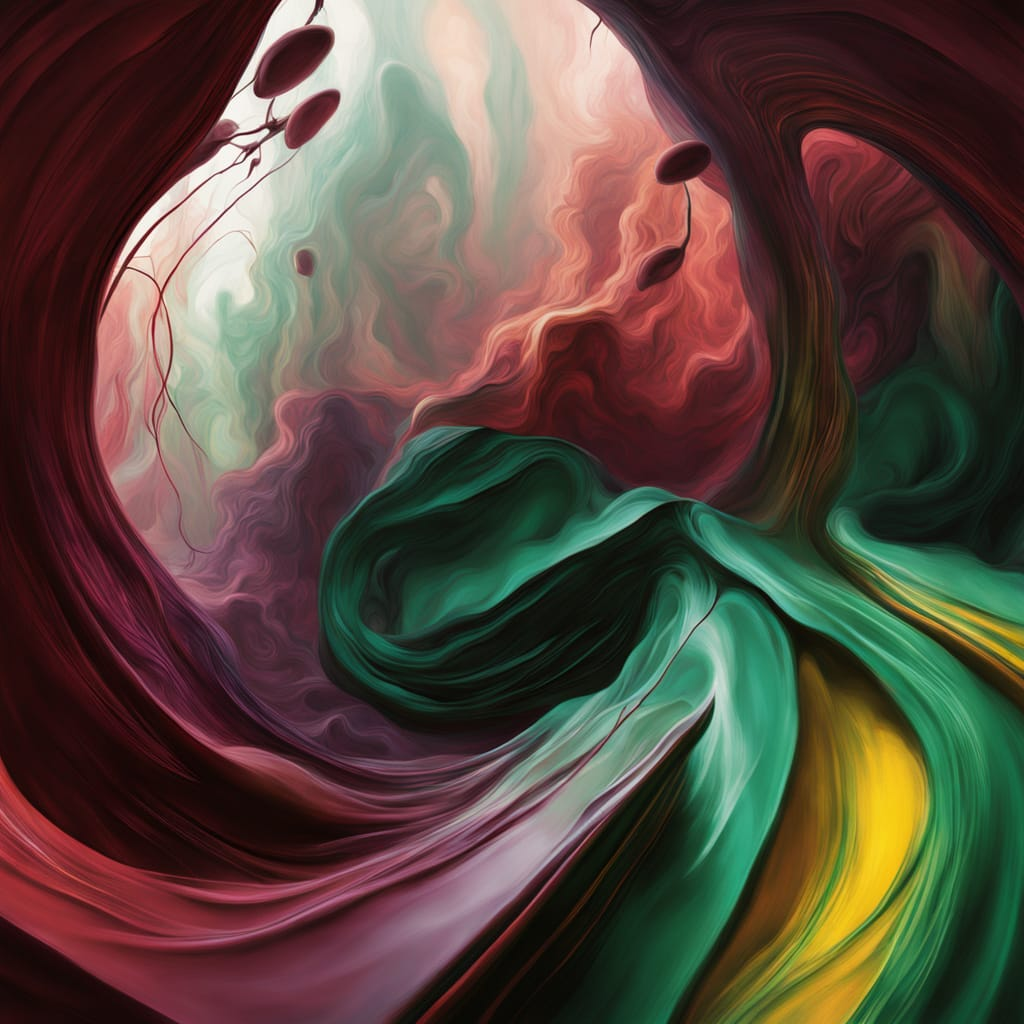

If Dalí painted dreams, Roberto Matta drafted the blueprints. Chilean-born, architect-trained, and Surrealist-certified, he turned inner weather into “inscapes” — vast psychic terrains where forms sprout, tunnel, splinter, and argue about physics. One look at The Vertigo of Eros (MoMA) and you can practically hear the space-time warranty voiding itself.
Who is this artist? Roberto Sebastián Matta Echaurren (1911–2002), a Santiago native who studied architecture before hopping to Paris, where he absorbed modernism at ground zero and slid into Surrealism like it was home base. The Art Institute of Chicago notes he worked in Le Corbusier’s studio — yes, that Le Corbusier — which helps explain the “cosmic architecture” vibe in works like The Earth Is a Man (Art Institute of Chicago).

What is he known for? Inscapes: imaginary interiors of the mind, mapped as sprawling, multi-dimensional landscapes. When you see him fold biomorphic figures into wormhole corridors and elastic horizons, you’re in Matta country. The Guggenheim’s Venice collection nails the arc — architect schooled, Paris in the 1930s, and then world-making painter whose influence ripples through mid-century art (Guggenheim Venice bio).
What is his style? Surrealism with jet fuel. He blends abstraction and figuration into panoramic interiors where color fields behave like weather fronts and line behaves like electricity. Think biomorphic forms, atmospheric gradients, and perspectives that keep changing their mind. For a crisp overview, see The Art Story profile.
Who taught him? Formally: architecture school in Santiago; professionally: a front-row seat in Le Corbusier’s studio (see the AIC artist page). Artistically, André Breton encouraged him in Paris — if Surrealism were a circus, Breton was ringmaster and Matta was the guy who added an extra dimension to the tent.

Does he use any special technique? Automatism as motor, plus architect’s draftsmanship as steering. He often built space with sweeping lines, airbrush-like gradients, and layered stains to make atmospheres you could fall into. MoMA sums it up with the “inscape” idea — projecting the psyche into sprawl (MoMA work page).
Who has he worked with? “Worked with” in Surrealism often means “collided with in orbit.” He moved among Breton, Dalí, and company; later, in wartime New York, he cross-pollinated with the younger crowd — Robert Motherwell, Arshile Gorky, Jackson Pollock — during a crucial stylistic hand-off from Surrealism to Abstract Expressionism (compact context via The Art Story).
Was he wealthy? He wasn’t a finance-mogul painter, but he wasn’t on a starving-artist diet either. Recognition came with awards and retrospectives, especially later in life — Chile’s National Prize for Art in 1990 and the Praemium Imperiale in 1995 signal major esteem (Prince/Princess of Asturias Foundation).
When was he most popular? Late 1930s–1950s: Paris years, New York exile years, and postwar expansion — prime time for the inscape project. Those decades cemented his influence on the Abstract Expressionists and on anyone who’s ever tried to paint what thinking feels like.

Tell me more, please Matta’s path shows how architecture can mutate into painting: plans become planets, sections become wormholes, and structural axonometrics morph into inner topographies. His worlds are navigable, but not politely so. You encounter junctions where cause and effect share a latte, then split the check six ways. If Surrealism opened doors to the unconscious, Matta diagrammed the electrical system, the HVAC, and the emergency exits.
Anything else left to tell? He didn’t just make pictures; he made languages. Those airy, tubular forms aren’t props — they’re grammar. His lines articulate action; his colors conduct mood. No wonder later painters found his canvases less like pictures and more like operating manuals for postwar emotion.
Any other interesting tidbits? Breton eventually expelled him from the Surrealist group after drama in the late 1940s, but by then Matta was already a continental bridge between movements. Also: once you see his “space of mind” idea, you start spotting it everywhere — from sci-fi concept art to any blockbuster where reality bends on cue.

Want to see more art in this spirit? Wander the Surrealism corner of the gallery and dream up your own inscapes at the LumAIere Surrealism Gallery. For more essays and updates, follow @DaveLumAI.
Tell me what you see in Matta’s worlds. Do those tunnels feel cosmic or personal? Drop a comment with your hot take, and hit follow so you don’t miss the next episode’s brain-gymnastics.
Art Prompt (biomorphic surrealism): A vast interior landscape stretches like a living observatory, where ribbed tunnels arc into a crimson-and-emerald horizon; glossy, tubular forms hover and splice, their edges airbrushed into mist, while perspective lines dive into a central whirlpool of light; floating membranes, needle-thin filaments, and fracture-like seams imply motion inside stillness; the palette hums with deep carmine, viridian, sulfuric yellows, and black-violet shadows; the mood is tense yet curious — an engineered psyche where gravity negotiates and space behaves like thought.
Video Prompt: Start with a slow dolly through a biomorphic interior: ribbed tunnels yawning open, tubular forms rotating gently; add drifting particulate and subtle lens breathing; ramp into a parallax fly-through as crimson and emerald gradients pulse, membranes flex, and filaments resonate to low-frequency rumbles; punctuate with quick rack-focus reveals of fracture-lines, then spiral into a luminous vortex that blooms and fades; keep motion silky and weightless, as if the camera is a thought gliding through architecture.
Video soundtrack picks for this episode’s vibe:
- Loom — Ólafur Arnalds & Bonobo
- Signals — Rival Consoles
New, atmospheric, and perfectly matched to the drift and pulse of Matta’s cosmic spaces.

Questions Recap — Rapid-Fire Answers: He’s a Chilean Surrealist who bridged to Abstract Expressionism; famous for inscapes; style = biomorphic, multi-dimensional space; architecture school + Le Corbusier shop-floor; techniques include automatism, airbrush-like gradients, layered stains; collaborated within Surrealist circles and influenced the New York School; not fabulously rich but highly decorated later; peak visibility mid-century; still a lodestar for anyone painting the inside of consciousness.