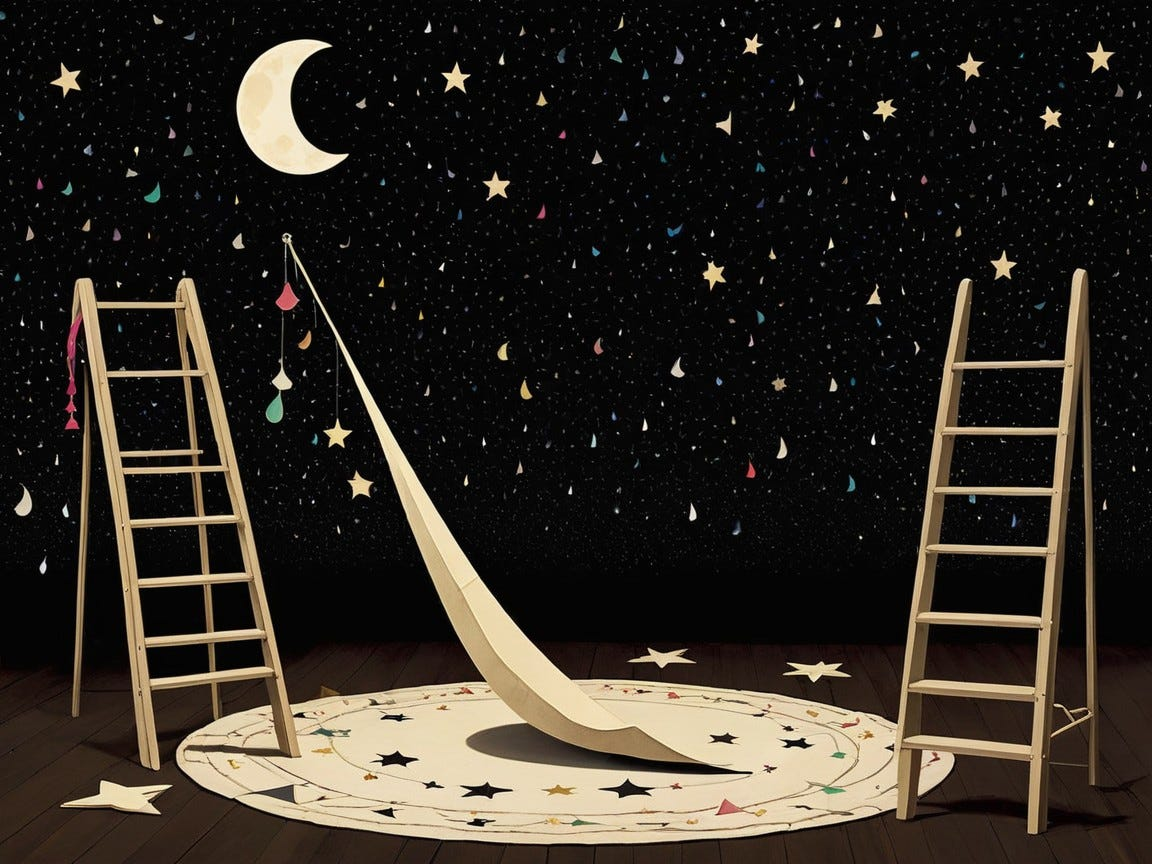

Joan Miró did not paint pictures so much as he invented a personal alphabet and then taught it how to dance. Born in Barcelona in 1893 and long faithful to Catalonia’s colors and symbols, he moved between Mont-roig, Paris, and later Mallorca, building a language of signs — eyes, stars, ladders, moons — that feels childlike until it suddenly winks and starts talking philosophy. If you like art that’s playful on the surface and quietly revolutionary underneath, welcome to Miró-land: primary colors, floating shapes, and the smug grin of a dot that knows it’s actually a planet.
Let’s answer everything you ever wanted to know (and a bit you didn’t know you wanted) about this biomorphic ringmaster.
Miró is the Catalan modernist who turned reduction into revelation. He’s best known for a soaring mix of abstraction and pictographic symbols — spidery lines, buoyant blobs, and crisp constellations of red, blue, yellow, and black — that make you feel as if gravity took a coffee break. Prime examples are gathered at Fundació Joan Miró in Barcelona, across the Atlantic at MoMA’s collection page (peek at “The Hunter (Catalan Landscape)” if you want a single image that explains “Miró-ness”), and in elegant surveys from the Guggenheim. Those symbols didn’t arrive by accident; Miró worked like a monk of mischief, stripping forms to their essence until a dot could carry more poetry than a paragraph.

Style? Critics put him under the Surrealist umbrella, but Miró’s true genre is closer to cosmic doodling with scholarly intent. He signed the Surrealist visitor log in 1920s Paris and embraced automatism — letting the hand move first, the mind second. Yet the results aren’t just subconscious soup; they’re composed like haiku, with airy fields (often raw canvas or flat grounds) punctuated by carefully placed signals. The Tate’s artist page nails how those “simple” lines and colors are anything but simple once you notice their balance and tension.
Who taught him? The short story: La Llotja (Barcelona’s art school) and the Cercle Artístic de Sant Lluc. The long story: Catalan Romanesque frescoes, French avant-gardes, and Spanish folk art all took turns teaching him. A proper, boots-on-the-ground bio comes from the museum that knows him best, the Fundació Joan Miró, which maps his orbit from Mont-roig to Paris to New York and Japan.
Special techniques?
- Automatism: loosen the grip, follow the line, discover the image.
- Material play: beyond painting, he made prints, ceramics, and sculpture with the curiosity of a crow in a jewelry shop — see the printmaking deep-dive via MoMA’s “Miró Prints and Books”.
- Ceramics collaboration: a lifelong dialogue with Josep Llorens Artigas yielded monumental murals and kiln-borne galaxies; the partnership is documented by the Guggenheim.
- Economy of means: thin lines, flat grounds, high-contrast color; the silence around the mark is part of the music.

Who did he work with? He didn’t “assist” the Surrealists; he sparred and sang alongside them — Breton admired him, poets inspired him, and craftspeople enabled him. With Artigas he made fire behave, and with printers and editors he built books where words and images share a hammock.
Was he wealthy? When was he most popular? Miró wasn’t a rich boy artist; he earned his status over decades of relentless reinvention. By the 1940s–1970s he was firmly canonical — wartime moves, New York exposure, and later monumental commissions pushed him from wunderkind to global fixture. If you want the institutional timeline receipts, scan MoMA’s historical exhibitions — he had a major show as early as 1941 (see the record for that exhibition here) and kept returning in force.
Tell me more! The Reina Sofía holds Miró across moods — from sharp early tensions to expansive late works; browse their artist portal to see how his symbols mutate without losing their DNA (artist page, and for a focused survey, this collection exhibition overview). Meanwhile, the Guggenheim Bilbao recently framed his Paris years as “Absolute Reality,” spotlighting his blend of Dada skepticism with Surrealist dreaming (exhibition synopsis).

Anything else left to tell? Miró’s ladder crops up like a recurring daydream — a promise that you can climb from earth to idea. And just when we think the catalog is closed, science peels back the paint: new imaging has revealed a hidden portrait of his mother beneath a 1920s work, a quiet drama that underscores how his “simple” surfaces often hide complicated beginnings (see recent coverage such as the Guardian’s report on the discovery).
Other interesting tidbits:
- He founded a museum in his own lifetime to nurture experimentation; the Barcelona foundation sits in a luminous building by Josep Lluís Sert and remains a pilgrimage site for color addicts and line whisperers (museum site).
- London got a blockbuster retrospective in the 2010s titled “The Ladder of Escape,” which doubled down on how his signs are pathways, not decorations (archived Tate exhibition page).
- If you crave Miró’s buoyancy translated into motion and merch, I’ve got playful abstractions and pop-bright prints in the Surrealism gallery at LumAIere; the main studio door is always open at lumaiere.com.

If this made you smile (or argue with a dot), follow for more and drop a comment: What’s your favorite Miró era — the earthy Catalan landscapes, the weightless Surrealist signs, or the late monumental works that feel like weather?
Art Prompt (biomorphic abstraction): An airy expanse of warm parchment becomes a stage where a harlequin of signs drifts weightlessly: a crescent moon tilts like a grin, a single watchful eye hovers, a spindly ladder leans toward nowhere, and jittery confetti of triangles and teardrops gathers near the “floor.” Use razor-thin black lines to stitch the scene; anchor it with primary red, ocean blue, and sunflower yellow, with small shocks of emerald and onyx. Keep the background breathable, as if silence were a color. Let curves feel carnival-light while angles buzz like whispered jokes. Aim for playful balance — objects seem casual until you notice they’re exquisitely placed. Mood: festive, surreal, a wink at nightfall.
Video Prompt: Open on a blank, textured field that inhales like paper. A hand-drawn line zips across and splits into a flickering ladder; cut to floating eyes and moon-slices bobbing in rhythm as primary-colored shapes pop into existence with soft plosive sounds. Shapes orbit, trade places, and snap into surprising balance; the camera pushes in slowly, then whip-pans to reveal a new cluster of symbols forming a playful constellation. Add subtle film grain, a barely-there vignette, and micro-jitters on the linework to keep it alive. End with the world exhaling back to quiet parchment as one tiny red dot blinks to black.

Songs to pair with the video:
- Electric Feel — MGMT
- Luna — The Smashing Pumpkins
P.S. For long-form essays and deep dives, the archive lives here. And if you’re tracking the bigger adventure, the monthly behind-the-scenes is over here. Your follows and comments fuel the next experiment — tell me which symbol you’d steal for your personal alphabet.