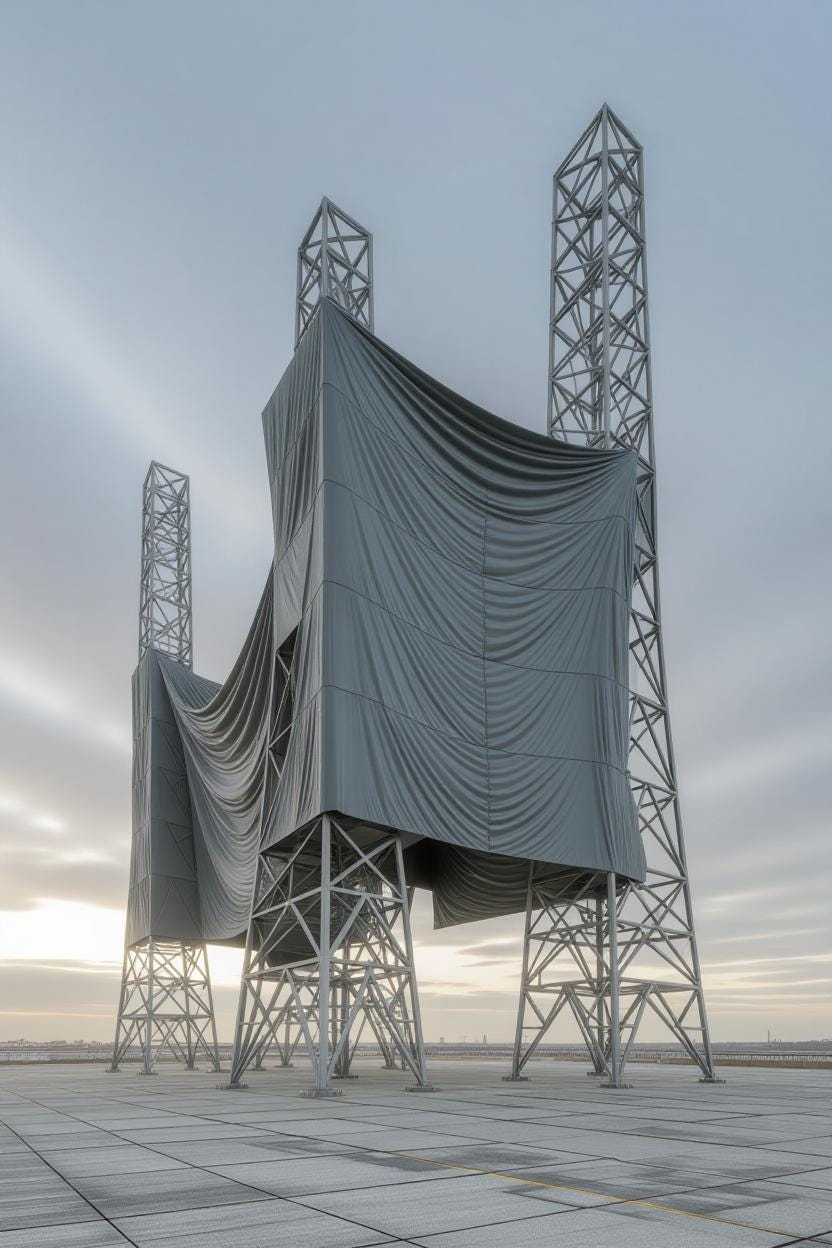

If Surrealism is a fever dream, Kay Sage is the structural engineer who calmly walked in with scaffolding and said, “Let’s give those anxieties a proper skyline.” American-born, Europe-tempered, and precision-obsessed, Sage built melancholic stage sets of the mind: latticed towers, tarpaulin-draped forms, and roads that lead somewhere and nowhere at once. Her worlds look like construction zones for feelings — quiet, eerie, and meticulously planned.
Who is she? An Albany-born painter and poet who slipped past society’s velvet ropes, studied in Italy, and found her way into Surrealism’s inner circles in late-1930s Paris. A great starting point is the AWARE profile, which sketches her trajectory from early Italian years to her decisive turn away from abstraction toward the dream-logic cityscapes that became her signature. For a deeper dive into training and background (wealthy family, classical art education, lots of ocean-crossing), SFMOMA’s essay on Midnight Street gives crisp context on her foundations and craft without the fluff.
What is she known for? The mood. Those imposing scaffolds. Draped, almost-human shapes that refuse to confirm or deny their humanity. Browns, grays, and steel-blues hanging like weather. The Metropolitan Museum’s page for Tomorrow is Never breaks down the Sage toolkit — somber palette, latticework, “trapped” horizons, and drapery that feels like a rumor of a figure. If you want a companion piece from her mid-1940s arc, Princeton’s collection entry on I Saw Three Cities keeps the same haunted urbanism, like blueprints left out in a desert wind.
Her style? Think “metaphysical architecture.” Where her Surrealist peers often splashed biomorphic chaos, Sage tightened the bolts. She stacked verticals against diagonals, stretched shadows across plazas, and draped forms so precisely you could guess the weight of the cloth. Her paintings often read as rehearsals for events that may never happen, in places that may never be finished.

Who taught her? It’s less “who” and more “how.” She trained in classical methods during years in Europe, then absorbed the metaphysical chill of de Chirico and the Surrealist program in Paris. SFMOMA notes her beaux-arts grounding, which explains the disciplined geometry inside the dreams. By the time she joined the Surrealists, she already had the technical grip to make unreality behave.
Special technique? Illusionistic perspective, scaffolded compositions, and draped forms that act like stage props for emotion. The Met’s write-up highlights those signature lattice structures and veiled figures; it’s less a single “trick” than a system — an architectural grammar for dread and distance.
Who did she work with? She was a powerful node in the network, exhibiting and organizing shows, and — crucially — sharing a long, charged creative life with fellow Surrealist Yves Tanguy. The National Museum of Women in the Arts recounts how the two fled Europe, married in 1940, and set up parallel studios in Woodbury, Connecticut, fueling each other’s output while maintaining distinct vocabularies. A solid archival window into her stateside years and exhibition hustle lives at the Smithsonian’s Archives of American Art.
Was she wealthy? Yes — old-New-York money. That meant access to European study, galleries, and the social contours of the avant-garde. But money didn’t buy the mood; her gravitas comes from composition, not pedigree. Again, SFMOMA sketches the backstory cleanly.
When was she most popular? The 1940s–1950s were the peak of visibility and production: New York shows, critical attention, and the mature language of scaffolds and veils falling into place. Tomorrow is Never (1955) is often cited as a late, haunting summit — proof that she could distill an entire weather system into grays and girders.

Tell me more, please. Sage wasn’t just painting; she wrote poetry — cool, flensing, and architectural in its own right. Scholarship notes multiple volumes in the late 1950s and early 1960s, including French-language work like Demain, Monsieur Silber, which mirrors her visual preoccupations with entrapment, angles, and distance (see academic discussions via William & Mary’s repository for recent commentary on those poems).
Anything else left to tell? Her partnership with Tanguy matters — mutual orbit, distinct poles. Curators and galleries have repeatedly paired them to illuminate both overlap and contrast; a recent exhibition recap tracks how their visions conversed while never collapsing into one voice. After Tanguy’s death, Sage’s work quieted and darkened, and her own life ended in tragedy in 1963 — a fact too often used to reduce her to biography. Better to stand before the work and feel how the wind moves through those pylons.
Any other interesting tidbits?
- She helped organize shows that safeguarded and spotlighted European Surrealism stateside during the war years — more impresario than footnote.
- If you want to see how the “architectural Surrealist” thread runs through her career, search museum databases for mid-40s works and note the consistent spatial grammar — the boards, tarps, trusses, and the horizon forever just out of reach.

Craving more visual rabbit holes (with a dash of AI-made eye candy)? Wander the Surrealism galleries on my site — this curated lane is a fun place to start. And if you like this series, you’ll probably enjoy where it’s going — drop a comment with your favorite Sage piece or a question you want answered next, and click follow so the algorithm knows we’re friends.
Art Prompt (surreal minimalism): A deserted expanse under a low, storm-stained sky; skeletal towers rise in strict verticals and diagonals, cross-braced like quiet cathedrals of metal. Vast tarpaulins drape over tall, angular forms, their folds catching a cold, graphite light. The palette is restrained — slate gray, muted umber, distant steel-blue — while the ground stretches in long, ruler-straight perspectives that vanish into a pale horizon. The air feels pressurized and still, as if time has paused mid-construction; shadows are long and crisp, edges exacting, the mood solemn and suspended — precision-dreaming rendered with architectural calm.
Video Prompt: Begin with a slow dolly across a windless plain as skeletal towers enter frame in perfect perspective lines. Pull up into a gentle crane to reveal tarpaulins draped over tall, angular shapes; the fabric breathes subtly, as if the structures are holding their breath. Transition with match cuts between diagonals — beam to beam, shadow to shadow — while the color grade stays in slate gray, muted umber, and steel-blue. Add micro-particles in the air to suggest dust motes in stillness. End on a measured push toward the vanishing point as the light cools a half-stop, leaving the scene poised between building and memory.

Songs to score the mood:
- Drift Dive — The Antlers
- Desert Horse — Melody’s Echo Chamber
If this episode gave you goosebumps shaped like scaffolding, follow for the next one — and tell me in the comments which Sage work you’d want to see in person and why. I read them all, occasionally with a hard hat on.