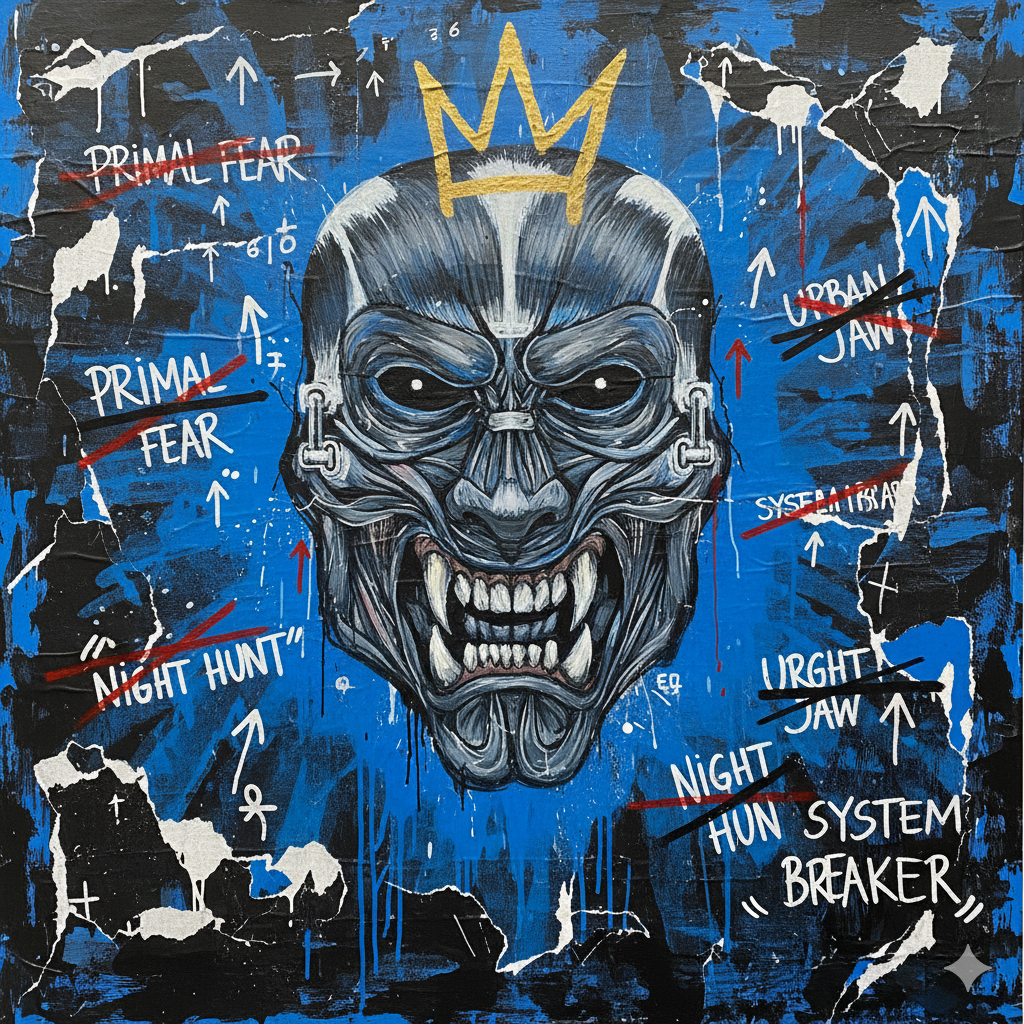

Let’s time-travel to downtown New York when boomboxes were heavy, hair was tall, and gallery openings were somehow both glamorous and sticky. Into this neon thicket rockets Jean-Michel Basquiat: poet with paint, DJ of symbols, and the kid who could turn an anatomy diagram into a thunderclap.
Who is this artist? Brooklyn-born in 1960 to a Haitian father and Puerto Rican mother, Basquiat sprinted from Lower East Side street inscriptions (as SAMO with Al Diaz) to international fame before age 25. His leap from the scene to the spotlight bent the curve of contemporary art itself, and it began in earnest with the 1981 PS1 exhibition New York/New Wave, which supercharged his trajectory and “helped launch his career” according to the museum’s own chronology (MoMA PS1 Archives). A concise bio and timeline live with the artist’s estate at Life & Legacy (basquiat.com).
What is he known for? For detonating the canvas with a mash-up of text and image, street and studio, history and hot-wired present. Signature moves include repeated symbols (hello, three-point crown), boxing stats, saints, griots, jazz references, and that unforgettable practice of writing and then crossing out words so you look harder: “I cross out words so you will see them more; the fact that they are obscured makes you want to read them,” he explained (Whitney, audio-guide note for Hollywood Africans). For a crystal-clear example of his electricity, stroll through Untitled (1981) at The Broad (thebroad.org/art/jean-michel-basquiat/untitled) or the blistering yellow of Hollywood Africans (1983) at the Whitney.

What is his style? Neo-Expressionism with extra octane: urgent brushwork, oilstick scrawl, collage, and layered writing that reads like a verse — half shouted, half whispered. The Whitney summarizes it as a hybrid of text/image, abstraction/figuration, and social commentary punching at power structures (Whitney artist page).
Who taught him? Mostly: curiosity, record stores, city walls, and museums. After a childhood car accident, his mother gave him Gray’s Anatomy, a book he absorbed so deeply he later formed a noise band named Gray — and the medical diagrams echo through his paintings and prints (MoMA artist page, Smarthistory on Horn Players, Christie’s essay). In the gallery world, early champions opened doors and basements: Annina Nosei famously offered him a studio below her gallery and his first New York solo show in 1982 (Deitch Projects archive).

Does he use any special technique? So many. A few greatest hits: • Cross-outs to sharpen attention (Whitney). • Xerox collages — he literally bought a photocopier for the studio — folded into canvases along with paint and oilstick (Nahmad Contemporary “Xerox” exhibition; see materials lists on Broad works like Wicker). • List-poems of names, numbers, and fragments that behave like hooks in a song — because music was baked into his process.
Who has he worked with? Collaboration was practically a second medium. • With Andy Warhol (and often Francesco Clemente) he created tag-team paintings that looked like two radios playing at once — see the overview from The Warhol Museum (lesson page) and the Clemente/Warhol/Basquiat triads via Bruno Bischofberger (collaboration page). • He also produced a hip-hop single, “Beat Bop” by Rammellzee & K-Rob, and drew the cover — MoMA has the whole story (MoMA Magazine).
Was he wealthy? In the 1980s art market — oh yes. By 1985 he was literally the face of “new art, new money,” and his market has since scorched the record books: in 2017, Untitled (1982) sold for $110.5M, a record at the time for an American artist at auction (Sotheby’s press release). He also spent highly productive (and remunerative) stretches working with blue-chip dealers, including a crucial Los Angeles period with Larry Gagosian that recently got a deep-dive exhibition (The Guardian on “Made on Market Street”).
When was he most popular? If you had to circle a bullseye year: 1982. Collectors, curators, and critics often treat it as peak Basquiat output and value (Artsy editorial). The ignition point was 1981’s New York/New Wave (MoMA PS1 Archives), and the mid-80s Warhol collaborations kept him constantly in the conversation (Warhol Museum).

Tell me more, please. Basquiat wasn’t just adding graffiti to canvases; he was composing visual essays. Think of the works as sampling — of textbooks, TV, jazz, colonial history, and boxing — with the mix engineered for maximum friction. René Ricard’s 1981 Artforum essay “The Radiant Child” understood this early and helped canonize him (Artforum archive). Meanwhile, the paintings themselves kept teaching: crowns signal self-sovereignty and reverence for Black heroes, lists act like invocations, and those anatomical cutaways insist that history lives in the body (Whitney, The Broad Untitled (1981)).
Anything else left to tell? He moved fast. In just a decade he left enough fuel to keep museums buzzing for generations (see Whitney’s Hollywood Africans and The Broad’s Basquiat cluster starting with Untitled (1981)). For a solid doorway into the work, I love the compact, image-rich Taschen volume — Jean-Michel Basquiat (Basic Art Series) — it’s the perfect under-arm companion to a museum day.
Any other interesting tidbits?
- He and Warhol collaborated like sparring partners — sometimes literally painting over each other’s moves.
- He treated a photocopier like a printing press and a percussion instrument — see the scholarship around his Xerox works (Nahmad Contemporary).
- His rise from PS1 to blue-chip galleries is one of the wildest “10, 9, liftoff” stories in art history.
If this episode sparked something, tap follow and drop a comment: What’s your favorite Basquiat era — radiant 1981–82, L.A. on Market Street, or the tag-team years with Warhol? And if you want more long-form dives, my writing feed lives here: @DaveLumAI.
Art Prompt (Neo-Expressionism): An urban-night canvas crackles with electric cobalt and asphalt black; a feral, mask-like head dominates the frame, teeth bared, cheekbones hinged open as if diagrammed; chalky oilstick lines map tendons and molars; numbers, arrows, and terse phrases appear, get struck through, and refuse to disappear; a jagged three-point insignia hovers like improvised royalty; paint is scraped, dripped, and reworked over torn paper seams; the whole surface feels hot to the touch — swaggering, feverish, brilliantly unpolished.

Video Prompt: Animate the scene with rapid, handheld push-ins; let lines draw themselves in real time, then flash-cut to words that appear and are immediately crossed out; intercut photocopy textures, paper tears, and paint splatters; sync beats to on-off strobe of a three-point emblem pulsing near the top; add brief, gritty film grain and a hiss of aerosol; end on a hard freeze of the mask-head, then smash-cut to a bold title card for one second.
Two songs that slap with this vibe:
- New Person, Same Old Mistakes — Tame Impala
- Paper Planes — M.I.A.
— If this made your eyeballs happy, follow for the next episode and tell me below what you want to see next — the dots of Kusama, the silkscreens of Rauschenberg, or the razor-clean illusions of Bridget Riley?