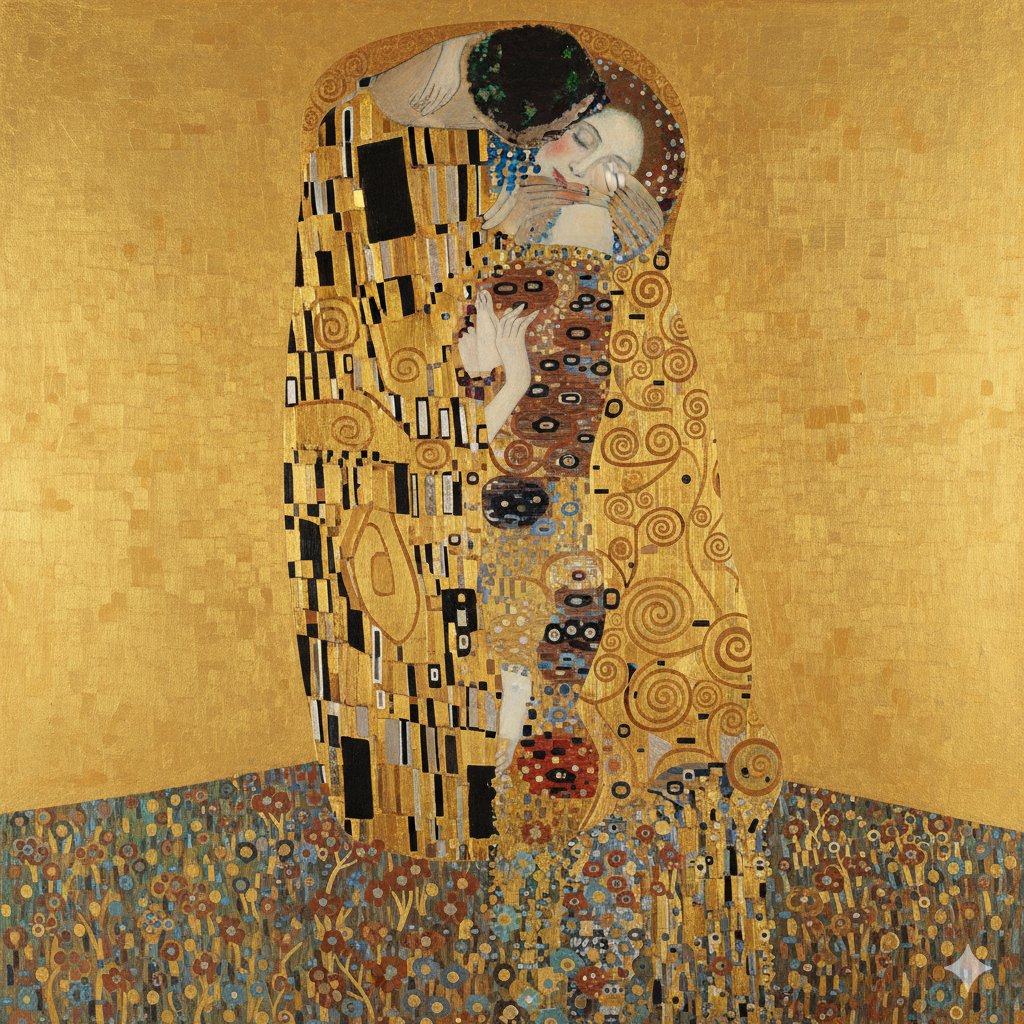

If Vienna 1900 had a soundtrack, it would be a shimmering waltz scored for gold leaf and side-eye. Gustav Klimt (1862–1918) helped conduct that orchestra: co-founder of the Vienna Secession, patron-magnet, and maker of paintings that somehow feel both Byzantine and dangerously modern. Let’s slip past the rope and get close.
Who is this artist? An Austrian symbolist painter born on the outskirts of Vienna, Klimt rose from a modest family to become the city’s most in-demand portraitist and an agent of tasteful chaos. He co-founded the Vienna Secession in 1897 and presided over it through its most radical years, pushing Vienna toward a new aesthetic vocabulary that embraced international currents and a “no manifesto” ethos (overview, bio + timeline).

What is he known for? Gold. Pattern. Women rendered like living mosaics. Think of the glimmering embrace in The Kiss (Belvedere), the hypnotic wall-sized Beethoven Frieze (Secession), and the fever-dream radiance of Portrait of Adele Bloch-Bauer I (“Woman in Gold,” Neue Galerie). Klimt’s “Golden Phase” is a secular iconography for a society drunk on progress and Freudian footnotes.
What is his style? Symbolism meets Art Nouveau (Jugendstil): flattened space, ornamental fields of tesserae-like patterning, and a sensual frankness that made censors clutch pearls. Klimt absorbed Japanese prints and — after visiting the mosaics of Ravenna — amplified the gleam with actual gold and silver leaf (Ravenna context; concise analysis of The Kiss’s materials and look via Smarthistory).
Who taught him? At the Vienna School of Arts and Crafts (Kunstgewerbeschule), Klimt studied under decorative-arts heavyweights Ferdinand Laufberger and Julius Victor Berger, who drilled technique and put the teen prodigy on real commissions along the Ringstrasse (teaching context, Belvedere’s early-works note).
Does he use any special technique? Klimt’s studio alchemy married oil paint with gold and silver leaf, casein, and relief touches; in large formats like the Beethoven Frieze, he even embedded materials such as mother-of-pearl and mirror fragments to turn walls into tactile symphonies (Secession overview, materials list).
Who has he worked with? Early on he formed the Künstler-Compagnie with his brother Ernst and Franz Matsch — Vienna’s go-to team for theater murals and imperial décor (bio section). In 1902 he contributed the Beethoven Frieze to a group show designed by architect Josef Hoffmann and powered by the Secession’s dream of a total work of art (Gesamtkunstwerk), a collaboration of 21 artists that turned an exhibition into a manifesto you could walk through. He also aligned with the design ethos around the Wiener Werkstätte (Hoffmann, Moser), cross-pollinating art, craft, and fashion (movement primer).

Was he wealthy? Let’s say “commission-comfortable.” Portrait clients in Klimt’s circle paid 8,000–10,000 crowns — eye-watering sums when a teacher’s annual salary hovered around 1,200, and a villa cost ~40,000 (Belvedere: Klimt as a High Earner). His patrons included Vienna’s richest industrial and banking families — Bloch-Bauer, Lederer, Wittgenstein, Primavesi — who collected his works in depth (client overview).
When was he most popular? From the turn of the century through the 1910s: Secession leadership (1897–1908), the 1902 Beethoven show, the 1908 Kunstschau triumph, and the Golden Phase’s greatest hits. The Belvedere even acquired The Kiss during his lifetime, cementing his star status (Belvedere context).
Tell me more, please. Klimt began mainstream — imperial theaters, museum staircases — then detonated expectations with the University of Vienna ceiling paintings (Philosophy, Medicine, Jurisprudence). Critics cried “indecent,” the state blushed, Klimt ditched public commissions forever, and the works (later stored in Schloss Immendorf) were believed destroyed by retreating SS in 1945; we know them now through photos, studies, and recent color reconstructions (overview, project note). He summered at Lake Attersee, painting flat-as-tapestry landscapes between swims and naps — locals dubbed him Waldschrat (forest goblin) for his long smock wanderings (Attersee explainer, Klimt Foundation story).
His life partner, couturière Emilie Flöge, ran a fashion salon designed in the Secession style; their creative loop — reform dresses, patterned textiles, and portraiture — helped translate modern design into daily life (bio, museum feature).

Anything else left to tell? Restitution history shadows Klimt’s fame. The most famous case returned Adele Bloch-Bauer I to the sitter’s heirs, after which it was acquired by the Neue Galerie for a record price; the saga distilled a century’s worth of loss and repair into one gold-clad face (museum page, background). Another long-missing work, Portrait of Fräulein Lieser, resurfaced and set a local auction record in 2024–2025 (report).
Any other interesting tidbits?
- The Beethoven Frieze is still on view at the Secession — yes, you can stand inside a Klimt idea (visit info, building note).
- If your jewelry box wants some tasteful Klimt, the Belvedere Shop sells The Kiss Necklace. It’s the legal, conservation-approved way to wear a little gold rush.
- For a tight primer on why that kiss still kisses, this walk-through stays crisp: Smarthistory on The Kiss.
So… what made it all click? Klimt turned Vienna’s anxiety and glamour into ornament that behaves like meaning. The bodies are tender; the patterns are loud; the space is shallow, but the feeling is deep. That tension — flesh vs. façade, psyche vs. surface — is why we’re still leaning in.

Art Prompt (Gilded Symbolism): A luminous, square canvas filled with swirling, mosaic-like ornament: spiraling branches and tessellated rectangles ripple across a gold-leaf field, as if hammered metal were breathing. A central pair of stylized figures stands merged within a robe of patterned tiles — matte umbers, onyx blacks, and glints of warm amber — set against a flat, timeless backdrop. Skin is porcelain-pale with soft gradients; the ground is a shallow meadow of dotted florals, tapering into pure abstraction. Edges are crisp, contours simplified, and every surface sings with fine, decorative detail — subtle impasto, gilded highlights, and rhythmic, Art Nouveau curves that feel ceremonial and intimate at once.
Video Prompt: Close with a slow push-in on a gold-leaf field as tiny flecks catch light like breathing metal; glide laterally to reveal sinuous spirals uncoiling in parallax. Cut to macro shots of patterned rectangles tilting in subtle 3D, then rack-focus to porcelain-pale faces emerging from the ornament. Add a gentle wind ripple through the floral foreground; let dust-mote particles drift to imply depth. Finish with a vertical tilt that reunites the figures inside a robe of shifting tesserae, then a micro-glint as the gold blooms brighter on the last beat (10–12 seconds, loopable).
Soundtrack pairings:
- La Ritournelle — Sébastien Tellier
- Space Song — Beach House

If you like this series, follow for the next episode and drop your favorite Klimt detail (or your hot take on gold leaf) in the comments. Want more essays like this? Read more by Dave LumAI here.