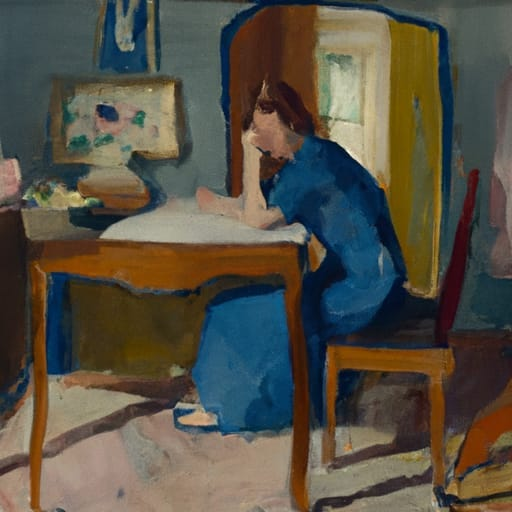

Mary Cassatt didn’t need to paint Parisian cafés at 2 a.m. to make a scene. She turned the quiet universe of private life into headline art: moments so intimate you feel like you should knock before entering. Born in 1844 in Pennsylvania and based mostly in France, she became the American inside the Impressionist circle — exhibiting with them, debating with them, and sometimes out-Impressionisting them with a box of pastels and audacity. If you’ve ever seen a painting where patterned fabric, soft daylight, and a child’s cranky honesty form a perfect little galaxy, you’ve probably bumped into her orbit.
Who is this artist?
An American painter and printmaker who embedded herself in the French avant-garde. Cassatt studied at the Pennsylvania Academy of the Fine Arts, decamped to Paris in the 1860s, copied Old Masters in the Louvre, and then joined forces with a circle that included Degas, Monet, and friends.
What is she known for?
Tender, observational portraits — especially of women and children — where the psychological truth is as important as the pose. She could catch a toddler’s “Nope!” energy with two brushstrokes. If you need a single star example, see the luminous The Child’s Bath at the Art Institute of Chicago: patterned textiles, a steep viewpoint, and gestures that speak louder than words.
What is her style?
Impressionist light and color, but calibrated for interiors and close-ups. Expect cropped compositions, patterned surfaces, and brushwork that feels both delicate and decisive. In the 1890s she also absorbed ideas from Japanese woodblock prints — flattened space, bold outlines, and adventurous color harmonies — then translated them into radical color drypoints and aquatints.
Who taught her?
Formal schooling began in Philadelphia; in Paris she studied privately (École doors were not exactly flung open for women), including with Jean-Léon Gérôme. The most catalytic mentor/frenemy was Edgar Degas, whose eye for composition and printmaking experiments met her grit and curiosity head-on. He invited her to exhibit with the Impressionists in 1879, and the rest is art-history chemistry.

Does she use any special technique?
Oh yes. Cassatt went on a printmaking tear in 1890–91, creating color drypoints and aquatints that look like paintings on paper — layered inks, velvety lines, and daring color blocks echoing ukiyo-e. She also wielded pastel like a lightsaber: soft, powdery, and somehow razor-sharp.
Who has she worked with?
Not “co-painted a canvas” worked with, but exhibited and traded ideas with the Impressionists — Degas most notably. She also shaped taste: Cassatt advised American collectors (notably Louisine Havemeyer), helping funnel Impressionist masterworks into U.S. museums. (If you’ve admired a wall of French moderns on American soil, there’s a non-zero chance Cassatt nudged them stateside.)
Was she wealthy?
She came from a comfortable, upper-middle-class family — enough to get to Europe and keep painting through the lean years. She earned real recognition later, and by 1904 France awarded her the Légion d’honneur — respect with hardware attached.
When was she most popular?
Her breakthrough visibility came with the Impressionist exhibitions from 1879 onward. The 1890s color prints added a second rocket stage to her reputation, and American interest in her work blossomed as collections grew.
Tell me more, please
Cassatt had range: beyond mother-and-child scenes, she painted readers, theatergoers, and everyday gestures that feel unposed. She pioneered how pattern and perspective can do emotional work — tilted floors, cropped chairs, a splash of vermilion — so you feel the room as much as you see it. Want to see the vibe from a different angle? Little Girl in a Blue Armchair (a mood, a posture, a manifesto in upholstery).
Anything else left to tell?
Her advocacy for women artists mattered. Cassatt used her platform to support exhibitions featuring women and to model a professional life in art — no small feat for someone balancing social expectations, travel, and the daunting logistics of a 19th-century career. Later in life, eye trouble curtailed her work, but the legacy was already secured.
Any other interesting tidbits?
- She loved process: proofs, re-worked plates, and color trials. If you’re a print nerd, her editions are a playground.
- She could make wallpaper a supporting actor and an armchair the co-star.
- Despite the “quiet” subject matter, she was fearless about experimentation — compositionally spicy, even when the palette whispers.
Want to see more art I make?
Browse fresh prints and projects here: https://lumaiere.com/?gallery=impressionist9.
Prefer words? Follow more writing here: @DaveLumAI.

Art Prompt: A sun-lit salon tilted slightly off-axis, where oversized cobalt and ultramarine armchairs sprawl like sleepy cats; a small figure reclines diagonally across the nearest chair, shoes half-off, posture unapologetically informal. Use soft, broken brushwork with creamy pastels — powder blue, sea-glass green, and warm ivory — letting textured strokes define form more than hard lines. Crop boldly so furniture runs out of frame; let patterned fabric ripple in loose zigzags. Keep the air bright but gentle, as if dust motes are applauding. Echo late-19th-century interior intimacy, with flattened planes and subtle, print-inspired outlines, balancing elegance with the honest slouch of a real afternoon.
Video Prompt: Start on a high, slightly tilted angle over a sun-washed room where rich blue armchairs dominate. Slow push-in toward a diagonally lounging figure; add a soft parallax as patterned fabrics breathe. Animate drifting dust motes and a faint shimmer of daylight across upholstery. Cut to a brief side-glide that reveals the cropped edge of another chair, then return to a gentle push-in that lands on the relaxed pose. Keep brush-stroke textures alive with micro-movement, as if pigment is settling. 12–15 seconds, seamless loop, ambient room tone only, color grade in creamy blues and warm ivories.
Two tracks that pair nicely with the video prompt
- Near Light — Ólafur Arnalds
- Says — Nils Frahm
If this episode sparked a thought (or a hot take about patterned upholstery), drop a comment below — and follow for more artist deep dives and creative experiments. Your insights keep this series lively!