If you are new to the series, start with The Modern Religion Series: Many Paths, One Curious Human.
Judaism is one of those traditions that can make a simple question feel suspiciously underdressed. Ask, “What is Judaism?” and the most honest answer is probably, “A religion, a people, a civilization, a library, a legal tradition, a memory project, a calendar, a long argument, and somehow also a dinner.” That is not evasion. That is just accuracy wearing comfortable shoes.
So when was Judaism founded, and by whom?
That depends on whether you are asking the question historically, theologically, or in the way people ask when they secretly want one neat sentence and a nice tidy date. Traditionally, Judaism traces its story to the covenant with Abraham and then to Moses and the revelation of Torah at Sinai. Historically, scholars describe Judaism as emerging from the religion of ancient Israel and taking recognizable later form over many centuries. In other words, if you are looking for a single founder in the way some religions have one obvious launch point, Judaism politely declines the simplification. Abraham matters. Moses matters enormously. The people Israel matter. The Torah matters. The story is old, layered, and not especially interested in becoming a PowerPoint bullet. (Encyclopedia Britannica)
One of the clearest and most famous summaries of Jewish belief appears in a verse that has done a frankly unreasonable amount of heavy lifting across the centuries:
“HEAR, O ISRAEL: THE LORD OUR GOD, THE LORD IS ONE.” The Holy Scriptures According to the Masoretic Text (Jewish Publication Society, 1917), Deuteronomy 6:4.
That gets you very quickly to one of Judaism’s core tenets: radical monotheism. One God. Not a committee. Not a cosmic focus group. One.
But Judaism is not only a belief system. It is also a practice-centered tradition. It cares very much about what people do. Torah, covenant, prayer, study, Sabbath, justice, mercy, communal life, and mitzvot all belong in the conversation. If you tried to reduce Judaism to “belief in God” alone, Judaism would probably raise an eyebrow and ask what exactly you plan to do about your neighbor, your business ethics, your calendar, your food, your speech, your obligations, your rest, your debts, your festivals, your memory, and your treatment of strangers. This is not a religion that likes leaving life in the abstract. (Encyclopedia Britannica)
Another famous line makes that practical side hard to miss:
“Thou shalt love thy neighbour as thyself: I am the LORD.” The Holy Scriptures According to the Masoretic Text (Jewish Publication Society, 1917), Leviticus 19:18.
And a third text, beloved well beyond Jewish communities, keeps the ethical pulse beating:
“You have been told, O mortal, what is good, And what GOD requires of you: Only to do justice And to love goodness, And to walk modestly with your God.” The Holy Scriptures, Tanakh (JPS translation as presented by Sefaria), Micah 6:8.
So is Judaism growing or shrinking?

Globally, the answer is: modest growth in absolute numbers, but not the kind of explosive growth that turns demographers into confetti cannons. Pew reported that the world’s Jewish population grew by 6 percent, from about 14 million in 2010 to nearly 15 million in 2020. That is growth. At the same time, Pew notes that this total remains below the estimated 16.6 million Jews alive in 1939 before the Holocaust, and the world as a whole grew faster. So “growing” and “still marked by historic loss” are both true at once. Europe declined, while Israel and some other regions grew. (Pew Research Center)
Is that the same as popularity? Not really. Population and popularity are cousins, not twins. Population is headcount. Popularity is visibility, cultural influence, public curiosity, conversion interest, media presence, and social perception, which are much harder to measure cleanly. A religion can be numerically small and culturally influential. Judaism has been doing that for a very long time.
What are the tenets of Judaism?
At risk of compressing a civilization into carry-on luggage, some major themes include belief in one God, covenant, the authority of Torah, the importance of mitzvot, communal responsibility, justice, mercy, remembrance, study, prayer, and Sabbath. Different Jewish movements and communities frame these differently, sometimes very differently, which is worth stressing. Judaism is not one giant room where everyone nods in perfect sync. It is more like a house full of related rooms, many books, and an impressive amount of commentary.
How has Judaism benefited individuals?
For many Jews, Judaism offers structure, meaning, identity, moral responsibility, prayer, study, rhythm, and belonging. It gives ordinary time a shape. Friday night is not just Friday night. Bread is not just bread. Memory is not just memory. A calendar becomes a way of walking through existence with intention. Study itself becomes sacred labor. Even disagreement can become a form of devotion, which is one of Judaism’s more fascinating contributions: the idea that wrestling seriously with truth is not a failure of faith but often part of faithfulness.
How has Judaism benefited families?
Shabbat is one obvious answer. In both religious practice and social research, it functions as recurring family time with candles, meals, blessings, songs, conversation, and an actual built-in excuse to stop behaving like a raccoon trapped inside a notification factory. A study indexed by PubMed on Jewish families and Shabbat found recurring themes such as “Shabbat brings us closer together” and the power of blessing children. Jewish family practice also places strong emphasis on teaching, memory, and transmitting tradition across generations. That does not make every family magically harmonious, because nothing on earth has solved relatives, but it does give families recurring rituals designed to keep them from becoming a set of people who merely share a Wi-Fi password. (PubMed)
How has Judaism benefited society?
Tzedakah is one major example. Often translated as charity, it is more deeply tied to justice, obligation, and human dignity. Jewish ethics also developed rich traditions around caring for the poor, honoring the stranger, protecting dignity, and restraining power. That has shaped philanthropy, education, legal reasoning, communal institutions, and broader moral discourse far beyond Jewish communities themselves. Judaism’s long tradition of study has also contributed enormously to literature, law, philosophy, commentary, and education. The religion has a habit of taking words very seriously, and civilizations generally do better when words, law, and ethics are not treated like optional accessories. (The Rabbi Sacks Legacy)
How has Judaism benefited the human race, all living things, and even the physical universe?
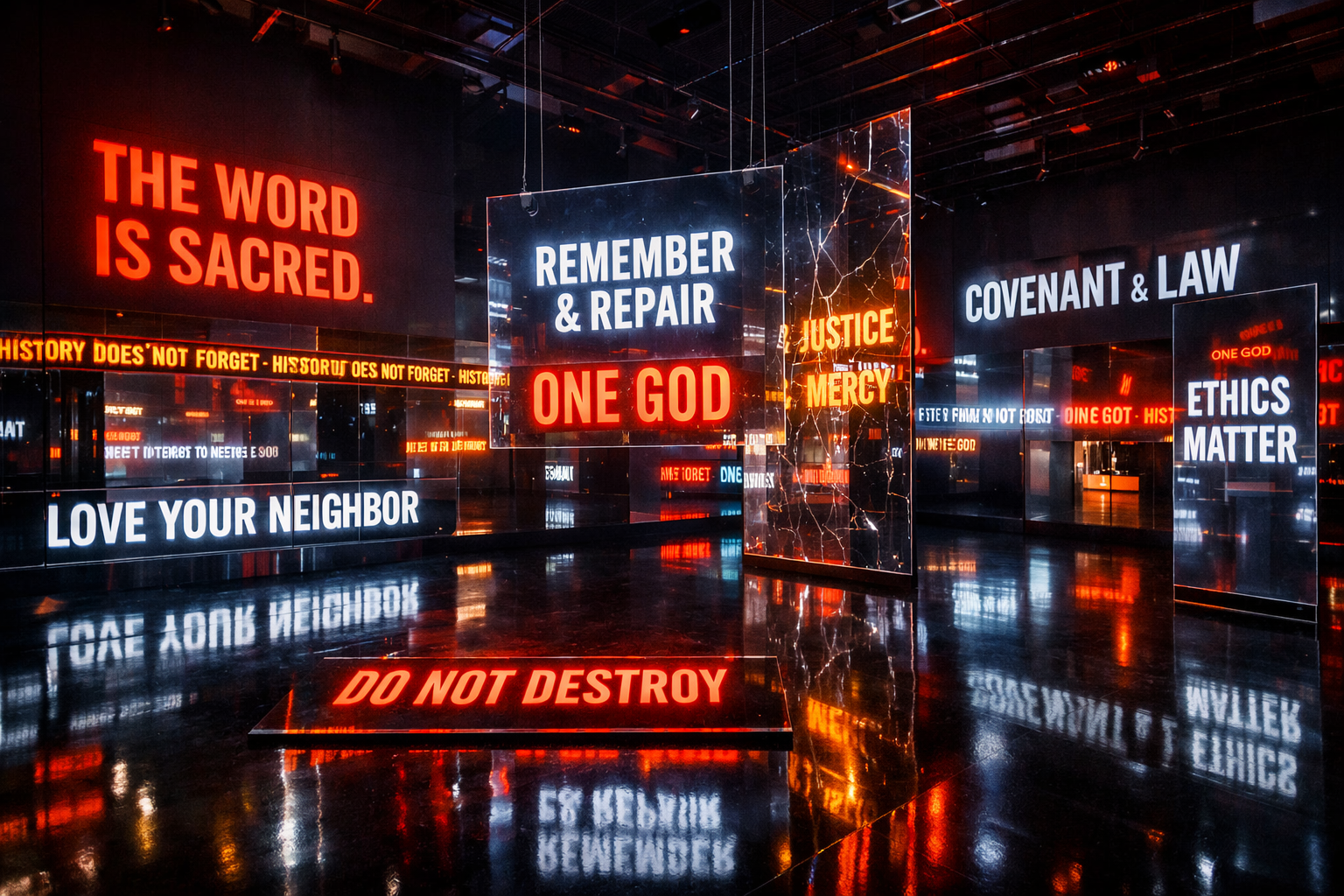
That depends on how literally you want to frame “benefited.” Religions are not particle accelerators, and Judaism does not claim to improve the orbit of Jupiter by force of excellent sermon craft. But in ethical and civilizational terms, Judaism has given humanity a durable vocabulary of monotheism, covenant, law, justice, sacred time, dignity, responsibility, and memory. For living things and the natural world, Jewish thought includes bal tashchit, the prohibition against needless destruction or waste, which later tradition broadened into a wider ethic of restraint. And in Genesis, creation itself is not described as disposable junk but as fundamentally good: “And God saw every thing that He had made, and, behold, it was very good.” The Holy Scriptures According to the Masoretic Text (Jewish Publication Society, 1917), Genesis 1:31. (Chabad)
How does Judaism portray God, the divine, divinity, the infinite?
Judaism portrays God as one, creator, sovereign, morally serious, and bound to Israel through covenant, while also remaining greater than human language can comfortably contain. Some Jewish texts speak in very personal language. Others emphasize divine mystery and transcendence. Judaism is quite capable of intimacy and awe in the same paragraph. It is not a tradition that imagines God as small, manageable, or easily diagrammed on a napkin. At the same time, Judaism places immense importance on the lived relationship between God, people, law, history, and ethical action. (My Jewish Learning)
What conflict has resulted in all the above categories?
A great deal, unfortunately. Judaism has endured ancient conquests, expulsions, forced conversions, legal restrictions, pogroms, discrimination, and the Holocaust. The Holocaust alone was the systematic, state-sponsored persecution and murder of six million European Jews by Nazi Germany and its collaborators. Antisemitism did not begin there, and it did not end there, which is one of the bleakest facts in human history. Any honest discussion of Judaism has to include not only its teachings and contributions, but also the repeated hostility directed against Jews across many eras and places. (Holocaust Encyclopedia)
Has Judaism undergone persecution or discrimination?
Yes. Repeatedly. On a scale so large and over so many centuries that the question is less “has it?” and more “which century would you like to start with?” That said, Judaism is not only a story of survival under pressure. It is also a story of creativity under pressure, scholarship under pressure, prayer under pressure, and community under pressure. Which is to say: resilience, but not the inspirational-poster version. The real version.
Any famous works of art related to Judaism?
Plenty. The Hebrew Bible and the Talmud belong on the writing side immediately. In visual art, Jewish ceremonial art includes Torah ornaments, menorahs, mezuzah cases, spice boxes, and countless beautifully crafted ritual objects. The painted synagogue at Dura-Europos is one of the great surprises of ancient religious art. Medieval illustrated Haggadot, including famous examples such as the Washington Haggadah and the Rylands Haggadah, show how richly Jewish storytelling and manuscript art developed. In modern art, Marc Chagall’s White Crucifixion is one of the most striking works connected to Jewish suffering and memory in the modern era. (Encyclopedia Britannica)

Any other interesting tidbits?
Quite a few.
Judaism has survived without reducing itself to sameness. It contains legal traditions, mystical traditions, philosophical traditions, devotional traditions, diasporic cultures, multiple languages, and a famously vigorous relationship to commentary. It is old enough to be ancient, alive enough to be contemporary, and intellectually energetic enough to make “one final question” a phrase with very little practical meaning.
And perhaps that is part of its enduring power. Judaism does not merely ask people to believe something. It asks them to remember, study, argue, rest, bless, mourn, repair, give, and return. It makes ordinary acts matter. It insists that time can be sanctified, that ethics are not decorative, and that memory is a responsibility.
That is not a small legacy.
If this article gave you something to think about, follow along for the rest of the series and drop a comment with which religion, tradition, or philosophical system you want to see explored next.
References: My Jewish Learning, Pew Research Center on Jewish population change, United States Holocaust Memorial Museum, Britannica overview of Judaism, Chabad on bal tashchit, The Met on the Washington Haggadah, The Met on the Rylands Haggadah, Art Institute of Chicago on Chagall’s White Crucifixion
Art Prompt (conceptual): A monumental text-based installation unfolding across a cavernous dark gallery, where huge luminous phrases blaze across walls, floors, mirrored panels, suspended acrylic slabs, and scrolling LED bands in relentless layers of language. The composition should feel both austere and overwhelming, with sharp declarative statements colliding in space, reflected infinitely in polished black surfaces and fractured glass. Use a palette of electric crimson, icy white, amber LED glow, deep charcoal, and faint ultraviolet haze. Let the typography be immaculate, bold, and commanding, alternating between monumental stillness and hypnotic repetition. The mood should feel urgent, cerebral, seductive, and slightly unnerving, as if the room itself has learned how to think in slogans and now refuses to stop.
Video Prompt: A dark, futuristic gallery opens in near silence as glowing words flicker to life across walls, mirrored floors, hanging panels, and transparent screens. Huge phrases pulse, scroll, fracture, multiply, and reflect into infinity while the camera glides, spins, rushes forward, then snaps into sharp pauses on bold statements blazing in crimson, white, and amber light. Add quick rhythmic cuts between wide architectural views and intimate close passes over luminous typography, with reflections rippling like liquid glass and subtle atmospheric haze catching every beam. The mood should feel sleek, urgent, hypnotic, and intellectually electric, with motion that is instantly arresting and visually addictive.
Song recommendations:
- Nothing to Declare — MGMT
- Habibi — Tamino