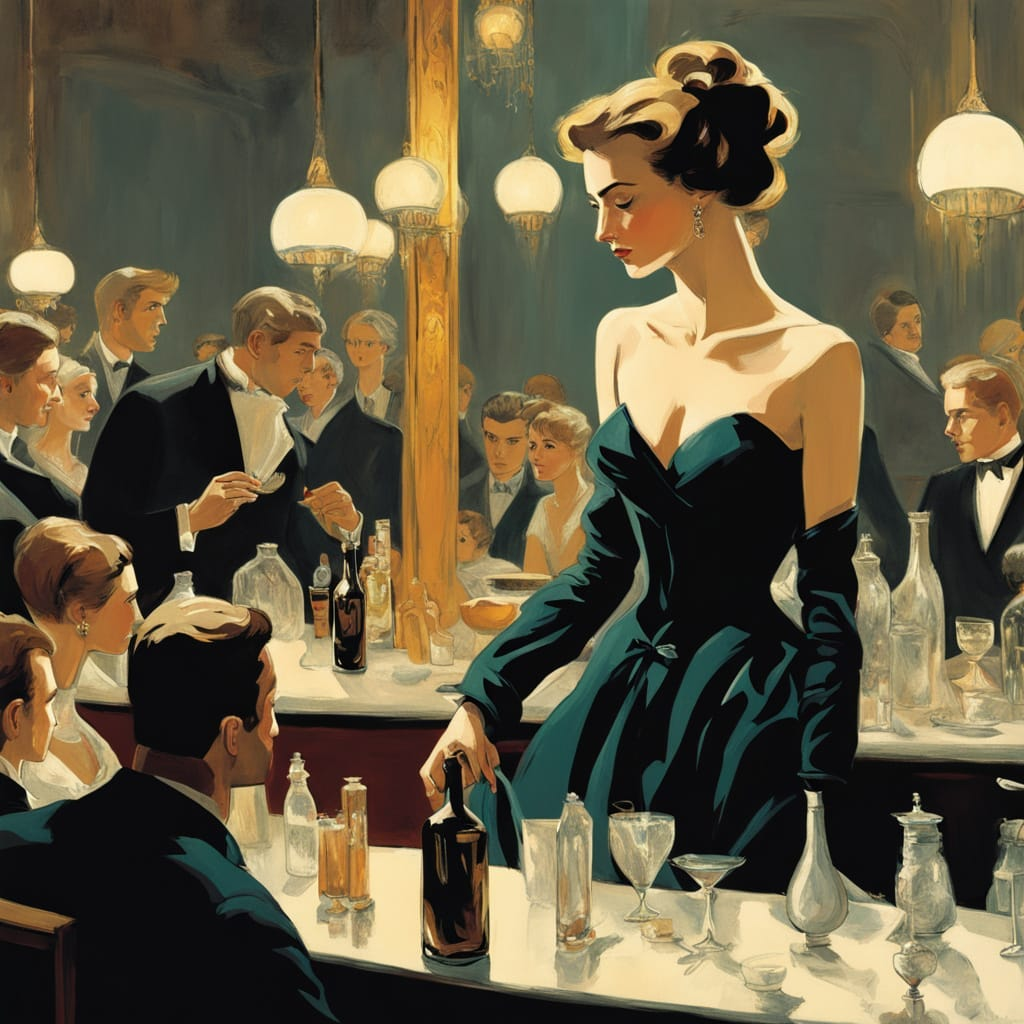

Who is this artist? A Paris native (1832–1883) with impeccable tailoring and even sharper paint handling, Édouard Manet was the well-heeled maverick who steered painting from polished Academic respectability toward the exhilarating chaos of modern life. If the 19th-century art world was a formal dinner, Manet was the guest who showed up early, rearranged the seating chart, and then served a completely new menu. For a crisp overview, see the National Gallery’s page on him, which sums up his background, training, and trademark love of black beautifully: National Gallery (London).
What is he known for? Scandals and breakthroughs — often in the same frame. Le Déjeuner sur l’herbe (1863) detonated polite taste with a non-mythological nude picnicking beside fully clothed men (the outrage helped fuel his fame). You can meet the painting at the source: Musée d’Orsay. He later perfected the “now” of Paris — cafés, concerts, glass, gaslight — with uncanny immediacy, culminating in his late masterpiece A Bar at the Folies-Bergère (1882) at the Courtauld. Earlier, The Spanish Singer (1861) earned his first big Salon success: The Met.
What’s his style? Direct, high-contrast, and pointedly modern. Manet flattened space, simplified forms, and used visible, confident strokes. Against the pastel shimmer of his younger Impressionist friends, he kept a restricted palette where black isn’t a hole — it’s a star. The National Gallery puts it plainly: black was “very important,” he worked “directly from the model,” and you can feel Spanish gravity (Velázquez) under the Parisian sparkle: National Gallery (London).
Who taught him? Thomas Couture, a respected history painter whose studio he joined in 1850, gave him rigorous academic chops to subvert later. (Think: rules first, rule-breaking second.) Background via the National Gallery of Art (Washington).

Does he use any special technique? He favored direct painting — fast, decisive, wet-into-wet passages that feel fresh rather than fussed over — and he loved the punch of black. He painted from life, building forms with clear tonal contrasts instead of silky, invisible blends, a stance the National Gallery (London) highlights. He also absorbed Spanish painting’s frankness after seeing Velázquez in Madrid, which stiffened his resolve to keep surfaces alive and honest.
Who has he worked with? “Collab” in 1870s terms meant friendships, painting trips, and cafés. He was close with Monet (they painted side-by-side at Argenteuil; see Manet’s The Monet Family in Their Garden at Argenteuil, The Met), Degas, Renoir, Pissarro, and — critically — Berthe Morisot, who married his brother Eugène and became one of the era’s brightest lights. Manet’s only formal student was the brilliant Eva Gonzalès: National Gallery (London), Eva Gonzalès.
Was he wealthy? Comfortably so. He was born to an affluent Parisian family (his father was a judge), which gave him a financial cushion — and the confidence — to rock the boat. See the National Gallery of Art (Washington).

When was he most popular? Popularity was…complicated. His notoriety exploded in the 1860s (hello, 1863’s Salon des Refusés), but genuine establishment recognition arrived later, including admission to the Légion d’honneur in 1881 (see Encyclopedia.com). By the early 1880s, his portraits (like Spring) were winning hearts even as his health declined.
Tell me more, please Manet is often called the bridge between Realism and Impressionism. He influenced the latter profoundly yet never exhibited in their independent shows, preferring to fight on the Salon’s main stage. He wanted modern subjects with classical backbone: direct gazes, visible brushwork, and a refusal to varnish reality. For a smart summary of his arc and early defenders (like Émile Zola), see the Met essay.
Anything else left to tell? Two human notes. First, he married Suzanne Leenhoff, a pianist, and kept a tight circle of writers and painters — Baudelaire and Zola among them — who understood what he was doing before the juries did. Second, late in life he suffered terribly (likely neurosyphilis); his final months included an amputation and an astonishing run of intimate flower still lifes. For the medical history, see this clinical review on PubMed.
Any other interesting tidbits? • He’s the “modernity is beautiful” guy before that was cool — glass, mirrors, crowds, and electric light as worthy subjects. • He loved borrowing from the Old Masters, then tweaking composition and lighting until the picture felt unmistakably now. • If you want to see the moment painting stares directly at modern life and blinks last, stand in front of A Bar at the Folies-Bergère (Courtauld) and let the mirror mess with your sense of space.

If you enjoy this series, explore our Impressionist collection (prints and more) woven through our ongoing projects — browse the set here: lumaiere.com Impressionist gallery. Drop a comment with your favorite Manet moment, and hit follow so you don’t miss the next episode. Your hot takes on modernity are half the fun.
Art Prompt (Modern Realism): A luminous café-concert interior under warm gaslight: a poised barmaid centered against a towering mirror, her pale face quietly resigned yet resolute; bottles of emerald and amber glass glint along a marble counter; a crystal bowl of oranges punctuates the composition with citrus brightness; the mirror doubles the crowd into a smoky, kaleidoscopic blur, where a gentleman in a dark coat leans in from the right; high above, a trapeze performer’s legs slice into the reflection like a surreal garnish. Use direct, confident brushstrokes and a restrained palette of inky blacks, champagne whites, teals, and rose-gold highlights; flatten perspective subtly so the surface feels present and modern; keep edges crisp around the figure, looser in the reflected crowd; aim for a mood that’s elegant, uneasy, and irresistibly contemporary.
Video Prompt: Begin on a close-up of oranges and bottle labels, then glide along the marble counter; rack-focus to the barmaid’s steady gaze; snap-pan to the mirror where the reflected crowd blooms into soft bokeh; insert a quick tilt to reveal the trapeze legs slicing through the reflection; add subtle flicker of gaslight and faint glass clinks; finish with a slow push-in that fractures the space between “real” and “reflected.” Keep motion silky and confident, with micro-zooms on highlights and brief speed-ramps on the snap-pan; color-grade for creamy blacks, pearly whites, and cool teal bottle glows; stay under 20 seconds and land on the gaze.

Songs to cut with:
- Lisztomania — Phoenix
- Nara — E.S. Posthumus
Friday Night Laughs Mini A 4-panel comic strip:
- Panel 1: A 19th-century Salon jury room. Three powdered wigs glare at a canvas of…a bar counter stacked with oranges. Caption: “Is this still life or snack break?”
- Panel 2: An artist in perfect gloves rolls in a mirror taller than everyone. “It’s not a reflection of you,” he says. “That’s why it’s good.”
- Panel 3: A trapeze artist’s legs dangle into the top of the panel as a critic faints: “Perspective! My only weakness!”
- Panel 4: Cut to the café-concert. The barmaid stares at the reader. Speech bubble: “I’d like to return this century. It doesn’t fit yet.” (Background patrons applaud. One wigged juror buys an orange.)
