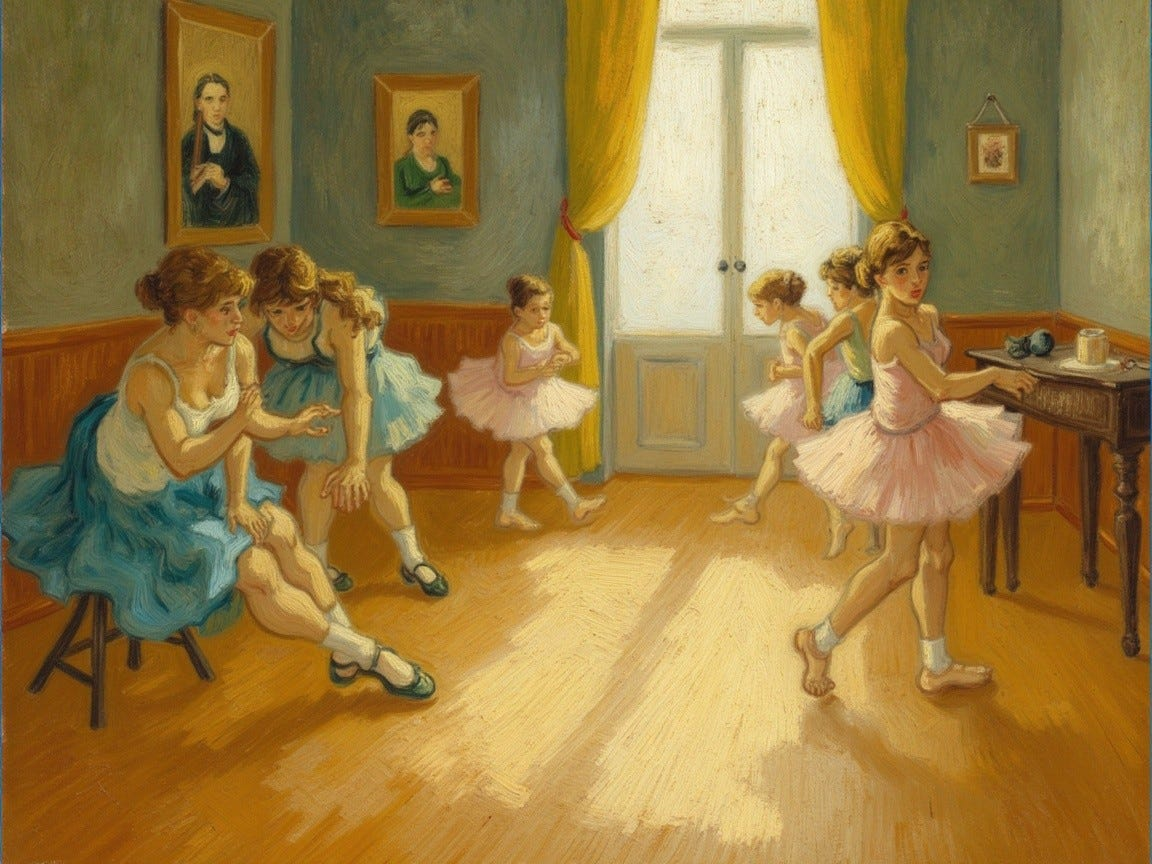

If art history had a backstage pass, Edgar Degas would be the guy chain-smoking in the wings, muttering “point those toes!” while sketching furiously. Born in Paris in 1834, Degas is best remembered as the unofficial patron saint of ballerinas. Nearly half his body of work depicts dancers — practicing, stretching, collapsing in exhaustion, or basking under the gaslights. Forget the graceful swan image; Degas gave us the sweat, the strain, and the sheer grind that makes ballet sparkle.
Who was he?
Degas was the Parisian son of a banker who wanted him to go into law. Instead, he took the legal code and pirouetted straight into art school. He studied briefly at the École des Beaux-Arts, then sharpened his skills in Italy copying Renaissance masters like Michelangelo. Clearly, his father’s dream of a lawyer was not to be.
What’s he known for?
Ballerinas, horses, and women at their toilette. That’s his holy trinity. Degas had an obsession with capturing bodies in motion, whether it was the disciplined grind of the rehearsal hall or the chaos of horse racing. His dancers are so famous now that even people who’ve never set foot in a gallery could pick one out of a lineup.
What was his style?
Degas is often lumped in with the Impressionists, but he’d rather you didn’t. While Monet and Renoir were out chasing sunlight like caffeinated cats, Degas stayed indoors, perfecting unusual perspectives and rich, moody interiors. He favored pastels later in life, layering color in ways that made movement pop like a GIF centuries before Photoshop.

Who taught him?
He trained under Louis Lamothe, a disciple of Ingres. From Ingres he inherited a love of line and contour, which he bent to his own ends. While Ingres gave us smooth, polished neoclassicism, Degas twisted it into angles, awkward gestures, and radical cropping that feels shockingly modern.
Special techniques?
Degas was a technical tinkerer. He used pastels like paint, combining them with fixatives and layering until they had the richness of oil. He dabbled in photography and sculpture, experimenting with wax and bronze. His most famous sculpture, Little Dancer of Fourteen Years, scandalized Parisians with its mix of real fabric and hair — “too real” for comfort.
Collaborations?
Though famously prickly, Degas moved in circles with Monet, Manet, and other Impressionists, even exhibiting with them. But he was the guy muttering that Impressionists should be painting “better” while secretly reshaping modern art with his draftsmanship.
Was he wealthy?
Born into privilege, yes — until his family’s finances tanked. After his father’s death, debts forced Degas to sell off much of his art collection. Fortunately, his own works began selling well, and he managed to keep afloat, though he lived frugally and increasingly reclusive as he aged.
When was he most popular?
Degas hit his stride in the late 19th century. By the 1880s, his ballerinas were everywhere, and his pastels were fetching high prices. Today, his work is among the crown jewels of museums like the Musée d’Orsay and the Met.
Any other tidbits?
Degas was notoriously grumpy, famously feuding with friends and offering backhanded compliments like a pro. He also lost much of his eyesight later in life, which pushed him further toward sculpture and pastels, since oils required too much precision. Despite his difficult personality, his work remains universally admired — proof that genius and charm are not always a package deal.
So next time you see a Degas ballerina, remember: behind the grace and tulle was an artist with the eye of a drill sergeant, the hands of a draftsman, and the patience of someone who knew real beauty was born from repetition and sweat.

Art Prompt:
A pastel-hued interior with warm lamplight spilling across polished wooden floors. Figures in delicate tutus stretch and lean, their gestures caught mid-motion, some weary, some focused. The composition feels cropped, as if glimpsed from the corner of the room, with soft textures layering chalky pinks, muted greens, and pale yellows. Shadows sink into the floorboards while the dancers glow in powdery light, the atmosphere both intimate and fleeting.
Video Prompt:
A softly lit rehearsal hall where ballerinas stretch, leap, and collapse into graceful exhaustion. The camera glides at unusual angles, sometimes low to the floor, sometimes from a hidden corner, as pastel tones flicker into motion. Chalky textures shimmer across the frame, blending with subtle movements of light and shadow. The mood shifts between quiet concentration and sudden bursts of energy, evoking the rhythm of practice and the fleeting beauty of motion.
Songs to pair with the video:
- “Your Best American Girl” — Mitski
- “Saturnine” — RY X
Follow for more art adventures, and drop a comment: do you see Degas as an Impressionist — or the outsider who quietly reinvented the rules?